
Low Voltage Rescue Standards Australia: 2026 Guide
Ask five different training providers what the low voltage rescue standards actually require and you'll probably get five different answers. One quotes a renewal period that doesn't match what your mate's employer told him. Another throws out a course code that's apparently been superseded. A third just says "book in, we'll sort it" and moves on before you can ask a real question. That's not good enough when your name's on the line.
If you're a leading hand or site supervisor, you already know how this plays out. Something goes wrong on site, someone gets hurt, and the first question isn't "what did head office say." It's "who was on that crew, and was their ticket current." That question lands on you first.
This guide lays out the low voltage rescue standards Australia currently works to, in plain terms. What UETDRRF004 actually covers, who's legally on the hook to hold it, how renewal timing works, and where LVR fits alongside your first aid and CPR obligations. No jargon for the sake of sounding official, just what you need to know to keep your crew compliant and your own liability covered.
What Are The Low Voltage Rescue Standards In Australia?
Short answer, before you scroll through the rest of this: low voltage rescue in Australia is governed by AS/NZS 4836:2011 – Safe working on or near low-voltage electrical installations and equipment. This standard sets out the safety requirements for anyone working on or near live electrical systems up to 1000V AC.
Under this standard, plus the Work Health and Safety laws that sit alongside it, workers in this environment need to:
Hold current, nationally recognized rescue training (unit code UETDRRF004 – Perform Rescue from a Live LV Panel)
Have access to a compliant low voltage rescue kit on-site
Keep their CPR competency current (HLTAID009)
Refresh their certification periodically to stay compliant with whatever their employer or site requires
These requirements apply right across the country. The catch is that specific enforcement and renewal expectations can shift a bit depending on which state regulator you're dealing with, which is exactly why so much of the confusion out there happens in the first place.
What Do Australia's Low Voltage Rescue Standards Actually Cover?
The Role Of AS/NZS 4836:2011
This is the standard doing the heavy lifting behind everything else in this guide.
AS/NZS 4836:2011 governs safe working on or near low voltage electrical installations and equipment. It covers systems up to 1000V AC and 1500V DC, which is a wider bracket than most people realize when they first hear "low voltage" and assume it means low risk. It doesn't. Low voltage electrical incidents kill people every year, which is exactly why a standard this detailed exists.
One thing worth being clear on: this standard doesn't replace your state's WHS legislation. It sits alongside it. Think of AS/NZS 4836:2011 as the technical rulebook for how the work gets done safely, while your state WHS laws set out who's responsible for making sure it actually happens. You need both working together.
How The Standard Applies On-Site
In practical terms, meeting this standard on a real job site means three things need to be in place at once:
Trained personnel, someone on-site holding current, nationally recognized rescue competency
A compliant rescue kit, accessible, not buried in a locked ute three sites away
Proper PPE, insulated gloves, insulated mats, rescue hooks, the works
That middle point trips a lot of crews up. It's not enough to have a kit somewhere in the building. It needs to be genuinely accessible to whoever's working near live LV equipment, because in a real rescue situation, minutes and even seconds matter.
On-Site Compliance Checklist

The National Training Framework Behind LVR Certification
Unit Of Competency UETDRRF004 Explained
Here's the plain-English version, because the official unit descriptor reads like it was written for someone who already knows what it means.
UETDRRF004 covers rescue from a live low voltage panel. That's specifically what it trains you for: getting someone away from a live LV panel safely and starting the right emergency response. It doesn't cover rescue from overhead power lines or underground cables, those sit under different competencies entirely, and if a provider tells you one course covers everything electrical, that's worth questioning.
This unit is delivered under the UET Transmission, Distribution and Rail Sector Training Package, which houses a handful of other related codes for different rescue and electrical safety scenarios. Worth knowing they exist so you're not thrown if you see one mentioned, but for the vast majority of electricians, apprentices, and site crews working around LV panels, UETDRRF004 is the one that applies.
How Nationally Recognized Training Fits Into Compliance
"Nationally recognized" isn't just a marketing phrase providers slap on their website. It means the training is delivered under a unit of competency registered on the national training framework, by a Registered Training Organisation that's been through ASQA accreditation to deliver it.
Why does that distinction matter? Because a Statement of Attainment from an accredited RTO carries legal and audit weight. If a WHS inspector or an auditor asks for proof of current rescue training, an SOA from a properly accredited RTO answers that question immediately. A certificate from an informal, non-accredited provider doesn't carry the same weight, and in a genuine audit situation, that gap becomes your problem fast.
Who Is Legally Required To Meet These Standards?
Electricians, Apprentices & Contractors Working On Live LV Systems
If your day-to-day work puts you anywhere near live low voltage equipment, this applies to you. That covers a wider group of people than most crews realize:
Licensed electricians
Apprentices working under supervision
Solar installers
Linespersons
Utilities workers
Anyone else whose role brings them near live LV equipment, even occasionally
That last point catches people out. It's not just the person doing the hands-on electrical work. If your role means you're regularly in that environment, you're inside the scope of who needs to be covered.
PCBU And Site Supervisor Duty Of Care Under WHS Law
This is where it gets personal for a lot of leading hands.
Under WHS law, a PCBU (Person Conducting a Business or Undertaking) carries the primary duty of care for the health and safety of workers. But that duty doesn't stop at head office. It flows down through site supervisors and leading hands, and in practice, the person standing on-site when something goes wrong is often the first one questions get directed at, not the business owner in an office somewhere else entirely.
That's not scaremongering, it's just how duty of care works. Safe Work Australia's WHS guidance makes it clear that responsibility for safe systems of work sits with everyone in that chain, from the PCBU down to the individual worker, and each link carries a genuine obligation.
Duty Of Care Flow
PCBU → sets the safety system and resourcing
Site Supervisor / Leading Hand → enforces it on the ground, day to day
Worker → follows the system, keeps their own certification current
Every link in that chain matters. If one breaks, the whole thing breaks with it.
How LVR Standards Interact With First Aid And CPR Requirements
The HLTAID009 Pairing
There's a reason you'll almost never see low voltage rescue training offered without CPR bundled in alongside it, and it's not just a sales tactic.
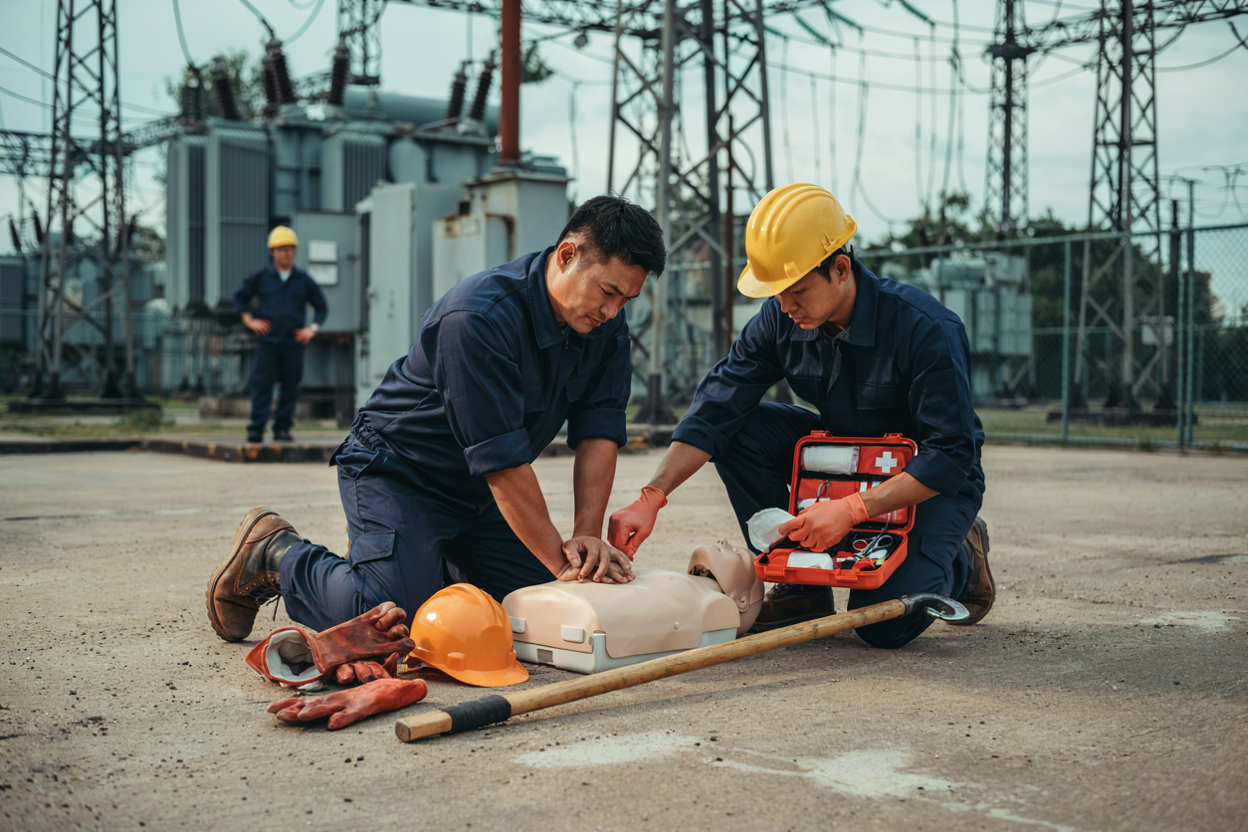
Think about what actually happens in a live LV rescue situation. Someone's been in contact with a live low voltage panel, they've been safely removed from that danger, and now the immediate next step is often CPR. Rescue and resuscitation aren't two separate skills here, they're two halves of the same emergency response. ARC and ANZCOR guidelines reflect this, which is why HLTAID009 competency is treated as a near-universal pairing alongside UETDRRF004.
Why Most Employers Require Both, Not Just One
Here's the practical reality: a rescue-only ticket without current CPR competency behind it isn't something most employers accept as meeting their compliance obligations. What's the point of training someone to safely get a colleague away from a live panel if nobody on-site can then keep that person alive before emergency services arrive? That's exactly why job ads and site inductions almost always list both UETDRRF004 and HLTAID009 together, as the baseline expectation.
Staying Compliant: What Employers And Crews Actually Need To Track
Certification Currency And Renewal
This is the section everyone wants a straight number for, and giving you one without checking it against your specific RTO documentation would be doing you a disservice. Renewal periods can vary depending on your RTO and your employer's own policy. The right move isn't to go off a number you saw on a random forum, it's to check your own Statement of Attainment and confirm the exact interval directly with your RTO or employer.
What matters more than memorizing a number is building the habit of actually checking. A lapsed ticket doesn't announce itself, it just quietly becomes a problem the day someone asks to see it.
Audit-Readiness And Documentation
When a WHS audit happens, whether it's scheduled or a surprise walk-through after an incident, there are a few things that typically get checked straight away:
Current Statement of Attainment on file for every relevant worker
USI records matching up correctly against training completed
Kit inspection logs showing the rescue kit has actually been checked and maintained, not just purchased once and forgotten
Picture a scenario like this: an auditor walks a site, pulls names off the crew list, and asks to see current LVR documentation on the spot. If those records are sitting in someone's head, or on a wall calendar back at the depot, that's a stressful wait on paperwork that should've been instant.
Tracking Compliance Across A Crew
If you're managing certifications for more than one or two people, the "I'll remember when it's due" approach breaks down fast, especially with staggered start dates and different renewal timing across the crew.
Moving to some kind of digital tracking, even something as simple as a shared spreadsheet with renewal dates flagged, beats relying on memory or a wall calendar. It also means you're not the single point of failure if you're on leave or flat out on another job when someone's ticket is about to lapse.
For more detail on what a compliant rescue kit actually needs to include, our guide on the Low Voltage Rescue Kit Australian Standard breaks that down properly.
How To Choose An Accredited LVR Training Provider
What Accreditation Actually Looks Like
Anyone can put "accredited" on a website. Checking whether it's actually true takes a couple of minutes, and it's worth doing every time before you book.
Here's how: search the provider's RTO number on training.gov.au and confirm they're currently registered to deliver UETDRRF004 specifically, not just electrical training in general. If a provider hesitates when you ask for their RTO number, treat that as a red flag.
Nationally Recognized vs. Uncertified Training
For a deeper breakdown of what a proper LVR course should actually include from start to finish, have a look at our Low Voltage Rescue Course Requirements guide.
Practical vs. Classroom-Only Training: Why It Matters
Here's the objection we hear more than almost any other: "how do I know this isn't just another box-ticking course."
Fair question, and a fair few providers out there do deserve that skepticism. A slideshow-only course where nobody actually touches a rescue kit or works through a real live-fault scenario might tick the compliance box on paper, but it doesn't leave your crew genuinely prepared for the moment it matters. Practical, scenario-based training, the kind where people work through a realistic rescue simulation rather than just watching slides go by, is what actually builds the muscle memory that counts on a real site. That's the difference between a certificate sitting in a drawer and a crew who genuinely know what to do.
Conclusion
Getting your low voltage rescue certification sorted isn't really about ticking a box for an auditor somewhere down the track. It's about knowing that if something goes wrong on a live site, the right person is standing there with the training and the kit to actually do something about it in those first critical seconds. That's the whole point of AS/NZS 4836:2011 and everything built underneath it, not paperwork for its own sake, but a genuine system designed around keeping people alive.
For leading hands and site supervisors especially, this isn't an abstract compliance topic. It's personal. When something happens on-site, the questions don't start with head office, they start with whoever was running that crew that day. Knowing your own certification is current, and knowing everyone under you is covered too, isn't extra admin. It's the difference between a clean conversation with WHS and a genuinely difficult one.
The good news is that none of this is complicated once you know what to actually check. Confirm your unit code is current, confirm your renewal date against your own Statement of Attainment rather than a number you half remember, and make sure whoever's training your crew is properly accredited and verifiable on training.gov.au. Two minutes of checking now saves a lot of stress later.
At the end of the day, low voltage rescue training only matters if it actually works when it's needed. Standards, unit codes, and renewal periods all exist to build toward one outcome, a crew that knows exactly what to do the moment something goes wrong near live electrical equipment. Get the paperwork right, but never lose sight of the fact that the paperwork exists to protect an actual person standing on an actual site.