
How to Write a Workplace Emergency Plan: 2026 Guide
You've just received an audit notice from Workplace Health and Safety Queensland. Your emergency procedures folder is somewhere on a shelf, last updated three years ago, missing half the required elements. Sound familiar?
For a lot of Queensland employers, the workplace emergency plan exists. Technically. It's a document written when the business first opened, listing a fire warden who resigned in 2021, referencing an assembly point that is now a car park. Nobody's tested it. Half the current staff have never seen it.
That's not a plan. That's a liability.
Under the Work Health and Safety Act 2011 (Qld), every PCBU has a legal duty to prepare, maintain, and implement an emergency plan, and to make sure workers are trained to carry it out. This guide walks you through what a compliant workplace emergency plan must contain and how to build one that holds up.
What Must Be Included in a Workplace Emergency Plan?
Under the Work Health and Safety Act 2011 (Qld) and the Work Health and Safety Regulation 2011, a compliant workplace emergency plan must include:
Emergency procedures step-by-step response actions for all foreseeable emergencies (fire, medical, chemical spill, evacuation)
Evacuation procedures designated routes, assembly points, and person-in-charge responsibilities
Notification procedures who contacts emergency services and how (000, site emergency number)
Medical treatment and assistance location of first aid equipment and trained first aiders on site
Effective communication how the emergency is communicated to all workers, including those with disabilities
Testing and practice documented schedule for drills and plan reviews
Emergency roles and responsibilities named wardens, deputies, and their specific duties
Post-incident response procedures for managing the scene after the emergency is resolved
A workplace emergency plan must be in writing, accessible to all workers, and reviewed regularly or following any emergency event.
What Is a Workplace Emergency Plan? (And Why Most Queensland Businesses Get It Wrong)
Most employers know they're supposed to have one. Fewer know what it actually has to contain, and that gap is exactly where compliance problems start. A workplace emergency plan is a formal, written document that sets out how your business will respond to emergencies. It's not a general WHS policy or a risk register. It's a specific, structured document that tells people exactly what to do, who does it, and how it gets communicated before, during, and after an event.
The most common gaps WHSQ inspectors find: no named deputy for the warden, assembly point not communicated to workers, and a plan that was written once and never reviewed. According to Safe Work Australia, workers were killed in Australian workplaces in 2023-24. Behind every one of those statistics is a workplace where something went wrong and in many cases, an emergency response that wasn't ready.
Emergency Plan vs Emergency Procedure - What's the Difference?
The plan is the overarching document. The procedure is the specific action sequence that sits inside it, what you do when the fire alarm activates, step by step. Many employers write a procedure and think they've written a plan. They haven't. Confusing the two is one of the most common reasons businesses fail an audit.
Who Is Legally Required to Have One in Queensland?
Every PCBU in Queensland, full stop. Section 43 of the Work Health and Safety Act 2011 (Qld) captures every business, regardless of size or industry. There is no "we're too small" exemption. A sole trader with one worker is a PCBU. The obligation applies.

Queensland Legal Requirements for Workplace Emergency Plans
The legislative framework sits across two documents. The Work Health and Safety Act 2011 (Qld) establishes the duty. The Work Health and Safety Regulation 2011 (Qld), Division 4, sets out what the plan must contain. Together they define both the obligation and the standard. What a WHSQ inspector checks: does the plan exist in writing, does it cover the required elements, has it been tested, and do workers know about it.
What the WHS Regulation 2011 Actually Says
Division 4 doesn't leave much room for interpretation. Your plan must address emergency procedures, evacuation procedures, notification of emergency services, medical treatment and assistance, communication to workers, testing and practice, roles and responsibilities, and post-incident response. Each element must be documented, not assumed or covered verbally. In writing, accessible to all workers.
A Queensland trade business recently received a WHSQ improvement notice after an inspector found their emergency plan four years out of date: warden gone, assembly point changed, no drills documented.
How Often Does Your Emergency Plan Need to Be Reviewed?
Under Queensland WHS obligations, your plan must be reviewed:
After any emergency event including near-misses
After significant workplace changes new premises, new processes, new workforce composition
At a minimum, annually even if nothing has changed
A plan that was accurate when it was written but hasn't been touched since isn't a maintained plan. It's a document.
How to Write a Workplace Emergency Plan - Step by Step
This isn't about downloading a generic template and filling in your business name. A compliant workplace emergency plan has to reflect your actual workplace, your specific risks, your actual staff, your real evacuation routes.
Step 1 - Identify Foreseeable Emergencies for Your Workplace
Foreseeable emergencies are the ones that could realistically happen in your specific workplace. A construction site plans for falls and electrocution. A childcare center addresses anaphylaxis and asthma. A restaurant covers fire and gas leaks. Start by walking your site. Your hazard identification process and risk register should feed directly into this step.
Step 2 - Assign Emergency Roles and Responsibilities
Your emergency plan must name a chief warden, floor or area wardens, at least one trained first aider, and a communications officer. Every named role needs a deputy, because emergencies don't wait for your warden to come back from annual leave. Role descriptions must be written into the plan, not assumed or communicated verbally.
Step 3 - Document Evacuation Procedures and Assembly Points
Your assembly point needs to be documented and communicated to every worker, including casuals and new starters. Evacuation routes need to account for physical accessibility. Signage and emergency lighting need to be in place and functional.
Step 4 - Connect Your Plan to Your First Aid Arrangements
Your emergency plan must name the location of every first aid kit on site and identify trained first aiders by name. Not "a first aid kit is available on site." The specific kit, the specific person.
Under the WHS Regulation, the number of first aiders required depends on your workplace size, the nature of the work, and the distance from emergency services.
Step 5 - Build in Testing, Drills, and Review Cycles
Your plan needs a documented drill schedule covering frequency, who conducts, and how outcomes are recorded. A drill that happened but was never written down does not satisfy WHSQ requirements. Build review triggers into the plan itself: after any incident, staff changes, or changes to premises.
Emergency Plan Requirements by Industry - Queensland Focus
The core requirements apply to every Queensland workplace, but what they look like in practice depends on your industry.
Construction and Trade Sites
Falls from height, electrocution, and crush injuries aren't edge cases on a construction site. They're foreseeable events that your emergency plan must specifically address. That means who does what in the first two minutes, where the first aid equipment is, and who's trained to use it.
For electrical trade work, LVR-trained staff are a direct component of emergency response capability. A worker who can isolate a live voltage source and perform resuscitation is a different asset than one who can only call for help.
Childcare and Education Settings
ACECQA Regulation 97 requires every approved education and care service to have a documented emergency management plan, on top of WHS Act obligations, not instead of them. Individual anaphylaxis action plans and asthma action plans are components of that broader plan. They are not substitutes for it.
Small Business and Office Environments
The obligation applies regardless of headcount. For low-risk environments, a single-page document covering all eight required elements is a compliant plan. What it cannot be is non-existent, verbal, or three years out of date.
How Staff Training Connects to Your Emergency Plan
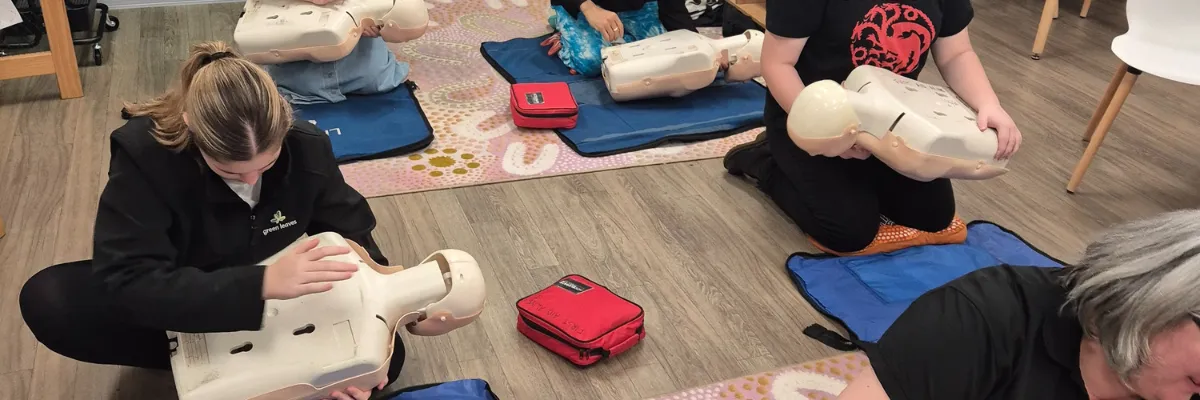
A written plan is only half the equation. Without trained staff who know how to execute it, your emergency plan is just a document. The WHS Act requires you to ensure workers are trained to implement the plan. Training is what turns a written document into an actual emergency response capability.
What Training Does Your Emergency Plan Need to Reference?
Accelerate First Aid delivers nationally accredited workplace training across Queensland, coming to your site and issuing certificates the same day. All courses accredited under RTO 31106.
Common Mistakes Queensland Employers Make With Emergency Plans
Nominating a warden who has since left the business. The plan must name a current employee and a deputy. If the named warden resigned and nobody updated the plan, your emergency response has no designated lead.
Assembly point that no longer exists or is inaccessible. If it's changed, the plan must be updated and re-communicated to every worker.
Plan not communicated to new or casual workers. Induction is not complete without emergency plan orientation.
First aid kit locations not documented in the plan. The location must be stated explicitly, written down, so anyone can find it under pressure.
No drill schedule or documented drill history. Undocumented drills don't satisfy WHSQ requirements.
Plan never reviewed after a near-miss or incident. A near-miss is a legal trigger for review, not just a learning moment.
Assuming HLTAID012 covers all training obligations in a childcare setting. It doesn't. 22300VIC and 22556VIC are separate requirements that HLTAID012 does not satisfy.

Free Workplace Emergency Plan Template Queensland 2026
A Queensland-compliant workplace emergency plan template covers eight core components:
Business and site details legal entity name, site address, number of workers, nature of work
Emergency contact list 000, your site emergency number, and the WHSQ hotline
Foreseeable emergency register the specific emergencies your workplace has identified as realistic risks
Named warden list with deputies chief warden, area wardens, and a named deputy for every role
Evacuation map placeholder a diagram of your site showing exits, routes, and the assembly point
First aid arrangements kit location by room or area, and the names of trained first aiders on site
Drill schedule template frequency, who conducts, how outcomes are recorded
Review log date of last review, trigger for review, who conducted it, and what changed
For low-risk environments, a one-page plan covering those eight elements is enough. For higher-risk environments the plan will be more detailed, but the structure stays the same. What makes it real is named people being current, procedures being tested, and the document being reviewed when something changes.
WRAPPING UP
A workplace emergency plan isn't a bureaucratic formality. It's the document that tells your people what to do in the worst two minutes of their working lives. A plan written once and filed away will fail the people who need it most.
The gap between what most businesses have and what satisfies Queensland WHS obligations is often smaller than employers expect. A named warden, a documented assembly point, a tested drill schedule, first aid arrangements in writing, these are things any workplace can put in place. The barrier isn't complexity. It's the assumption that what's already on the shelf is good enough.
The employers who get this right treat the emergency plan as a living document. They update it when staff change, review it after incidents, and make sure every worker knows what it says and what they're expected to do. Staff training is what turns the written plan into a real response capability. It's a legal obligation, not an optional enhancement.
The goal has never been to satisfy an auditor. The goal is to make sure that when a worker collapses, a fire breaks out, or a child goes into anaphylactic shock, the people in that building know exactly what to do, in what order, without hesitation. That kind of readiness doesn't happen by accident. It's built, deliberately, before anything goes wrong.