WHS First Aid Requirements: Full Employer Guide
Most business owners think a first aid kit stuck on the staff room wall covers them. A few plasters, a bandage, maybe an eye wash bottle if someone's organized. Job done, box ticked.
It doesn't work like that.
The Work Health and Safety Regulation sets out specific, enforceable requirements around trained first aid officers, equipment and risk assessment, and falling short carries real penalties.
Here's the number that catches most employers off guard: Safe Work Australia's Code of Practice says low-risk workplaces need at least one trained first aider for every 50 employees, and higher-risk workplaces need more. Most Queensland SMEs have never sat down and run that ratio against their own headcount, which means a fair few are non-compliant right now and don't even know it.
This guide walks through what WHS first aid requirements mean for your business: how many first aid officers you need by law, what has to be in your kit, when a risk assessment becomes mandatory, and what happens if an inspector finds a gap.
What Are the WHS First Aid Requirements? (Quick Answer)
Under the WHS Act, every PCBU (Person Conducting a Business or Undertaking) has to provide:
A first aid risk assessment: based on how many people work there, what industry you're in, and the layout of the site
Trained first aid officers: generally 1 per 50 workers in low-risk workplaces, more in higher-risk environments
A stocked, accessible first aid kit: matched to the actual hazards your risk assessment turns up, not just a generic off-the-shelf box
First aid facilities: a dedicated first aid room where the scale or risk of the site calls for it
Ongoing training and currency: first aid officers need to stay properly qualified, and CPR competency needs regular renewal
These obligations come from the WHS Act and Safe Work Australia's Model Code of Practice: First Aid in the Workplace, and apply regardless of business size.
What Does the WHS Act Actually Require for First Aid?
The PCBU's Legal Duty
If you're running a business in Queensland, you're what the law calls a PCBU. Doesn't matter if you're a sole trader with a couple of staff or a company with hundreds, the same basic duty applies.
Here's the bit that trips people up: this duty can't be handed off. You can appoint a first aid officer, bring in a training provider, get a consultant to run your risk assessment. But the legal responsibility stays with you as the PCBU. It's non-delegable.
We've seen business owners assume that once they've nominated a staff member as the "first aid person," the liability sits with that person instead. It doesn't work that way. If something goes wrong and the coverage wasn't adequate, the obligation traces back to the business, not just whoever was wearing the badge that day.
WHS Act vs the Model Code of Practice: What's Binding, What's Guidance
The WHS Act itself is law. It sets out the broad duty, that you must provide adequate first aid arrangements, but it doesn't spell out exact numbers or ratios.
The detail comes from Safe Work Australia's Model Code of Practice: First Aid in the Workplace, and in Queensland specifically, the WorkSafe Queensland Code of Practice. Technically, a Code of Practice isn't law in the same way the Act is, and you could in theory meet your obligations a different way. But in practice, courts and regulators treat it as the accepted standard for what "adequate" looks like. If you're not following it and something happens on site, you'll be the one explaining to an inspector why your alternative approach was just as good.
So the practical answer for almost every Queensland employer is simple: follow the Code of Practice, because it's the benchmark everyone, including WorkSafe, measures you against.

How Many First Aid Officers Do You Need?
Low-Risk vs High-Risk Workplace Ratios
This is the calculation most businesses skip:
Workplace Risk Level | Minimum First Aid Officer Ratio | Example Industries |
Low risk | 1 officer per 50 workers | Offices, retail, professional services |
High risk | Higher ratio required, assessed per site | Construction, manufacturing, warehousing, trades |
Worth noting: exact ratio figures can shift depending on which schedule you're referencing, so check the current WorkSafe Queensland figures directly rather than relying on any single source, including this one.
The bit people get wrong most often is assuming the ratio is a flat number regardless of risk. A 40-person office and a 40-person warehouse floor are not the same calculation, and a risk assessment is what actually tells you which category you sit in and whether you need to round up.
A Worked Example
Say you're running a small logistics business with 45 staff on the books, a mix of warehouse floor and office admin. On paper you might sit just under the 50-worker threshold for a straight low-risk ratio. But warehouse work isn't low-risk. Forklifts, manual handling, loading docks, that changes the picture, and it's exactly why a proper risk assessment matters more than counting heads and dividing by 50. Two businesses with identical staff numbers can land on completely different officer requirements depending on what actually happens on site.
If you've already got staff who've done their general first aid certificate and you're trying to work out whether that's enough coverage for your headcount, our guide on whether you need a first aid certificate for work walks through that.
First Aid Kit and Facility Requirements
What Must Be in a Compliant Kit
Here's something that surprises a lot of employers: there's no single universal list of what has to go in a first aid kit.
Your kit contents are meant to be driven by what your risk assessment actually finds. A quiet accounting office and a busy trade workshop don't need the same kit, and if yours looks identical to every other business regardless of what you actually do, that's a bit of a red flag.
That said, most compliant kits will generally include:
Wound dressings and bandages of various sizes
Antiseptic wipes and saline for cleaning wounds
Adhesive tape and dressing strips
Scissors and disposable gloves
A resuscitation face shield or mask
An instruction booklet or first aid guide
Eye wash, particularly for workplaces with dust, chemicals or debris risk
Higher-risk sites, think construction, manufacturing, anywhere with heavy machinery, will often need additions on top of that baseline: burns, dressings, splints, more extensive trauma supplies. Again, the risk assessment is what tells you, not a generic list off the internet.
When You Need a Dedicated First Aid Room
Not every business needs a first aid room. Smaller, lower-risk workplaces are usually fine with a well-stocked kit and a clear process for who responds.
But once you hit a certain scale, or your risk profile goes up, a dedicated space starts becoming expected rather than optional, think larger worksites, higher-risk industries, or places where an injury needs somewhere private and appropriate to be treated before an ambulance arrives. The Code of Practice ties this back to scale and risk rather than a hard headcount trigger.
Running a Compliant First Aid Risk Assessment
The Five-Step Assessment Process
A proper risk assessment isn't a five-minute walk around the office with a clipboard. It's a genuine, structured look at what could go wrong on your site and what you'd need to respond to it. Broadly, it works through five steps:
Identify the hazards: what's actually present on site that could cause harm? Machinery, chemicals, manual handling, lone working, whatever applies to you
Assess the workforce and layout: headcount, shift patterns, how spread out the site is, whether there are multiple buildings or levels
Determine the likelihood and severity of injury: some hazards are common but minor, some are rare but severe, both matter
Match your first aid provisions accordingly: officer numbers, kit contents, whether a dedicated room is warranted
Review it regularly: a risk assessment done years ago for a business that's since grown isn't worth much anymore
That last point trips a lot of businesses up. Risk assessments aren't a one-off document you file away and forget, they need revisiting whenever your workforce, layout or operations change meaningfully.
Common Risk Factors for Queensland SMEs
A few things come up again and again:
Site layout: multi-level offices, warehouses with separated loading and admin areas, anywhere a first aider might not be within quick reach
Shift work: staff outside standard business hours still need first aid coverage during those hours
Remote or lone workers: tradies, delivery drivers, and anyone away from the main location need their own consideration, since "run and grab the first aid officer" doesn't apply
If any of these sound like your business, treat your risk assessment as more than a formality. It genuinely changes what adequate coverage looks like for you.
Which First Aid Qualification Meets WHS Requirements?
HLTAID011: The Standard Workplace Qualification
For the vast majority of Queensland workplaces, HLTAID011 (Provide First Aid) is the qualification that satisfies your WHS first aid officer requirement. It covers CPR, basic life support, wound and injury management, and asthma and anaphylaxis response, all in a single course.
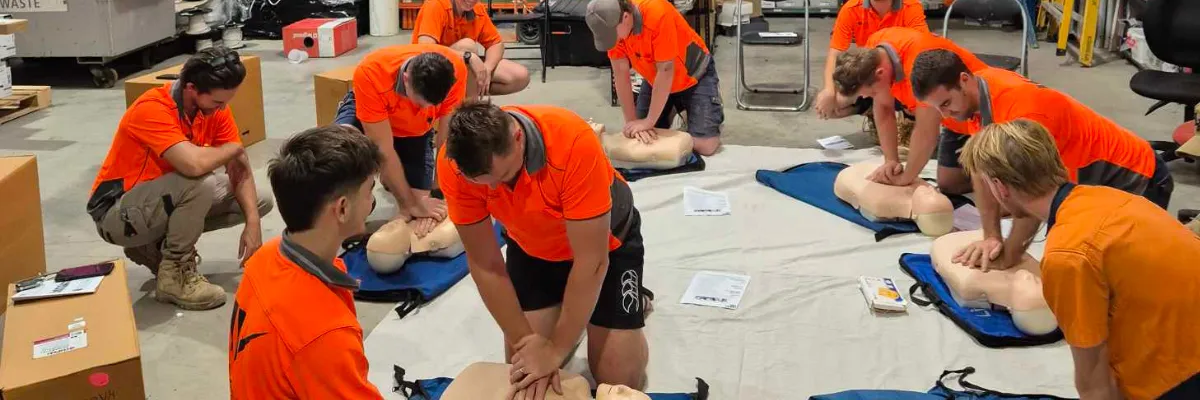
Our HLTAID011 group training comes with same-day certificates for everyone in the group. For most low and moderate risk Queensland SMEs, this single qualification is genuinely all you need to meet your obligations.
When a Higher-Level Qualification Is Required Instead
Some sites need more than the standard course. If you're running a higher-risk environment, think construction, certain manufacturing settings, remote or isolated work, the Code of Practice may call for officers trained to a higher level, such as HLTAID014 (Provide Advanced First Aid). We've covered that in our Advanced First Aid Requirements guide if that sounds closer to your situation.
A Quick Word on UEECD0007
This one causes genuine confusion, so it's worth clearing up. UEECD0007 is not a first aid officer qualification at all, it's a WHS regulations unit, mostly relevant to electrical and trade contexts. If you've come across it while researching first aid requirements, you've likely stumbled onto a different compliance need entirely. We've broken down what that unit actually covers in our codes and practices in the workplace piece, but for meeting your WHS first aid officer obligation, HLTAID011 or HLTAID014 is what you're after, not UEECD0007.
Ready to meet your WHS first aid obligations? Book HLTAID011 group training for your team and get same-day certificates for every attendee.

Renewal, Record-Keeping and Staying Compliant
Certificate Validity vs CPR Currency
This is the single most common compliance gap we see.
Full HLTAID011 Certificate | CPR Component | |
Renewal cycle | Longer term | Renewed more frequently |
Your full first aid certificate has a longer validity period than the CPR skills sitting inside it, and CPR needs renewing far more often. A lot of employers only track the longer certificate date and miss the CPR renewal, so staff can end up holding an expired CPR competency without realizing it.
What Records a PCBU Should Keep
Keep it simple but current:
A register of who's trained, in what, and when each component expires
Copies of Statements of Attainment for every trained officer
Your most recent risk assessment, and when it was last reviewed
A record of kit checks and restocking dates
If an inspector asks, this is the paper trail that shows you're actively managing compliance, not just meeting it on the day.
What Happens If You're Not Compliant?
Penalties and Enforcement
WHS penalties for first aid non-compliance aren't a slap on the wrist. Depending on severity and whether it's linked to an actual incident, penalties can run into serious money, and individual officers or directors can face personal liability too. Figures change, so check current penalty schedules directly with Safe Work Australia before making decisions based on cost alone.
The Real-World Cost of a Gap
Businesses that treat this seriously aren't doing it because they're worried about an inspector turning up. They're doing it because eventually, something will happen on most worksites over a long enough timeframe, and when it does, having someone properly trained in the room is the difference that actually matters.
What to do this week:
Run or review your risk assessment: if it's out of date, or your team has grown, it's due
Confirm your officer ratio: count your heads, check your risk category, and work out if you're actually covered
Book your training: get your team into HLTAID011, or HLTAID014 if your site calls for it, and close the gap
Meeting your WHS first aid requirements doesn't need to be complicated once you've run the numbers. Get in touch with Accelerate First Aid to book group HLTAID011 training and get every certificate issued the same day.
Conclusion
Most Queensland business owners don't set out to be non-compliant. It just happens quietly, because first aid feels like one of those boxes you tick once and forget about. A kit gets bought, someone's nominated as the "first aid person," and everyone moves on with running the actual business. The law doesn't work off good intentions though, it works off ratios, risk assessments and current certificates, and those three things drift out of date faster than most employers realize.
The good news is none of this is hard to fix once you know what you're being measured against. Run the risk assessment properly instead of guessing. Work out your real officer ratio based on what happens on your site, not just a headcount divided by fifty. Get the kit matched to your actual hazards rather than a generic box off a shelf.
CPR currency is where we see businesses slip up most. The longer-term certificate feels like the finish line, so the more frequent CPR renewal quietly falls off everyone's radar until an inspector, or worse, an actual emergency, exposes the gap. Building that renewal date into whatever calendar your business already runs closes the single most common compliance hole we come across.
It's also worth remembering the paperwork exists for a reason that has nothing to do with paperwork. Someone on your team is going to be the person standing closest when a colleague collapses, cuts themselves badly, or stops breathing properly. Whether that moment goes well or badly comes down to whether the right person had done the right training recently enough to remember it under pressure. That's the whole point behind every ratio and requirement in this guide.
Treat this less like a compliance chore and more like something you'd want covered regardless of what the regulation said. Get the numbers right, keep the training current, and you've genuinely done right by the people you employ, not just by the inspector who might never show up.