

Understanding WHS Codes & Practices in Electrotechnology
Here's a situation a lot of operations managers in the electrical and electrotechnology industry know well. You're responsible for keeping your worksite compliant. You know the Work Health and Safety Act 2011 (Qld) exists, you know it applies to you, and you know there are penalties if you get it wrong. But when it comes to whs codes practices electrotechnology, what they actually require and what they look like on a real worksite, most operators genuinely aren't sure where they stand.
That gap between knowing you need to comply and knowing what compliance actually looks like in practice is where most businesses get into trouble. Not because they don't care about safety. Because the legislation is dense, the codes are lengthy, and nobody's got the time to read 80 pages of regulatory guidance on a Tuesday morning when there's a crew waiting on-site.
WHS codes of practice in electrotechnology cover the things that matter most in a real working environment: hazard identification, risk control, electrical safety obligations, emergency procedures, and documentation. They're also the core of what UEECD0007 teaches. This article breaks down which codes apply to electrical workers in Queensland, which laws govern your obligations, what UEECD0007 actually covers, and what your duties are as a PCBU, written in plain language, without the legal padding.
What Are WHS Codes of Practice in Electrotechnology?
WHS codes of practice in electrotechnology are practical guides that set out how to manage specific health and safety risks associated with electrical work. Issued under the Work Health and Safety Act 2011 (Qld) and the Work Health and Safety Regulation 2011 (Qld), these codes don't replace the law. They explain how to meet it in a real workplace context.
For electrical workers and their employers in Queensland, the relevant WHS codes of practice cover:
Electrical work safe systems, isolation procedures, and live work controls
Managing risks in the workplace hazard identification and the hierarchy of controls
Managing the work environment and facilities site conditions and worker welfare
Construction work if electrotechnology tasks occur on construction sites
First aid in the workplace emergency response obligations for PCBUs
Incident notification what must be reported to SafeWork QLD and when
Compliance with an applicable code of practice is not mandatory in the strictest legal sense. But if a PCBU chooses not to follow a code, they must demonstrate an equally effective alternative method of managing the risk. In practice, it means the burden of proof shifts to you.
Which WHS Laws and Regulations Apply to Electrical Workers in Queensland?
Knowing which codes apply is one thing. Understanding the legal framework they sit within is another, and it's the framework that determines your actual exposure if something goes wrong.
The WHS Act 2011 (Qld) - Your Primary Legal Obligation
The Work Health and Safety Act 2011 (Qld) is the foundation. It applies to every Queensland workplace, and electrotechnology worksites are no exception. Every person conducting a business or undertaking must ensure, so far as is reasonably practicable, that workers and others aren't exposed to health and safety risks.
The sections that matter most for electrical businesses:
If you're an operations manager or business owner, s.27 applies directly to you. The due diligence obligation means you can't delegate compliance and walk away from it. Completing or arranging training like UEECD0007 is a documented way to demonstrate that.
The Electrical Safety Act 2002 (Qld) - Where It Fits
The Electrical Safety Act 2002 (Qld) runs alongside the WHS Act. It's not a replacement, it's an addition.
Administered by the Electrical Safety Office (ESO), a division of WHSQ
Covers licensing requirements, electrical safety obligations, and Safe Work Method Statements for electrical work
The Electrical Safety Regulation 2013 (Qld) sets specific technical requirements beneath the Act
Codes of practice issued under both Acts may apply to an electrical worker simultaneously
If you're running an electrical business in Queensland, you may be subject to obligations under two separate pieces of legislation at the same time, and inspectors from either regulator can visit your site.
Safe Work Australia Codes of Practice - Practical Guidance Documents
Think of Safe Work Australia codes of practice as the how-to manual beneath the legislation. They don't create new legal duties. They explain how to meet the ones that already exist.
Key codes of practice for Queensland electrical workers:
How to Manage Work Health and Safety Risks
Construction Work
Managing Electrical Risks in the Workplace
If you choose not to follow one, you need to prove you managed the risk just as effectively another way. They're also admissible in court proceedings as evidence of what a reasonable PCBU should have done. All three are free to download from safeworkaustralia.gov.au.
The Hierarchy of Controls - How It Applies on an Electrotechnology Worksite
Most electricians and site managers have heard the term "hierarchy of controls." Fewer can explain it clearly, and fewer still can apply it correctly when they're standing in front of a live electrical hazard. That's what happens when training is treated as a box-tick rather than a practical tool.
What the Hierarchy of Controls Requires
Under WHS Regulation 2011 (Qld) r.36, PCBUs are required to work through this hierarchy when managing risks. It's not a suggestion, and it's not a choice. You start at the top and work down. You only move to a lower level of control when a higher one isn't reasonably practicable.
The six levels, in order:
Elimination - Substitution - Isolation - Engineering controls - Administrative controls - PPE
PPE, including gloves, arc flash protection, and safety footwear, is the last line of defense, not the first. A worksite that relies on PPE as the primary control for electrical hazards is one equipment failure away from a serious incident.
Applying the Hierarchy to Electrical Hazards
Training records are an administrative control. They're a documented, legally recognized part of your risk management system. An inspector reviewing your site will expect to see them.
What UEECD0007 Teaches You About WHS Codes and Practices
Who Needs UEECD0007 in Queensland
If you work in electrotechnology in Queensland, or you manage people who do, this is your unit. UEECD0007 (Apply Work Health and Safety Regulations, Codes and Practices in the Workplace) applies to:
Electrical apprentices, as it's embedded in the Certificate III in Electrotechnology Electrician
Licensed electrical workers seeking to refresh or formally document their WHS obligations
Workers entering the UETDRRF004 (Low Voltage Rescue) pathway, where UEECD0007 is a common co-requisite
Operations managers and WH&S officers at electrical or electrotechnology businesses
Any PCBU needing documented evidence of staff WHS training for a tender submission or SafeWork QLD audit
What the Unit Covers - Learning Outcomes in Plain English
Identifying applicable legislation workers learn which WHS laws, regulations, and codes apply to their specific workplace and role
Understanding PCBU and worker duties what the WHS Act 2011 (Qld) actually requires from both the business and its people
Applying the hierarchy of controls how to identify electrical hazards and select the right level of control
WHS consultation processes how to participate in toolbox talks, safety meetings, and hazard reporting
Completing WHS documentation incident reports, hazard registers, and training records done correctly
Responding to WHS breaches what to do when something's wrong, who to tell, and how fast
A worker who identifies an unsafe condition but doesn't know the correct reporting process is a liability risk for the whole business.
How UEECD0007 Relates to Other Qualifications and Licenses
Sits within the UEE Electrotechnology Training Package as a recognized component of Certificate II, III, and IV electrotechnology qualifications
Accepted as a standalone nationally recognized unit of competency for compliance purposes
Does not replace an electrical license, it documents WHS knowledge, not technical competency
Pairs naturally with UETDRRF004 (Low Voltage Rescue) and first aid units for a complete compliance package
PCBU Obligations - What Employers and Contractors Must Do
What "Reasonably Practicable" Actually Means
"Reasonably practicable" is defined in s.18 of the Work Health and Safety Act 2011 (Qld). It's a proportionality test, not an absolute standard. The Act requires you to weigh up the likelihood of harm occurring, the severity of that harm, how much you knew or should have known about the hazard, and what it would cost to control it.
A practical way to think about it: "If a SafeWork QLD inspector reviewed what I did, would a reasonable person in my position have done the same?" That's the test. Not perfection. Reasonable, proportionate action given what you knew and what was available to you.
Consultation, Cooperation, and Coordination Duties
Under ss.46-49 of the Work Health and Safety Act 2011 (Qld), PCBUs must consult workers when identifying hazards, making decisions about risk controls, and changing work procedures. Workers also have the right to request that a Health and Safety Representative (HSR) be elected, and if they do, the PCBU must facilitate that process.
Toolbox talks and safety meetings satisfy the legal consultation duty, but only if you document them
A verbal conversation doesn't count as consultation for compliance purposes. Write it down, date it, and keep it on file.
Where multiple PCBUs share a worksite, coordination duties apply to all of them, not just the principal contractor
WHS Documentation You Must Be Able to Produce
WHS training records including UEECD0007 certificates of attainment for relevant workers
Safe Work Method Statements (SWMS) for all high-risk construction work
Hazard and incident registers, current, not from three years ago
Risk assessments for electrical work activities
Evidence of consultation including toolbox talk records and safety meeting minutes
Electrical Safety Management System (ESMS) if applicable
Common WHS Violations in Electrotechnology and How to Avoid Them
The breaches SafeWork QLD finds most often in electrical businesses aren't the result of deliberate corner-cutting. They're gaps in systems, gaps in training, and gaps in documentation that built up quietly over time.
No Safe Work Method Statement, or one that isn't followed by SWMS are legally required for high-risk electrical tasks. Having one buried in a folder nobody reads doesn't satisfy the requirement.
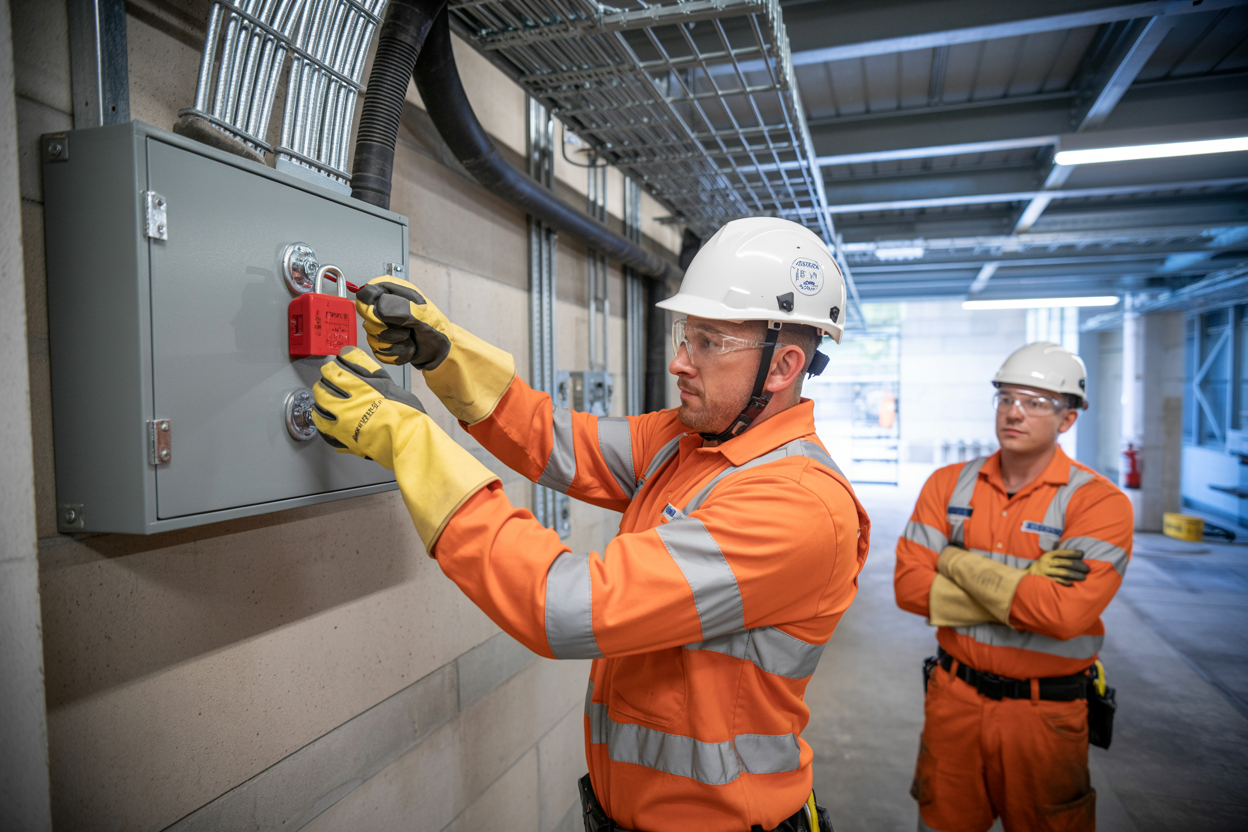
No documented lock out/tag out procedure If it's not written down, trained on, and followed, it's not a system.
PPE not provided, not used, or wrong for the task Providing PPE isn't enough. Workers need to be trained in when and how to use it.
Workers not trained in WHS obligations, no unit of competency on record If your training register doesn't show UEECD0007, that's a breach waiting to be cited.
Inadequate hazard identification before work commencement Hazard identification needs to be systematic, documented, and done before the work starts.
Failure to notify SafeWork QLD of a notifiable incident within the required timeframe Not knowing the requirement doesn't remove the obligation.
Enforcement actions are published on the SafeWork QLD website. Your clients can see them. Tenderers can see them. If you're chasing a contract and your business appears on that list, the conversation is already harder before it starts.

How to Stay Compliant - Practical Steps for Electrical Businesses
Build Your WHS Training Register Today
A training register shows who has completed what training, when they completed it, and with which registered RTO. If an inspector asks for it, you hand it over. Your training register needs to record:
Worker name
Unit of competency completed (e.g. UEECD0007)
RTO name and RTO number
Date of completion
Certificate number
Store copies digitally and keep a version on-site. SafeWork QLD inspectors can request records on the spot, not in three days when you've had time to pull things together.
Schedule Regular WHS Reviews
WHS compliance isn't static. Hazards change, work practices change, and the people on your crew change. An annual review of your risk assessments and SWMS is the baseline recommendation.
UEECD0007 has no formal expiry date, but industry best practice suggests a refresher every 3-5 years
Set calendar reminders for certificate review dates and treat them like licence renewals
New starters should complete UEECD0007 before they're on-site, not after their first week
Your Next Steps
WHS compliance in electrotechnology isn't complicated once you understand what's actually required of you. The Work Health and Safety Act 2011 (Qld) sets the framework, the codes of practice explain how to meet it, and units like UEECD0007 give your workers the documented knowledge to operate within it. The gap most businesses fall into isn't ignorance of the law, it's the space between knowing it exists and having systems that prove you're following it.
Start with your training records. Check whether your workers hold a current UEECD0007 certificate of attainment. If they don't, or if you can't find the records, that's your first gap and your first priority. A training register costs nothing to build and everything not to have when an inspector walks onto your site.
From there, look at your documentation. SWMS, hazard registers, risk assessments, toolbox talk records, they all need to be current and on-site, not sitting in a filing cabinet from three years ago. The businesses that come through SafeWork QLD audits without issues aren't necessarily doing more than everyone else. They're just doing it consistently and keeping the paperwork to show it.
UEECD0007 sits at the foundation of all of that. It's the unit that gives workers a working understanding of their obligations, their rights, and the correct process when something goes wrong on-site. Whether you're an apprentice completing your trade qualification, a licensed electrician refreshing your compliance records, or an operations manager trying to get your team sorted before a tender deadline.