What Is a Blended First Aid Course? Everything Explained
Sarah manages a childcare centre in Brisbane's northern suburbs. She needs four staff members certified before the end of the month. Taking the whole team off the floor for a full day isn't possible — they'd have to close two rooms and call in casuals just to make it work. Then someone tells her about blended learning, and the problem disappears.
A blended first aid course splits training into two parts: online theory you complete at your own pace before the course date, and a face-to-face practical session where a qualified trainer assesses your hands-on skills. That's it. Two components, one nationally recognised certificate.
The blended first aid course format isn't a shortcut or a compromise. It's an ASQA-registered delivery mode accepted right across Australia — including by Queensland workplaces, childcare services, and schools. The theory happens on your device, whenever it suits you. The practical happens in person, where the skills that actually matter get assessed properly.
Courses available in the blended format include HLTAID009 (CPR), HLTAID011 (Provide First Aid), and HLTAID012 (First Aid in an Education and Care Setting) — so whatever your role or regulatory obligation, blended delivery is almost certainly an option.
This article covers how blended courses work, whether the certificate is accepted everywhere a traditional one is, what the practical session actually looks like, and who this format suits best
What Is a Blended First Aid Course?
A blended first aid course is a training format split into two components — online self-paced theory completed before your course date, and a face-to-face practical assessment conducted by a qualified trainer.
Online theory component: completed at home or work, at your own pace, across one or more sittings before the practical date
Face-to-face practical: hands-on skills assessment with a qualified trainer — CPR on a manikin, AED use, bandaging, recovery position, and more
Certificate issued: a single nationally recognised qualification — HLTAID011, HLTAID009, or HLTAID012 depending on your enrolment
Regulatory acceptance: accepted by ASQA-registered RTOs across Australia — Queensland workplaces, childcare services, and schools
The certificate issued at the end of a blended course is identical to one issued after a traditional full-day course — no difference in recognition, validity period, or regulatory acceptance.
How Does a Blended First Aid Course Actually Work?
Think of it like studying for a driver's licence. You don't sit in a classroom all day doing theory and then practise parallel parking in the same session. The knowledge part happens separately — then you prove you can actually do it. Blended first aid works the same way.
There are two stages, and you can't skip either one.
Stage 1: Online Theory
After you enrol, you get login details for an online learning platform. From there, you work through the theory modules at whatever pace suits you — early morning, late at night, during a lunch break. You can split it across multiple sittings if that's easier.
The theory covers:
Anatomy basics relevant to emergency response
The DRSABCD action plan
Recognition of common emergencies
How an AED works and when to use one
The legal obligations of a first aider in Australia
There are short knowledge checks throughout, and a theory assessment at the end. You need to pass that assessment before you can attend the practical session.
Does the online theory have a time limit?
Providers set their own access windows, but most give you a comfortable window between enrolment and your practical date. You're not racing. You complete it when it works for you, and you show up to the practical with the foundation already in place.
What do I need to complete the online component?
A device with internet access and a reasonably quiet space to focus. That's genuinely it. No special software, no webcam requirement. A laptop works best for longer sittings, but a tablet or phone will do the job.
Stage 2: Face-to-Face Practical
This is where the actual skills assessment happens. It's conducted at a registered training venue or, for groups, on-site at your workplace. A qualified trainer works through each skill with participants and assesses them individually — this isn't a group pass/fail situation.
Skills assessed during the face-to-face practical include:
CPR on adult, child, and infant manikins — correct compression depth, rate, and rescue breaths
AED operation — powering on, pad placement, shock delivery sequence, post-shock CPR
Bleeding control and wound management
Burns and shock management
Recovery position
Choking response — back blows and abdominal thrusts
Blended delivery doesn't cut content — it redistributes it. The theory happens before the day. The practical is where you prove you can apply it.
Your certificate is issued on successful completion of both components.
Once you understand how the course is structured, the next question most people ask is whether their employer, regulator, or licensing body will actually accept it.

Is a Blended First Aid Certificate the Same as a Traditional One?
Yes. Full stop.
The certificate you receive after completing a blended first aid course carries the same unit code, the same validity period, and the same Australian Qualifications Framework national recognition as one issued after a traditional full-day course. There is no asterisk, no footnote, no "blended delivery" stamp on the certificate. It shows HLTAID011 — and that's what every employer, regulator, and licensing body in Australia looks at.
As an ASQA-registered RTO, Advanced Resuscitation Training issues nationally recognised qualifications under the HLT Health Training Package. The delivery mode — blended or face-to-face — doesn't change that.
Here's who accepts it:
✅ Accepted Across Queensland
Safe Work Australia / Queensland WHS Act ✓
ACECQA National Quality Framework ✓
Queensland DET (school staff requirements) ✓
AHPRA CPD compliance ✓
NDIS Practice Standards ✓
Construction site induction packages across SEQ ✓
AHPRA is worth calling out specifically. AHPRA doesn't prescribe how your training was delivered — it recognises the unit code. So if you're a nurse, a dental assistant, or an allied health professional renewing your first aid for registration purposes, blended delivery is completely fine.
Same goes for childcare. ACECQA requires staff to hold a current, nationally recognised first aid qualification to meet NQF staff ratio requirements. Blended HLTAID011 satisfies that requirement. Full stop.
Will my employer accept a blended first aid certificate?
Almost certainly, yes — and here's why. Employers who require first aid certification are specifying a unit code, not a delivery format. "Staff must hold current HLTAID011" means exactly that. How you obtained it isn't part of the requirement.
If you're genuinely unsure — maybe you work in a highly regulated environment, or your employer has a specific training policy — it takes about two minutes to check. Ask your HR team or WHS officer whether they have any restrictions on delivery mode. The answer is almost always no.
One thing worth being clear about: a purely online first aid certificate is not compliant. No hands-on practical, no certificate — that's not a blended course, that's an incomplete one. Under Australian training package rules, the practical assessment is mandatory. Blended delivery satisfies that requirement because the face-to-face practical is still there. A fully online course does not.
Who Is a Blended First Aid Course Right For?
Honestly — most people. The format was built around the reality that most people who need a first aid certificate are also trying to hold down a job, run a team, manage a roster, or get kids to school. A full day out isn't always possible. Blended delivery works around that without cutting corners on the skills component.
Here's who it suits particularly well:
Busy HR managers and WHS officers — scheduling is easier and compliance value is identical. Getting a team certified doesn't have to mean everyone out of the office for a full day.
Childcare educators and centre directors — staff complete the online theory at home in the evenings, then only need a half-day away from the centre floor for the practical. Two rooms stay open. Operations continue.
Trades and construction workers — fast pathway to the ticket. Weekend practical sessions available. If you need it sorted before a site start, blended gives you a realistic path.
Healthcare and aged care workers — shift workers can chip away at the online theory between shifts, then book the practical on a day off. No need to sacrifice a rostered day for a full-day course.
School administrators — on-site practical delivery means staff complete the theory independently before the trainer arrives. No one travels, no relief cover headache.
Parents and community members — the self-paced online theory is non-intimidating. You arrive at the practical already familiar with the content, which makes the hands-on component far less daunting.
Can blended first aid training be delivered on-site?
Yes. For groups, ART brings the practical session to your workplace. Staff complete the online theory independently before the trainer arrives — so the only thing happening on your premises is the skills assessment. No theory lectures, no wasted time, no one travelling across town.
Blended may not suit everyone. Some people genuinely prefer a full face-to-face day — they want to cover everything in one room, ask questions as they go, and not have to self-manage an online component beforehand. That preference is completely valid, and the traditional format is still available. The blended course isn't better — it's different, and for most people, it's more practical.
What Happens During the Face-to-Face Practical Session?
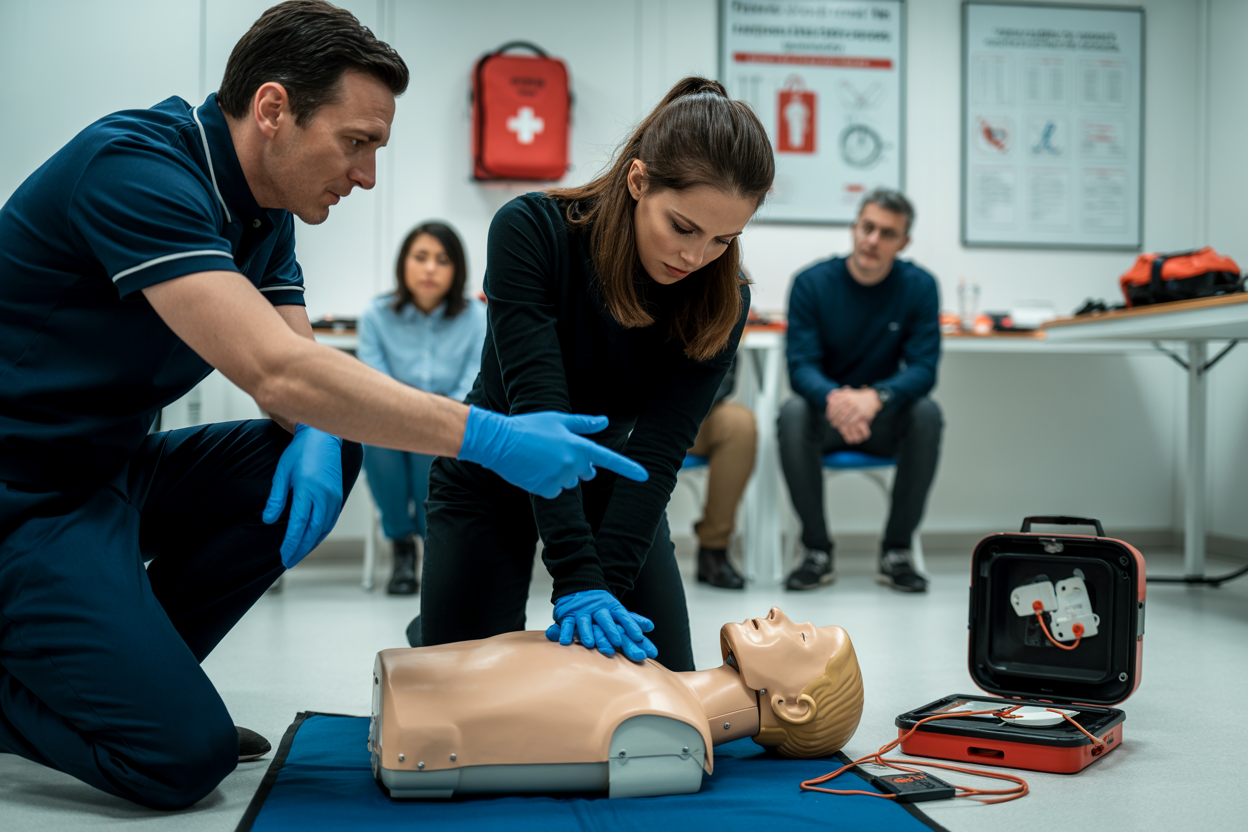
This is the part people are most curious about — and if you've never done a first aid course before, it's also the part that causes the most unnecessary anxiety. So here's exactly what to expect.
The practical session is run by a qualified trainer with a clinical or paramedic background. Not a generic trainer who picked up a certificate on a weekend course. ART's trainers come from real clinical environments — that comes through immediately in the way they teach, the way they explain what's actually happening inside someone's body during a cardiac arrest, and the way they handle questions.
The environment is supportive. No prior experience is needed or expected.
Here's how the session runs:
Arrival and trainer introduction — you meet the trainer, confirm your online theory is complete, and get a quick brief on how the session will run. If you haven't finished the online component, you won't be assessed — so get that done before you show up.
Brief theory recap — the trainer checks in on the key concepts from the online component before any practical work begins. This isn't a test. It's a warm-up.
CPR skills station — you'll practise on adult, child, and infant manikins. The trainer will check your compression depth, compression rate, and rescue breaths. Current Australian Resuscitation Council (ARC) guidelines set the standard here — and ART's courses are built around those guidelines.
AED station — you'll power on an AED trainer unit, place the pads correctly, work through the shock delivery sequence, and continue CPR post-shock. By the end of this station, using a defibrillator won't feel unfamiliar. That matters — because hesitation kills time.
Bleeding and wound management — direct pressure technique, wound packing basics, and tourniquet awareness. Practical, hands-on, no theory slides.
Recovery position — correct positioning of an unconscious breathing patient and ongoing monitoring technique.
Choking response — back blows and abdominal thrusts on an adult, and the modified technique for infants.
Burns and shock management — recognition and initial response for both.
Individual skills sign-off — the trainer assesses each participant individually on the core competencies. This is a competency-based assessment, not a written exam. You demonstrate the skill. The trainer confirms you can do it. That's the bar.
Most people are surprised by how quickly the practical goes — and how much more confident they feel walking out than they did walking in.
How to Get Started With Blended First Aid Course
Advanced Resuscitation Training runs blended HLTAID011 — individual bookings and group sessions both available. If you're booking for a team, on-site delivery means your staff complete the online theory independently before the trainer arrives at your workplace. No one travels, no full day blocked out, no operational disruption.
Whether you're an HR manager trying to get a team certified before an audit, a childcare director juggling ACECQA compliance, a tradie who needs the ticket before a site start, or a parent who just wants to know what to do if something goes wrong — the blended format gets you there without making your life harder in the process.
Booking is straightforward. Pick a practical session that works around your schedule — or, if you're organising training for a group, request an on-site session and we'll bring the practical to your workplace.
After booking, you'll receive login details for the online theory component. Complete it in your own time — evenings, weekends, whenever suits — before your practical session date. There's no rush, no livestream to join, no fixed time you need to be online.
On the day of your practical, show up, work through the skills with your trainer, get signed off, and you're done.
Questions before you book? Call us or send a quick inquiry — we'll get back to you within two business hours.