What First Aid Should Every Parent Know Before an Emergency
She was loading the dishwasher. Just a regular Tuesday afternoon.
Then she noticed the silence. That particular kind of silence that every parent learns to dread — no cartoons, no giggling, no little feet on the floorboards. She walked into the lounge and found her four-year-old on the floor, face pale, not moving.
She called 000. And then she froze.
Not because she didn't love her son. Not because she was weak or panicked or a bad mum. She froze because she had absolutely no idea what to do next — and nobody had ever shown her.
That moment of freezing isn't a character flaw. It's the predictable result of never having practised. And it happens to parents every single day across Brisbane, the Gold Coast, and every suburb in between.
This article covers what first aid should every parent know — six core skills that can keep someone alive in the minutes before an ambulance arrives. No medical background needed. No nursing degree. We'll cover choking, CPR, anaphylaxis, severe bleeding, burns, and what to do when someone loses consciousness — all in plain English, for everyday families.
At the end, we'll show you the fastest way to turn this knowledge into a nationally recognised certificate.
What First Aid Should Every Parent Know? (The Essential Skills)
Every parent should know how to respond to the six most common paediatric and family emergencies before an ambulance arrives. These skills require no medical background — only basic training and regular practice.
Choking response — back blows and abdominal thrusts for children and adults; finger sweeps only when the object is clearly visible
CPR (cardiopulmonary resuscitation) — 30 chest compressions to 2 rescue breaths; current ARC guidelines apply to all ages with minor technique variations
Anaphylaxis management — recognise the signs, administer an EpiPen, call 000 immediately, lay the person flat
Severe bleeding control — apply firm direct pressure, do not remove the dressing, elevate if possible, call 000 for arterial or uncontrolled bleeding
Burns treatment — cool running water for 20 minutes; do not use ice, butter, or toothpaste; cover loosely with cling wrap
Unconscious but breathing — place in the recovery position; monitor airway; call 000 and stay until help arrives
Each of these skills is covered in full during an HLTAID011 First Aid course Australia's nationally recognised standard first aid certificate.

How to Help a Choking Child or Adult (And What Most Parents Get Wrong)
"I froze completely. I never want to feel like that again."
That's how one Gold Coast mum described watching her daughter choke on a grape at the kitchen table. She was right there. Less than a metre away. And she didn't know what to do.
Most parents don't. And the scary part is — choking can go from scary to life-threatening in under a minute.
The Difference Between a Mild and Severe Choking Episode
If someone is choking but can still cough forcefully — encourage them to keep coughing. Their airway isn't fully blocked. Stay close and let their body do the work.
A severe episode looks different. The person goes silent. They can't speak, cough, or breathe. They might grab at their throat. Their face starts to change colour. That's a full obstruction — act immediately.
Back Blows and Abdominal Thrusts: The Correct Sequence
According to the Australian Resuscitation Council, the correct response for a conscious adult or child with a severe obstruction is:
Stand to the side and slightly behind the person
Support their chest with one hand and lean them forward
Deliver 5 firm back blows between the shoulder blades with the heel of your hand
Check after each blow — if the object hasn't cleared, move to abdominal thrusts
Make a fist just above the belly button, grab it with your other hand, and pull sharply inward and upward — 5 abdominal thrusts
Alternate between 5 back blows and 5 abdominal thrusts
Call 000 — don't wait to see if it resolves on its own
For infants under 12 months, lay them face-down along your forearm, support the head, and use the heel of your hand with much gentler force — 5 back blows, then turn them face-up for 5 chest thrusts. Never abdominal thrusts on a baby.
What to Do If the Person Becomes Unconscious
If they lose consciousness before the object clears — lower them carefully to the ground and start CPR immediately. The compressions themselves can sometimes dislodge the obstruction. Before you give rescue breaths, look into the mouth — if you can clearly see the object, remove it. If you can't see it, don't do a blind finger sweep. You risk pushing it deeper.
How to Perform CPR: What Parents Need to Know Before It Matters
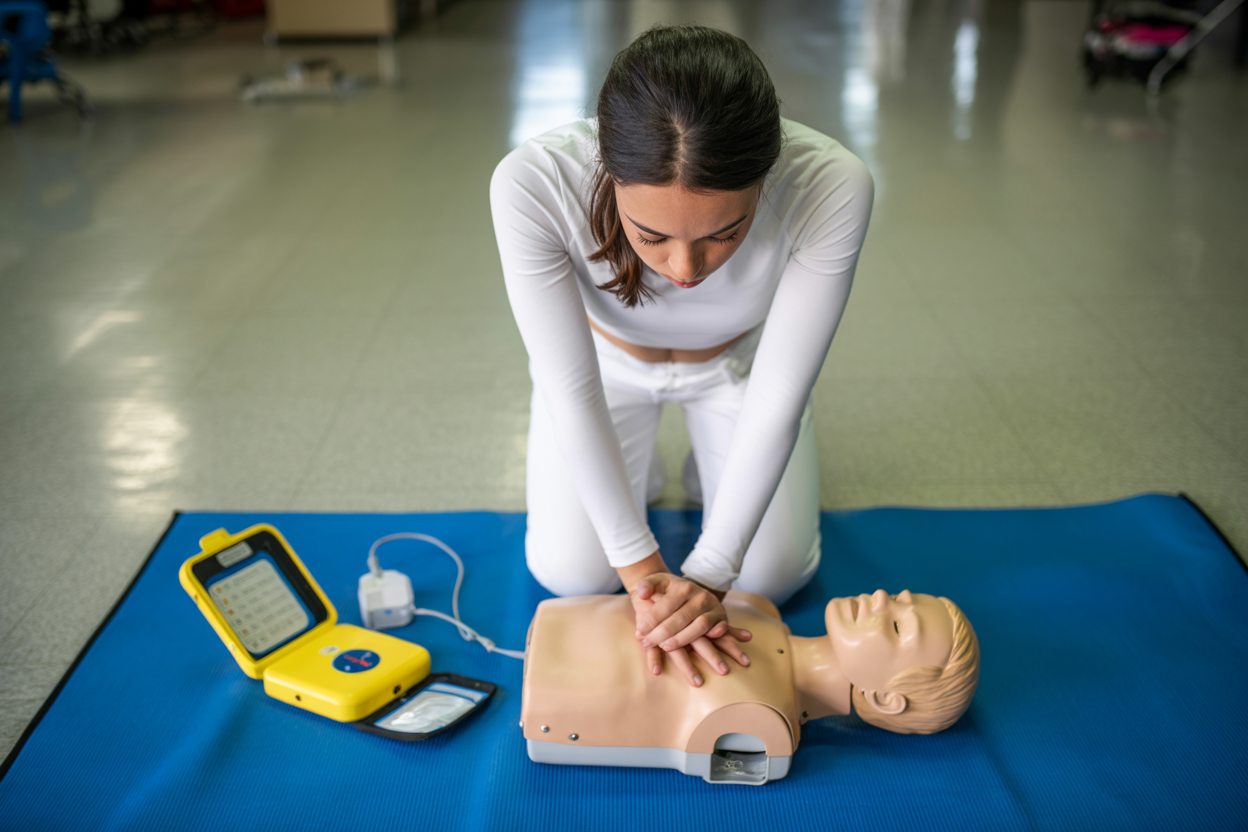
According to the Australian Resuscitation Council, bystander CPR more than doubles a cardiac arrest victim's chance of survival. Double. And yet only 1 in 2 Australians feel confident they could actually do it.
Proper training closes that gap.
When to Start CPR and Why Hesitation Is the Biggest Risk
If someone is unresponsive and not breathing normally start CPR. Don't wait for a pulse check. Don't wait to see if they come around. The moment you recognise cardiac arrest, call 000, put the phone on speaker, and start compressions. The 000 operator will talk you through it.
The Compression-to-Breath Ratio Every Parent Must Know
30 compressions : 2 rescue breaths. Repeat.
For an adult: place the heel of one hand on the centre of the chest, place your other hand on top, push down hard about 5 centimetres at a rate of 100 to 120 compressions per minute. That's roughly the beat of Stayin' Alive by the Bee Gees, which sounds ridiculous but is genuinely how instructors teach it.
Push hard. Push fast. Let the chest fully recoil between compressions. And don't stop.
If you're not trained or not comfortable giving rescue breaths compression-only CPR is supported by the ARC for untrained bystanders. Continuous hard compressions without rescue breaths still gives the person a meaningful chance. Do something.
Child CPR vs Adult CPR: The Key Differences
The rate is the same across all ages. The depth and force adjust. Infants are small — two fingers on the centre of the chest, 4 centimetres down, same speed.
Using a Defibrillator (AED): It's Easier Than You Think
AEDs are voice-guided. You turn it on and it tells you exactly what to do, step by step. It will not deliver a shock unless it detects a shockable rhythm — so you literally cannot accidentally shock someone who doesn't need it. Most shopping centres, sporting clubs, schools, and community facilities have them. The machine does the analysis. Your job is to attach the pads, stand clear when prompted, and keep doing CPR between shock cycles.
💬 "Bystander CPR more than doubles survival odds. Every parent can learn it with proper training."
Anaphylaxis: The Emergency Every Queensland Parent Needs to Understand
Anaphylaxis hospitalisations in Australia have doubled over the past 20 years, according to the Australian Institute of Health and Welfare. And in Queensland — with its outdoor lifestyle, backyard BBQs, beach days, and sporting ovals — insect stings and food allergens are everywhere.
The thing is, anaphylaxis doesn't always look like what you'd expect. And by the time it does, you might already be behind.
How to Recognise Anaphylaxis (Before It Becomes Life-Threatening)
Hives on their own are not anaphylaxis. A rash, some redness, a bit of itching after eating something — that's an allergic reaction worth watching closely. But it's not the same thing.
Anaphylaxis is what happens when that reaction goes systemic. The signs that tell you this has become a life-threatening emergency are:
Difficulty breathing or noisy breathing
Throat tightness or swelling — the person might say it feels like something is closing
Sudden drop in blood pressure — pale skin, going limp, collapsing
A child who becomes floppy or loses consciousness
Vomiting combined with any of the above
When you see those signs — you don't wait to see if it settles. You act.
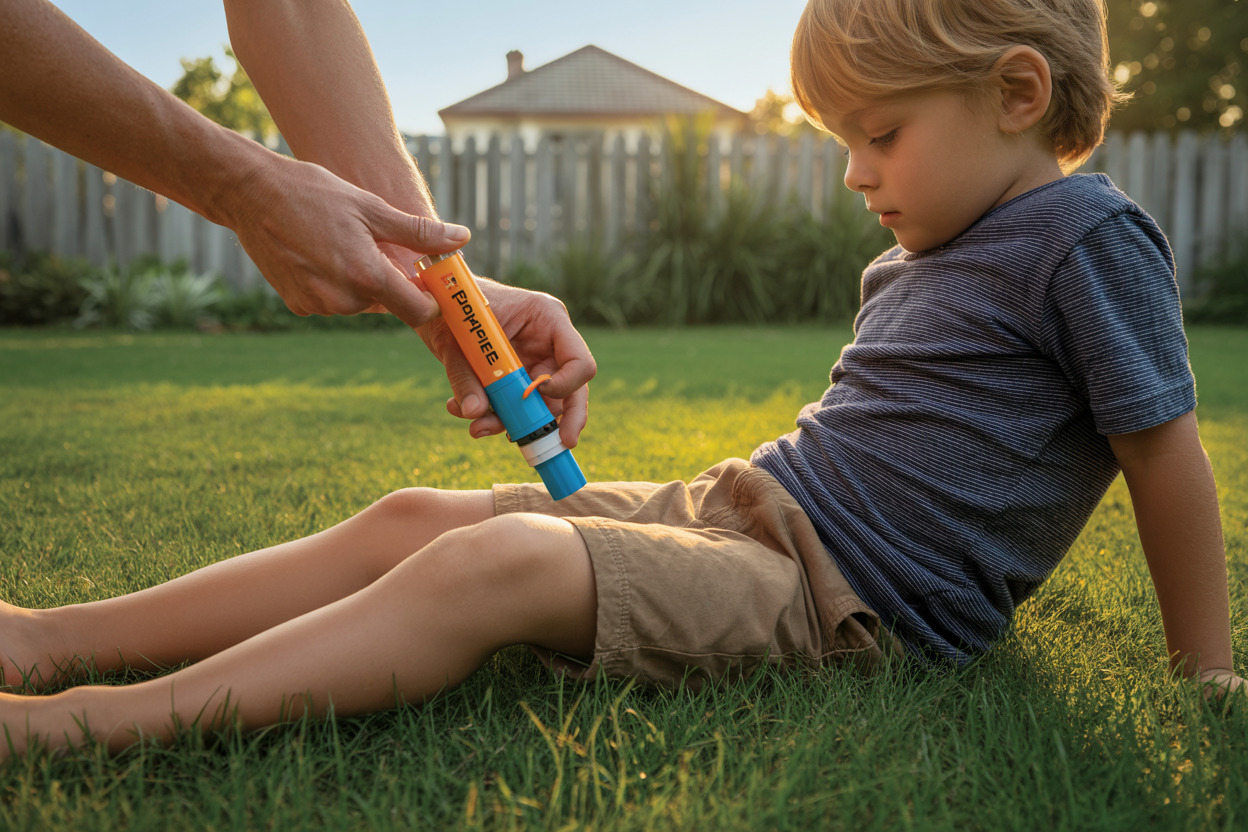
How to Use an EpiPen: The Four Steps
The ASCIA (Australasian Society of Clinical Immunology and Allergy) four-step protocol is what every parent needs to know:
Blue to the sky — remove the blue safety cap
Orange to the thigh — press the orange tip firmly against the outer mid-thigh; it can go through clothing
Hold for 10 seconds — keep firm pressure until you hear or feel the click
Call 000 immediately — then lay the person flat; do not let them sit up or stand
One of the most common and dangerous mistakes parents make is reaching for an antihistamine first. Antihistamines do not treat anaphylaxis. The EpiPen goes in first. Then 000. Then you stay with them.
What to Do After You Give the Injection
The injection buys time. It is not a cure. Lay the person flat and do not let them stand up, even if they say they feel better. A biphasic reaction means symptoms can return hours later, even after the EpiPen has worked. Hospital observation is non-negotiable.
If your child has a known allergy, the ASCIA Action Plan is something every carer and family member should have. Download it from allergy.org.au.
Severe Bleeding: How to Control It While Waiting for an Ambulance
Kitchen accidents. Backyard injuries. A bad fall at Saturday morning footy. Severe bleeding doesn't announce itself and when it happens, most people panic and wait for someone more qualified.
Nobody more qualified is coming. You're it.
How to Tell If Bleeding Is Serious
Minor cuts bleed a clean cloth and some pressure sorts them out. Arterial bleeding is different. The blood is bright red, coming fast, possibly spurting with each heartbeat. If you're looking at a wound thinking this is a lot it probably is. Call 000 and start controlling the bleeding at the same time. Don't choose between the two.
Direct Pressure Doing It Properly
Use whatever you have a clean cloth, a tea towel, a folded t-shirt. Press firmly against the wound and push down hard. Harder than feels comfortable.
Don't lift the dressing to check. If blood soaks through, add another layer on top and keep pressing. Removing the dressing disturbs the clotting process. If the wound is on a limb with nothing embedded elevate it above heart level while maintaining pressure.
Tourniquets When and How
In a limb wound with uncontrolled arterial bleeding, a tourniquet isn't a last resort — it's the right tool. An improvised tourniquet tied above the wound and tightened until the bleeding stops is a legitimate life-saving measure. Note the exact time you applied it and tell the paramedics when they arrive.
Burns First Aid The One Rule That Saves Skin
Hot drinks are the number one cause of burns in young children in Australia. Not house fires. A cup of tea on the edge of the coffee table. A bowl of pasta pulled down from the bench. A moment of curiosity and a second of bad timing.
Burns happen fast. The damage that follows happens slower — and that's the part you can influence.
Call 000 immediately if the burn is larger than the patient's palm, on the face, hands, feet, or across a joint, caused by a chemical or electrical source, or if the person burned is a child under 5. When in doubt, call.
The 20-Minute Rule Why It Matters
Cool running water. 20 full minutes. Start immediately — before you call anyone, before you look for a dressing. Burn damage keeps progressing into deeper skin layers after the heat source is removed. Cool water stops that. Even a short delay reduces how effective it is.
Lukewarm from the tap is exactly right. Not ice water. Not a cold shower. Set a timer — 20 minutes feels long when you're standing there.
What Never to Put on a Burn
Ice — causes further tissue damage
Butter or oil — traps heat and creates infection risk
Toothpaste — a persistent myth that introduces bacteria
Popping blisters — blisters are the body's own sterile dressing; leave them alone
After the 20 minutes, cover loosely with cling wrap. Remove any jewellery near the burn before swelling starts.
Unconscious but Breathing The Recovery Position Every Parent Must Know
Someone collapsing without warning is one of the most disorienting things a parent can witness. Your brain wants to shake them, sit them up, get them water — and most of those instincts are wrong.
How to Tell If Someone Is Unconscious
The DRSABCD framework is the mental checklist first aid instructors teach — worth knowing in plain English.
D — Danger: Is it safe to approach? Don't become a second patient.
R — Response: Squeeze their shoulders, call their name loudly.
S — Send for help: Call 000 or direct someone specific — "You, in the blue shirt, call 000 now."
A — Airway: Tilt the head back gently to open the airway.
B — Breathing: Look, listen, and feel for normal breathing for up to 10 seconds.
C — CPR: If they're not breathing normally — start immediately.
D — Defibrillation: Attach an AED as soon as one is available.
How to Put Someone in the Recovery Position
Kneel beside them and straighten their legs
Place the arm nearest to you at a right angle to the body, elbow bent, palm facing up
Bring their far arm across their chest, back of their hand against their near cheek
Pull up their far knee so the foot is flat on the floor
Pull on the bent knee to roll them gently toward you onto their side
Tilt the head back slightly to keep the airway open
Adjust the top knee so hip and knee are at right angles
Stay with them. Keep monitoring their breathing. Do not leave an unconscious person alone.
When to Start CPR Instead
Unconscious and breathing recovery position. Unconscious and not breathing normally roll them onto their back and start CPR immediately. The breathing check tells you which scenario you're in. If breathing stops at any point, start compressions. Unconsciousness is always a 000 call.
First Aid Situations Unique to Brisbane and Gold Coast Families
The six skills above apply everywhere. But raising a family in Southeast Queensland — beach weekends, backyard pools, summer sport, bushland walks — means some specific scenarios are worth knowing about.
Pool and water emergencies are a reality for a huge number of Queensland families. If someone is pulled from the water, regardless of how long they've been under, remove them, call 000, and begin CPR immediately. Don't wait for signs of breathing. Keep going until paramedics arrive.
Beach emergencies have their own considerations. The Australian Resuscitation Council no longer recommends vinegar for bluebottle stings — hot water immersion is now the approach. Know the difference between a local reaction and a systemic one. Breathing difficulty or throat tightness after a sting is a 000 call, not a wait-and-see situation.
Heat exhaustion and heat stroke are genuine Queensland risks. Heat exhaustion — heavy sweating, weakness, cool pale skin — responds to shade, wet cloths, and fluids. Heat stroke — confusion, absence of sweating, hot dry skin — is a 000 call. Cool them aggressively while you wait. Whether you're at Burleigh Heads, Carindale, or North Lakes, Queensland summers demand every family knows the difference.
Insect sting reactions catch families off guard because most stings are unremarkable. But a bee, wasp, or jack jumper ant sting can trigger anaphylaxis in someone with an undiagnosed allergy. Normal local swelling stays around the sting site. A systemic reaction spreads and affects breathing. Local: monitor. Systemic: EpiPen and 000.
Ready to Stop Worrying and Start Knowing?
Reading about these skills is a start. But there's a gap between reading a step-by-step guide and being able to do it calmly, correctly when your hands are shaking and someone you love is on the floor in front of you.
That gap only closes with practice.
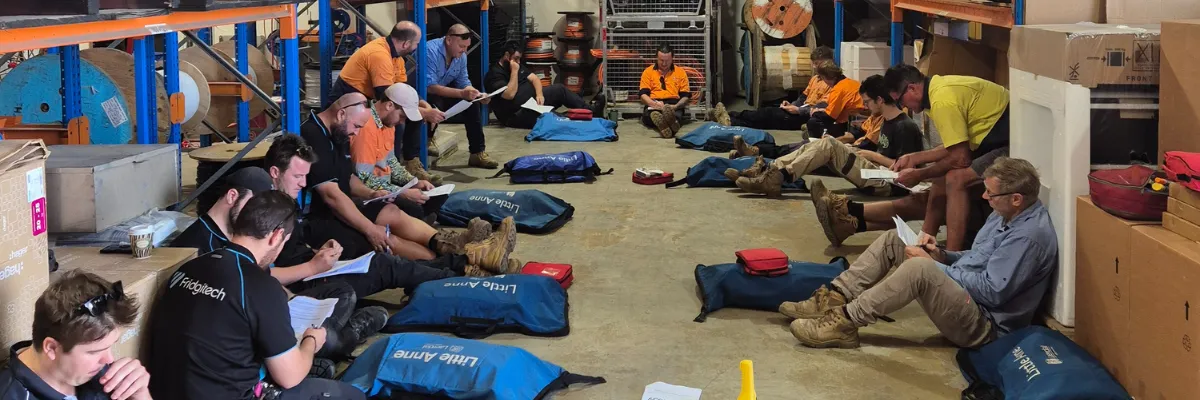
HLTAID011 First Aid course is a practical, hands-on course designed for everyday parents — not healthcare workers. You'll practise every skill in this article on a manikin, with a qualified instructor beside you. All of it, hands-on, until it feels like something you can actually do rather than something you once read about.
You don't need a medical degree. You don't need prior experience. You just need to show up.