Training for Childcare Workers Australia: Are You Compliant?
You've completed HLTAID012. Your director ticked the box. But if an ACECQA auditor walked into your centre tomorrow and asked to see your asthma and anaphylaxis certificates, would you actually pass?
For childcare educators across Australia, this is not a hypothetical. It happens. And when it does, the most common discovery is that HLTAID012 does not satisfy the separate regulatory requirement for asthma and anaphylaxis training under the Education and Care Services National Regulations 2011.
Think about that for a second. You've done the training. You sat through it. Maybe you even covered anaphylaxis content in that session. But if the certificate in your file doesn't show the right course codes, it doesn't count, not at audit, and not under the law.
That requirement sits in Regulations 136 and 137. It calls specifically for 22300VIC (anaphylaxis management) and 22556VIC (asthma management). Two separate course codes. Both required. Neither covered by HLTAID012 alone.
This gap isn't because educators are careless. Its because directors often book the one course they know, assume it covers everything, and nobody checks until an auditor does. In this article, you'll learn exactly what training for childcare workers in Australia requires, why the HLTAID012 gap catches so many educators off guard, what ACECQA auditors actually look for, and how to get correctly coded certificates that hold up when it counts.
What Training Do Childcare Workers Need in Australia?
Childcare workers in Australia are required to hold the following nationally recognized training to meet ACECQA compliance standards under the Education and Care Services National Regulations 2011:
HLTAID012 — Provide First Aid in an Education and Care Setting (includes CPR; valid 3 years)
22300VIC — Provide an Emergency First Aid Response for Anaphylaxis (valid 3 years; satisfies ACECQA Regulation 136)
22556VIC — Provide an Emergency First Aid Response for Asthma (valid 3 years; satisfies ACECQA Regulation 137)
All three certifications must appear on your training record with the correct course codes. HLTAID012 alone does not satisfy Regulations 136 and 137. Certificates must be issued by a nationally recognized RTO and include a practical component to be accepted at audit.
The Three Certifications Every Childcare Worker in Australia Actually Needs
HLTAID012: What It Covers and What It Doesn't
HLTAID012 is the foundational first aid unit for childcare workers. It covers CPR, basic emergency response, and first aid management in an early childhood context. Its valid for three years and requires a practical component.
What it doesn't do is satisfy Regulations 136 and 137.
HLTAID012 may touch on anaphylaxis and asthma as part of broader first aid content. But covering content in a session is not the same thing as issuing a compliant certificate. When an ACECQA auditor reviews your training records, they are not asking what happened in the room. They are looking at the course codes printed on the certificate. If 22300VIC and 22556VIC aren't there, the training doesn't satisfy the regulation, full stop.
22300VIC: The Anaphylaxis Requirement Explained
22300VIC directly satisfies Regulation 136 of the Education and Care Services National Regulations 2011. Its valid for three years from the date of issue.
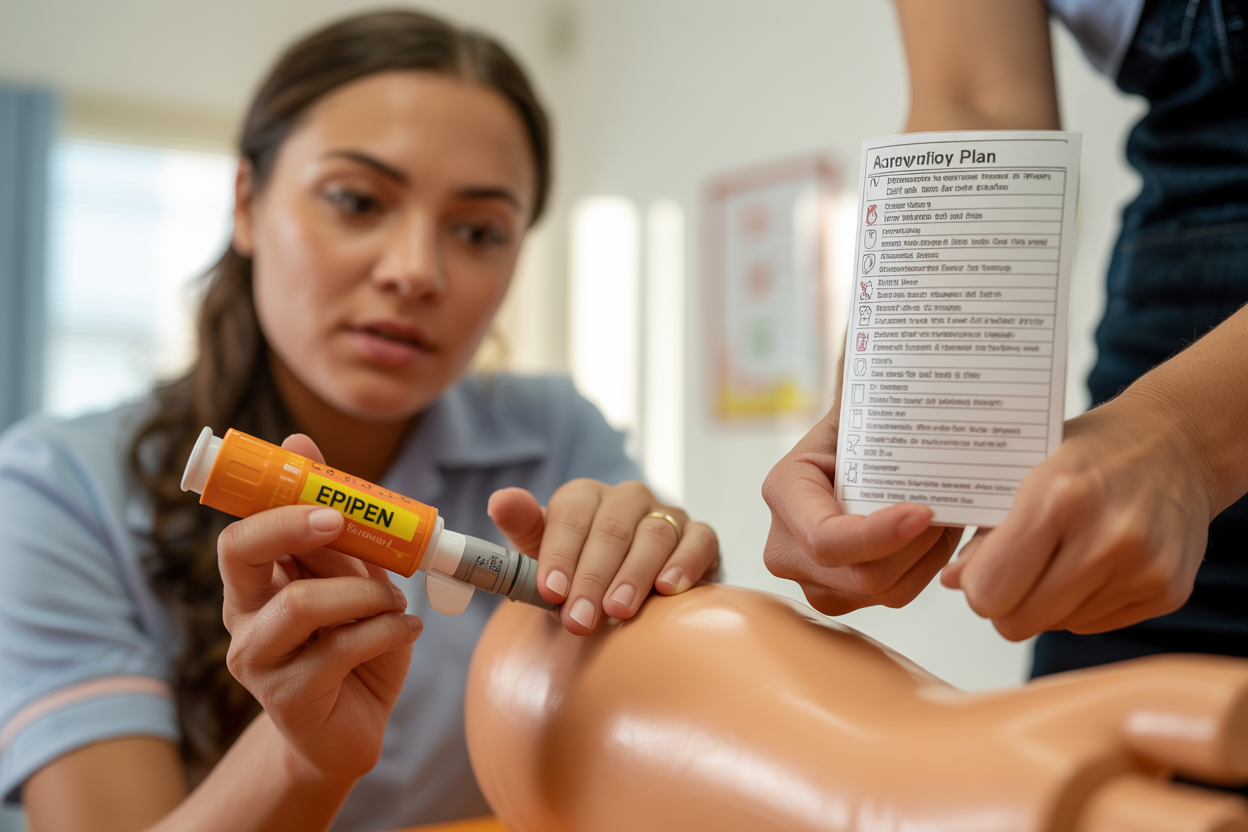
The practical component includes hands-on practice with EpiPen trainer devices, practice devices that simulate the injection without using a real EpiPen, as well as anaphylaxis action plan review and decision-making under simulated emergency conditions. Competency is assessed by a qualified trainer. You don't just watch it happen. You do it. That hands-on assessment is what makes the certificate audit-valid.
22556VIC: The Asthma Requirement Explained
22556VIC satisfies Regulation 137. Also valid for three years.
The practical component covers spacer technique, correct use of a reliever puffer, and emergency response to acute asthma. A trainer watches you demonstrate. That competency demonstration is what the certificate reflects, and its what ACECQA needs to see evidence of.
A lot of childcare workers have sat through a session where someone held up a puffer and explained how it works. That is not the same as being assessed on correct spacer technique. The difference matters, not just at audit, but in the room when a child is struggling to breathe.

Why So Many Childcare Workers Think They're Compliant, But Aren't
The HLTAID012 Misconception
Here's how it usually goes. A director books the team through HLTAID012. Everyone attends. Certificates are filed. The compliance box gets ticked. And nobody questions it, until someone in an ECE Facebook Group mentions 22300VIC, or an auditor arrives and asks to see the specific course codes.
Directors aren't making this mistake because they're negligent. They're making it because HLTAID012 is the course they know, the one that gets recommended, and the one that sounds like it should cover everything.
Many educators have sat in sessions that genuinely did cover anaphylaxis content. A trainer explained what anaphylaxis is. Someone demonstrated an EpiPen. The session felt thorough. But if the certificate that came out of that session was coded as HLTAID012 and nothing else, that training does not satisfy Regulation 136. The content was there. The course code wasn't. And the course code is what the auditor checks.
What ACECQA Auditors Actually Check
ACECQA auditors are not reviewing what happened in your training session. They are looking at the course codes printed on the certificates in your training records. The certificate is the audit evidence, not the content, not the trainer's memory, not your director's assurance that "we covered all of that."
If 22300VIC and 22556VIC are not printed on the certificate, the training doesn't count toward Regulations 136 and 137. The code has to be there. Once you understand that, you can make sure you never fall short of it again.
ACECQA Childcare Training Requirements: What the Regulations Actually Say
Regulation 136 requires that approved providers ensure at least one educator who holds current anaphylaxis management training is present at all times when children are being educated and cared for. That training must be provided by a registered training organisation and must include a practical component. Regulation 137 mirrors this exactly for asthma management. Same requirement. Same standard. Same practical component obligation.
Plain English: at least one qualified educator must be in the room at all times holding current 22300VIC and 22556VIC, not just HLTAID012, and the training that produced those certificates must have included hands-on practical assessment.
Nominated Supervisors must hold current 22300VIC and 22556VIC with no flexibility. For educators more broadly, at least one in each group must hold current certification at all times. In practice, whole-team certification is the only approach that removes audit risk entirely. Relying on one qualified educator to be present in every room during breaks, absences, and shift overlaps is a fragile position.
Both certificates are valid for three years, the ACECQA minimum. ASCIA recommends annual renewal and updated its EpiPen technique guidelines in 2024, reflecting real clinical changes to how the injection is administered. The National Asthma Council Australia has similarly updated its spacer technique guidelines. If a child in your room has a known allergy or a history of acute asthma, working from outdated techniques is a risk that annual renewal removes.
Why Online-Only Asthma and Anaphylaxis Training Won't Pass an ACECQA Audit
This one isn't a grey area. ACECQA requires a demonstrated practical component for both 22300VIC and 22556VIC. That requirement is written into the training package specifications for both units. Online-only certificates will not satisfy the requirement at audit. If a provider issued your certificate without a trainer watching you demonstrate EpiPen technique or spacer use, that certificate is non-compliant, regardless of how professional it looks in your inbox.
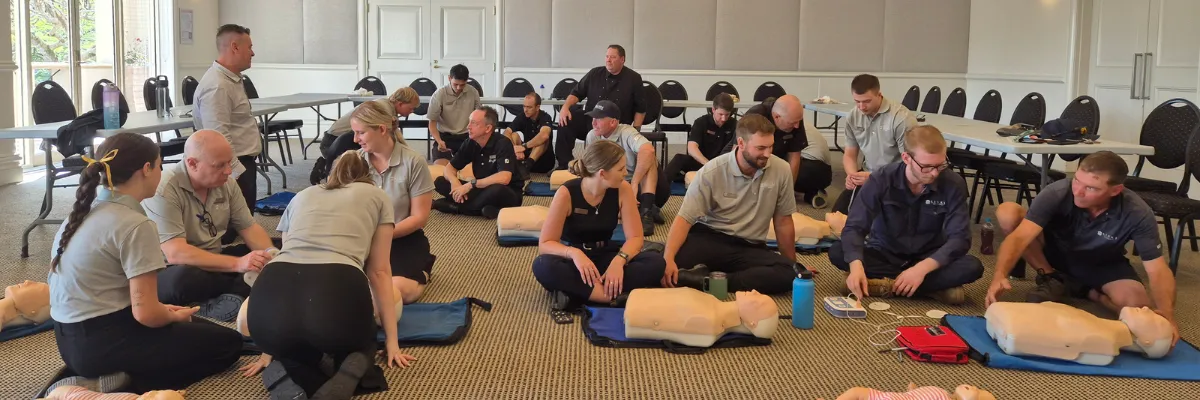
A compliant session includes hands-on practice with EpiPen trainer devices, spacer and reliever puffer technique with physical equipment, anaphylaxis action plan review under simulated emergency conditions, and competency signed off by a qualified trainer. That's what makes it audit-valid.
Before you book, watch for these signs. Online-only delivery with no in-person component, no mention of practical assessment on the course page, no RTO number on the certificate, or course descriptions that don't state 22300VIC and 22556VIC explicitly. If a provider can't tell you clearly how the practical component is delivered and assessed, that's your answer.
What to Look for in a Childcare First Aid Training Provider
The course codes on the certificate are non-negotiable. Before you book with any provider, ask directly: what course codes will appear on my certificate? The answer needs to be 22300VIC and 22556VIC printed as those exact codes. The RTO number must appear on the certificate and must be verifiable on training.gov.au. If a provider can't give you a straight answer, move on.
Same-day certificate delivery matters more than most educators realize until they've been burnt by a late one. Ask upfront when you'll receive your certificate and what course codes will appear. The answer should be the same day, in your inbox before you leave. Anything vague is worth questioning.
Flexible scheduling is the difference between booking and not booking for most childcare workers. Saturday sessions and mobile delivery to your center remove the barriers that make weekday training impossible for shift workers.
Trainer experience in early childhood settings shapes whether the training actually lands. A trainer who knows ECE environments builds scenarios around the situations childcare educators actually face. Accelerate First Aid's head trainer Jarryd Hunter brings more than 20 years of first aid training experience, a paramedic background, and more than 15 years delivering specifically into the early childhood sector.
How Accelerate First Aid Delivers 22300VIC and 22556VIC
The mobile delivery model means Jarryd comes to your workplace. Your team trains together in your own environment, without anyone having to organize travel or take leave. Individual session venues are also available for educators booking independently.
Your certificate is issued the same day, guaranteed. It carries the correct course codes, 22300VIC and 22556VIC, delivered digitally to your inbox before you leave the session. Issued under First Aid Alive RTO 31106, fully verifiable on training.gov.au. No chasing. No corrections. The certificate that arrives in your email is the one that will hold up at audit. Every course is nationally recognized across Australia and fully compliant with ACECQA Regulations 136 and 137.
Your Next Steps
You've done the hard part already. Most educators don't know the difference between HLTAID012 and 22300VIC until an auditor is standing in their center asking to see the paperwork. You know it now, and that puts you in a completely different position to act on it before it becomes a problem.
Start with your certificates. Pull them out and check whether 22300VIC and 22556VIC are printed there explicitly. If all you can see is HLTAID012, you have a gap that needs to be closed before your next ACECQA assessment.
Check your renewal dates while you're at it. Three years goes faster than it feels when you're in the middle of a busy room. If your certificates were issued more than two years ago, you're closer to lapsed than you probably realize. With ASCIA updating its EpiPen technique guidelines in 2024, there's a clinical reason to renew sooner, not just a compliance one.
If your director booked your last round of training and assumed HLTAID012 covered everything, have the conversation. Show them this article. The compliance gap is a known industry-wide problem that catches good centers off guard, and the fix is straightforward once you know what you're looking for.
For centers where multiple educators need to renew at the same time, group workplace delivery removes every logistical barrier. Accelerate First Aid comes to your center, the whole team trains together, and everyone walks away with correctly coded certificates in their inbox the same day.
For educators booking independently, Saturday sessions are available across Brisbane and the Gold Coast. You can book on your phone tonight and have your 22300VIC and 22556VIC certificates sorted this weekend. The process is built for people who are time-poor and need it done properly.
The audit doesn't give you much warning. The certificate gap doesn't fix itself. But you've read this far, you know exactly what's required, and the path from here to fully compliant is a single booking away.