Steps to Get Your Childcare First Aid Certificate
You just landed a job at a long day care center. Congrats, seriously. But there's one thing sitting between you and your first shift on the floor: a childcare first aid certificate. Without it, your director can't count you on ratio, and that means no roster spot, no matter how good you are with kids.
Here's the thing nobody tells new educators upfront. Getting certified isn't complicated, but it does have a specific order of operations, and skipping a step can cost you time you don't have before your start date.
That's exactly what this guide sorts out for you. If you've been typing "steps to get childcare first aid certificate" into Google trying to figure out where to even start, you're in the right spot. We're going to walk through eligibility, picking the right course (HLTAID012, not HLTAID011, more on that soon), what actually happens on training day, and how to get your certificate counted toward ratio, so you can walk into your first shift already sorted.
Quick Answer: The Steps to Get HLTAID012 Certified
If you're after the fast version, here it is:
Confirm HLTAID012 is the right unit for your role (not HLTAID011)
Check any center-specific requirements with your employer
Book a course that fits your ratio and rostering needs
Complete any pre-course reading, if your provider assigns it
Attend the training session and get through the practical assessments
Receive your Statement of Attainment, your digital certificate
Hand your certificate to your center director for compliance records
That's the whole shape of it. So if you're stressing about a start date creeping up, there's a good chance you can still make it happen without a mad scramble.
Why Childcare First Aid Certification Works Differently to Standard First Aid
Here's something that trips a lot of new educators up. First aid isn't just first aid. If you've done a workplace first aid course before, maybe years ago for a retail job or an office gig, you might think you're already covered. You're not, and honestly, that gap could hold up your whole onboarding if nobody flags it early.
HLTAID012 vs. HLTAID011: Which One Do You Actually Need?
This is the question that trips up almost every new hire, so let's just sort it out plainly.
If you're on the floor with kids, and let's be honest, that's most people reading this, you need HLTAID012. It's the unit built around what actually happens in a long day care center, not a generic office scenario.
What Makes It "Childcare-Specific"
A standard first aid course teaches you adult CPR and calls it a day. HLTAID012 goes further, because kids aren't just small adults, their bodies respond differently in an emergency. This unit covers:
Infant and child CPR variations (technique changes depending on age)
Choking response across age groups, from tiny infants to toddlers to older kids
Anaphylaxis and asthma management woven directly into the training, not treated as an afterthought
That last point matters more than people realize going in. If you end up working somewhere with kids on individual medical action plans, and most centers have a few, you'll want training that's actually drilled you on EpiPen use and asthma response, not just mentioned in passing. We go deeper on this in our Asthma & Anaphylaxis Management page if you want the full picture.

Step 1: Confirm Eligibility & Requirements
Before you book anything, sort out whether you're even eligible, and what your specific center expects. This step is quick, but skipping it is where most delays happen.
Age & Prerequisite Check
The good news here is HLTAID012 doesn't have formal prerequisite units you need under your belt first. There's no "you must have done X before you can do this" hurdle. If you're wondering about the minimum age requirement specifically, we've got a full breakdown in our minimum age for childcare first aid course guide, worth a look if that's your exact question.
Confirm With Your Employer First
This one's easy to skip and it shouldn't be. Every center runs onboarding a little differently. Some directors need you certified before Day 1, full stop. Others will give you a grace period while you get sorted, as long as you're not the only person meeting ratio in a room.
Either way, don't assume. Ask.
New to a center? Ask your director whether you need to be certified before Day 1.
Getting this answer early means you're not scrambling the night before your first shift trying to find a course with availability.
Step 2: Choose the Right Course & Provider
Once you've confirmed you're eligible, the next decision is who to train with. And honestly, this is where a lot of new educators get it wrong, not because they're careless, but because on the surface, one first aid course looks pretty much like another. It isn't.
What to Look For in a Provider
Before you book, run through this quick mental checklist:
RTO-registered. You want a nationally recognized Statement of Attainment, not a certificate of attendance that means nothing to your director or to ACECQA.
Childcare-specific scenario training. Infant choking drills, EpiPen practice, the stuff that actually maps to your day-to-day, not a generic corporate first aid module recycled for every industry.
On-site options. So your center isn't sending educators off-site and risking a ratio breach.
Digital certificate issuance. You shouldn't be waiting weeks for paperwork when your director needs proof for compliance records now.
Booking Logistics for Centre Directors & New Educators
If you're a director trying to get multiple new hires certified without shutting a room down, on-site training is usually the better play compared to sending everyone off to a training center. Staggered scheduling means you're never left short-staffed and scrambling to cover ratio for the day.
Book a ratio-safe session that won't disrupt your floor coverage.
Step 3: What Happens on Training Day
With your course booked, here's exactly what to expect on the day, because walking in without knowing the shape of it just adds unnecessary nerves.
Course Format
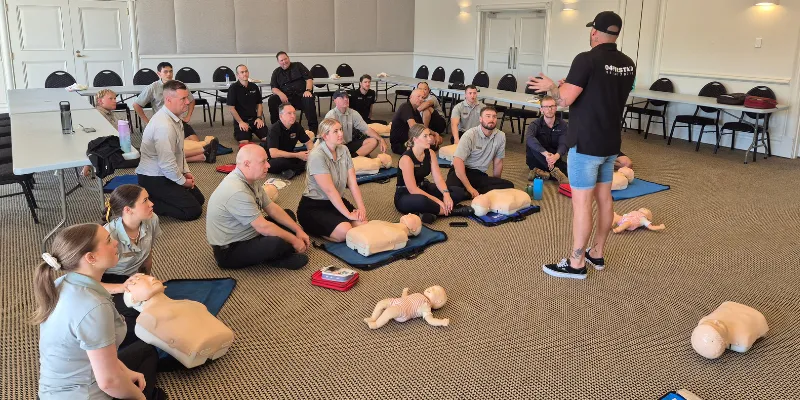
HLTAID012 is a mix of classroom-style theory and hands-on practical assessment. You're not sitting through slide after slide. Expect to be up, moving, and practicing on mannequins for a decent chunk of the session.
What You'll Practice
This is the part that actually matters once you're on the floor. You'll get hands-on time with:
Infant and child CPR
Choking response across age groups
EpiPen and anaphylaxis response
Asthma attack management
Basic wound care and emergency response documentation
That last one, documentation, sounds boring but it's not nothing. Knowing how to correctly log an incident is part of what keeps a center compliant and keeps you covered too if something ever goes wrong.
Pre-Course Preparation Tips
A few practical things to sort out before you show up:
What to wear. Practical, comfortable clothing. You'll be on the floor doing CPR practice, not sitting at a desk, so leave the office wear at home.
What to bring. ID, and any pre-course reading if your provider assigned it.
What not to worry about. Nerves. Genuinely, everyone feels a bit off before a practical assessment like this, and that's normal. The whole point of the day is to walk out feeling calm and capable, not to catch you out. Good trainers know that and build the session around helping you get there, not testing you like it's exam day.

Step 4: Receiving & Using Your Certificate
Training's done, now here's how to make sure it actually counts.
Digital Certificate & Statement of Attainment
Once your course is complete, you should receive your Statement of Attainment. Quick plain-language note here, a Statement of Attainment is your official proof that you've completed the unit of competency, HLTAID012, and it's what your director needs on file, it's not just a "certificate of attendance" style document with no real weight behind it.
Giving Your Certificate to Your Centre Director
Don't just file this away yourself and forget about it. Get a copy straight to your director so they can:
Add it to your staff file
Log your expiry date for compliance tracking
Count you toward ratio immediately
That last point is the whole reason you did this. Once your certificate is logged, you're counted, and you can actually be rostered on properly instead of hovering as a not-quite-compliant new hire.
Certificate Validity & What's Next
Your certificate isn't good forever, there's a validity window before you'll need to look at renewal or requalification. We won't go deep into the specifics here since we've covered that in full in our HLTAID012 validity duration guide, and if you're an existing educator renewing rather than a brand-new hire, our Childcare First Aid Requalification guide is the better read for you.
Get Certified, Get Counted
You don't need to overthink this. Confirm you're eligible, check with your director about any grace period, book a session that fits your roster instead of shutting your center down, and walk in ready to be counted from your very first shift.
Book Your HLTAID012 Course Today
Starting a new role in early childhood education comes with a fair bit to sort out, and first aid certification is one of the few things that genuinely can't wait. The good news is it doesn't have to be complicated once you know the order to tackle it in.
Every educator who's sat through this process before you felt some version of the same nerves walking in. Most walked out surprised by how manageable it actually was, and more than a little proud of the fact that they now know exactly what to do if a child in their care needs them.
That confidence doesn't come from the piece of paper itself. It comes from the practice, the mannequins, the EpiPen drills, the moments where a trainer walks you through a scenario until it stops feeling foreign and starts feeling like something you'd actually know how to do under pressure.
New faces are joining childcare teams all the time. Getting certified quickly and properly isn't just a box to tick, it's what lets a director trust you on the floor and lets you trust yourself in the moment it counts.
Confirm you're eligible, book a session that works around your roster, and walk away certified. That's the whole process, start to finish.