
Short Course Electrical Safety Australia: What's Included?
Someone on your crew needs electrical safety training. You've searched "short course electrical safety Australia" and now you're staring at a list of providers, unit codes, and acronyms wondering which one actually applies to your business - and whether the course will hold up if SafeWork QLD comes knocking.
You're not alone. For operations managers, site supervisors, and business owners in Australia's trades and construction sector, electrical safety training is one of the most commonly misunderstood compliance requirements in the WH&S space. The problem isn't a lack of options - it's that there are too many, and the wrong choice can cost you twice.
This article cuts through the confusion. You'll find out exactly what a short course in electrical safety covers in Australia, which nationally recognized units are involved, who legally needs to complete them, and how to get your team trained without unnecessary disruption.
What Is Included in a Short Course in Electrical Safety in Australia?
A short course in electrical safety in Australia is a nationally recognized, accredited training program that teaches workers how to identify, manage, and respond to electrical hazards in the workplace. Delivered by registered training organisations (RTOs), these courses cover:
Australian WH&S laws and regulations - your legal duties under the Work Health and Safety Act 2011
Electrical hazard identification - recognizing live equipment, overhead lines, and unsafe installations
Risk assessment and control measures - applying the hierarchy of controls to electrical risks
Safe work procedures - permit-to-work systems, isolation procedures, and lockout/tagout
Emergency response - what to do if an electrical incident occurs on site
Relevant unit of competency - typically UEECD0007 or UETDRRF004 depending on the role
Why Electrical Safety Training Is a Legal Requirement in Australia
Electrical safety training isn't a nice-to-have. It's a legal obligation. And "I didn't know" is not a defense that holds up in front of a SafeWork QLD inspector.
What the Work Health and Safety Act 2011 (Qld) Says
Section 19 of the Work Health and Safety Act 2011 (Qld) sets out the primary duty of care for a Person Conducting a Business or Undertaking - a PCBU. If you run a business or employ workers in Queensland, that's you.
Under Section 19, a PCBU must provide "information, training, instruction or supervision" necessary to protect workers from health and safety risks. That language is not optional. It's a statutory obligation that applies regardless of whether an incident has occurred.
The Safe Work Australia model WH&S Regulations add further specificity around training for workers exposed to electrical hazards. Between the two, the message is consistent: untrained workers near electrical risks are your legal problem.
The Duty of Care That Falls on You as a PCBU
If you conduct a business, employ workers, or engage contractors - you're a PCBU. The primary duty of care under the WH&S Act 2011 (Qld) falls on your shoulders.
This duty is proactive, not reactive. You don't wait for someone to get hurt and then ask whether training was adequate. The obligation exists before anything goes wrong - and it means documenting that workers have completed appropriate training and being able to produce that documentation on request.
What SafeWork Queensland Can Do If Your Team Isn't Trained
SafeWork Queensland has real enforcement teeth. An inspector can arrive unannounced, request training records, and if those records aren't in order, issue:
Improvement notices - requiring rectification within a specified timeframe
Prohibition notices - stopping work immediately until the issue is resolved
Monetary penalties - significant fines for individuals and body corporates
Training records are your legal evidence of due diligence. Without them, you're exposed. Don't wait for an inspector to find out your team isn't covered.
Which Short Course in Electrical Safety Do You Actually Need?
This is where most businesses get it wrong. They book a course, get the certificates, and find out six months later the unit code doesn't match what their licensing body or construction client asked for. Rebook. Explain it to the crew. Getting clear on the right unit before you book saves you all of that.
UEECD0007 - Apply WH&S Regulations, Codes and Practices in the Workplace
UEECD0007 is the foundational electrical safety unit for most workers in trades, construction, and site-based roles who aren't licensed electricians working on live panels.
Who needs it:
Electrical workers and apprentices in Queensland
Construction and site workers with exposure to electrical hazards
New managers and supervisors stepping into a safety oversight role
Workers entering the Low Voltage Rescue (UETDRRF004) pathway - UEECD0007 is often a co-requisite
UETDRRF004 - Perform Rescue from a Live LV Panel (Low Voltage Rescue)
UETDRRF004 - commonly called Low Voltage Rescue or LVR - is for workers who operate on or near live low voltage panels, switchboards, or electrical infrastructure.
Who needs it:
Licensed electricians on construction sites in Queensland
Switchboard workers and electrical contractors
Any worker whose role brings them near live LV panels
What's different: It carries an annual renewal requirement. Miss the window and the certificate lapses - your worker is no longer legally covered for that scope of work. The Electrical Safety Office Queensland takes this seriously, and so should you.
When You Need Both Units
For some roles, UEECD0007 alone isn't enough. UEECD0007 is often a co-requisite or embedded component of the LVR pathway - UEECD0007 first, then UETDRRF004. A registered RTO can often deliver both in a single combined session.
Roles that typically require both:
Licensed electricians working on construction sites
Switchboard and panel workers
Electrical contractors whose clients require documentation of both units
How to Know Which Unit Applies to You
Electrical Safety Office (ESO) Queensland - check the licensing pathway for your workers' license class
NECA requirements - your apprenticeship network will specify which units are required
Tender and contract documentation - construction clients are increasingly specific about unit codes; check the tender requirements directly
Still unsure? Call us and we'll confirm the right unit for your industry at no cost
What Does a Short Electrical Safety Course Actually Cover?
Nobody wants to pull workers off a job for slides being read aloud by someone who's never been on a construction site. Here's exactly what your team will go through.
Module 1 - Australian Electrical Safety Laws and Your Obligations
Workers learn the key duties under the Work Health and Safety Act 2011 (Qld) that apply directly to them on site. By the end, your team understands their individual legal responsibilities - not just yours as the employer. A worker who understands their own duty of care behaves differently on site than one who thinks safety is management's problem.
Module 2 - Identifying Electrical Hazards on Site
Workers learn to recognize electrical hazards before they become incidents - damaged wiring, live equipment that isn't labelled, overhead lines in the path of machinery, unsafe installations. Training uses real-world worksite scenarios your crew will recognize. Workers leave knowing what to look for, not just that hazards exist.
Module 3 - Risk Assessment and the Hierarchy of Controls
Workers learn to apply the hierarchy of controls to electrical risks in the correct order: elimination, substitution, engineering controls, administrative controls, and PPE last. Skipping straight to PPE is one of the most common mistakes on Australian worksites - this module fixes that.
Module 4 - Safe Work Procedures (Isolation, Lockout/Tagout, Permits)
Your team will learn:
Isolation procedures - how to safely isolate electrical equipment before work begins
Lockout/tagout requirements - securing isolated equipment so it can't be re-energized during work
Permit-to-work systems - what they are, when they're required, and who issues them
Workers leave knowing the process - not just that a process exists.
Module 5 - Emergency Response to Electrical Incidents
Workers learn what to do if an electrical incident, shock, or fire occurs on site - how to respond without putting themselves at risk, how to call for help, and what not to do in those first critical seconds. The instinct to reach for someone who's been electrocuted is exactly the wrong move.
This module connects directly to CPR and first aid capability. If your team hasn't completed HLTAID009 (CPR) or HLTAID011 (First Aid), this is a natural point to address that gap.
What Participants Walk Away With
Workers receive a nationally recognized statement of attainment - accepted by SafeWork QLD, the Electrical Safety Office Queensland, and major construction clients across Australia.
Certificate valid across Australia - not just Queensland, not just one client's requirements
Issued - upon successful completion
Assessment format: no surprise formal exams

How to Get Your Team Trained Without Disrupting Your Operation
The training itself usually isn't the hard part. The hard part is logistics.
Individual Enrolments vs Group Bookings
With a public course, workers travel to a training center and join a mixed cohort from different industries. It works for one or two workers who need to upskill individually.
With a group booking, a trainer delivers the session specifically for your team. Everyone is in the same environment, examples land better, questions are more relevant, and the training sticks. Your team trains together, your safety culture develops together, and it gets done in one hit instead of sending workers off over several weeks.
On-Site Delivery - How It Works
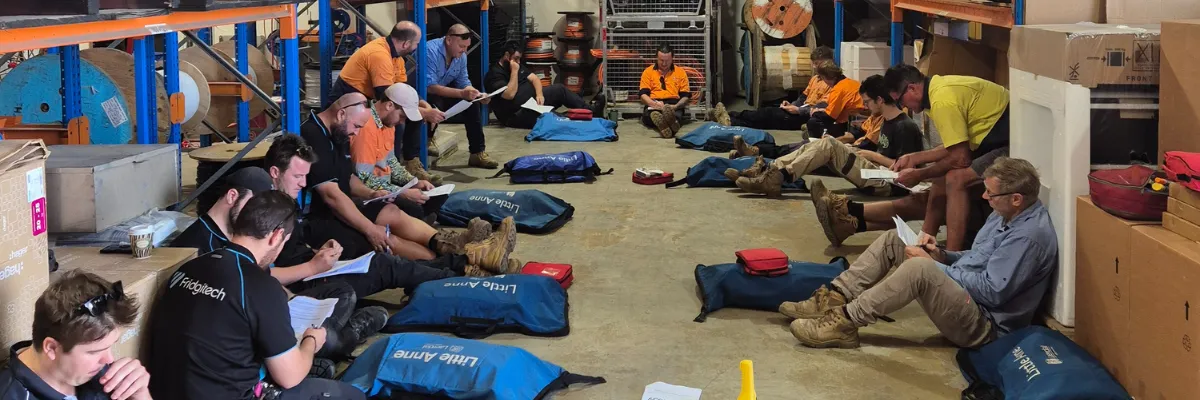
A trainer comes to your workplace. Your workers don't travel. Your operation stays as close to normal as possible.
What you need to provide:
Adequate space - a lunchroom, site office, or undercover outdoor area all work
Any site-specific hazard information so the trainer can contextualize the session
That's it. Where possible, training is contextualized to your actual worksite - the equipment your team uses, the hazards in your environment. A generic training center can't replicate that.
How to Choose an RTO for Electrical Safety Training
Booking with the wrong provider means your workers hold a certificate that won't satisfy your licensing body, client, or SafeWork QLD. You're back to square one.
Check Registration Status First
Not every provider delivering "electrical safety courses" is a registered RTO. Some aren't registered with ASQA at all. Others are registered but don't have UEECD0007 or UETDRRF004 on their scope - meaning they can't issue a nationally recognized certificate for those units.
Go to training.gov.au:
Search the provider name or RTO number
Open their scope of registration
Confirm the specific unit codes are listed - not just "electrical safety" generally
What Else to Look For
Google reviews from trades and construction businesses - not just generic ratings, but from people in the same situation as you
Trainer qualifications - Certificate IV in Training and Assessment (TAE40116 or equivalent)
Same-day certificate issuance - workers need documentation now, not in three weeks
On-site delivery capability - not all providers offer it; confirm upfront
Red Flags That Tell You to Walk Away
No RTO number displayed on the website
Vague course descriptions with no unit codes listed
Certificates issued weeks after training
Can't answer questions about their scope of registration
Ready to Get Your Team Trained?
Electrical safety training in Australia isn't complicated - but getting it wrong is expensive. The wrong unit code, the wrong provider, or a certificate that can't be verified on training.gov.au can leave your business exposed to the exact risks you were trying to eliminate.
A short course in electrical safety doesn't have to disrupt your operation. Whether your workers need UEECD0007, UETDRRF004, or both - on-site group delivery means you get it done with minimal disruption and walk away with documentation that holds up.
What separates compliant businesses from those that get caught out isn't budget or size. It's whether someone confirmed exactly what was required, booked with a provider they could verify, and got it done before a SafeWork QLD inspector or tender deadline made the decision for them.
The only step left is acting on it - because the WH&S Act 2011 (Qld) doesn't make allowances for businesses that understood their obligations but got around to it eventually.