
Safety Course, No Experience Needed Get Started Today
Craig had a new apprentice starting Monday. Sixteen years old, first job, hadn't so much as held a multimeter yet, and Craig's phone was already buzzing with one question from the kid's mum: "does he need to know anything before this WHS course, or is he going to sit there lost the whole time?"
Fair question. And it's one Craig gets a version of every time he brings someone new onto the crew, whether it's a fresh-faced apprentice, a labourer switching over from another industry, or someone who's never set foot on a construction site in their life.
Here's the short answer: no, they don't need to know anything. UEECD0007 is built for people who are starting from zero. No license, no trade background, no prior safety training, none of it. Walk in knowing nothing about site safety, walk out with a certificate.
This article breaks down exactly what "no experience needed" actually means, who the course suits, what happens on the day, and how to get a new starter booked in fast.
Do You Need Experience to Do a Safety Course?
No. UEECD0007 doesn't require any prior WH&S training, electrical license, trade qualification, or site experience. It's built as a genuine starting point, not a refresher for people who've already done safety training somewhere else. You don't need to have studied anything beforehand either.
What you don't need:
Prior WH&S or safety training of any kind
An electrical licence or trade qualification
Site or industry experience
Any pre-course study or reading
What you do need:
Basic English literacy (enough to follow written and spoken instruction)
Valid photo ID
To attend and take part in the whole session
That's it. If a new starter can tick those three boxes, they're eligible.
What "No Experience Needed" Actually Means for UEECD0007
There's a difference between a safety course that's technically open to beginners and one that's actually built for them. UEECD0007 is the second kind.
Built for First-Timers, Not Just Refreshers
A lot of WHS-style courses out there are really designed for people topping up or renewing something they already hold. You sit through content that half-assumes you already know the basics, and you're playing catch-up from the start. UEECD0007 isn't that. It starts from the assumption that you know nothing about workplace health and safety on a construction or electrical site, and it builds from there. If your new starter has never heard the term "safe work method statement" in their life, that's fine. That's exactly who this is for.
No Electrical License or Trade Background Required
You don't need to be a licensed electrician, an apprentice partway through their ticket, or even someone who's worked a trade before. Labourers, general hands, career-changers, none of them need a trade background to sit this course and pass it.
Worth being upfront about one thing though: "no experience to attend" and "no experience to pass" aren't quite the same statement. You don't need experience to walk in the door. You do still need to pay attention and demonstrate you've understood the content to get certified. Nobody's handing out certificates just for showing up. More on how that assessment works a bit further down.
Not sure exactly what your new starter needs before they're allowed on-site? Our Safety Course Prerequisites page breaks down every requirement in one place.

Who This Is Actually For
"No experience needed" is a broad statement, so let's get specific about who actually walks through the door for this one.
New Apprentices and First-Year Trade Starters
This is the most common one Craig deals with. A new apprentice signs on, and before they're allowed anywhere near a live site, someone needs to confirm they understand the basics of workplace safety. First-year apprentices make up a big chunk of who sits this course, and it's usually their very first formal safety training of any kind.
Labourers and General Site Hands
Not everyone on a site is a tradie or an apprentice. General labourers and site hands need the same WHS grounding, even if they're not the ones doing the electrical work. If anything, they need it more, since they're often moving around a site with less direct supervision than someone paired with a licensed tradesperson.
Career-Changers Entering the Trades
People switching into the trades from a completely different industry, retail, hospitality, office work, wherever, often carry a bit of nervous energy into their first safety course. They're used to a different kind of workplace, and site safety can feel like a foreign language at first. That's normal, and it's exactly what this course is designed to sort out.
One distinction worth making here: this course is for people doing this for the first time. If someone on your crew already holds current WHS competency and just needs it renewed, that's a different path with different content. Check our renewal guide instead of booking them into this one by mistake.
Got a mixed group of new starters and renewals to book? Our team can help you work out who fits where, get in touch to check the fit before you book.
What a First-Timer Should Expect on the Day
Knowing what's actually going to happen tends to settle nerves faster than anything else. So here's the rundown.
Course Format
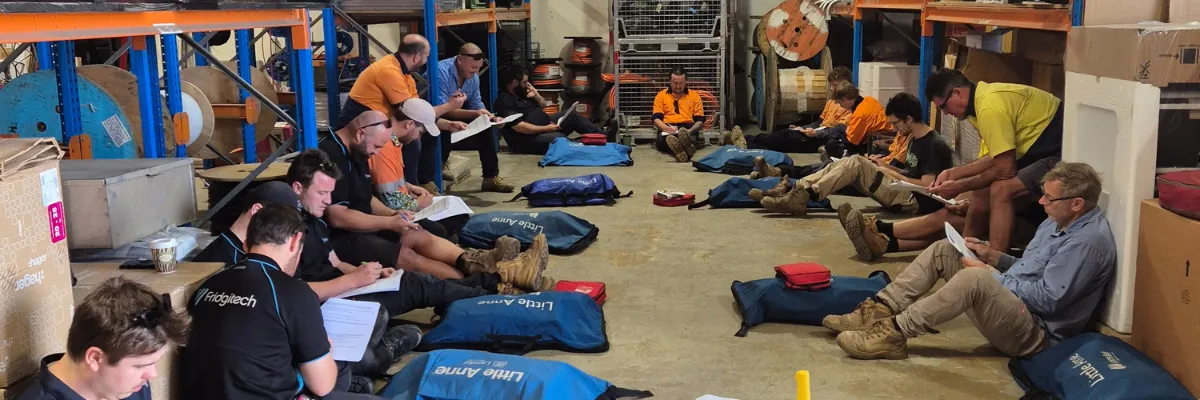
UEECD0007 runs as a single structured session that moves through theory, hands-on practical work, and an assessment component, all covered in the one sitting. There's no piecing it together across separate visits and no coming back later to finish it off.
How Beginners Are Supported Through Assessment
This is usually the bit that worries first-timers most: the word "assessment." Nobody wants to feel like they're sitting an exam they haven't studied for.
Here's how it actually works. The assessment isn't designed to catch people out. It's built to confirm you've absorbed what was covered, and trainers work through the content in a way that supports people who are hearing it all for the first time.
A rough shape of the session looks like this:
No trick questions, no assumed prior knowledge, no separate study period. Just a session that starts at zero and ends with a certificate in hand.
Do New Starters Need to Prepare Beforehand?
Short answer: no, and this is genuinely one of the most common questions Craig fields from nervous new starters or their parents.
No Pre-Reading or Study Required
There's no textbook to read the week before, no online module to click through, no homework. Turn up, and the course itself does the rest. If your new starter is the type to over-prepare for everything, you can save them the stress. There's nothing to prepare.
What to Bring on the Day (ID and Comfortable Clothing, Nothing Else)
Two things, that's the whole list:
Valid photo ID, needed for check-in and certification
Comfortable clothing, suited to a session that includes a practical, hands-on component
That's genuinely it. No laptop, no notebook, no printed booking confirmation, no highlighter set. Just show up as a person with ID and clothes they can move in.
If you want the official word on why WHS induction training matters before someone sets foot on-site, Safe Work Australia's guidance on WHS induction covers the regulatory reasoning behind it, worth a read if you're the one making the call on who needs this training and when.
Zero-Prep Checklist
Photo ID
Comfortable clothing
No study
No pre-reading
No prior experience

Getting a New Starter Booked and Certified Fast
Once you know a new starter's eligible and doesn't need to prep for anything, the only thing left is getting them in the door.
Group Booking for Multiple New Starters
If Craig's bringing on more than one new person at a time, a couple of apprentices starting the same intake, or a labourer and an apprentice together, there's no need to book them in separately. Group bookings mean the whole cohort sits the course together, gets certified together, and Craig's not chasing up scattered dates across the calendar.
Digital Certificate Delivery
This is the bit that actually solves Craig's biggest headache. He doesn't want to be waiting around for a certificate to land in his inbox before he can hand it to a site supervisor or principal contractor. Certificates are issued digitally, ready to forward on without the usual back and forth.
Courses run locally on the Gold Coast, so there's a decent shot the schedule fits around your crew without a big disruption to a live job or a long wait for the next intake.
Got more than one new starter to sort out? Our Trades Compliance Bundle covers WHS, First Aid/CPR and LVR renewals for the same crew in one relationship, worth a look if this is the first of many training needs coming up for your team.
Conclusion
Craig's story isn't unusual. Every trade business on the Gold Coast hits this same moment eventually. A new face turns up, keen to start, and someone has to work out what training stands between them and the tools. The good news is that this particular hurdle is a lot smaller than most people expect. Nobody's new starter needs to walk in already knowing anything.
What tends to trip people up isn't the course itself, it's the assumption that there's some invisible baseline everyone else already meets. There isn't. A first-year apprentice, a labourer switching industries, someone who's never worn a hard hat in their life, they're all starting from the exact same place, and that's the whole point of a course built for beginners rather than bolted onto one.
The practical side matters just as much as the reassurance. No pre-reading, no assumed knowledge, and a certificate that turns around fast. For a business owner juggling live jobs and tight margins, that's not a small thing. It's the difference between a new starter sitting idle waiting on paperwork and a new starter actually being useful on-site soon after joining the crew.
There's also a quieter reason this matters, one most site-responsible employers don't say out loud but feel all the same. Nobody wants to be the person who let someone start work under-prepared. Getting a new starter properly trained from day one isn't just a box to tick for a principal contractor or an audit trail. It's the difference between sending someone home safe every afternoon and hoping nothing goes wrong.
None of this needs to be complicated, and it shouldn't be. A new starter with zero background in safety training, zero trade experience, and zero idea what to expect can still walk out the other end fully certified and genuinely ready for site work. That's not a lowered bar, it's just a course designed around where people actually start.
If there's one thing worth taking from all this, it's that hesitation usually comes from not knowing what's involved, not from anything about the person themselves. Once that gap gets filled in, booking a new starter stops feeling like a decision that needs agonising over and starts feeling like exactly what it is: one straightforward step in getting someone properly and safely onto a job site.