Risk Control Measures Electrical Workers Must Know
If a SafeWork Queensland inspector walked onto your site right now, could every one of your electricians explain the risk control measures they're applying and why?
Not just "we always do it that way." Actually explain it, name the control, name the hazard, show the paperwork. For most electrical contractors and site managers, that's a confronting question. Under the Work Health and Safety Act 2011 (Qld) and the Electrical Safety Act 2002 (Qld), applying risk control measures isn't optional. It's a legal obligation. Getting it wrong means improvement notices, site shutdowns, and in serious cases, prosecution. The good news is there's a clear, structured framework for all of it.
What are risk control measures for electrical workers?
Risk control measures for electrical workers are actions taken to eliminate or reduce the risk of injury, death, or property damage from electrical hazards. In Queensland, these measures must follow the Hierarchy of Controls as required under the Work Health and Safety Act 2011 (Qld) and the Electrical Safety Act 2002 (Qld).
The six levels of control, applied in order of priority, are:
Elimination remove the electrical hazard entirely
Substitution replace with a lower-voltage or safer alternative
Isolation lock out / tag out (LOTO) to isolate the energy source
Engineering controls install guarding, RCDs, or insulation barriers
Administrative controls safe work procedures, permits, and training
PPE insulated gloves, arc flash rated clothing, safety footwear
Electrical workers must apply the highest practicable level of control on every job, not default to PPE as a first response.
What Are Risk Control Measures? (And Why Electrical Workers Can't Wing It)
A risk control measure is any action you take to eliminate or reduce harm from a hazard. In the electrical trades, "winging it" based on experience isn't just unprofessional. It's illegal. Under the WH&S Act 2011 (Qld) and the Electrical Safety Act 2002 (Qld), every PCBU has a duty to identify hazards, assess risks, and apply controls so far as is reasonably practicable.
What the law actually says about controlling electrical risks in Queensland
The WH&S Act 2011 (Qld) s.17 places the primary duty of care on the PCBU. The Electrical Safety Office (ESO) Queensland enforces these obligations, with powers to conduct unannounced site inspections, issue improvement and prohibition notices, and refer matters for prosecution. If a worker is injured on your site and there's no documented risk control in place, you'll be defending yourself in court, not a safety committee.
External reference: Electrical Safety Office Queensland
The difference between a hazard and a risk
A hazard is the source of potential harm: a live conductor, a frayed cable, a wet switchboard enclosure. A risk is the likelihood and consequence of harm occurring from that hazard. Confusing the two leads to applying the wrong controls. Distinguishing them is the foundation of every risk control decision on site.
Why "we've always done it this way" is not a legal defense
The legal standard isn't "has anything gone wrong yet." It's what a reasonably practicable PCBU would do given what's known about the hazard. Past practice without documentation offers zero legal protection. WorkSafe QLD inspectors assess the controls present at the time of inspection, not what your team did without incident years ago.

The Hierarchy of Controls How It Works for Electrical Hazards
The Hierarchy of Controls tells you which risk control measures to apply first. It's a ranked system, and Queensland law requires you to work from the top down, applying the highest practicable level of control before dropping to the next tier.
Elimination the control most electrical workers skip too quickly
Remove the hazard entirely. For electrical workers, the most common application is scheduling work on de-energized equipment rather than live systems. If the power can be off, it should be off. You cannot bypass elimination without documented justification. "It would take too long" doesn't qualify.
Substitution practical examples for electrical trades
Replace the hazard with something that presents a lower risk, such as battery-operated tools instead of mains-powered in wet environments, or lower-voltage systems where the task permits. Substitution must demonstrably reduce the risk, not simply swap one hazard for another of equal severity.
Isolation and LOTO lockout/tagout procedures on Queensland sites
Isolate the energy source so it cannot be re-energized while work is in progress. The LOTO sequence: isolate -> lock -> tag -> test -> work. Under the Electrical Safety Regulation 2013 (Qld), LOTO is mandatory for any work on or near energized equipment. If your SWMS doesn't describe your LOTO procedure, it's non-compliant.
External reference: Electrical Safety Regulation 2013 (Qld)
Engineering controls RCDs, insulation, guarding
Physical modifications that reduce exposure to the hazard regardless of what workers do: RCDs, insulated barriers, cable guarding, arc flash barriers. Engineering controls must be maintained and tested. An untested RCD is false assurance, not protection.
Administrative controls SWMS, permits, training
Systems and procedures that change how people work: SWMS, permits to work, toolbox talks, trained supervision. They're important, but they depend entirely on human behavior. A SWMS nobody has read is not a control measure. Administrative controls only work when workers understand the reasoning behind them.
PPE last resort, not first response
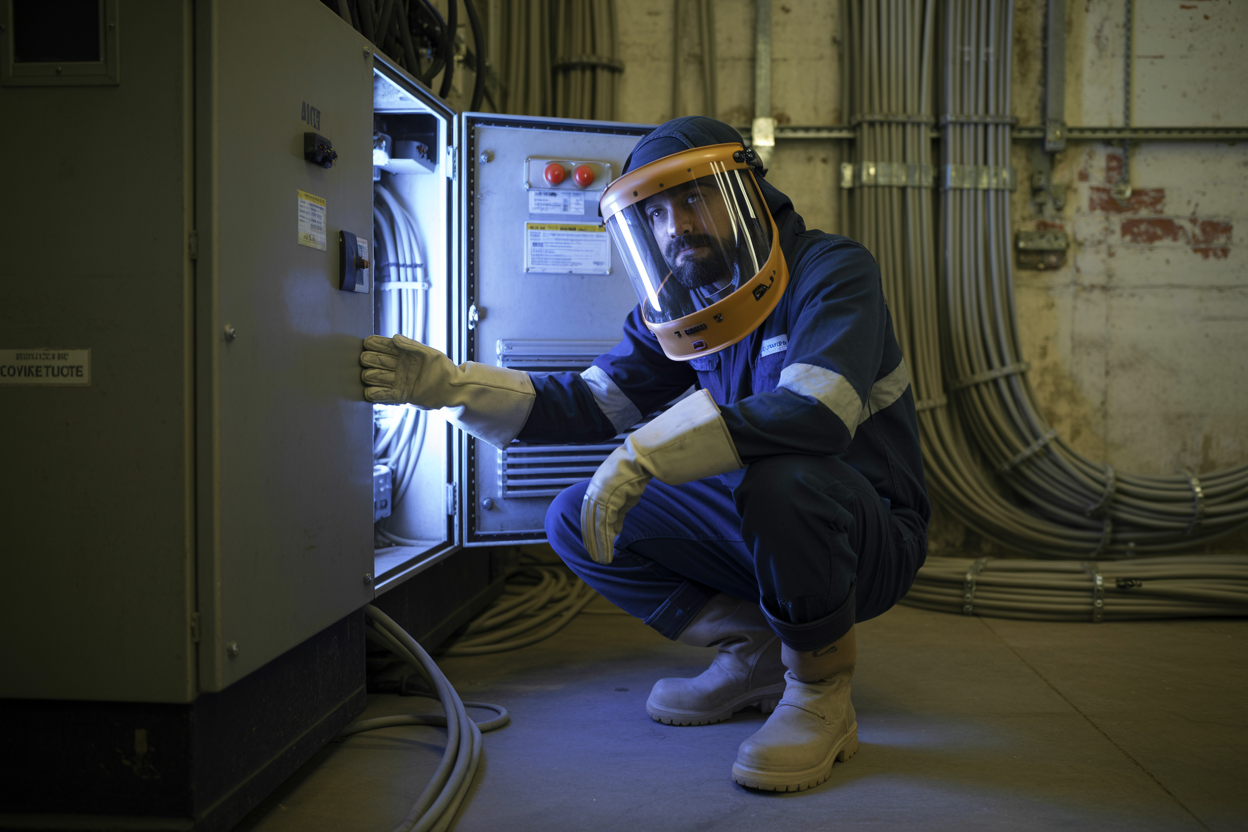
Insulated gloves, arc flash rated clothing, safety footwear, face shields. PPE is what keeps someone alive when every higher-order control has already been applied and a residual risk remains. Treating it as your primary control is legally indefensible and genuinely dangerous.
Electrical Hazards Electrical Workers Face Every Day
These are the hazards that show up on real worksites. For each one: what can go wrong and which control tier applies.| Hazard | Applicable Control Tier | |---|---| | Live conductor contact | Elimination / Isolation (LOTO) | | Arc flash | Engineering / PPE | | Confined space electrical work | Administrative / Engineering | | Overhead powerline proximity | Elimination / Engineering | | Non-compliant equipment | Elimination / Substitution |
Live conductor contact and electric shock
Contact with a live conductor can cause cardiac arrest, severe burns, and death. Low-voltage systems are lethal under the right conditions. The control hierarchy starts at elimination: de-energize before work begins. Where that's not practicable, a documented LOTO procedure is the mandatory next step. Complacency on familiar jobs is one of the most consistent factors in electrical injury data. "I've done this a hundred times" is not a risk control measure.
Arc flash and arc blast
When an arc flash event occurs, temperatures can exceed 20,000 degrees. The pressure wave, molten metal, and UV flash can cause death or severe burns several meters from the fault point. You don't need to be touching anything. Engineering controls are the primary defense: arc flash barriers, correctly rated switchgear, and incident energy analysis. PPE must be rated in cal/cm2 appropriate to the calculated incident energy.
Working in confined spaces with electrical equipment
Confined space electrical work combines electrocution risk with limited escape and potential atmospheric hazards. A confined space permit, atmospheric testing, and a rescue plan must be in place before anyone enters, with a trained person available to execute it. A rescue plan on paper with no-one to carry it out isn't a control measure.
Overhead powerlines proximity hazards on construction sites
Queensland has recorded fatalities from overhead powerline contact involving plant, scaffolding, and ladders. Elimination is the first control: can the work be re-routed away from the powerline zone? Where not practicable, physical exclusion zones, spotter systems, and notification to the relevant energy authority where required are mandatory. If your SWMS doesn't mention overhead powerlines when they're present, it has a gap.
Damaged or non-compliant electrical equipment
Insulation failure, earth faults, and fires often start with damaged or non-compliant equipment, and are frequently discovered only after something has gone wrong. Tag out immediately, remove from service, replace with compliant equipment. A test and tag regime that exists on paper but isn't being run isn't a control measure.
What Queensland Law Requires Your Legal Obligations as a PCBU or Electrical Worker
Under s.19 of the WH&S Act 2011 (Qld), a PCBU must ensure the health and safety of workers so far as is reasonably practicable. In practice: safe systems of work, maintained and compliant plant and equipment, trained and supervised workers, and adequate facilities including emergency response equipment.
External reference: WH&S Act 2011 (Qld)
Worker obligations what individual electricians are legally required to do
Under s.28 of the WH&S Act 2011 (Qld), workers must take reasonable care for their own and others' health and safety, comply with instructions, not misuse safety equipment, and report hazards. Electrical workers also carry licensing obligations under the Electrical Safety Act 2002 (Qld). A licensed electrician who bypasses an isolation procedure isn't just creating a safety risk. They may be breaching their license conditions.
External reference: Electrical Safety Act 2002 (Qld)
Safe Work Method Statements when mandatory for electrical work
A SWMS is mandatory for high risk construction work, including electrical work near energized installations under the Electrical Safety Regulation 2013 (Qld). It must identify hazards per task step, describe control measures mapped to the Hierarchy, and be communicated to all workers before work begins. A SWMS workers sign without reading isn't a control measure. If an incident occurs, it'll be used against you.
What WorkSafe Queensland can do if controls aren't in place
Inspectors can enter without notice, issue improvement or prohibition notices on the spot, and refer for prosecution. A Category 1 offence carries serious financial penalties for individuals and body corporates alike. Before it reaches prosecution, gaps in your documentation can cost you something more immediate: a contract.
How to Document Risk Controls So They Actually Protect Your Business
Getting your documentation right is methodical, not complicated. Here's what needs to be in place.
What a compliant SWMS looks like for electrical work
Task description and work location
Identified hazards per task step
Risk control measures mapped to the Hierarchy of Controls
Worker names, signatures, and date of communication
Supervisor and PCBU sign-off with date
Review date and amendment history
Emergency procedures and contact details
PPE requirements per task step, not just "PPE as required"
Building a risk register what to include and how often to review
Hazard identification: what could cause harm and to whom
Risk rating: likelihood multiplied by consequence
Control measures in place, mapped to the Hierarchy
Residual risk rating after controls applied
Person responsible for each control
Review date: minimum annually, or after any incident or near-miss
A risk register that hasn't been updated in two years is a historical document. Inspectors will check the date.
Training records why certificates alone aren't enough
A certificate proves completion on a date, not that your worker is applying their training on site today. Your training register must record the unit code, RTO name and number, completion date, certificate number, and expiry where applicable. Add supervisor verification that trained behaviors are being observed on site.
How to prepare your documentation for a SafeWork QLD audit
Current training certificates: indexed and accessible
SWMS for all high-risk electrical tasks: reviewed and worker-signed
Risk register reviewed within the last 12 months
Plant and equipment test records current, including RCD logs
Incident and near-miss register current
Emergency procedures posted and communicated
UEECD0007 The Training That Ties It All Together
Applying Work Health and Safety Regulations, Codes and Practices in the Workplace covers WH&S legislation and codes of practice, hazard identification and risk assessment, control measures mapped to the Hierarchy, SWMS and safe work procedures, and incident reporting. Every element maps to a legal obligation covered in this guide.
Who needs to complete it in Queensland
Electrical workers and apprentices embedded in licensing pathways across Queensland
Workers entering UETDRRF004 (Low Voltage Rescue) UEECD0007 is a co-requisite; workers need both
Site managers and WH&S officers stepping into safety oversight for the first time
Businesses needing documented WH&S knowledge for tender compliance
If your crew is heading into Low Voltage Rescue training, they need UEECD0007 alongside it. Don't find that out the day before.
Get Your Team's WH&S Training Sorted
Risk control isn't a once-a-year toolbox talk conversation. It's the thread that runs through every job your crew touches. The businesses that get audited and walk away clean aren't the ones who got lucky. They're the ones who made documentation and training a non-negotiable part of how they operate.
The Hierarchy of Controls, compliant SWMS documentation, a current risk register, verified training records: none of it is complicated. What it requires is consistency. And consistency requires workers who understand why each step exists, not just workers who can sign a form and move on.
That's where UEECD0007 does its job. It gives electrical workers and site managers the foundational knowledge to apply risk control measures correctly, document them in a way that satisfies WorkSafe QLD, and build a safety culture that prevents incidents rather than just responding to them.
If a SafeWork Queensland inspector walked onto your site tomorrow, your documentation should tell a story that matches what your workers are doing on the ground. Training records, SWMS, risk register, test and tag logs: each one a piece of evidence that your business takes its obligations seriously. That's what due diligence actually looks like.