
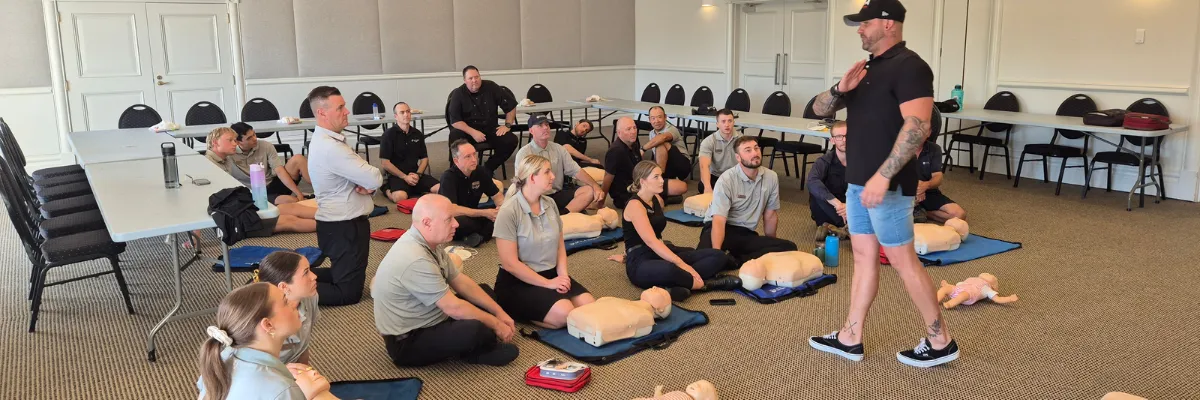
Provide Cardiopulmonary Resuscitation: 2026 Australian Guide
Most Australians have done CPR training at some point. But if you're being honest — you'd probably hesitate if someone collapsed right now. Not because you don't care. Because you're not sure you'd get it right.
That doubt has a name: skill fade. It's well-documented, completely normal, and not a reflection of how capable you are. It just means your knowledge needs a refresh. And given that ANZCOR — the Australian and New Zealand Committee on Resuscitation — regularly updates how we provide cardiopulmonary resuscitation, there's a good chance some of what you learned a few years back has shifted.
This guide reflects the current 2026 ANZCOR standard. By the time you've finished reading, you'll know the correct sequence, the right compression rate and depth, how rescue breaths work (and when you can skip them), how to use an AED, and what the most common mistakes are. If you've been meaning to get across to nationally recognized CPR training and haven't quite gotten around to it, this is a good starting point.
How to Provide Cardiopulmonary Resuscitation: Step-by-Step
Cardiopulmonary resuscitation (CPR) is an emergency procedure that maintains blood flow to the brain and vital organs when the heart has stopped. To provide CPR in Australia, follow the ANZCOR 2026 guidelines:
Check for danger — ensure the scene is safe for you and the casualty
Check for response — tap shoulders, call their name
Call 000 — or direct someone else to call immediately
Open the airway — tilt head back, lift chin
Check for breathing — look, listen and feel for no more than 10 seconds
Begin compressions — 30 chest compressions at 100–120 per minute, 5–6cm depth
Give rescue breaths — 2 breaths after every 30 compressions (30:2 ratio)
Continue until help arrives — the person recovers, or you cannot continue
Use an AED if available — turn it on and follow the prompts
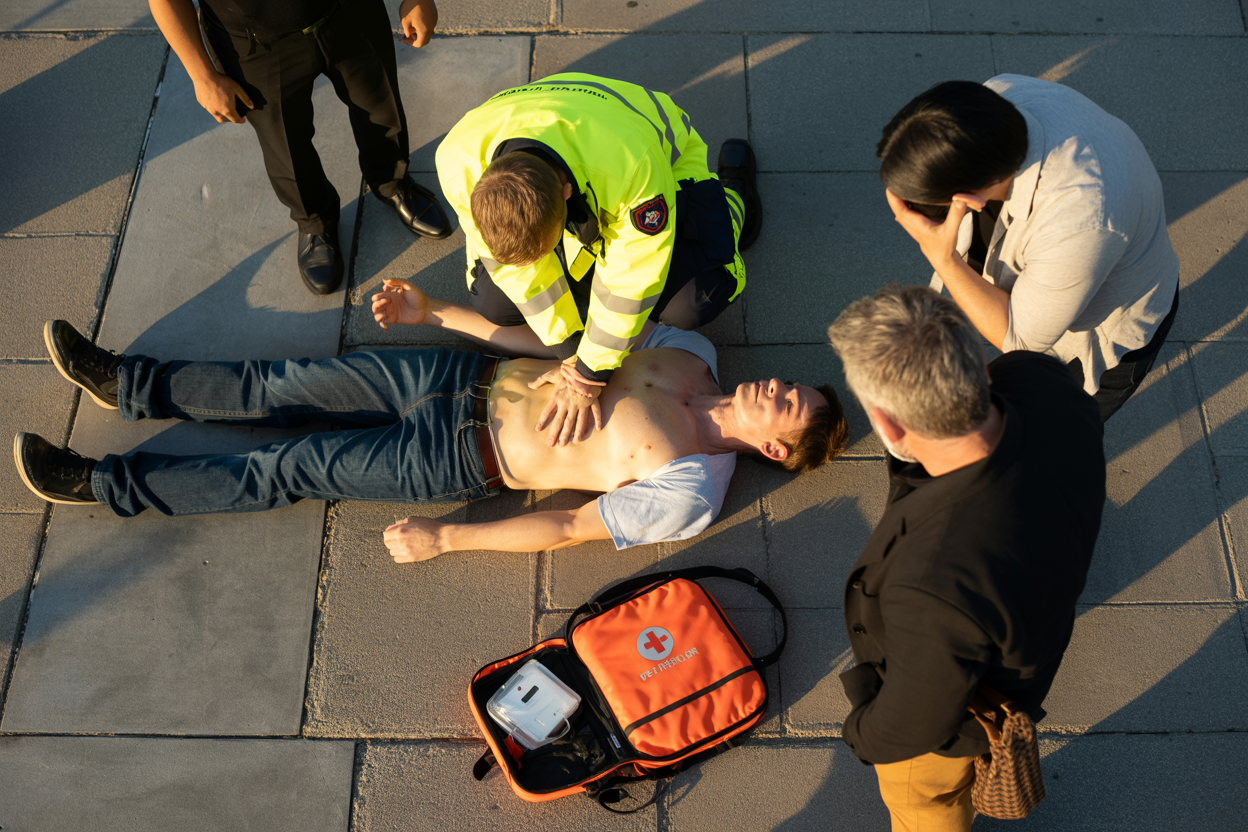
What Is Cardiopulmonary Resuscitation and Why It Matters in 2026
CPR — cardiopulmonary resuscitation keeps oxygenated blood moving to the brain and vital organs when the heart has stopped. It doesn't restart the heart. What it does is buy time — for a defibrillator to arrive, for paramedics to get there, for the brain to survive what would otherwise be irreversible.
Cardiac arrest and heart attack are not the same thing. A heart attack is a circulation problem — a blockage cutting blood supply to part of the heart. The person is usually conscious and can tell you something is wrong. Cardiac arrest is an electrical problem — the heart stops beating effectively and the person collapses, unresponsive, not breathing normally. Cardiac arrest is the emergency where CPR is needed immediately.
Bystander CPR — started before paramedics arrive — doubles or triples survival odds according to the Australian Resuscitation Council. And yet, fewer than 12% of bystanders act. The gap isn't training, it's confidence. People freeze because they're not sure they'll do it correctly.
The Chain of Survival | Where CPR Fits
The chain of survival describes the sequence of actions that give a cardiac arrest patient the best chance of survival:
Early recognition + call 000 — spot the signs, get help coming
Early CPR — start compressions to maintain blood flow
Early defibrillation — restore normal heart rhythm with an AED
Early advanced care — paramedics take over with medications and equipment
CPR is link two. Without it, links three and four rarely get the chance to work. Every second of quality CPR while waiting for early defibrillation is a second the brain stays viable.
The ANZCOR 2026 CPR Guidelines | What's Changed and What Hasn't
If you did CPR training two or three years ago — the fundamentals haven't changed dramatically. The sequence is the same. The ratio is the same. What matters more now is precision — particularly around compression rate and depth, where small deviations have a measurable impact on how well CPR actually works.
ANZCOR operates within the global ILCOR framework — the International Liaison Committee on Resuscitation — which conducts systematic reviews of resuscitation evidence that national bodies like ANZCOR translate into local guidelines. When ANZCOR updates something, it's based on the best available evidence, not arbitrary revision.
The 2026 parameters you need to know:
The emphasis on full chest recoil and minimizing interruptions matters — both affect how much blood actually gets pumped. Leaning on the chest even slightly prevents the heart from refilling. Every pause drops perfusion pressure. The goal is steady, uninterrupted, high-quality compressions.
CPR for Adults vs Children vs Infants | Key Differences
The technique changes depending on who you're helping. Here's a quick reference:
For children and infants, depth shifts from a fixed measurement to one-third of the chest — because chest size varies significantly across that age range. The ratio stays 30:2 across all groups for a single rescuer. Push hard enough, fast enough, and let the chest fully recoil.
How to Provide Cardiopulmonary Resuscitation | Full Technique Breakdown
The step-by-step list earlier in this guide gives you the sequence. This section goes deeper on each phase — what you're actually doing, why it matters, and where people most commonly go wrong.
Phase 1 — Scene Safety and Initial Assessment (DRS)
Before you touch anyone: Danger. Response. Send for help.
Danger first — a rescuer who gets hurt is a second casualty. Environmental hazards are real: traffic, water, heat, electrical equipment. Two seconds to look around before you move in.
Response — tap shoulders firmly, call their name. If they don't respond, move immediately.
Send for help — call 000, or point at one person in the crowd and say "you, call 000 now." Vague instructions get ignored. Name someone. Send someone else to locate an AED at the same time.
Phase 2 — Airway and Breathing Assessment
Tilt the head back and lift the chin — this moves the tongue away from the back of the throat. Check for breathing: look for chest rise, listen, feel for air on your cheek. No more than 10 seconds.
Here's something that catches a lot of people off guard:
Agonal breathing looks and sounds like the person might be okay. They're not. It's a reflex, not functional breathing, and waiting to see if it resolves costs critical minutes. If they're unresponsive and not breathing normally, start compressions.
Phase 3 — Chest Compressions (The Most Important Part)
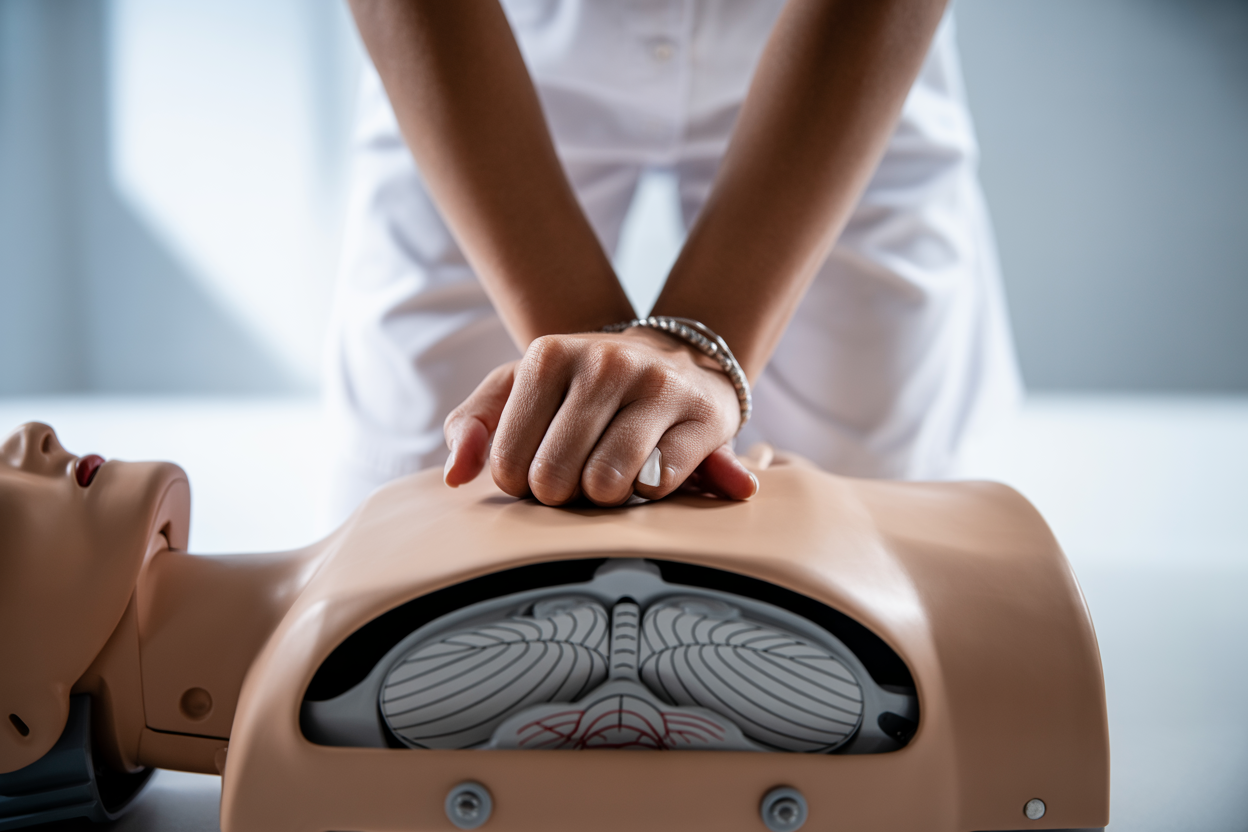
Heel of one hand on the centre of the chest — lower half of the sternum. Other hand on top, fingers interlaced. Arms straight, shoulders directly over your hands. Then compress.
Rate: 100–120 per minute. The beat of "Stayin' Alive" by the Bee Gees sits at 103 bpm — right in the target range.
Depth: 5–6 cm for adults. Deeper than most people instinctively go. Feel the resistance and push through it.
Full chest recoil: Release completely between compressions. Don't lean on the chest — let it come all the way back up.
Rescuer fatigue: Switch with a second person regularly to maintain quality without breaking rhythm.
Phase 4 — Rescue Breaths
After every 30 compressions, give 2 rescue breaths. Head tilted back, nose pinched, seal over the mouth, one slow second breath. Watch for chest rise. If it doesn't rise, recheck head position and try once more — then go straight back to compressions.
If you're not comfortable doing mouth-to-mouth — for any reason — that's okay.
For trained responders, a pocket mask or face shield is worth keeping in a first aid kit. It creates a barrier and makes rescue breaths easier to deliver effectively.
Phase 5 — AED Integration
Don't stop compressions while someone sets up the AED. Keep going until it's ready to analyse. Turn it on, follow the audio prompts — AEDs are built for untrained users and will walk you through every step. If a shock is advised, clear everyone from the person, deliver it, then resume compressions immediately. No pulse check. Straight back to compressions.
Common CPR Mistakes and How to Avoid Them
Knowing what can go wrong isn't about being critical — it's about being prepared. Most of these errors aren't careless. CPR is physically demanding, emotionally intense, and usually performed by someone who hasn't practiced recently.
The thing most people don't realise until they've done hands-on practice is how physically demanding compressions are at the right depth and rate. Fatigue pushes you shallower and slower — exactly the wrong direction. That's why switching rescuers regularly matters, and why muscle memory built through practice makes such a difference when it counts.
Imperfect CPR is significantly better than no CPR. A bystander who starts compressions immediately — even if the rate or depth is slightly off — gives that person a dramatically better chance than someone waiting for a more qualified rescuer to arrive.
That moment — where training either kicks in or doesn't — happens without warning. The difference between acting and freezing almost always comes down to how recently you practiced.
Who Needs to Know How to Provide CPR in Australia | Legal and Compliance Context
The short answer is: more people than you'd think. And for a lot of industries, it's not optional.
HLTAID009 — Perform CPR — is the nationally recognised unit of competency that covers what we've been talking about throughout this guide. It's the certificate most employers, registration bodies, and licensing authorities mean when they say "current CPR."
The 12-month renewal cycle is set by the Australian Resuscitation Council and enforced by ACECQA for childcare. For other industries, renewal frequency varies — but annually is the standard most employers apply. Check with your employer or registration body rather than assuming your previous certificate is still valid.
HLTAID009 covers CPR only. If your role requires a broader skill set — anaphylaxis, choking, bleeding, fractures — you're looking at HLTAID011, the full first aid certificate that includes CPR as a component. If your workplace requires a full first aid certificate, HLTAID011 is what you need.
How to Stay Current CPR Training and Renewal
Getting certified or renewing your HLTAID009 is straightforward. A standard course covers theory and hands-on practical work — manikin practice, compression technique, rescue breaths, and AED familiarisation. Certificate issued the same day.
Online-only CPR is not nationally recognised. HLTAID009 requires a hands-on practical component — watching videos or completing a digital workbook won't satisfy that requirement. If someone is offering a fully online CPR certificate, it won't meet the standard your employer or registration body is looking for. The practical element is where the actual skill gets built.
The annual renewal isn't just a compliance tick. Guidelines update. Confidence — the kind that makes you act instead of freeze — rebuilds every time you practice. Think of it as a skill upgrade, not a repeat.
If you're ready to book or want to check what's available, the next step is simple:
Not sure which course is right for you? Compare HLTAID009 and HLTAID011 here.
The Bottom Line
Most people who hesitate in an emergency don't hesitate because they don't care. They hesitate because they're not sure they'll get it right. That gap between knowing CPR exists and feeling genuinely capable of doing it — that's what training closes.
The 2026 ANZCOR guidelines haven't reinvented how we provide cardiopulmonary resuscitation. The sequence is the same. The ratio is the same. What's shifted is the emphasis on precision — depth, rate, recoil, minimising interruptions — because the research keeps showing quality matters as much as speed. Getting those details right under pressure is a skill, and skills fade without practice.
Imperfect CPR, started immediately, saves lives. The person who acts — even nervously, even imperfectly — is the one who makes the difference.
Your certificate is valid for 12 months. If it's expired, or if you've never had one, there's no better time than this week.