Oxygen Therapy Legal Requirements Explained Simply | QLD
The oxygen cylinder in your emergency kit is easy to overlook until someone asks who is allowed to use it. For Brisbane practice managers, that question usually comes from an accreditation surveyor or an indemnity insurer, and the practice's position on oxygen therapy legal requirements is rarely written down.
In Queensland, those requirements don't sit in one rulebook. They're spread across state medicines law, workplace health and safety duties, professional guidance for sedation and the HLTAID015 unit itself. Each one covers a different part of the picture, which is why the answer often comes down to guesswork.
This guide explains it simply. You'll see which Queensland laws apply to oxygen in a first aid setting, what your WHS duties mean for the equipment and the staff using it, what the professional bodies actually say (and what they don't), and where HLTAID015 training fits. It finishes with a checklist you can file before your next audit.
Do You Need a License to Give Oxygen in First Aid?
No. Queensland has no separate license for first aiders to give oxygen. Your legal obligations come from workplace health and safety law instead: the practice must provide suitable first aid equipment and staff trained to use it. The nationally recognized unit for oxygen therapy is HLTAID015.
What the law expects of a Queensland practice:
Trained people. Workers must have access to staff trained in first aid (WHS Regulation 2011 (Qld), r 42).
Suitable equipment. First aid equipment, including oxygen, must suit your risks and be kept in working order.
Current competency. Staff refresh their HLTAID015 skills on a regular cycle.
Written procedures. Follow the First aid in the workplace Code of Practice 2021 (Qld).
Clinical standard. Give oxygen in line with ANZCOR guidelines.
Where Oxygen Therapy Legal Requirements Come From in Queensland
That short answer hides four separate sets of rules, and each one asks something different of your practice.
There's no single rulebook for oxygen therapy in Queensland. Medicine law is about the oxygen itself. WHS law is about your practice. Clinical and professional guidance is about how it's given. The training standard is about what actually counts as "trained".
Think of it as four keys on the one ring. Most of the confusion starts when someone expects one key to open every door.
Source | Answers the question | Who enforces it |
Medicines law | Can a first aider possess or give it? | Queensland Health |
WHS law | Does the practice need trained staff and equipment? | WHSQ |
Clinical and professional guidance | How should it be given, and what do sedation practices expect? | ANZCOR, Dental Board, ANZCA |
Training standard | What counts as being trained? | ASQA, through RTOs |
Start with the question most practice managers ask first: whether oxygen counts as a medicine.

Queensland Medicines Law and Oxygen
The Medicines and Poisons Act 2019 in plain English
In Queensland, medicines are covered by the Medicines and Poisons Act 2019 (Qld) and the Medicines and Poisons (Medicines) Regulation 2021. Together they control who can deal with scheduled medicines, which covers things like buying, possessing and giving them.
There's a general approval for emergency first aid. It covers people who hold a current first aid certificate issued by an RTO. That sounds like it'd settle it, but the Queensland Health fact sheet on that approval names glyceryl trinitrate for first aid providers. It doesn't name oxygen.
Is medical oxygen a scheduled medicine?
So you've got to look at oxygen's own status under the Regulation, and Queensland Health is the place to confirm it. If oxygen isn't scheduled, the legal questions that matter sit in WHS law and training. If it is, staff giving it need to fall within an authority or approval under the Regulation.
Medical oxygen is also a therapeutic good, supplied under TGA regulation. That covers how the product is made and supplied, a separate question from whether a first aider is allowed to give it.
Why this differs from other states
Tasmania licenses first aid organizations for certain substances, and oxygen isn't on its list.
Medicines law decides who can give oxygen. WHS law decides what your practice has to have in place.
Your WHS Duties for Oxygen Equipment and Staff
The PCBU duty under the WHS Act 2011 (Qld)
PCBU stands for "person conducting a business or undertaking". In a dental practice that's usually the business owner, often the principal dentist.
Under the Work Health and Safety Act 2011 (Qld), the PCBU owes the primary duty of care. That covers workers and other people at the workplace, and in a practice that includes your patients. So when someone asks who's responsible for the oxygen in the kit, the honest answer starts with the practice itself, not the assistant who happens to be closest to the cylinder.
What WHS Regulation r 42 requires
Regulation 42 of the Work Health and Safety Regulation 2011 (Qld) is the heart of the WHS first aid requirements. It requires the PCBU to provide first aid equipment and access to trained first aiders, and both have to match the practice's risks.
A practice that sedates patients has a very different risk profile from an office down the road, and that's what justifies advanced resuscitation training and oxygen in the kit. A basic first aid box might suit a reception desk. It doesn't match a patient who's sedated in the chair.
What the First Aid in the Workplace Code of Practice 2021 expects
The First aid in the workplace Code of Practice 2021 turns the WHS first aid requirements into practical steps:
Risk assessment. Work out what could go wrong at your practice.
First aider numbers. Have enough trained people on hand.
Suitable equipment. Match the kit to the risks.
Written procedures. Set out how first aid is given.
Regular review. Revisit it all as things change.
Storing and maintaining oxygen cylinders
Oxygen cylinders come under dangerous goods storage and handling rules. The principles are simple enough:
Keep cylinders secured and upright.
Store them somewhere ventilated.
Keep them away from ignition sources.
Maintain them to the supplier's instructions.
The part most practices let slide is the paperwork. Keep a check log for the cylinder level, regulator function and masks. It's the first thing you'll be glad you had when someone asks, and the compliance checklist further down shows what to file.
For sedation practices, a third layer sits on top.
Sedation Practices: What the Dental Board and ANZCA Actually Say
This is the bit that trips up a lot of sedation practices. Many believe that the Dental Board requires the whole clinical team to hold resuscitation training. When you read what the Board actually says, it's narrower than that.
What the Dental Board requires
Endorsed dentists only. Conscious sedation is restricted to dentists with an endorsement.
Approved course. The endorsed dentist completes a Board-approved course in sedation and medical emergencies before renewing registration.
No team rule. The Board page sets no requirement for assistants or the wider team.
So if you've been telling the principal dentist "the Board says everyone has to be trained", that's worth correcting before an auditor does it for you.
Where team expectations come from: ANZCA PS09
The team side of dental sedation oxygen requirements comes from somewhere else. Endorsed dentists are expected to be familiar with ANZCA PS09, the sedation standard the Board refers to.
Staffing and equipment. PS09's staffing and equipment sections are where trained assistants and oxygen availability show up.
Version mismatch. The Board page cites PS09 (2014), while ADA Policy 6.17 cites PS09 (2022). Confirm which version is current before quoting it in your policy.
Why most practices train the whole team anyway
WHS duty. Your risk profile calls for trained first aiders and suitable equipment.
Indemnity expectations. Insurers may expect current training across the team.
Accreditation evidence. Surveyors look for proof the team can respond.
The dentist administers the sedation, but if a patient deteriorates, it's the assistant who grabs the oxygen, the therapist who sets up suction, and whoever's nearest who starts the response. Training the whole team isn't a Board rule. It's sound practice, and it's how dental sedation oxygen requirements actually play out in a real emergency.
Rules on paper only matter if staff know where their responsibility starts and stops.

Duty of Care and Liability When Staff Give Oxygen
Staff on duty owe a duty of care
When a patient collapses in the chair, your team aren't bystanders who happened to be walking past. They're at work. When they respond, they act under their employer's duty of care and within their own training, which is a different position from a stranger stopping to help on the street.
Working within training and procedure
The simplest protection for your staff is also the simplest rule: give oxygen only within the scope of their training and the practice's written procedure. Staff trained on your kit, following your procedure and giving oxygen in line with ANZCOR guidelines are doing exactly what's expected. Problems start when people go beyond their training, or there's no procedure at all.
Good Samaritan protection and why it rarely applies at work
Good Samaritan laws are meant to protect people who help in an emergency without expecting payment. Staff responding on shift are usually in a different position, because they're at work and acting under their employer's duty. Don't build your approach around it, and don't assume staff are either fully covered or fully exposed. Get advice for your specific position.
Records and privacy
Incident notes. What happened, what was done and when.
Patient privacy. Notes are handled like any other patient record.
Post-incident review. What went well, what to change.
HLTAID015's assessment requirements list duty of care, privacy and legal requirements as required knowledge, so it's built into the training itself.
All of this comes back to one thing: staff who are trained and current.
Where HLTAID015 Training Fits
What HLTAID015 covers
HLTAID015 Provide advanced resuscitation and oxygen therapy is the nationally recognized unit that brings the pieces together. It covers oxygen therapy and advanced resuscitation in line with Australian Resuscitation Council guidelines, plus the legal and duty-of-care knowledge your staff need to back up the hands-on skills.
It's not only knowing how to fit a mask. It's knowing why they're allowed to, and where their responsibility ends.
Prerequisite and the HLTAID007 question
HLTAID011 is the prerequisite for HLTAID015.
HLTAID015 supersedes the old HLTAID007, but it isn't equivalent, so an old HLTAID007 certificate doesn't count as current.
How often to refresh
The unit itself says to check refresher requirements with your state WHS regulator, and most practices refresh on a regular cycle. Skills like setting up oxygen fade fast when staff rarely touch the kit, so a regular refresher is about confidence as much as compliance.
Training on your own oxygen kit, after hours
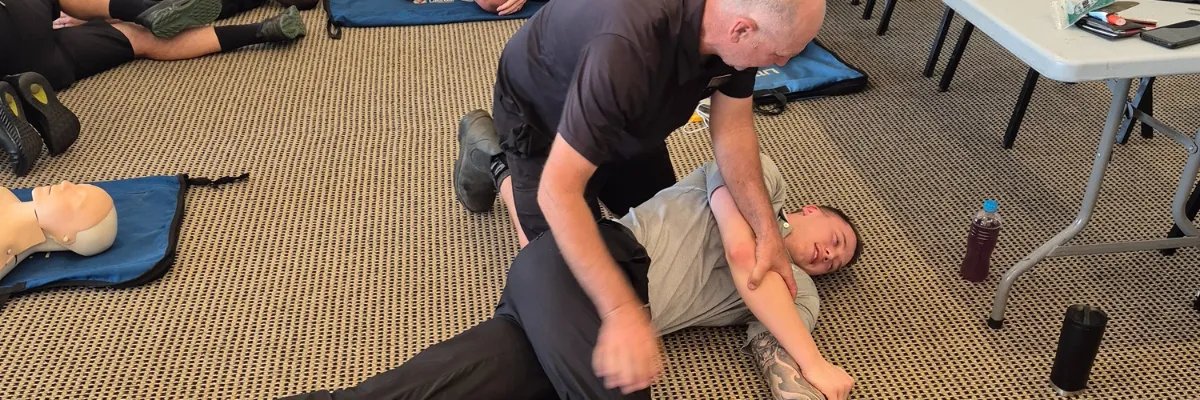
The best training happens where the emergency would. It can run on-site at your practice, after hours or on a Saturday, using your own oxygen and resuscitation equipment. No cancelled sedation lists, and no staff learning on a regulator they'll never see again.
Here is everything above, condensed into what to file.
Oxygen Compliance Checklist for Brisbane Practices
Print it, tick it off and file it. If a surveyor or insurer asks about oxygen, this is what they'll want.
Requirement | Evidence to file | How often |
Trained staff on every session | HLTAID015 statements of attainment | Track renewal dates |
Oxygen kit maintained | Check log | Regularly, to supplier instructions |
Written oxygen procedure | Policy document | Annual review |
Emergency drills | Drill log | Regularly |
Endorsed dentist current | Board registration and course record | Each registration renewal |
Risk assessment | First aid risk assessment | On change or annually |
Ready the Next Time Someone Asks About the Oxygen
Oxygen therapy legal requirements in Queensland don't come from one rulebook. They come from four: medicine law, WHS duties, clinical and professional guidance, and the HLTAID015 training standard. The practice owner holds the duty, the endorsed dentist holds the sedation endorsement, and the team carries the response.
Start by checking your gaps. Run the self-check above or download the full checklist. Most practices find one or two things missing, usually an old procedure or an unsigned check log.
Then work out who needs training. Look for staff without a current HLTAID015, and anyone whose renewal is coming up. Then request an on-site quote so the whole team trains after hours or on a Saturday, on your own oxygen kit, without cancelling a sedation list.
Get those three steps done and the folder pretty much builds itself. Next time a surveyor asks who can use the oxygen, the answer is already on file.