OHS Course Guide: Everything You Need to Know
Still Googling "OHS course" trying to work out what your crew actually needs? You're not the first business owner to land on this page confused, and you won't be the last. Here's the thing though, in Queensland, OHS hasn't been the correct term since 2011. It got replaced by WHS, Work Health and Safety, and if you're running an electrical or trade business on the Gold Coast, the course your team actually needs a certificate for is UEECD0007, which is a mouthful but basically means "apply work health and safety regulations, codes and practices in the workplace."
This guide cuts through that terminology mess fast: what the course covers, who on your crew needs it, and how to book it without pulling your whole team off a live job. Whether it's a tender, an insurer, or a principal contractor's induction pack that's put this on your desk, you'll know exactly what to do next by the end of this page.
OHS vs WHS: What Changed in 2012 (and Why It Still Trips People Up)
Quick answer for anyone in a hurry: no, OHS is not the same thing as WHS anymore. OHS, Occupational Health and Safety, got replaced by WHS, Work Health and Safety, legislation in Queensland from 1 January 2012. Same underlying duty of care underneath it, but WHS is the legally correct term now, and any training or certificate you're chasing should say WHS, not OHS, if it's going to actually reflect what you're required to do today.
The 2012 harmonization: Queensland's shift from OHS to WHS law
Back before 2012, every state ran its own version of occupational safety law, and they didn't always line up with each other. Queensland, along with most other states, moved to a harmonised WHS system so the rules were more consistent nationally. What matters for running your business is the date, and what it means for you now.
What actually stayed the same
Here's what a lot of business owners get wrong, they think the whole system got rebuilt from scratch. It didn't. Your duty of care as a PCBU (person conducting a business or undertaking, which is almost certainly you) hasn't gone anywhere. You still owe your workers and apprentices a safe working environment. That obligation didn't change in 2012, it just got a new name and a refreshed set of codes underneath it.
Why the old term still costs trade businesses time
This is the bit that actually bites people. Tradies search "OHS course," find old content, book the wrong thing, or turn up to a site with paperwork that says OHS on it and get questioned by a principal contractor who knows the terminology's moves. Old habits die hard in an industry that's been saying "OHS" for decades, and plenty of people, including some training providers, still use it out of habit.
So to break it down simply:
OHS: the pre-2012 term. Still floating around informally, and it's actually still the correct legal term in Victoria, which adds to the confusion if you've got a crew who've worked interstate.
WHS: the current legal term in Queensland, since January 2012.
What hasn't changed: your duty of care as a PCBU.
What has changed: national harmonization, updated codes of practice, and the specific unit code your team now needs to hold, which is UEECD0007.
Now that the terminology's settled, here's exactly what UEECD0007 covers, and whether your crew needs it.

What Is UEECD0007 and Who on Your Crew Actually Needs It
UEECD0007 is the unit code for "Apply Work Health and Safety Regulations, Codes and Practices in the Workplace." That's the official title. In plain English, it's the course that proves someone on your team understands how to apply WHS law on an actual job site, not just recite it back in a classroom.
What the unit covers
The course walks through how WHS regulations and codes of practice apply day to day on-site, things like identifying hazards, understanding your obligations, and knowing how to act on safety issues rather than just being aware they exist. It's practical, not theoretical box-ticking, which matters if you're the type of business owner who's skeptical of training that feels like a rubber stamp.
Licensed electricians, apprentices, and site supervisors: who's required
This is where most of the confusion happens, honestly. Not everyone on your crew necessarily needs UEECD0007 for the same reason, and it depends a bit on their role and what a given site or contract requires. As a rule of thumb though:
Licensed electricians working on live sites are commonly required to hold it
Apprentices are frequently required too, particularly where a principal contractor's induction pack specifies it
Site supervisors and leading hands are often expected to hold it given their responsibility for others on-site
If you're not sure who on your team needs it and who doesn't, that's genuinely one of the most common questions we get, and it's worth checking against whatever specific tender or contractor requirement put this on your desk in the first place, since requirements can vary by job.
UEECD0007 vs White Card vs site-specific induction
This is the other big point of confusion, and it's a fair one because on the surface they can sound like the same thing.
They're not interchangeable, and having one doesn't mean you're covered for the others. A lot of business owners assume White Card covers everything, and it doesn't, it's a general induction, not a WHS competency specific to your trade.
Knowing what the course covers is one thing. Knowing what happens if you skip it is another.
WHS Obligations for Gold Coast Trade Business Owners
Your duties as a PCBU under the WHS Act 2011 (Qld)
If you're running a trade business, chances are you're a PCBU whether you've ever used that term or not. Under section 19 of the WHS Act, a PCBU has a primary duty of care to protect, so far as reasonably practicable, the health and safety of workers. That's the legal wording. What it means practically is you're on the hook, not your apprentice, not your site supervisor, you, for making sure the people working for you are properly trained and competent to work safely.
A few of the core obligations that sit under that duty:
Providing and maintaining a work environment without risks to health and safety
Providing adequate facilities for workers to carry out their work safely
Providing the safe use, handling, and storage of plant and substances
Providing the information, training, instruction, or supervision necessary to protect workers from risks
Monitoring the health of workers and conditions at the workplace
That fourth point is where UEECD0007 sits. Training isn't a nice-to-have you do when you get around to it, it's part of how you actually meet your legal duty as a PCBU.
What happens if a worker's WHS competency lapses mid-job
This is the scenario that keeps a lot of business owners up at night, and fair enough. If a worker's WHS competency lapses while they're actively on a job, you're exposed in a few ways at once. If an inspector turns up and asks for evidence of current training and you can't produce it, that's a problem. If something goes wrong on-site and it comes out that competency had lapsed, that's a much bigger problem, for the worker, the business, and you personally as the PCBU. Even an audit or a principal contractor spot-check can catch you out if your paperwork isn't current.
Principal contractor induction packs and tender compliance
Most Gold Coast trade businesses don't come looking for WHS training because they woke up thinking about compliance. It's almost always external, a principal contractor's induction pack, or a tender that won't be considered without proof of training on file. This is where it stops being just a legal obligation and starts being a commercial one too.
One Gold Coast trade business we worked with had every one of their WHS competencies current and on file well before a tender closed. When it came down to two similar bids, the client later told them their compliance paperwork was one of the deciding factors, not because it was flashy, but because it was simply ready to go without any chasing. That's the kind of edge current training gives you. It's not glamorous, but it's real.
None of this matters if you can't get your crew trained without pulling them off a live job.

Booking WHS Training Without Losing Billable Work
Group and on-site delivery options for your crew
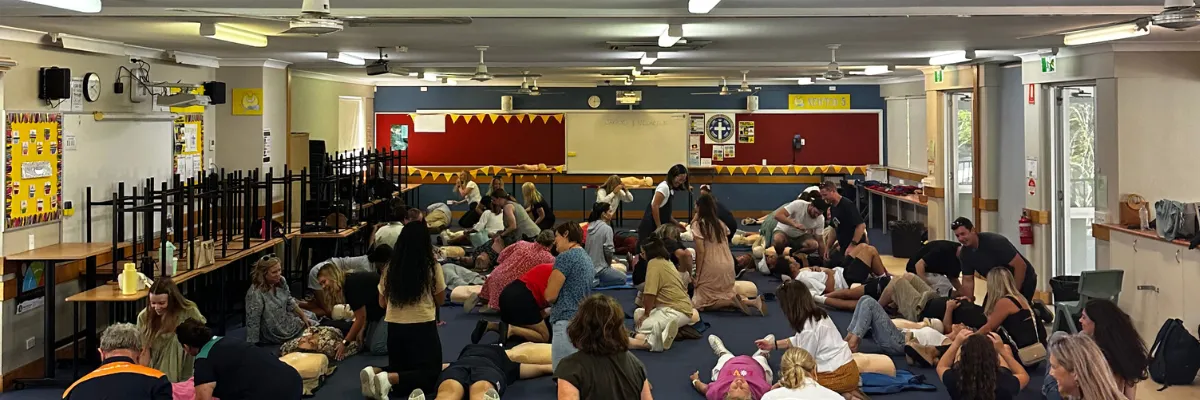
You already know the cost of pulling a crew off a live job for training that doesn't need to happen the way it usually happens. Lost billable hours, a job that slips, a client who starts asking questions. Group and on-site delivery deals with that, rather than sending each tradie off individually, you get the whole crew sorted in one session, timed around your actual job schedule rather than a fixed public course date. For a business running a small to mid-sized team, that's the difference between one coordinated session and weeks of chasing individuals to book themselves in separately.
Digital certificate delivery
This is the bit that actually matters once the training's done, the certificate. If you're handing paperwork to a principal contractor before a start date, waiting around for a certificate to land in the post isn't good enough. Digital certificate delivery means you've got proof in hand fast enough to actually use it.
Coverage across the Gold Coast
If your crew's working out of the Gold Coast's trade and industrial corridors, training that comes to where you actually are matters more than a course that's technically "on the Gold Coast" but inconvenient to get to.
A quick summary of what group booking typically looks like:
Sessions scheduled around live job commitments, not fixed public timetables
On-site delivery available across the Gold Coast
Digital certificates issued fast
Suited to small and mid-sized crews, so a whole team can be handled in one go
Booking is only half the equation, the provider you choose determines whether this holds up if it's ever questioned.
Choosing a Registered WHS Training Provider on the Gold Coast
Why RTO registration matters if this is ever audited
Here's the thing about training, anyone can run a course and hand you a certificate that looks official. What actually matters, if this ever gets questioned by an inspector, a principal contractor, or worse, after an incident, is whether that certificate came from a Registered Training Organisation. An RTO number means the training's been delivered against a nationally recognized standard, not just whatever the provider felt like covering that day. If you're skeptical about "training as an industry," this is genuinely the one thing worth checking before you book, not after.
Questions to ask before you book
A few things worth asking any provider before you hand over money:
Are you a Registered Training Organisation, and what's your RTO number?
Does the certificate reference UEECD0007 specifically, or something vaguer?
Can you deliver on-site or in a group, timed around our job schedule?
How fast do certificates actually land once training's done?
Have you worked with trade or electrical businesses before, or is this a generic safety course?
If a provider hesitates on any of those, that's worth noting.
What to look for in a provider
A provider worth trusting with this is a Registered Training Organisation delivering UEECD0007 specifically for trade and electrical businesses across the Gold Coast, with training run by people who bring real trade-context experience to the room rather than a generic corporate safety script. Look for group and on-site delivery built around your team, and certificates that go out fast.
If you want to check any of this yourself before booking, you can verify UEECD0007 directly on training.gov.au, worth doing if you'd rather see it in black and white than take a provider's word for it.
Conclusion
If you've made it this far, you've probably got a fairly clear picture now. OHS isn't the correct term anymore, WHS is, and for most electrical and trade businesses on the Gold Coast, UEECD0007 is the specific course your crew needs to hold before they can get on-site or qualify for that tender sitting on your desk. None of that needs to be complicated, and sorting it shouldn't cost you your working week either.
The confusion between OHS and WHS trips up more business owners than you'd think, simply because the old term stuck around in everyday conversation long after the law changed. That's not a reflection on you or your crew, it's just how language works when legislation moves faster than habit does. What matters now is knowing the difference, and knowing it's not just a technicality, it's the difference between paperwork that holds up and paperwork that doesn't.
Working out exactly who on your team needs to hold UEECD0007 is often the harder part, more than the training itself. Licensed electricians, apprentices, and site supervisors can all be caught by it depending on the job, the site, or the contract in front of you, and it's worth checking against whatever specific requirement put this on your desk rather than guessing. Getting that wrong in either direction, training people who didn't need it or missing someone who did, costs you time either way.
Group and on-site delivery exists precisely so a crew can get sorted without every tradie losing time off the tools, and fast digital certificates mean you're not left waiting once training's done, with a start date creeping closer and nothing to show for it. The businesses that handle this well aren't the ones with the most paperwork, they're the ones who got it sorted before anyone came asking.
At the end of the day, this comes back to something most Gold Coast trade business owners already feel even if they don't say it out loud. It's not really about ticking a box for an inspector, it's about not being the boss who let something happen because a competency had quietly lapsed. Getting current, getting it right, and getting proof in hand fast enough to use it, that's what actually protects the crew and the business behind them.