Nationally Recognized Low Voltage Rescue Course: Guide
Take a sparky who shows up for an early induction on a commercial job in Brisbane. Coffee in the cupholder, tools in the back, ready to go. Then the site supervisor checks his LVR ticket. Lapsed. He gets sent home, the builder reschedules, and the contractor who sent him loses a full day of billable work. All because a nationally recognised low voltage rescue course didn't get renewed on time.
That's all it takes to lose a day on the tools.
National recognition is what makes that ticket actually count. It means the unit, UETDRRF004 Perform Rescue from a Live LV Panel, is delivered and assessed by a registered training organisation listed on training.gov.au. And that's what builders, facility managers and induction portals are checking for. A nice looking certificate doesn't cut it. They want the unit code and the RTO behind it.
If you're running a small crew, getting this right is pretty simple. No knock-backs at the gate. No gaps in your training records. No mornings wasted standing outside a site office trying to sort it out on the phone.
This guide covers what makes an LVR course nationally recognized, how to check a provider and unit code from your phone, how often Queensland electricians need to renew, and how to book an LVR and CPR combo in Brisbane with early starts and same-day certificates.
How Do You Check If an LVR Course Is Nationally Recognized?
A nationally recognized LVR course is delivered by a registered training organisation (RTO) that has the low voltage rescue unit on its scope of registration. Completing it earns you a Statement of Attainment that's recognized across Australia. To check a provider:
Find the RTO number on the provider's website or booking page.
Search that number on training.gov.au and confirm the registration is current.
Check the LVR unit code (UETDRRF004 Perform rescue from a live LV panel) is listed on the RTO's scope.
Confirm you'll receive a Statement of Attainment showing the unit code and RTO number.
Check whether HLTAID009 Provide CPR is included, since site inductions usually ask for both.
What "Nationally Recognized" Actually Means for an LVR Course
Plenty of blokes have done LVR every year for as long as they can remember and never once looked at what's printed on the certificate. Fair enough. But that bit of paper is what the gate checks, so it's worth knowing what makes nationally recognized LVR training the real deal.
The three parts: RTO, unit code, Statement of Attainment
There's three things that have to line up:
The course is delivered and assessed by an RTO that has the unit on its scope.
You get a Statement of Attainment that lists the unit code, the unit title and the RTO number.
That statement is recognized in every state and territory. Do it in Brisbane, it counts interstate too.
Miss any one of those and it's not nationally recognized. Simple as that.
Nationally recognized vs in-house or "certificate of attendance" training
A toolbox session at the depot or a certificate of attendance from a quick run-through might feel like training. And it might even be decent. But neither shows a unit code, so induction portals reject them. The portal doesn't care how good the session was. It's looking for a code.
Nationally recognized | Non-accredited | |
Who issues it | RTO with the unit on scope | Employer, supplier or trainer |
Unit code shown | Yes | No |
Portable across states | Yes | No |
Accepted at induction | Yes | Usually rejected |
What UETDRRF004 covers
The unit is built around rescue from a live LV panel. That means hazard and risk control, using an LV rescue kit, and handing over to CPR once the casualty is clear. It doesn't cover overhead lines or underground cables. You can check the full unit details on training.gov.au. The national regulator, ASQA, oversees the RTOs delivering it.
Knowing what makes a ticket count is one thing. Checking it is quicker than you'd think.

How to Verify an LVR Provider on training.gov.au
Here's the good news. You don't need to ring anyone or dig through fine print. You can check an RTO's LVR course from your phone in the ute before your first job of the day.
Step-by-step check on your phone
Grab the RTO number off the provider's website or booking page.
Punch it into the training.gov.au RTO search.
Open the scope tab.
Look for the LVR unit code in the list.
That's it. If the code's there and the registration's current, you're good.
Red flags that a course won't pass induction
If you spot any of these, keep scrolling:
No RTO number anywhere on the site
No unit code, just a vague "LVR ticket"
Fully online with no practical rescue assessment
Certificates that take weeks to show up
That last one's a killer when you've got an induction on Monday. A certificate stuck in someone's inbox is about as useful as a multimeter with a flat battery.
Why LVR unit codes change, and what to look for
Training packages get updated every so often and unit codes change with them. So you might see a different code floating around from one year to the next. Don't stress about that. What matters is the unit sits on the provider's current scope and you walk away with a Statement of Attainment from a current RTO. You can read more about how RTOs are regulated on the ASQA site.
Once the provider checks out, the next test is the site gate.
Why Nationally Recognized LVR Matters on Brisbane Sites
Brisbane's got no shortage of work for sparkies right now. Warehouses, commercial fit-outs, hospitals, big infrastructure jobs. But the bigger the site, the tighter the gate. And that's where LVR training in Brisbane stops being a box you tick and starts being the thing that gets you through the door.
Site inductions and principal contractors
Builders, facility managers and the large projects around Brisbane typically check LVR and CPR currency at induction. Some check it at the portal before you even arrive. Others check it at the sign-in desk.
Either way, the result's the same if your ticket's lapsed or it isn't nationally recognized. You get turned away. The job gets pushed. And someone loses a day. Usually the bloke paying the wages.
Queensland rescue and resuscitation requirements
This isn't just a builder thing either. The Electrical Safety Regulation 2013 (Qld) requires workers doing electrical work to be trained in rescue and resuscitation. You can read the regulation yourself on the Queensland legislation site.
Training records after an incident
Nobody likes thinking about this part, but it's worth a minute. If something goes wrong on a job, the Electrical Safety Office may ask for your training records. Current Statements of Attainment are your evidence. That's it. Not an email saying someone did it, not a spreadsheet note. The statement.
So keep a copy for every person on your crew, somewhere you can find it fast. It's a quick job to file and it could save you a lot of hassle down the track.
Recognized training only helps if it's current, and in Queensland that clock resets every year.
How Often Queensland Electricians Need to Renew LVR and CPR
If you've ever wondered how often you need to do LVR in Queensland, the answer's short. Every year.
The annual requirement
The rescue and resuscitation training required under the Electrical Safety Regulation has to be kept current every year. Not every second year. Not "when the builder asks". Every year.
Why LVR and CPR are booked together
Rescuing someone off a live board is only half the job. Once they're clear, somebody's got to start CPR. That's why an LVR and CPR refresher in Brisbane is usually done as one session, with CPR taught to ANZCOR guidelines. One session, both tickets, done.
Aligning your crew to one renewal date
Most small crews have tickets expiring all over the calendar. One bloke in March, another in July, the apprentice sometime in October. Put everyone through together once and you've only got one date to remember from then on.
Here's what that annual session actually looks like when it's run properly.
What Happens in a Nationally Recognized LVR and CPR Course
A lot of experienced sparkies turn up expecting someone to read slides out loud. It shouldn't be like that. Here's what an LVR and CPR course in Brisbane involves when it's run properly.
Pre-course learning
Before the day, there's some online learning to knock over. It works on your phone, so it can be done at smoko or on the couch the night before. Every participant also needs a USI. Get that sorted early, especially for the apprentice or any new starters, because a missing USI holds up the certificate.
The practical rescue
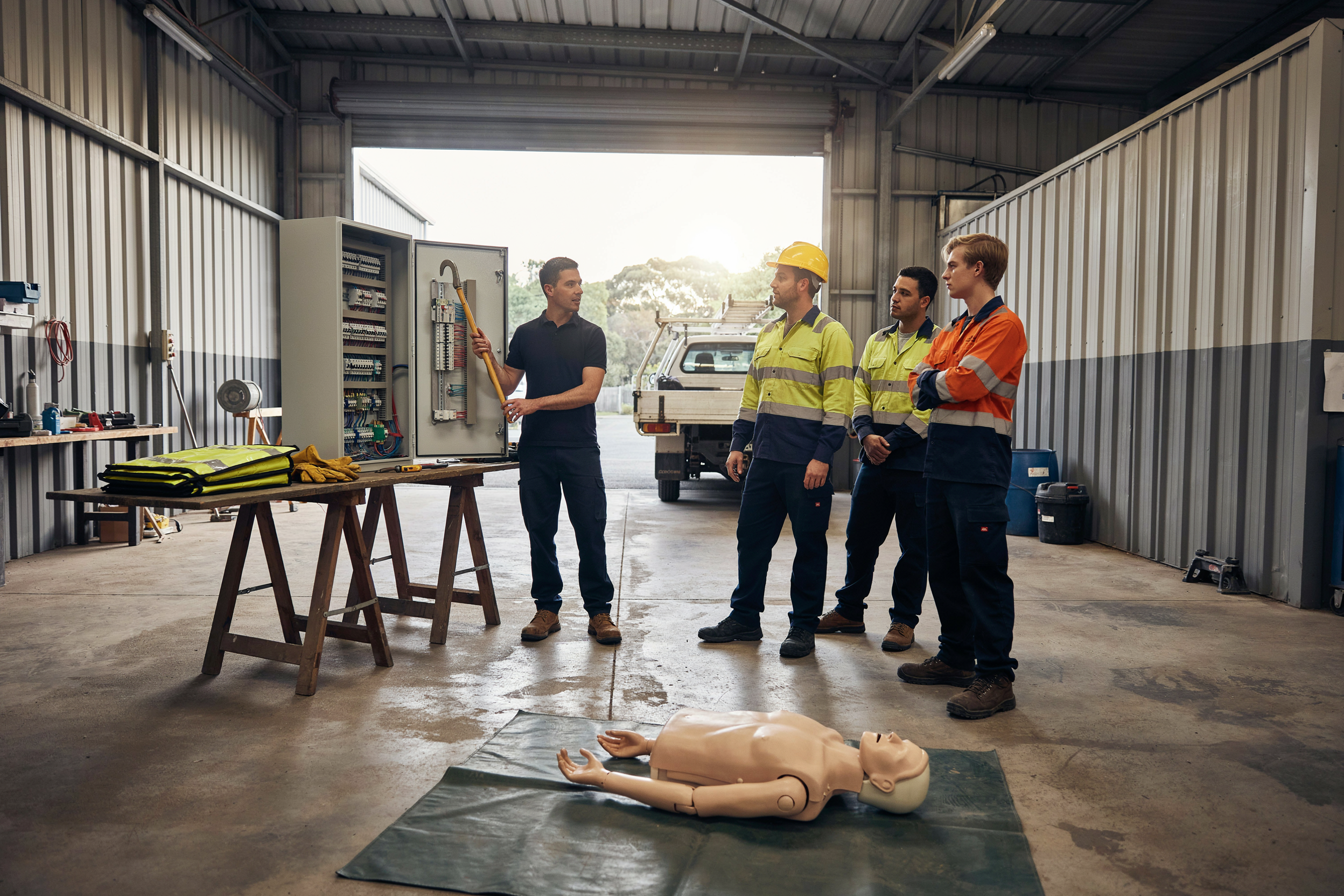
This is the part that matters. You'll work on a switchboard mock-up with a proper LV rescue kit and run through the whole thing hands-on:
Isolating the supply
Getting the casualty clear of the live panel
Moving the casualty safely to where CPR can start
Doing it with your hands is a different thing to hearing about it. It's the difference between knowing where the main switch is and actually reaching for it with your heart going flat out.
CPR assessment (HLTAID009)
Then it's straight into CPR. You'll be assessed on adult and infant CPR plus using an AED, all taught to ANZCOR guidelines.
Start times and certificates
Early starts are available, and certificates are issued the same day. That means the crew can be back on site the same day, certificates in hand, ready to upload to the next induction portal.
If that sounds like the kind of course your crew should be sitting, this is how to book it in Brisbane.
Onsite and Public LVR Courses in Brisbane with Accelerate First Aid
There's two ways to get your crew's LVR done. Bring the trainer to you, or head to a public session. Both get you the same nationally recognized ticket, it just comes down to what suits your week.
For a lot of small crews, onsite LVR training in Brisbane is the easy option. The trainer comes to your workshop or a client site, sets up the gear and runs everyone through in one hit. Nobody's driving across town before sunrise, and nobody's sitting in traffic when they should be on the tools.
Getting a quote is simple. Tell us about your crew and where you're based, and we'll send one through. It's a group LVR course in Brisbane without the headache of getting everyone to the same venue on the same morning.
If you've only got a couple of people due, a public course is the go. When you're searching "LVR course near me" you want something close to home or close to the job, so check the booking page for sessions across Brisbane.
On the day, bring your USI and photo ID. If you're only doing LVR, bring evidence of your current CPR too.
Every course is delivered with RTO 31106, which issues your Statement of Attainment. So you can check us on training.gov.au the same way you'd check anyone else, and have a read of our Google reviews while you're at it.
That way the whole crew gets sorted in one hit, with the paperwork lined up for every induction coming your way.