Nationally Recognized First Aid Certificate: 2026 Guide
A Brisbane site supervisor booked his team through a cheap online provider. Fast, easy, done. Three weeks later, his principal contractor rejected every single certificate — the course wasn't delivered by a registered training organisation. Fourteen workers. Monday morning. No site access.
It's a scenario that plays out more often than most people realise. And it's almost always avoidable.
A nationally recognised first aid certificate isn't just any piece of paper with a first aid logo on it. In Australia, "nationally recognised" has a specific legal meaning — it means the qualification was issued by a Registered Training Organisation (RTO) that's registered with the Australian Skills Quality Authority (ASQA). The certificate sits within the Health Training Package (HLT), and the unit code that represents the national standard for first aid is HLTAID011 — Provide First Aid.
HLTAID011 is the certificate that Queensland workplaces, childcare services, schools, construction sites, and healthcare employers ask for. It's valid for three years, with the CPR component needing annual renewal. And it has to include a hands-on practical assessment — full stop.
This guide covers exactly what the nationally recognised certificate is, who legally needs it in Queensland, how long it stays valid, how to spot a dodgy provider, and how to book the right course — whether you're an HR manager, a childcare educator, a tradie, a nurse, or just someone who wants to be ready if something goes wrong.
What Is a Nationally Recognised First Aid Certificate in Australia?
A nationally recognised first aid certificate is a qualification issued by an ASQA-registered Registered Training Organisation that's accepted across every Australian state and territory. The specific unit that represents the national standard is HLTAID011 — Provide First Aid. It sits within the Health Training Package (HLT), regulated by the Australian Skills Quality Authority (ASQA), and it's the benchmark qualification that regulators, employers, and industry bodies across Australia rely on.
A nationally recognised first aid certificate in Australia:
Is issued only by ASQA-registered Registered Training Organisations (RTOs)
Uses the unit code HLTAID011 — Provide First Aid (replaced HLTAID003 in 2021)
Is valid for 3 years, with the CPR component (HLTAID009) requiring annual renewal
Is accepted by WorkSafe Queensland, ACECQA, AHPRA, Safe Work Australia, and most employers
Includes a mandatory practical assessment — it cannot be completed 100% online
Is portable across all Australian states and territories
HLTAID011: Australia's Standard First Aid Certificate Explained
What HLTAID011 Replaced and Why the Code Change Still Causes Confusion
If you've pulled out an old induction checklist and it still says HLTAID003, you're not alone. Back in 2021, the Health Training Package went through a full refresh and HLTAID003 was replaced by HLTAID011 as the standard first aid unit code.
The skills covered are essentially the same — the content wasn't gutted and rebuilt from scratch. But the old code is superseded, which means HLTAID003 certificates are no longer being issued. If you're holding one, it remains valid until its expiry date. When it comes time to renew, your new certificate will carry the HLTAID011 code.
The problem is that plenty of Queensland employers and HR managers still have HLTAID003 written into their induction checklists, contractor management systems, and compliance registers. That causes confusion on both sides — workers who've just renewed under HLTAID011 getting questioned about whether their certificate is "the right one," and managers unsure whether to accept it. It's the right one. HLTAID011 is its direct replacement.
If you're responsible for a compliance register, it's worth doing a quick audit of any documentation that still references the old code and updating it.
What HLTAID011 Covers: Skills and Competencies
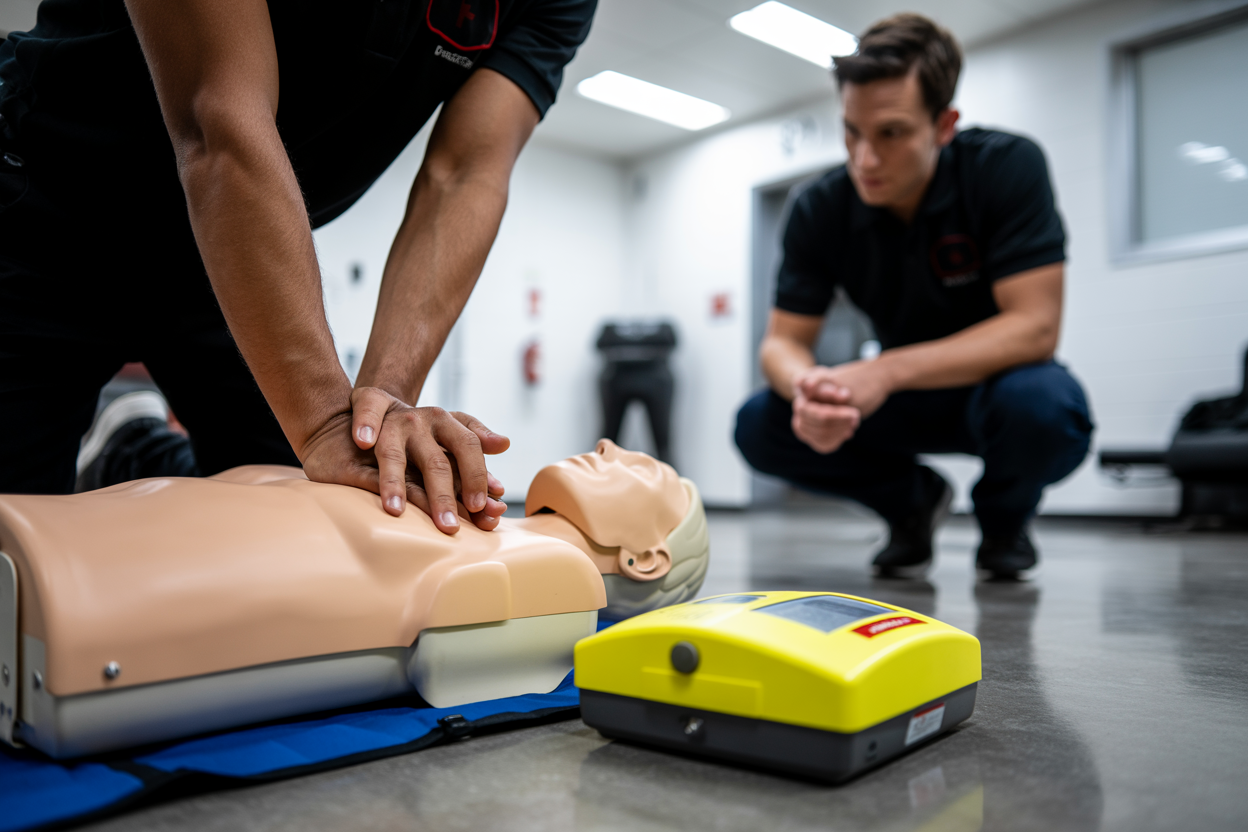
HLTAID011 is a full first aid qualification. It goes well beyond basic CPR. The skills covered include:
CPR — following current Australian Resuscitation Council (ARC) guidelines
AED operation — automated external defibrillator use
Choking — response for adults, children, and infants
Bleeding — wound management and haemorrhage control
Burns — assessment and initial management
Shock — recognition and treatment
Fractures — immobilisation and patient management
Unconsciousness — airway management, recovery position
Asthma and anaphylaxis — recognition and initial response (awareness level)
Scene management — assessment, bystander safety, emergency service liaison
Patient monitoring — ongoing observation until handover
The reference to "current ARC guidelines" matters. The Australian Resuscitation Council updates its guidelines as new clinical evidence emerges — compression ratios, ventilation protocols, defibrillation sequences. A quality RTO delivers training that reflects the most current version, not a five-year-old manual.
Can I Do HLTAID011 Completely Online?
One question that comes up constantly: can I just do the whole thing online?
No. HLTAID011 requires a mandatory practical assessment under ASQA standards. Any provider offering a fully online HLTAID011 certificate is not delivering to the required standard — and that certificate won't hold up when it's checked. The standard delivery model is blended: online theory at your own pace, followed by a face-to-face practical session where you're assessed on your hands-on skills. That blended model is the most flexible legitimate option, and it's the one ART uses.
Now that you know what HLTAID011 covers, the next question is whether you — or your team — are legally required to hold it.
Who Legally Needs a Nationally Recognised First Aid Certificate in Queensland?
Workplace First Aiders - Safe Work Australia and the Queensland WHS Act
Under the Safe Work Australia Code of Practice for First Aid in the Workplace, every Queensland employer is required to provide trained first aiders based on the risk profile of the workplace and the number of workers on site. This obligation flows through the Queensland Work Health and Safety Act 2011.
The number of first aiders your workplace needs depends on two factors — how hazardous the environment is, and how many people are working there.
Certificates must be held by designated first aiders who are available during working hours. A certificate sitting in a drawer belonging to someone who left the business six months ago doesn't satisfy the obligation.
Childcare and Early Childhood Education: ACECQA Requirements
The National Quality Framework (NQF) administered by ACECQA sets a clear requirement: at least one trained first aider must be on the premises at all times when children are present. That requirement extends to excursions — every trip off-site needs at least one qualified first aider in attendance.
One question that genuinely confuses a lot of childcare educators and centre directors is whether they need HLTAID011 or HLTAID012.
HLTAID012 — Provide First Aid in an Education and Care Setting is the childcare-specific unit, and it's the one that directly satisfies ACECQA's NQF requirements. HLTAID011 is the general first aid certificate. Some Queensland childcare services accept HLTAID011, while others require HLTAID012 specifically — and some hold both. Queensland DET licensing requirements layer on top of ACECQA, which is part of why the compliance picture feels complicated. If you're unsure which unit your service approval requires, see our dedicated HLTAID012 guide for childcare workers.
Schools and Educational Institutions DET Requirements
Queensland state schools operate under Department of Education and Training (DET) requirements that mandate designated staff hold current first aid qualifications. Student-to-trained-staff ratios apply, and the responsibility for maintaining a compliance register sits with school administration — not individual teachers.
For principals and school business managers, that means knowing at any given moment how many staff members hold current certificates, which ones are approaching expiry, and whether ratios are being maintained across all year levels. It's a moving target, particularly with staff turnover and mid-year appointments.

Healthcare and Aged Care Workers AHPRA and Employer Mandates
AHPRA doesn't prescribe a specific first aid certificate as part of registration requirements, but that doesn't mean healthcare workers are off the hook. Queensland Health, private hospitals, aged care facilities, and GP clinics routinely require current HLTAID011 — or in some cases HLTAID015 — as part of their credentialling and employment conditions.
HLTAID011 covers first aid at the standard community level. HLTAID015 — Perform Advanced Resuscitation and Respond to Chest Pain is the advanced unit designed for registered healthcare professionals who may need to manage resuscitation in a clinical context. If you're a registered nurse or allied health professional wondering which one your employer actually needs, see our HLTAID015 page for the full breakdown.
NDIS support workers are a specific sub-group worth calling out. NDIS practice standards require support workers to hold current first aid certification, and this is being checked more closely as the sector matures. If you're working with NDIS participants and your certificate has lapsed — or you've never held one — this is the gap to close.
Construction, Trades, and Site Workers
Safe Work Australia and most principal contractors in Queensland require at least one HLTAID011-certified first aider per work group on construction sites. For most sites, HLTAID011 isn't just recommended — it's a non-negotiable line item on the site induction checklist before anyone gets through the gate.
With Olympic infrastructure projects running through to 2032, the sustained demand for current first aid tickets across Queensland's construction workforce is as high as it's ever been. For tradies and site workers, the urgency is almost always the same: someone gets told midweek that their certificate needs to be current before the next site start.
Once you know which certificate applies to your situation, the next question is how long it stays valid — and what happens if it lapses.
How Long Is a Nationally Recognised First Aid Certificate Valid?
HLTAID011 carries a three-year validity period. That's the standard across all Australian states and territories. Once you complete your course and your certificate is issued, you've got three years before a full renewal is required.
The part that catches people out is the CPR component.
HLTAID009 — Provide Cardiopulmonary Resuscitation is embedded within HLTAID011, but it has its own renewal rhythm. Annual renewal of the CPR component is strongly recommended under Australian Resuscitation Council guidance, and a growing number of employers, regulators, and industry bodies are moving from "recommended" to "required." WorkSafe Queensland, many aged care employers, and most construction site induction packages now expect annual CPR renewal — not just triennial.
The practical implication: if you hold HLTAID011 and your employer requires annual CPR, you'll be doing a short HLTAID009 refresh each year and a full HLTAID011 renewal every three years.
What if your certificate lapsed and you've quietly kept working without saying anything? It happens more often than people admit — a renewal date slips by during a busy period, and before long it's been months. The fix is straightforward. You book a full HLTAID011 renewal, complete it, and your compliance is restored from the date the new certificate is issued. There's no penalty for the individual renewing — the exposure sits with the employer if a WorkSafe inspection happens to land in the gap.
What Makes a First Aid Certificate "Nationally Recognised" and What Doesn't Count
Back to the Brisbane site supervisor from the start of this guide.
He booked through an online provider. It looked legitimate — professional website, certificate emailed quickly, low price. What he didn't check was whether the provider was registered with ASQA. They weren't. No RTO number. No practical assessment. No USI collection at enrolment. Fourteen certificates that looked real and meant nothing.
What should have happened: an ASQA-registered RTO, blended delivery with a face-to-face practical component, certificates traceable on training.gov.au, and fourteen workers with site access on day one. The difference between those two outcomes is a 60-second check before booking.
How to Verify Your Provider
The National Register at training.gov.au is the authoritative source. Search the provider's RTO number — it should appear on their website, on their certificates, and on any enrolment documentation they send you. If you can't find an RTO number, that's your answer.
Verifying your provider's RTO number before booking takes 60 seconds at training.gov.au. It can save your team's site access.
Red Flags to Watch For
Not every dodgy provider is obviously dodgy. Some invest in professional-looking websites and polished marketing. Here's what to watch for:
No RTO number displayed on the website, course page, or certificate sample
100% online delivery with no face-to-face practical component — not possible for a legitimate HLTAID011
No USI collection at enrolment — every ASQA-registered RTO is legally required to collect your Unique Student Identifier
Certificates issued immediately upon completing an online module — legitimate blended delivery requires attending a practical session
Overseas or unregistered provider — a certificate from an unregistered entity has no standing under Australian law regardless of how professional it looks
Advanced Resuscitation Training is an ASQA-registered RTO delivering HLTAID011 across Queensland. Our RTO number is displayed on every certificate, every course page, and every piece of enrolment documentation we issue. You can verify it at training.gov.au in under a minute.

How to Get Your Nationally Recognised First Aid Certificate
Public Courses vs On-Site Group Training
There are two ways to get HLTAID011 done — public courses or on-site group training — and the right choice comes down to how many people you're training.
Public courses suit individuals and smaller groups. You book into a scheduled session, attend with other participants from various backgrounds and industries, and walk away with your certificate. It's straightforward and easy to book at short notice.
On-site group training is a different proposition entirely. If you've got a team to train, bringing the training to your workplace removes the logistical headache of moving people to an external venue, minimises time away from operations, and lets the trainer tailor scenarios to your specific environment. ART delivers on-site group training across Queensland. For HR managers coordinating compliance across a team, and for school administrators trying to get staff trained without disrupting operations, on-site delivery is the option that actually works at scale.
Flexible Scheduling
One of the most common reasons people put off getting their first aid certificate is scheduling. Weekday courses mean taking time off work — for shift workers, that's often not even an option.
ART runs weekend and flexible session times across Queensland. The blended delivery model helps too — completing the online theory component at your own pace before the practical session means your face-to-face commitment fits more easily around a roster, school pickup, or a weekend that's already half full. For nurses on rotating shifts, tradies who can't afford a lost day, and parents juggling family commitments — flexible scheduling is what makes the difference between actually booking and perpetually meaning to.
Book Your HLTAID011 Course
Getting your nationally recognised first aid certificate through ART is straightforward. Start by choosing your format — an individual public course if you're booking for yourself, or on-site group training if you've got a team. From there, check availability online or call us to work through scheduling options that suit your roster, your team, and your deadline.
Once you're booked, complete the online pre-learning at your own pace — self-guided, done whenever suits you. Then attend your practical session and walk away with a certificate that's accepted by Queensland employers, regulators, and industry bodies across every sector.
Don't let a lapsed certificate cost you site access, your audit, or your confidence in an emergency.