Nationally Accredited HLTAID015 Course in Brisbane | 2026
The accreditation surveyor is halfway through your staff training file when she stops at one certificate. It says "Advanced Resuscitation" in bold, but there's no unit code, no RTO number and no Statement of Attainment wording anywhere on the page. Your dental assistant did the course and sat through the oxygen demo, yet that certificate may not count as a nationally accredited HLTAID015 qualification.
That's the gap accredited training closes. HLTAID015 Provide Advanced Resuscitation and Oxygen Therapy is a unit of competency listed on training.gov.au, and only a registered training organisation can assess it and issue a certificate that surveyors and employers recognise. For Brisbane dental, medical and day surgery teams who rely on oxygen, suction, airway adjuncts and an AED, that certificate is your evidence the team can use the equipment in your emergency kit.
This guide explains what nationally accredited actually means, what your clinical team learns, how to check an RTO before you book, and how onsite group training works for practices that can't close their surgeries.
What Does Nationally Accredited Mean for HLTAID015?
A nationally accredited HLTAID015 course means you are assessed against HLTAID015 Provide Advanced Resuscitation and Oxygen Therapy, a unit of competency in the national HLT Health Training Package, by a registered training organisation (RTO). If you are found competent, you receive a Statement of Attainment recognised by employers across Australia.
To check a course is nationally accredited:
Search the RTO's number on training.gov.au.
Confirm HLTAID015 is listed on that RTO's scope of registration.
Check the course uses the current unit code, not the superseded HLTAID007.
Confirm you will receive a Statement of Attainment showing the unit code, unit title and RTO number.
Make sure there is a face-to-face practical assessment on resuscitation and oxygen equipment.
Still, accreditation on paper only counts for as much as what your team actually gets their hands on during the training day.
What Your Clinical Team Learns in a Nationally Accredited HLTAID015 Course
Plenty of practice managers have sat through the version where the oxygen cylinder gets wheeled out right at the end, everyone has a quick look, and that's the "oxygen therapy" box ticked. A nationally accredited HLTAID015 course doesn't work like that, and it's the difference worth looking for in any advanced resuscitation and oxygen therapy course Brisbane teams book. Your team gets assessed on actually using the equipment, not watching someone else do it.
The skills in the unit
The full unit sits on training.gov.au, but in plain English your staff learn how to:
Respond to an emergency
Check the casualty and recognise when they need CPR, advanced resuscitation or oxygen therapy
Run single-rescuer and two-rescuer resuscitation with oxygen
Use airway adjuncts and suction
Give oxygen to a casualty who's still breathing
Use an automated external defibrillator (AED)
Maintain the equipment
Hand over to paramedics and debrief afterwards
That last one gets overlooked a lot. The debrief is where a team learns from the event instead of just surviving it.
Equipment your team gets hands-on with
This is where a proper oxygen therapy course Brisbane clinics book differs from a standard CPR class. Staff work through the kit themselves.
Equipment | What staff practise |
Oxygen cylinder and regulator | Setting up oxygen for resuscitation and for a breathing casualty |
Non-rebreather mask | Giving oxygen to a breathing casualty |
Nasal cannula | Giving oxygen to a breathing casualty |
Bag-valve-mask (BVM) | Two-rescuer ventilation with compressions |
Oropharyngeal airways (OPA) | Using airway adjuncts |
Suction unit | Clearing the airway |
AED | Using the AED during resuscitation |
What the practical assessment looks like
According to the Assessment Requirements, each person has to show:
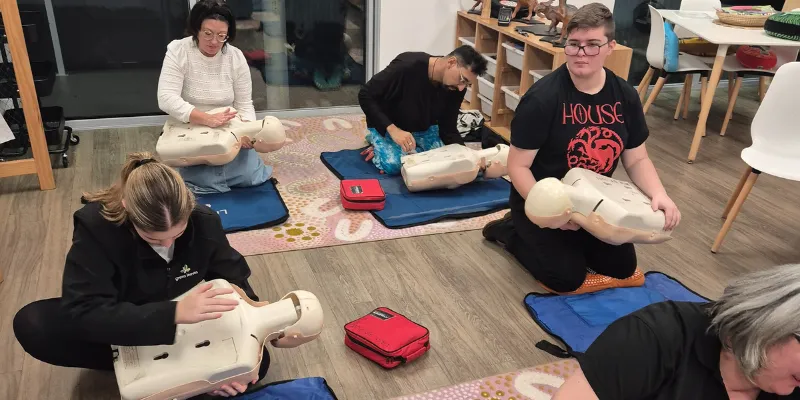
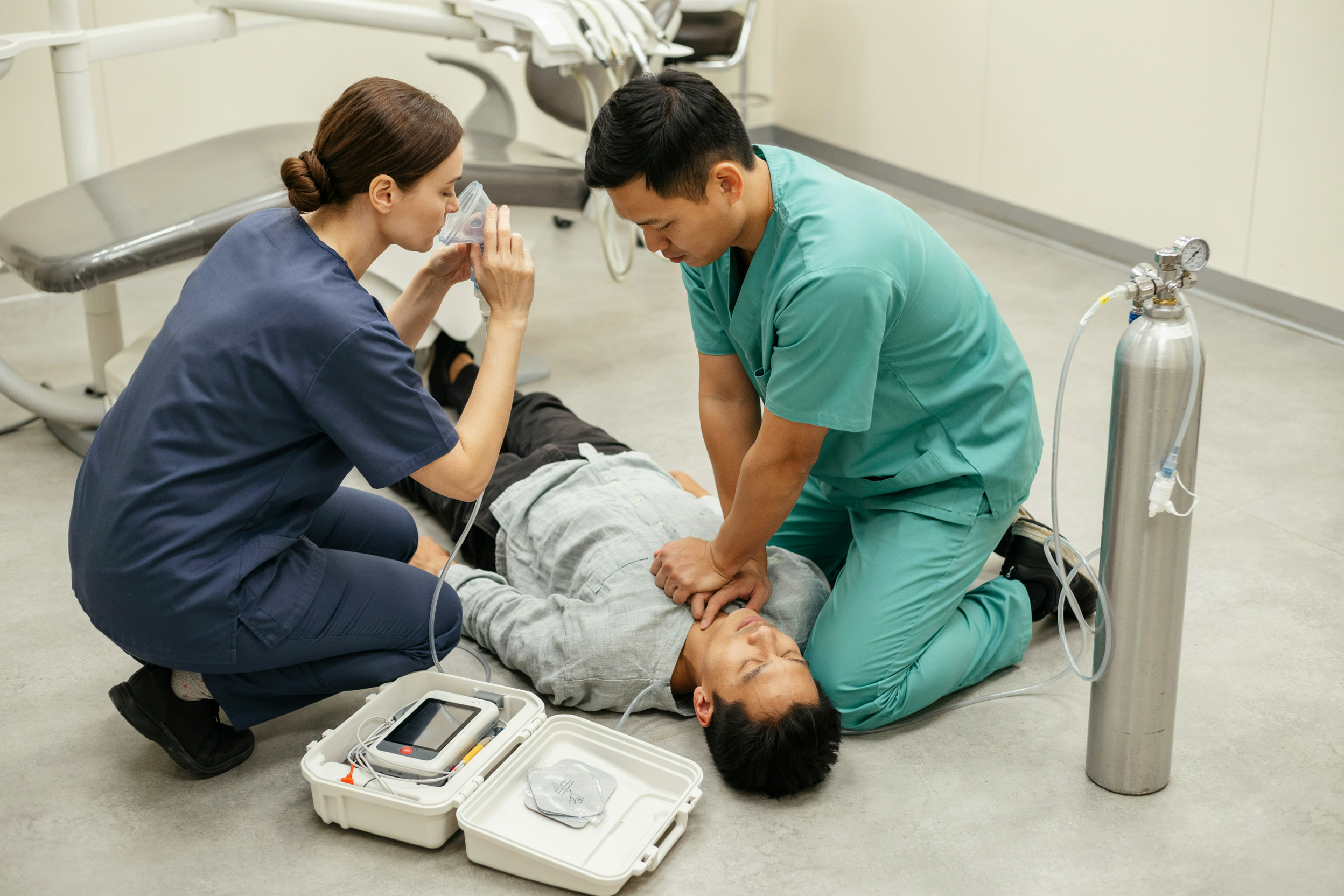
Uninterrupted CPR on an adult manikin on the floor
Two-rescuer BVM ventilation with compressions
Infant CPR
Maintaining resuscitation and oxygen equipment
The floor bit matters. Good compressions need a firm surface, and in a real arrest that's where you'll end up, kneeling beside the patient. It's the same physical standard that shows up in the advanced resuscitation course prerequisites.
How this applies in a dental or clinic setting
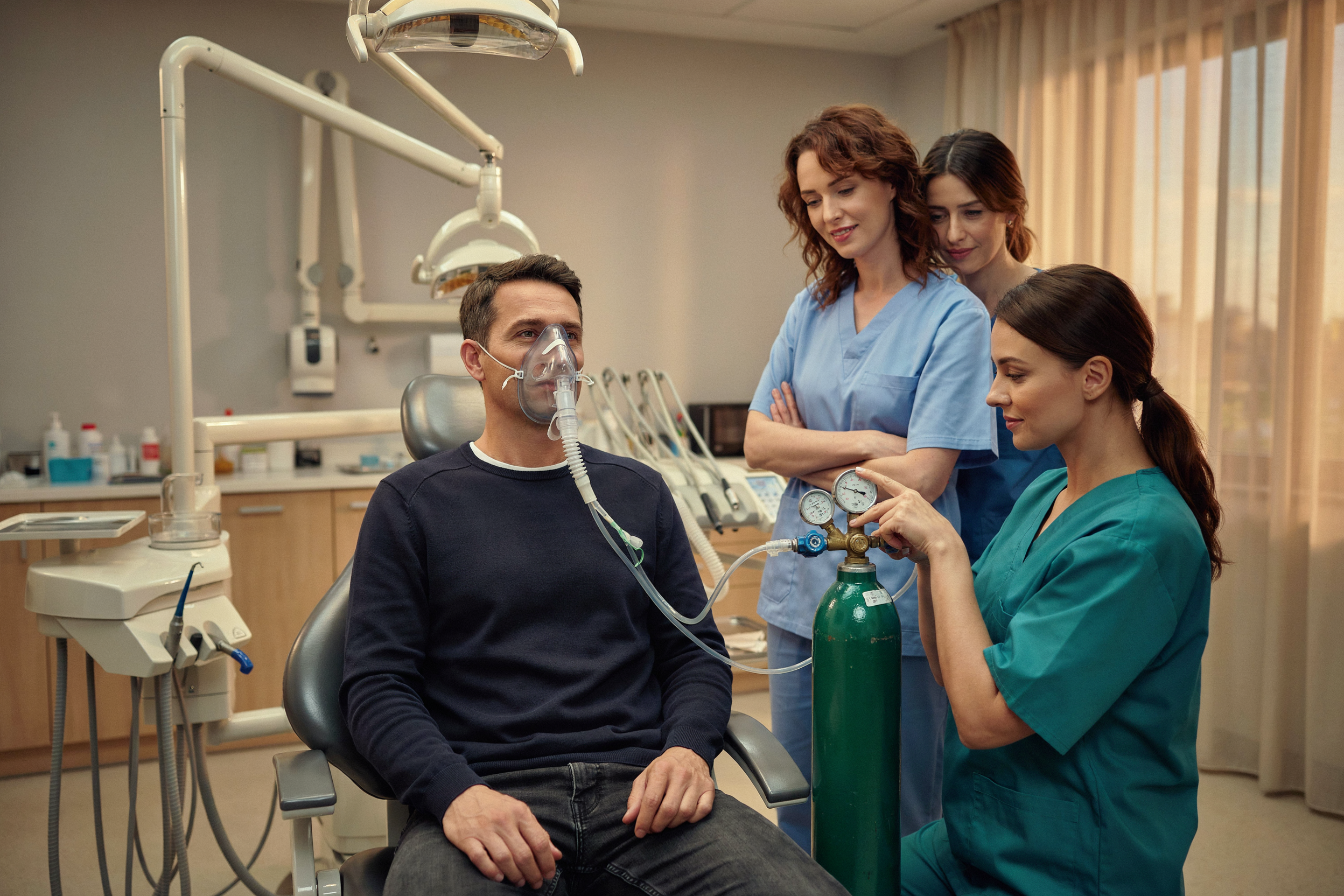
On a sedation day your team is the first response before any ambulance arrives, and these skills line up directly with what's in your emergency kit. Setting up oxygen, managing an airway and working as a two-person unit next to the chair is the whole point. That's what our HLTAID015 Provide Advanced Resuscitation and Oxygen Therapy course is built around.
So that's what gets taught. The next question is who's actually allowed to assess it.
How to Verify a Nationally Accredited HLTAID015 Provider in Brisbane
Here's the thing about booking HLTAID015 Brisbane training for a whole team. If the provider isn't legit, you don't find out until the surveyor does. Checking is quick, and you don't need to ring anyone.
Search the RTO on training.gov.au
Every registered training organisation has a public listing. Go to the training.gov.au organisation search and:
Search the RTO number from the provider's website or quote.
Open the Scope tab on their listing.
Find HLTAID015 in the list of units they're approved to deliver.
As a worked example, search RTO 31106 and follow the same steps. If HLTAID015 isn't on a provider's scope, they can't issue a nationally recognised HLTAID015 certificate, full stop. Doesn't matter how good the trainer is.
What a valid Statement of Attainment shows
Once your team finishes, the certificate is your evidence. A proper Statement of Attainment should show:
Learner name
Unit code (HLTAID015)
Unit title
RTO name and number
Issue date
Nationally Recognised Training logo
When you train with us, HLTAID009 Provide cardiopulmonary resuscitation appears on the same Statement of Attainment too, so the CPR side is on record.
Honestly, if you only check one thing, check the unit code and RTO number. That's what a surveyor looks at first.
Red flags before you book
⚠️ Watch out for these
"Advanced resus" advertised with no unit code
No RTO number on the website or quote
Online-only, with no practical assessment
HLTAID007 still being advertised
A "certificate of attendance" instead of a Statement of Attainment
A trainer who can't name the equipment they bring
Any one of these is worth a phone call before you pay. Two or more, and I'd keep looking.
Once the provider checks out, the next job is booking each person in your practice into the right unit.
HLTAID015 vs HLTAID011 vs HLTAID009: Booking the Right Level for Each Role
Not everyone in your practice needs the same course. The HLTAID015 vs HLTAID009 question comes up a lot, but it's really a three-way picture, because HLTAID011 sits in the middle and actually contains HLTAID009. They're levels that build on each other, not options competing for the same job.
Unit | What it covers | Who in the practice |
HLTAID009 | CPR only | Admin staff (minimum) |
HLTAID011 | Full first aid; includes HLTAID009 and HLTAID010 | Front desk; prerequisite for HLTAID015 |
HLTAID015 | Advanced resuscitation and oxygen therapy | Dentists, oral health therapists (OHTs), sedation-day assistants, nurses |
The HLTAID011 prerequisite
Your clinical staff need HLTAID011 before they can do HLTAID015, so book that in first for anyone who doesn't already hold it.
HLTAID007 is the old code
If older certificates in the file show HLTAID007, that's the unit HLTAID015 replaced. It's been superseded and the two aren't equivalent, so HLTAID015 isn't just a new name stuck on the same course. No need to panic over those older certificates though. They get replaced with HLTAID015 at each person's next renewal.
Which unit suits each role
Role | Commonly booked |
Dentist, sedationist, dental assistant (sedation days) | HLTAID015 |
Oral health therapist, dental assistant (general) | HLTAID015 or HLTAID011, confirm with your principal dentist |
Front desk, practice manager | HLTAID011, with HLTAID009 as the minimum |
With the level sorted for each person, the question becomes when and where the training happens.
Onsite Advanced Resuscitation Training for Brisbane Practices and Clinics
The biggest problem with training a clinical team usually isn't finding a course. It's finding a time. You can't close the surgeries, you can't cancel a sedation list, and sending people off one by one means multiple dates, parking and a lot of juggling. Onsite advanced resuscitation training Brisbane practices book gets around all of that by bringing the course to you.
After-hours and Saturday sessions
Training runs after the last patient's gone, or on a Saturday morning, so no sedation list gets cancelled and no appointments get moved. Blended pre-learning means staff knock over the theory online beforehand, which shortens the practical on the night.
Training on your own oxygen, suction and AED
This one's underrated. If a trainer brings a different regulator, suction unit and AED, your team learns on gear they'll never touch again, and on the day it counts that's where hesitation creeps in. Practising on the exact kit in your emergency trolley means the muscle memory carries straight over.
Group onsite or public class?
When most of your clinical team needs training, HLTAID015 group training Brisbane practices book onsite is usually the simpler option. If it's only a couple of new starters, seats in a public class make more sense than bringing a trainer out.
Getting everyone through training day is one part. Keeping the whole team current year after year is the other.
Keeping Your Team Current: Renewal, Records and Accreditation Evidence
Booking the training is the easy bit. The follow-through is what wears you down.
How often HLTAID015 is refreshed
Something that surprises a lot of people: the HLTAID015 unit itself has no expiry date. How often you renew advanced resuscitation is set by your employer, industry bodies and insurers, not by the unit.
In practice, most healthcare employers work to an annual refresher, in line with resuscitation guidance from ANZCOR. So an HLTAID015 refresher Brisbane clinics book every year is the normal rhythm, and it stops skills fading on gear your team doesn't touch every day.
What accreditation surveyors tend to ask for
Surveyors generally want evidence your staff are trained, which in practice means training records, current certificates and evidence you've run drills. The ACSQHC guide to the Primary and Community Healthcare Standards talks about staff training broadly. It doesn't name HLTAID015, but a current Statement of Attainment for each clinical staff member is solid evidence.
The sedation standard your dentist works to
Dentists endorsed for conscious sedation complete an approved course in sedation and medical emergencies, and they work to ANZCA PS09, the guideline for sedation and analgesia for procedures. Having the whole team currently in HLTAID015 supports that standard in the room, but it isn't something the Board requires of your assistants or OHTs.
Tracking renewal dates without a spreadsheet headache
An onsite group booking pays off twice here. Everyone trains together, so certificates arrive in one batch and renewals line up. Add a drill log between sessions and your accreditation evidence mostly looks after itself.
Booking Nationally Accredited HLTAID015 Training That Stands Up to an Audit
Think back to that surveyor stopping at the certificate with no unit code on it. That moment is completely avoidable, it just takes a bit of checking before you book.
A nationally accredited HLTAID015 course comes down to things you can actually see. The right unit code, an RTO with HLTAID015 on its scope, a proper Statement of Attainment and a face-to-face practical for every person.
What happens on the day matters just as much. Your team should be hands-on with oxygen, suction, airways, the bag-valve-mask and the AED, running two-rescuer resus on the floor like they would for real.
Checking a provider on training.gov.au is quick. And if you spot "advanced resus" with no unit code, HLTAID007 still advertised or a certificate of attendance, keep looking.
Book the right level for each person. HLTAID015 for your clinical and sedation staff, HLTAID011 for the front desk, and HLTAID009 as the minimum for admin.
For most practices the sticking point is timing, not the course. Onsite training after the last patient leaves, on your own kit, means no sedation list gets cancelled and the muscle memory carries straight over.
Then keep everyone current, with records you can find fast. Because what you're really after isn't a certificate in a folder, it's knowing that if a patient goes down in the chair, your team moves fast and gets it right.