

LVR Compliance Training: What Every Employer Must Know
It's early on a Monday. Your electrician rocks up to site induction, same as always. He's got his boots on, his gear in the Ute, and he's ready to start. Then the WHS coordinator pulls him aside, checks his tickets, and sends him home.
His LVR certificate expired three weeks ago.
The job starts without him. You're scrambling to find cover, explaining to the principal contractor why your guy isn't on the tools, and now someone's not getting paid. All because of one lapsed ticket.
This is the most common way LVR compliance training becomes a problem - not through ignorance, but through one of those admin things that slips through the cracks when you're running a team and chasing jobs at the same time.
If you're an electrical contractor, employer, or WHS coordinator managing a crew in Queensland, this article is for you. We're covering who needs UETDRRF004, how often it renews, what the law requires, and how to manage group LVR compliance training without the last-minute scramble.
What Is LVR Compliance Training?
LVR compliance training is the mandatory training requirement for electricians and electrical workers who work on or near live low voltage panels. It's delivered as the unit of competency known as UETDRRF004 - "Perform rescue from a live LV panel" - under the UET Electrotechnology training package, and it must be completed through a registered RTO to count on site.
LVR compliance training covers:
Recognizing electrical hazards at a live LV panel
Safely isolating power in an emergency
Performing a rescue from a live LV panel without becoming a second casualty
Delivering CPR and operating an AED following electrical shock
Completing the UETDRRF004 unit under a registered RTO - resulting in a nationally recognized statement of attainment
Who Needs LVR Compliance Training in Queensland?
Short answer: if your workers are anywhere near a live low voltage panel, they need a current UETDRRF004.
Licensed Electricians and Apprentices
The obvious group - but there's more nuance here than most employers realize.
Any electrician working on or near live LV panels needs a current certificate - not just the sparky doing the switchboard work, but anyone in the same environment who might be first on scene. Fourth-year apprentices are commonly required to hold LVR before site rotation. Solar installers working on switchboard connections need it too. Data or comms technicians working in electrical environments can also fall under the requirement, depending on the site.
Industries That Mandate LVR
It's not just construction sites. LVR compliance training is mandated across a wide range of industries:
Construction - principal contractor site conditions almost universally require it for electrical workers
Facilities management - anyone maintaining commercial or industrial electrical infrastructure
Mining services and utilities - standard requirement, often with stricter enforcement
Solar installation companies - a growing requirement across residential and commercial sectors
Government and infrastructure contractors - LVR is standard for electrical roles on public infrastructure projects
When a Principal Contractor Can Turn Your Worker Away
At site induction, the WHS coordinator checks tickets. If your worker's UETDRRF004 is expired - even by a day - they don't get on site. No grace period on Tier 1 construction sites. If you've committed a worker to a start date and they can't get through induction, you wear that problem.
Now you know who needs it - here's exactly what the training involves.
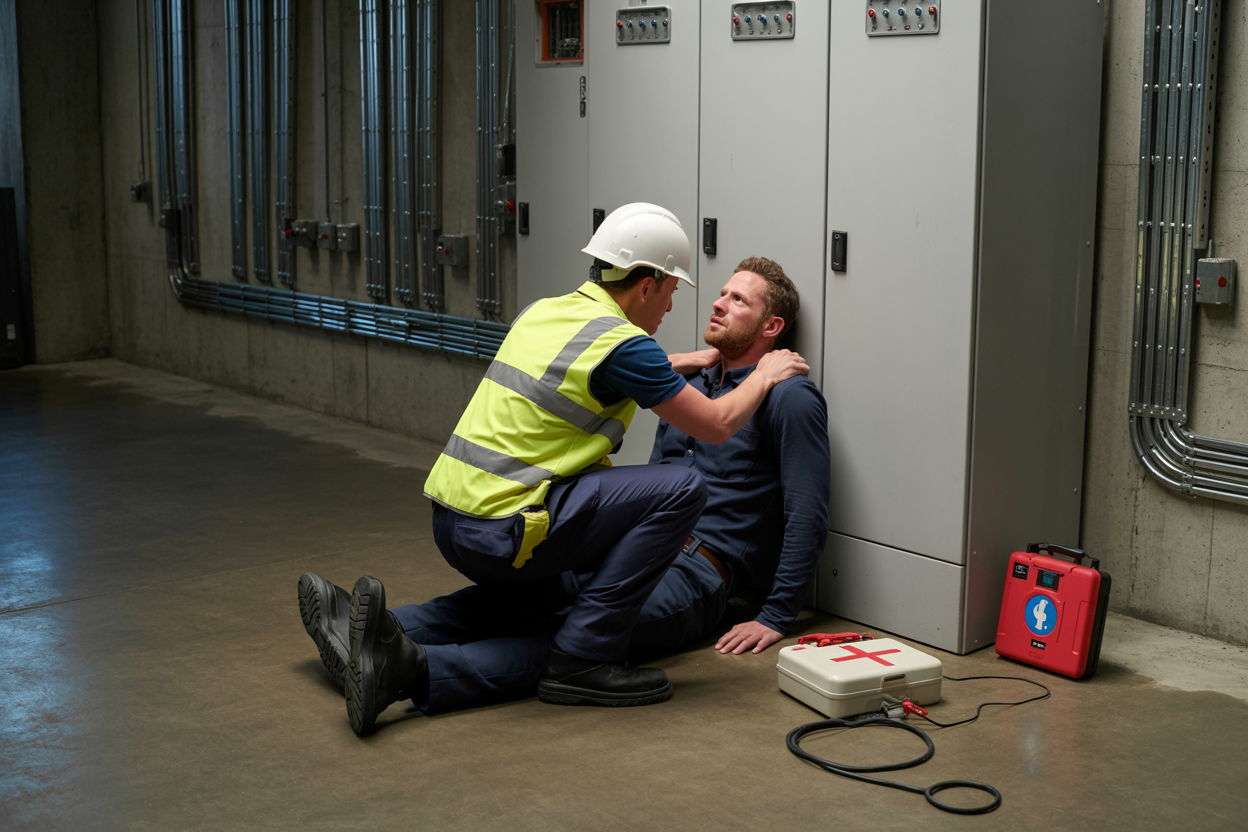
What Does LVR Compliance Training Actually Cover?
A lot of employers assume LVR is just a theory refresher with a tick-and-flick assessment at the end. It's not. The UETDRRF004 unit has real practical requirements - and that's a good thing, because the scenarios it prepares workers for are genuinely dangerous.
The UETDRRF004 Unit of Competency
UETDRRF004 is delivered under the UET Electrotechnology training package the same nationally recognized framework that governs electrical trade qualifications in Australia. The content, assessment standards, and certificate format are consistent regardless of which registered RTO delivers it.
The unit covers hazard identification at a live LV panel, isolation procedure, physical rescue without becoming a second victim, CPR following electrical shock, and AED operation. Defibrillation is often required after electrical incidents because ventricular fibrillation is a known consequence of LV shock.
It must be delivered by or under a registered RTO. A provider that isn't RTO-registered - or doesn't clearly disclose the RTO they deliver under - can't issue a certificate that'll hold up at site induction.
Practical vs. Theory
Here's what most tradies actually want to know: how much of it is sitting in a room listening to someone read slides?
Not much. The practical rescue scenarios are the core of the assessment. Your workers will physically simulate a rescue from a live panel, perform CPR on a manikin, and operate an AED. The theory side covers hazard identification, electrical safety law, and emergency response protocols - but it's not an all-day slide deck.
What the Certificate Confirms
When your worker completes the course, they receive a nationally recognized statement of attainment that is verifiable via the RTO's AVETMISS records, includes the UETDRRF004 unit code, and is accepted by principal contractors across Queensland and Australia.
The course itself is straightforward. What catches most employers off guard is how quickly that certificate expires.
How Often Does LVR Training Need to Be Renewed?
This is the one that trips up even experienced employers. A lot of people assume LVR renewal works the same way as first aid - every three years, done. It doesn't.
The 12-Month Validity Rule
UETDRRF004 is valid for 12 months from the date of issue. Every year, without exception.
It's one of the more frequent renewal cycles in the compliance world, and easy to lose track of when your workers hold several different tickets that all expire at different times. First aid is three years. CPR is annual. White card is indefinite. LVR is annual.
LVR renewal is not a refresher either. Your worker completes the full UETDRRF004 unit again - same practical requirements, same assessment standard.
What Happens When a Certificate Lapses
If a worker shows up to site induction with an expired LVR ticket, they're not getting on site. No exceptions on Tier 1 sites - and increasingly, no exceptions on mid-tier sites as principal contractors tighten their WHS documentation requirements.
There are two problems - the obvious one and the one most employers don't think about. The obvious one: your worker can't start, you lose time, and someone doesn't get paid. The less obvious one: if a worker was deployed in a live LV environment with an expired certificate and something went wrong, your business has a WHS liability exposure. Under Queensland law, competency has to be current and demonstrable.
How to Track Renewal Dates Across a Team
A basic spreadsheet with each worker's name, completion date, and expiry date - checked monthly - will catch most problems before they become urgent. Set reminders at the 10-month mark so you've got a buffer window to book.
Stagger bookings where possible - if your whole team did LVR in the same group session, they all expire at the same time. Spread them out and you smooth the renewal cycle.
Use an RTO that sends renewal reminders - not every provider does this, but the good ones do.
Employer Obligations Under Queensland WHS Law
If you're running an electrical contracting business in Queensland - even a small one - you need to understand what the law actually requires when it comes to LVR compliance training. Because "I didn't know his ticket had expired" is not a defense.
The Work Health and Safety Act 2011 (Qld)
Under Section 19 of the Work Health and Safety Act 2011 (Qld), a business has a primary duty of care to ensure workers are competent to perform the tasks they're assigned. That competency has to be demonstrable and verifiable - and for electrical workers performing LV panel work, a current UETDRRF004 certificate is the accepted standard.
It's not enough for your worker to have done the course once two years ago. Competency for LVR is defined as current - within the last 12 months. WorkSafe Queensland's guidance on managing electrical risks reinforces this - the obligation isn't just to provide training, it's to ensure training is current and appropriate for the work being performed.
PCBU Responsibilities for Subcontractors
If you're engaging subcontractors for electrical work - not just employees - you may still carry WHS obligations as the PCBU (person conducting a business or undertaking). You could be responsible for ensuring those subcontractors have a current UETDRRF004 before they set foot on site.
Build a simple pre-engagement check into your subcontractor onboarding. Ask for current tickets before committing anyone to a job. If their LVR is expired, that's their problem to fix - but deploy them anyway and it can quickly become your problem too.
Group LVR Training - The Smarter Option for Electrical Contractors
If you've got more than a couple of electricians on your books, booking them individually for LVR courses is the hard way to do it. Different dates, different invoices, different expiry dates - and someone always ends up booking last minute. Group LVR training fixes most of that in one session.
When your whole team does LVR compliance training together, you've got one expiry date to track, one renewal cycle to plan around, and zero risk of someone slipping through the cracks. For teams of four or more, onsite UETDRRF004 delivery is available. The trainer comes to your depot or workshop with all equipment needed for the practical scenarios, AED training, and CPR assessment - no travel time lost.
Arranging group training is a simple enquiry - name, business name, number of staff, and preferred dates.
How to Choose a Registered LVR Training Provider
Not all LVR providers are equal. A certificate from the wrong provider - or one that isn't properly registered can get your worker turned away just as fast as an expired one.
What to Verify Before You Book
1. They deliver UETDRRF004 specifically. Not a generic electrical safety course. The certificate your worker needs at site induction has to show UETDRRF004 as a completed unit of competency. If the provider can't confirm that's what they're delivering, move on.
2. They're a registered RTO - or deliver under one. You can verify any RTO's registration directly on training.gov.au. If a provider doesn't display their RTO number on their website, that's a problem.
3. The certificate format is nationally recognized. The statement of attainment must include the unit code, the RTO details, and be issued under the UET training package. If the format has ever been questioned on site, that's a red flag.
What Good LVR Training Looks Like
A generalist safety trainer who's never worked in the electrical trade will lose the room inside ten minutes. Tradies can tell. Look for a trainer with hands-on electrical trade experience, practical rescue scenarios with realistic equipment, and Google reviews from tradies that mention the practical content and certificate acceptance on site.
Red Flags to Watch For
No RTO number displayed anywhere on the website
No upcoming course dates listed
LVR bundled inside a longer program you don't need
Any report that the certificate format has been questioned on site
The Bottom Line on LVR Compliance
LVR compliance training is one of those things that's easy to stay on top of when you've got a system - and genuinely painful when you don't. A lapsed certificate doesn't just inconvenience the individual worker. It stalls jobs, creates WHS exposure, and puts you in the position of explaining to a principal contractor why your guy isn't on site when he's supposed to be.
The fix is straightforward. UETDRRF004 is a practical, focused unit that your workers can complete and walk away from with a nationally recognized certificate in hand. Group training makes it even easier - one session, one invoice, the whole team sorted. With a basic renewal tracking system in place, you should never be scrambling at the last minute again.
LVR compliance is a site access condition, not an optional extra. The sites your workers need to be on require it. Queensland WHS law backs it up. And the cost of staying on top of it is a fraction of what it costs when someone gets turned away at induction.