
Low Voltage Rescue Assessment: What to Expect
You've got your low voltage rescue assessment booked in. Maybe it's next week, maybe it's tomorrow morning before you're back on site by lunch. Either way you're probably doing what most tradies do the night before a practical assessment, lying there running through it in your head, wondering exactly what's going to happen when you walk in the door.
Here's the thing worth knowing straight up. The assessment isn't set up to catch you out. It's there to confirm you can actually do the job if it ever counts, isolate the hazard, get someone clear, and respond properly. That's it. Nobody's hiding tricks in the fine print, and nobody's trying to trip you up with a curveball you haven't trained for.
Most electricians who've been in the trade a few years have already had the "what if" conversation in their own head at some point, usually after hearing about an incident on another site, or after a near miss of their own. That's normal. It's part of why this ticket exists in the first place, and it's exactly why the assessment is built around real scenarios rather than a written test you can cram for the night before.
In this one we'll walk through what's actually assessed, what to bring with you, the spots where people tend to lose marks (and how to just not do that), and what happens the moment you pass.
There's no trick to any of it. Everything covered here is exactly what the unit is designed to check, nothing more, nothing hidden. If you've done the training properly and you walk in ready to actually run the process rather than just talk about it, you're already most of the way there.
What Happens During a Low Voltage Rescue Assessment?
Quick answer, if you just want the bones of it:
That's the full sequence, and it's the same sequence every time, whether it's a drill or the real thing. On the day you'll be assessed with an assessor watching on, running through each of these steps in order so they can see how you actually think and move under a bit of pressure, not just whether you can recite the theory.
It's worth getting comfortable with the idea that this is a practical demonstration, not an interrogation. The assessor isn't trying to catch you second guessing yourself, they're trying to see that the sequence is genuinely locked in, so that if it's ever needed for real, it comes out the same way, calm and in order, without anyone standing over your shoulder telling you what's next.
What's Actually Tested in a UETDRRF004 Assessment
This is the bit everyone actually wants to know. Not the theory, not the paperwork, what you're going to physically be doing when the assessor's got their clipboard out.
Hazard Identification and Scene Assessment
Before you touch anything, you've got to show you can read the scene. Where's the danger, is it still live, is the area actually safe for you to approach. This sounds obvious until you're standing there with an assessor watching and your brain wants to rush straight to the rescue part. Slow down here. It's the first thing they're looking at and it sets up everything after it.
Most electricians have done this exact scan a thousand times without thinking about it, walking onto a switchboard, clocking what's live and what isn't, sizing up the space before you get your tools out. The assessment is really just asking you to do that same scan out loud, deliberately, so the assessor can see the thinking rather than just the end result. It feels a bit unnatural at first, narrating something you'd normally just do instinctively, but that's the whole point. They need to see the process, not guess at it.
A lot of tradies actually find this the trickiest part of the whole day, not because the skill is hard, but because verbalizing something automatic feels forced. Give yourself permission to sound a bit clunky here. The assessor isn't marking you on how smooth your commentary is, they're marking you on whether the right checks are actually happening in the right order.
Isolating the Power Source
Next you've got to isolate the power, and isolate properly, not just switch something off and hope. You're expected to verify it's actually dead before you go near the casualty. This is probably the single most important part of the whole assessment, because in the real world it's the difference between a rescue and a second casualty.
Every sparky knows the drill here, switch off, lock out, tag out, test. It's the same discipline you'd use isolating a board before you start any live work, and the assessment is checking that discipline holds up even when there's someone lying on the ground in front of you and every instinct is screaming at you to just get to them. That urgency is exactly what trips people up, and it's exactly what the assessment is designed to test for.
Think about how many times you've isolated a circuit purely as routine, no drama, no pressure, just standard procedure before you start work. The assessment is asking whether that same standard holds up when the stakes are suddenly personal. It usually does, because it's genuinely muscle memory by this point in most tradies' careers, but the nerves of being watched can make people rush a step they'd never normally skip.
Safe Removal Using Insulated Rescue Equipment
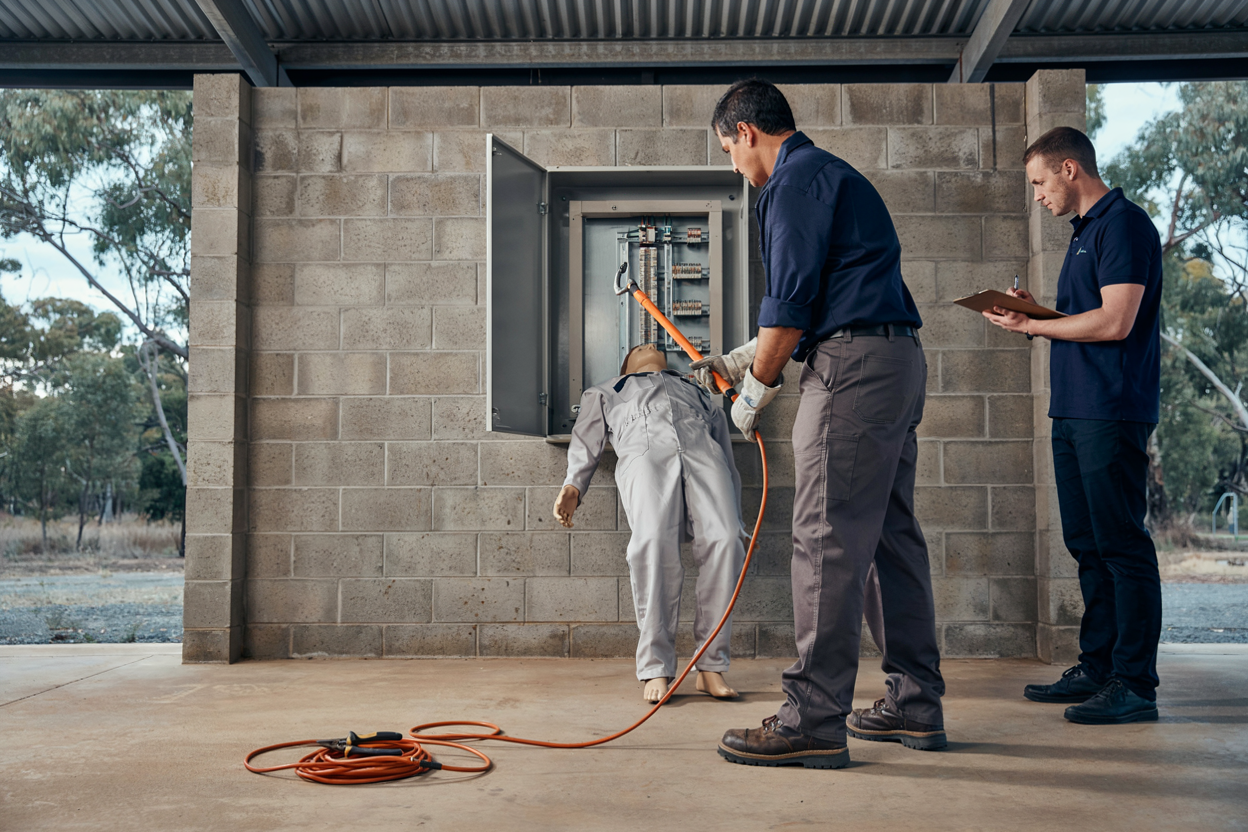
Once it's isolated, or if you can't isolate it fast enough and you're using proper insulated equipment to break contact instead, you're removing the casualty safely. Insulated rescue crook, insulated gloves, whatever your kit calls for. No bare hands, no shortcuts, no "she'll be right."
There's a reason this equipment exists and a reason you're trained on it specifically rather than just told to "get them clear somehow." Grabbing a casualty with bare hands while there's any chance the circuit is still live doesn't rescue anyone, it just adds a second body to deal with. The assessor wants to see you reach for the right gear without hesitating, because hesitation in a real incident costs seconds that matter.
For the full step-by-step technique breakdown, we've got a dedicated piece on performing a live LV panel rescue if you want to go deeper than assessment-day scope.
Handling the insulated equipment confidently is also part of what's being watched here. It's not enough to know it exists, you need to demonstrate that reaching for it is your automatic first move, not something you remember halfway through a rescue after your gut has already told you to grab the person directly.
Casualty Assessment and CPR/DRSABCD Response
Once the casualty's clear, you're running DRSABCD and moving into CPR if required. We won't go deep into technique here, that's its own full topic, but on assessment day you need to demonstrate the sequence cleanly and without hesitation, in the right order, without skipping ahead because you're nervous or skipping back because you second guess yourself halfway through.
This part often feels like the most stressful bit for a lot of tradies, simply because it's the least familiar. Isolating a board is muscle memory for an electrician. Running a full DRSABCD check on a person isn't, unless you've had recent first aid training too. That's completely normal, and it's exactly why this part of the assessment exists, to make sure it becomes second nature rather than something you're trying to remember from a slide deck years ago.
If you find this part the shakiest, you're not alone, and it's not a sign you're not cut out for the ticket. It's simply the part of the sequence that's furthest from your day-to-day trade skills, and it's the part most worth a bit of extra mental rehearsal before you walk in.
Communication and Reporting
Last piece, and it's easy to forget under pressure: communicating. Calling emergency services, giving them what they need, and reporting the incident properly afterwards. Assessors are watching for this just as closely as the physical rescue itself.
It's easy to think of communication as the boring admin bit that happens after the "real" work is done, but on a live site it's often the difference between help arriving fast and help arriving too late. Clear, calm information to emergency services, and a proper incident report afterwards, protects the casualty, protects you, and protects everyone else on site who might be relying on that paperwork down the track.
A calm, clear call to emergency services under pressure is its own skill, separate from the physical rescue entirely. Plenty of blokes who are rock solid on the practical side rush this bit, mumbling half the details or forgetting to state the location clearly. Treat it as seriously as every other step, because it genuinely is.
What to Bring to Your Assessment
Nothing complicated here, but turning up without the right gear is the easiest way to waste your own morning.
PPE: check whether you're bringing your own or it's provided. Don't assume, confirm before you walk in
Photo ID: and your enrolment confirmation, so they can actually check you in
Prerequisite certificates: if there's anything you needed to hold before booking this assessment, bring proof of it
Site-ready clothing and footwear: you're doing a practical, not sitting in a classroom, so dress like it
Five minutes double checking this the night before saves you standing at reception going through your ute looking for your ID, or worse, turning up in the wrong boots and realizing halfway through the practical that it's actually going to matter.
It's also worth thinking about this the same way you'd think about turning up to any job, prepped and ready rather than winging it. Tradies are generally excellent at this instinct on site, tools sorted, PPE sorted, nothing left to chance. Apply exactly that same mindset here and this part of the day looks after itself.
The mental prep matters just as much as the physical checklist. Walking in calm, having actually run through the sequence in your head the night before, and reminding yourself that this is a demonstration of skills you already have rather than a pop quiz, puts you in a completely different headspace than turning up rushed and unsettled. Most people who breeze through the practical aren't the ones who studied hardest, they're the ones who turned up composed.
Common Reasons People Get Marked Down (And How to Avoid Them)
Nobody fails this because they don't know what to do. Most people who lose marks know the sequence back to front, they just rush it or skip a step under pressure. Here's where it actually happens:
Rushing isolation before full verification: you switch it off, you're pretty sure it's dead, so you move on. That "pretty sure" is exactly what the assessment is checking for. Verify it properly every time, even when you're confident
Failing to maintain safe distance on approach: getting keen to start the rescue and closing the gap before the scene's actually confirmed safe
Skipping the verbalized "scene safety" call-out: you might be thinking it, but if you don't say it out loud, the assessor can't mark what's in your head
Incomplete or out-of-sequence DRSABCD response: missing a step or doing them out of order, usually because nerves kick in right at that point
There's a pattern in all four of these, and it's worth naming. Every single one comes from confidence in the outrunning process, not from a gap in actual knowledge or ability. You know the job, you've done isolations a thousand times, you've probably done first aid training before too, and that familiarity is exactly what makes people skip the verbalizing or shortcut the verification. The assessment isn't testing whether you know the steps. It's testing whether you'll actually follow them when your gut says you don't need to.
It's a bit like the difference between knowing how to reverse a trailer and actually doing it smoothly under pressure with someone watching and waiting. The knowledge was never the issue, it's the composure under a bit of scrutiny that separates a clean run from a marked down one. Slow down, say it out loud, and run the sequence exactly the way you trained it. That's most of the battle right there.
What Happens After You Pass
You pass, and that's it, you're done for another cycle. Here's what happens next.
Your certificate, or Statement of Attainment, gets issued and sent through so you've got something concrete to hand your employer. That's the piece of paper your leading hand or site supervisor actually needs on file, and you'll want to get it to them or keep a copy handy in case a job or a site audit is asking for proof of current certification.
For a lot of tradies, that paperwork is more than just a formality, it's peace of mind. Knowing you're covered, knowing your crew's covered, and knowing you won't be the one scrambling to explain a lapsed ticket if an auditor or a site manager comes asking. It's a small thing to file away, but it takes a genuine weight off your shoulders and off the shoulders of whoever's responsible for the crew's compliance.
One thing worth knowing, this ticket doesn't last forever. It needs renewing on a cycle, and if you want the full detail on exactly how often and when, that's covered properly in our renewal-timing article rather than repeated here.
Plenty of tradies treat this as a box to tick once and forget about, then find themselves scrambling when a job or a site inductor asks for proof and the certificate's nowhere to be found or has quietly lapsed. Filing it somewhere sensible the same day you get it, rather than leaving it buried in an inbox, is a small habit that saves a genuine headache later.