Is CPR Training Hard or Easier Than You Think?
Most people who Google is CPR training hard aren't actually afraid of learning CPR. What they're really afraid of is showing up to a room full of strangers and looking completely lost. They're worried they'll forget the steps halfway through, press too hard on the manikin, or just freeze when the trainer is watching. That quiet dread of looking incompetent — that's what keeps a lot of people putting this off.
Here's what actually happens inside a course, though: almost everyone surprises themselves.
CPR training through HLTAID009 — the nationally recognised standard in Australia — is built from the ground up for ordinary people with zero medical background. Not paramedics. Not nurses. Everyday Brisbane locals who've decided they want to be ready if something goes wrong, whether that's at the school pickup, the backyard pool, or a Saturday morning at the gym.
This post covers all the questions we hear most often at Advanced Resuscitation Training here in Brisbane. What actually happens on the day. What skills you walk away with. How long it takes. Whether you need any experience at all. And why the people who've been putting this off the longest are usually the ones who walk out saying "I wish I'd done that years ago."
Is CPR Training Hard?
CPR training is not hard. Most people with no medical background complete the HLTAID009 course in approximately four hours and leave feeling confident and capable. The skills taught — chest compressions, rescue breathing, and using a defibrillator — are broken into simple, repeatable steps that are practised hands-on under trainer guidance.
What makes CPR training manageable for beginners:
No prior first aid experience required
Step-by-step trainer instruction throughout
Hands-on practice on a manikin — not a written exam
Small class sizes allow individual feedback
Skills are repeated until they feel natural
Nationally recognised HLTAID009 certificate issued on completion
What Actually Happens in a CPR Course? (Step by Step)
If you've never done first aid training before, the unknown is often the worst part. You picture something clinical and intimidating — a room full of people who already know what they're doing while you fumble around trying to remember which hand goes where. That's not what it looks like.
Here's how a typical HLTAID009 session actually runs from start to finish.
What the Trainer Covers First
You arrive, get settled, and the trainer kicks things off with a quick theory overview. This isn't a lecture. It's a plain-English walkthrough of what cardiac arrest is, why early CPR matters, and what the DRSABCD action plan looks like in a real emergency. Most of this is delivered conversationally — think less classroom, more briefing. The goal is to give you just enough context so that when you get your hands on the manikin, the steps make sense.
The Hands-On Practice Component
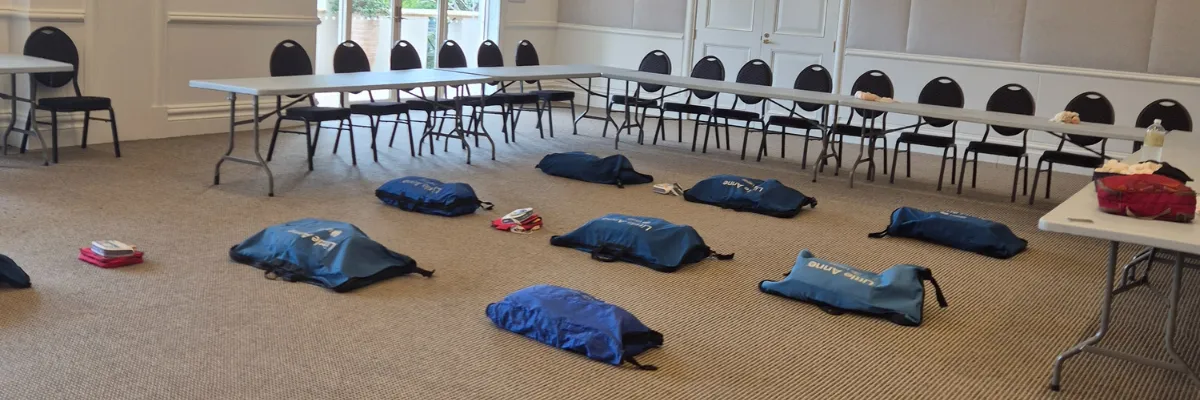
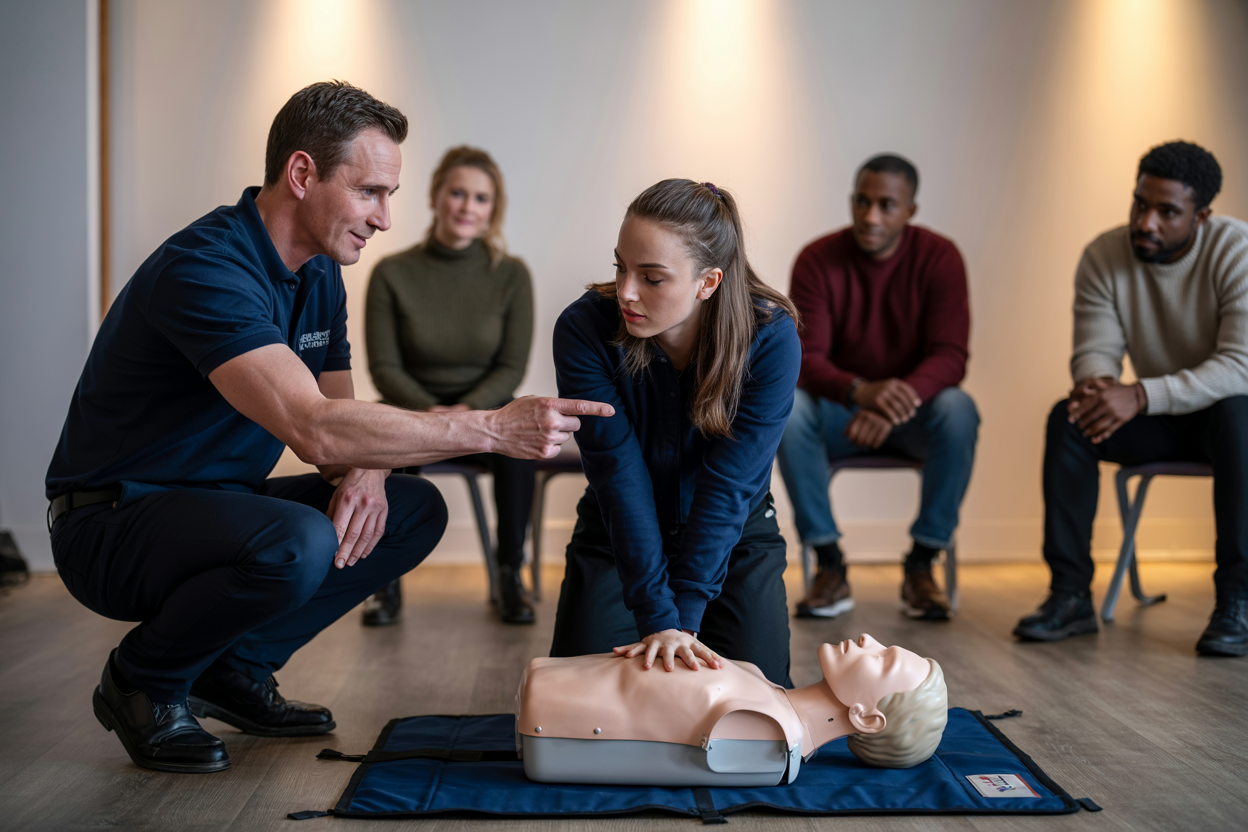
This is where most people's nerves disappear pretty quickly. You get down on the floor, you start compressions, and within a few minutes it stops feeling foreign. The trainer watches, gives feedback, and adjusts your technique in real time — depth, rate, hand position. You practice rescue breathing. You get introduced to the AED (defibrillator) and run through how to use it, because modern AEDs are designed to talk you through every step anyway.
Then you do it again. And again. The repetition is the whole point — by the time you finish the scenario run-through at the end, the sequence isn't something you're trying to recall. It's something your hands remember.
How Long Each Part Takes
The full session runs approximately four hours including the practical assessment. There's no written exam. Assessment is observed and practical — the trainer watches you perform the skills and confirms you've met the standard. Once that's done, your nationally recognised certificate is issued the same day.
Now you know what to expect on the day — here's a closer look at the specific skills you'll walk away with.
What Skills Will You Actually Learn?
This is where a lot of people are pleasantly surprised. The skills covered in HLTAID009 aren't vague or theoretical — you leave knowing specific techniques, specific numbers, and a specific sequence you can actually follow in a real emergency. That's the difference between feeling certified and feeling capable.
Adult CPR: Compressions and Rescue Breaths
For adult CPR, the current Australian Resuscitation Council (ARC) guidelines call for a 30:2 ratio — 30 chest compressions followed by 2 rescue breaths. Compressions should land at 100–120 per minute (roughly in time with the beat of Stayin' Alive — yes, really) and go down 5–6cm for an adult. That depth surprises a lot of first-timers. It feels like a lot. But that's what it takes to actually circulate blood, and your trainer will help you get the feel for it on the manikin before you second-guess yourself.
CPR for Infants and Children
Infant and child CPR uses different technique — and if you've got kids at home or you work in childcare, this part of the course carries particular weight. For infants, you use two fingers rather than the heel of your hand, and compression depth is shallower. For children, the approach sits somewhere between infant and adult technique depending on the child's size. The key differences are covered clearly in the course, and you practice both.
How to Use a Defibrillator (AED)
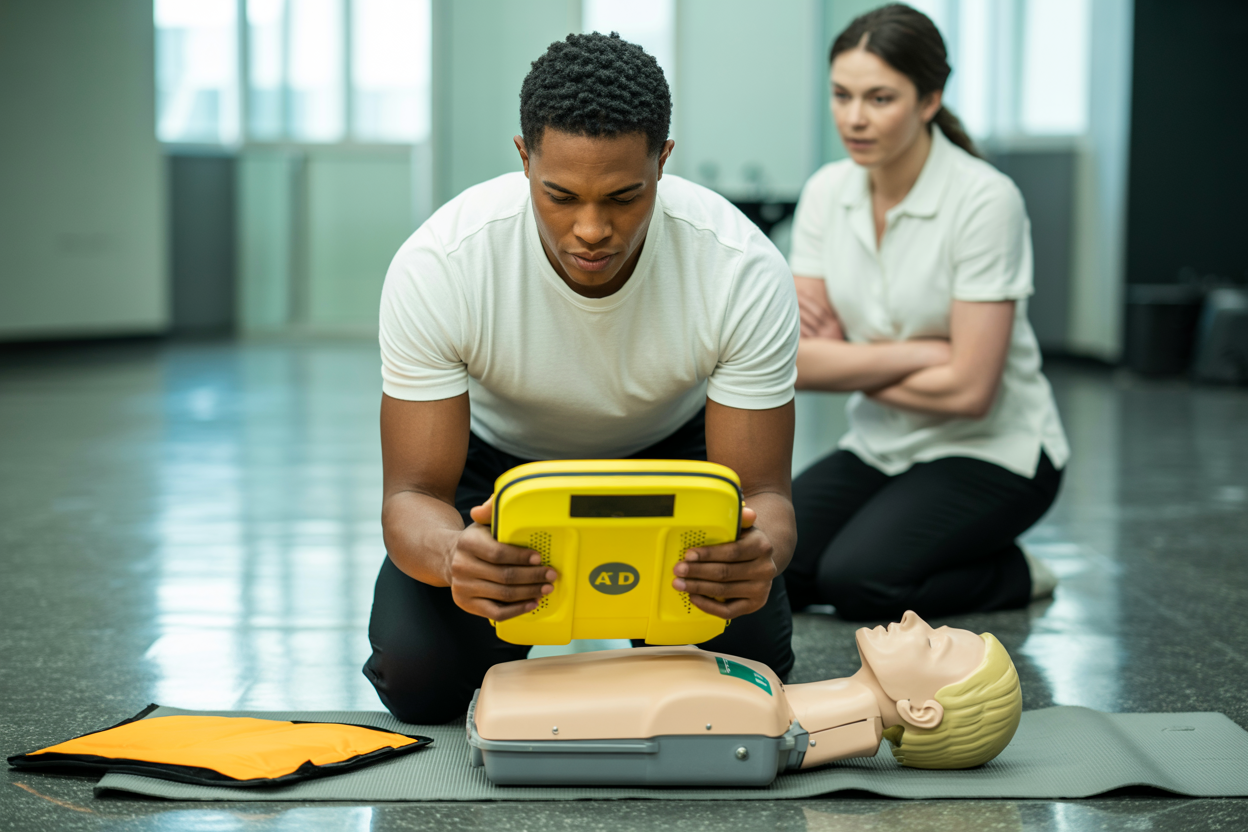
A lot of people arrive with no idea how to use an AED and leave wondering why they ever found it intimidating. Modern defibrillators provide voice prompts that walk you through every single step — where to place the pads, when to stand clear, when to deliver a shock. Your job is to turn it on and follow the instructions. The course gives you hands-on time with an AED trainer unit so none of it feels unfamiliar if you ever need to use one for real.
The DRSABCD Action Plan
DRSABCD is the emergency response framework used across Australia, and it gives you a sequence to follow when the pressure is on and your brain wants to go blank.
The beauty of DRSABCD is that it turns a high-stress moment into a checklist. You don't have to figure out what to do next — you just move to the next letter. The course drills this sequence until it's automatic.
All skills are practized repeatedly throughout the session. By the time you finish, the sequence isn't something you're trying to remember — it's something that's sitting in your muscle memory, ready to go.
Knowing the skills is one thing. The next question most people ask is whether they're fit or experienced enough to keep up.
What If You Have an Injury or Physical Limitation?
Reasonable adjustments are available for students with physical limitations. If you've got a shoulder injury, a bad back, or any other concern, let the training provider know when you book. Trainers are experienced at working with students who need modifications, and completing the course with adjustments in place is absolutely possible. The goal is genuine skill — not a performance.
The range of people who walk through the door at any given HLTAID009 session reflects Brisbane pretty well — trades workers in their work gear, childcare staff on a Saturday morning, parents who've been meaning to do this since their youngest started swimming lessons. None of them are paramedics. All of them leave capable.
No experience needed, no fitness test required — just show up ready to learn. Browse upcoming Brisbane dates here.
Once you know the course is built for beginners, the next practical question is usually about time — and whether it fits around a busy Brisbane life.
Can You Do CPR Training Online?
This question comes up constantly, and the answer is worth being clear about.
An online-only CPR certificate might look convincing on paper, but it won't hold up when your employer, your childcare licensing body, or a WorkSafe inspector asks for your HLTAID009. The hands-on practical component isn't a formality — it's the part where you actually learn to do compressions properly, use an AED, and run through a real scenario under trainer observation. That can't happen through a screen.
Still on the fence? Here's what first-time students actually say when they walk out..
Is CPR Training Hard for Specific Groups? (Parents, Childcare Workers, Trades)
The short answer is the same across the board — no, it's not hard. But each group tends to arrive with slightly different concerns, and those concerns are worth addressing directly.
CPR Training for Parents and Caregivers
For Brisbane parents, CPR training sits in the same mental category as installing a rear-facing car seat or knowing your child's anaphylaxis action plan. It's one of those things you do because the alternative — not knowing — is genuinely unacceptable once you've thought about it clearly.
Queensland records some of Australia's highest rates of child drowning incidents, and backyard pools, Moreton Bay access, and a long warm swimming season mean Brisbane families are regularly in environments where that risk is real. This isn't fear-mongering — it's just the context.
The infant CPR technique differences covered in HLTAID009 are particularly relevant here — two-finger compressions, shallower depth, modified rescue breaths. Parents who've done the course describe a specific kind of relief that's hard to put into words. One Brisbane dad who came in three weeks before swimming season — no prior first aid experience, toddler at home, backyard pool — left able to walk through the infant compression technique accurately and unprompted. He said he'd been putting it off for two years. Took four hours to fix that.
CPR Training for Childcare Workers
Childcare workers come in with a particular pressure that other students don't always have — an ACECQA audit date on the calendar and a certificate that needs to be current before it arrives. The stakes feel higher because they are.
HLTAID009 covers the CPR component, but if you're working in a childcare setting, HLTAID012 — the childcare-specific first aid course — includes pediatric first aid content on top of CPR and is the unit most commonly required for ACECQA compliance. Worth checking which unit your registration requires before you book.
One Brisbane room leader came in for her HLTAID012 renewal ahead of an upcoming audit. She arrived anxious about the practical assessment — it had been a while, and she wasn't sure how much she'd retained. The part she least expected to find straightforward? The AED practice. She left with her certificate in hand the same day.
CPR Training for Tradies and Construction Workers
WorkSafe Queensland compliance requirements mean a lot of construction site supervisors and trades workers end up in a CPR course whether they'd have chosen it or not. And that's actually fine — because the practical, no-nonsense format of HLTAID009 suits this group pretty well. There's no academic component to wade through. You show up, you learn by doing, you leave with a nationally recognized certificate.
The thing that catches a lot of tradies off guard is how much the technique has changed since they last trained. ARC guideline updates over the past decade have shifted the approach — compression-only CPR protocols, updated depth and rate standards, revised guidance on rescue breaths. One construction site supervisor who hadn't done CPR in ten years said the compression-only protocol update alone made the renewal worthwhile. He'd been operating on outdated technique for a decade without realising it.
FIFO workers and remote site staff are also increasingly booking CPR renewal ahead of rotations, particularly where site first aid requirements are part of the induction checklist.
CPR Training for Fitness Professionals
Personal trainers and gym instructors occupy an interesting position — they're in an environment where a cardiac event is a genuine possibility, their clients often trust them as a safety figure, and many find that holding a current HLTAID009 certificate is either a condition of their insurance or an expectation of the facility they work in.
The AED familiarization component is particularly relevant here. Gyms are increasingly well-equipped with defibrillators, and knowing how to use one confidently — not just knowing it's on the wall — is a meaningful part of working in that environment.
Ready to Stop Wondering and Start Knowing?
Brisbane's HLTAID009 CPR course — four hours, nationally recognized, certificate issued the same day.
If you've read this far, you already know the answer to the question you came in with. CPR training isn't hard. It's designed for people exactly like you — no medical background, no prior experience, no fitness standard to meet. Just a decision to show up and learn something that genuinely matters.
The people who walk out of every HLTAID009 session here in Brisbane aren't paramedics. They're parents who wanted to feel ready before swimming season. Childcare workers ticking off their ACECQA compliance. Tradies sorting their WorkSafe requirements. Gym instructors who wanted more than a certificate on the wall. Ordinary people who made a four-hour investment and left feeling like a completely different version of themselves in an emergency.
That's what this course delivers. Not just a laminated card. Actual capability.