How to Use an AED: Step-by-Step Life-Saving Guide
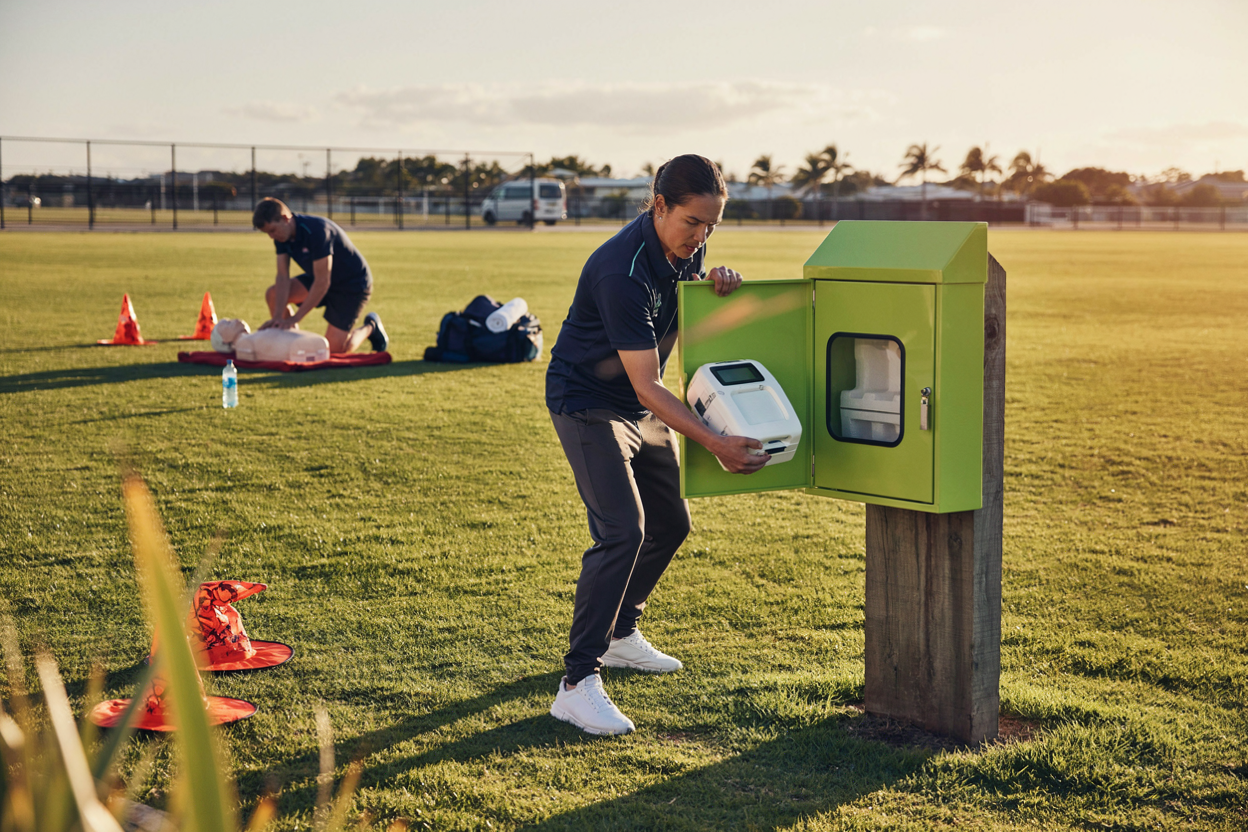
The AED case was mounted right there on the clubhouse wall. Bright green, hard to miss, the kind of thing you walk past every weekend without really seeing it. Then a player went down on the sideline mid-game, and three people ran straight past that cabinet. Not because they didn't know it was there. Because none of them were sure what happens after you open the lid.
That's the gap this guide closes. Knowing how to use an AED isn't about memorizing a textbook, it's about knowing, in the ten seconds it actually matters, what to do next. And the honest answer is: less than you think. The device does most of the thinking for you.
Below, we'll cover when an AED is called for, the step-by-step process, what the voice prompts actually mean, where the pads go (including the awkward questions nobody asks out loud), and how AED use fits together with CPR.
How Do You Use an AED?
To use an AED (Automated External Defibrillator), follow these steps:
Turn it on: press the power button, or just open the lid on some models. Voice prompts start straight away.
Bare the chest: get clothing out of the way, dry the skin off if it's wet.
Attach the pads: follow the little diagram printed right on the pads.
Stand clear: let the AED read the heart rhythm. Nobody touches the patient while it's analyzing.
Deliver the shock if advised: only press the flashing button when it tells you to.
Resume CPR: back to 30 compressions, 2 breaths, until the AED tells you to stop for another check or paramedics show up and take over.
AEDs are built for people who've never touched one before. They'll only tell you to shock if the heart rhythm actually needs it, and the voice prompts carry you through every single step, so you're never guessing.
When Do You Actually Need to Use an AED?
Here's the bit that trips people up more than the device itself. It's not the AED that's the hard part, it's deciding "does this actually call for one?" People freeze on that question far more than they freeze on the machine.
In Australia, the first aid framework you're working from is DRSABCD: Danger, Response, Send for help, Airway, Breathing, CPR, Defibrillation. An AED sits right at the end of that chain, and it comes in fast once you've worked through the steps before it.
What are the signs someone needs an AED?
They're unresponsive, no reaction when you talk to them, no reaction when you give them a firm shake.
They're not breathing normally, or they're only gasping. That gasping is called agonal breathing, and it's not a good sign, it's not "sort of breathing," it means treat this as cardiac arrest until you know otherwise.
If someone's coaching under-12s and a kid collapses, or a mate goes down at the gym, that split second of "am I sure enough to grab the AED?" is exactly where people lose time. You don't need to be sure. You need to send for the AED the moment those two signs are there.
Is it safe to use an AED if I'm not certain?
Yes. This is the part worth actually sitting with, because it removes the whole reason people hesitate. The AED analyses the heart rhythm itself. It won't advise a shock unless the rhythm genuinely needs one. You can't accidentally shock someone who doesn't need it, the machine simply won't let you.
How to Use an AED: The Step-by-Step Process
Right, this is the part that actually matters. Once you've recognised the emergency, here's exactly what to do next, in order, no skipping around.
Step 1: Turn It On
Press the power button. On some models the lid opening does this for you automatically. Either way, the second it's on, voice prompts start talking you through everything from here. You don't need to remember a sequence in your head. The AED remembers it for you.
Step 2: Expose and Prepare the Chest
Get the chest bare. Remove or cut away clothing, don't waste time fiddling with buttons. If the skin's wet, dry it off, the pads won't stick or read properly on wet skin. If there's a medication patch where a pad needs to go, take it off first.
Step 3: Attach the Pads Correctly
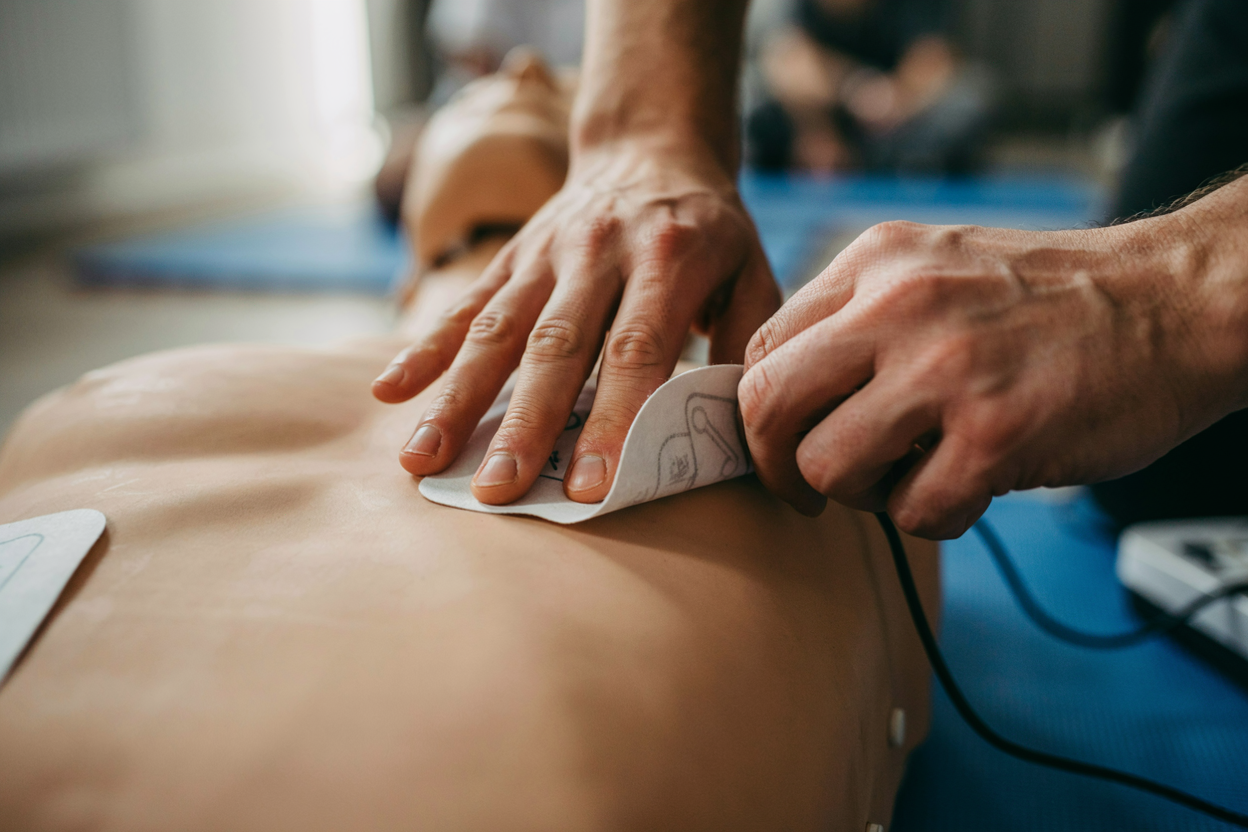
Every set of pads has a diagram printed right on them, right upper chest, left lower ribs. Just follow what's printed. We'll go deeper on exact placement further down, so don't stress about getting it perfect here, just get them in roughly the right spot.
Step 4: Stand Clear During Analysis
The AED will tell you it's analyzing the rhythm and to not touch the patient. This matters, even someone's hand resting on the chest can throw the reading off. Take a second, do a visual scan, make sure nobody's touching them anywhere.
Step 5: Deliver the Shock If Advised
If a shock's advised, the AED will charge and usually flash a button. Call it loud, "clear, clear, clear, shocking", and do one more visual check that nobody's in contact before you press it. If the person's body jerks when the shock goes through, that's completely normal. It's muscle response, not a sign anything's gone wrong.
Step 6: Resume CPR Immediately
Straight back into CPR, 30 compressions, 2 breaths. Keep that rhythm going until the AED prompts another analysis, or paramedics arrive and take over. This is where AED use and CPR stop being two separate things and become one continuous response, which we'll cover properly a bit further down.
The device is built to talk to a complete stranger through saving a life. That's the whole design behind it.
The steps are simple, but the voice prompts can throw people mid-emergency. Here's what each one actually means.
What Do the AED Voice Prompts Actually Mean?
This is the part almost nobody explains properly, and it's exactly where people get thrown mid-emergency. You know the steps, you're moving, and then the machine says something and your brain goes blank for half a second wondering what it wants from you. So here's what each prompt actually means and what you do when you hear it.
AED Says | What's Happening | What You Do |
"Analyzing rhythm, don't touch patient" | It's reading the heart's electrical activity | Stand back, make sure nobody's in contact |
"Shock advised, charging" | A shockable rhythm's been detected | Call "clear," confirm nobody's touching the patient |
"No shock advised" | The rhythm isn't one a shock will fix | Get straight back into CPR |
"Continue CPR" | Between analysis cycles | 30 compressions, 2 breaths, keep going |
Worth saying plainly: if it says "no shock advised," that's not the machine failing or getting it wrong. It just means a shock isn't what this particular rhythm needs right now, CPR is still doing the work. Don't stop and second-guess it. Keep going.
AED Pad Placement, Where Do the Pads Actually Go?
Standard adult pad placement
Right pad: upper right chest, just below the collarbone
Left pad: lower left ribs, on the side of the chest
That's it, the diagram printed on the pads themselves matches this exactly, so if you're standing there mid-emergency and your brain's blanked, look down at the pad. It'll show you.
Pacemaker, jewelry, or a very hairy chest?
These are the questions people are too embarrassed to ask in a course, so let's just answer them straight.
Pacemaker or ICD: if you can feel a hard lump under the skin where a pad's meant to go, place the pad about 8cm clear of it rather than directly on top. 8cm clear is close enough, don't waste time hunting for perfection.
Excess chest hair: most AED kits come with a razor for exactly this reason. If the pads won't stick, a quick shave and try again. Hair stops adhesion, adhesion is what makes the reading accurate.
Jewelry or metal near the pad site: move it out of the way if you can do it fast. If not, don't burn seconds on it, just avoid placing the pad directly over metal where possible.
None of this needs to be perfect. It needs to be close enough, fast enough. The AED is forgiving of imprecision, it's not forgiving of hesitation.
Do You Need Training to Use an AED?
Straight answer first: no. You don't legally need training to use an AED. It's designed for exactly this, a complete stranger, no course, no certificate, walking up and using it correctly under the machine's own voice prompts.
Can an untrained bystander legally use an AED?
Yes. Good Samaritan protections apply here in Queensland, if you're acting in good faith to help someone in an emergency, you're covered. AEDs are built for public, untrained use.
So what does training actually add, if the AED talks you through it anyway?
Speed and confidence under real stress. Reading a set of prompts for the first time while someone's not breathing in front of you is a very different experience to having already done it once, hands-on, with someone watching your technique and telling you if your pad placement's off or your compressions are too shallow. The steps are the same either way. What changes is how fast you move and how steady your hands are when it actually counts.
Training also builds the muscle memory the AED can't teach directly, the rhythm between compressions and shocks, how deep and how fast CPR needs to be, and what "good" pad placement feels like rather than just looks like on a diagram.
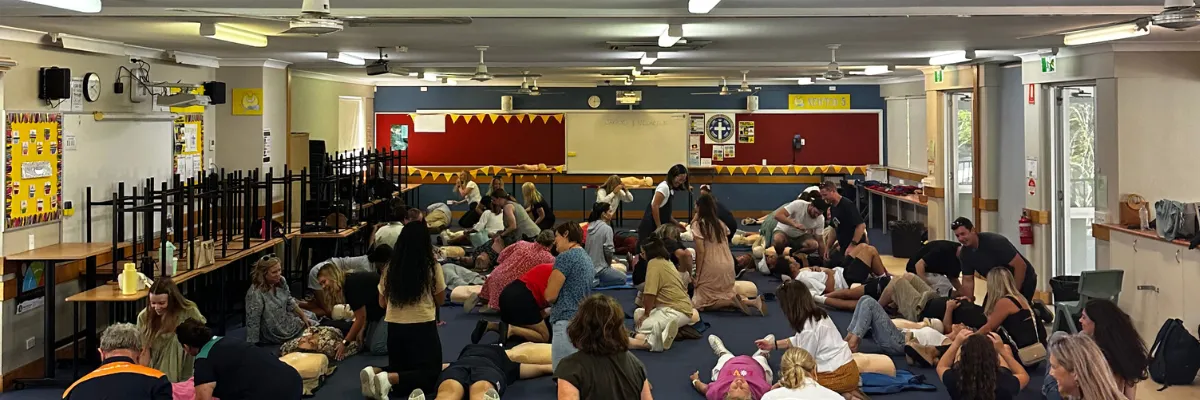
Reading the steps is one thing. Practicing them on a real AED, under pressure, with a paramedic trainer watching your technique, is another. If you want that hands-on confidence rather than hoping you remember it right on the day, you can book a hands-on CPR & AED session on the Gold Coast, HLTAID009, run by Accelerate First Aid.
Training builds confidence, but it's worth being clear on how AED use and CPR fit together, because neither one works alone.
AED and CPR, How the Two Work Together
This trips up more people than you'd think: the idea that you do CPR or you use the AED, like they're two separate options and you pick one. That's not how it works. They're one continuous response.
The AED doesn't replace CPR. It steps in at specific points to check whether a shock is needed, then hands straight back to CPR the second that check is done. The actual rhythm looks like this: CPR, then AED analyses, then either shock or no shock, then straight back into CPR. Round and round, until paramedics take over or the person starts responding.
Even in that split second right after a shock's delivered, the machine doesn't fix the heart on the spot. CPR is still what's keeping blood moving to the brain and organs in between.
If you remember one thing from this section, make it this: never stop CPR to "wait and see" if the AED is going to tell you to shock. Keep going until it specifically tells you to stop.
Where to Find an AED on the Gold Coast
Knowing the steps is one thing. Knowing where the nearest AED actually is when you need it is the other half of the equation, worth having half an eye on before you ever need it.
AEDs are turning up in more public spots across the Gold Coast every year, sporting clubs, gyms, shopping centers, workplaces, community centers. If you work out of the same handful of locations regularly, it's worth noticing where the nearest cabinet is next time you walk past one. Not memorizing a map, just registering it once so it's not a total unknown in an emergency.
Ambulance Queensland and St John Ambulance Australia both maintain AED locator tools if you want to check what's near an address or venue.
Conclusion
That green cabinet on the clubhouse wall isn't the hard part. It never was. The hard part is the half-second of doubt that keeps people frozen a few meters away from it, wondering if this really is bad enough to warrant grabbing it, or whether they'll somehow get it wrong. That doubt costs more time than the actual steps do, and it's the one thing worth leaving behind after reading this.
Once you strip it back, using an AED is closer to following a set of instructions than performing some specialized skill. Turn it on, bare the chest, follow the diagram on the pads, stand clear while it reads the rhythm, and do exactly what the voice tells you. The device was built assuming the person holding it has never touched one before, and it talks you through every decision so you don't have to make the call alone.
What actually changes the outcome isn't knowledge sitting in the back of your head. It's whether your hands move the moment they're needed, without that pause to second-guess yourself. That's the gap between reading about pad placement once, and having already felt what correct placement feels like with someone watching your technique.
None of this needs to be perfect to work. A pad that's close enough, compressions that are roughly in rhythm, a shock delivered a second or two later than ideal, all of that still beats standing still. The AED is far more forgiving of an imperfect attempt than it is of nobody attempting anything at all.
So the next time you walk past a green cabinet on a wall, at the gym, at the club, wherever it happens to be, take two seconds to actually notice where it is. Not because you'll need to recite these steps from memory. Just so that if the moment ever comes, the three people who ran past it last time aren't you.