How to Recognize a Severe Asthma Attack: Key Warning Signs
It's a Tuesday morning in September. One of your kids starts coughing, that tight, barking cough you've heard before. By the time you've crossed the room, his lips have a greyish tinge and he can't finish a sentence. You know something is wrong. But do you know exactly what you're looking at?
Knowing how to recognize a severe asthma attack isn't just useful knowledge for childcare educators. It's the difference between acting in time and waiting too long. Brisbane's spring season brings a predictable spike in asthma episodes, and the children most at risk are often the ones whose symptoms look deceptively mild in the early stages. This guide walks you through the specific warning signs that separate a mild episode from a severe or life-threatening attack, what to look for, what to listen for, and what changes in a child's behavior should trigger immediate escalation.
What Are the Signs of a Severe Asthma Attack?
A severe asthma attack in a child requires immediate action. The key warning signs include:
Breathing difficulty: visibly struggling to breathe, unable to complete a full sentence
Rapid or noisy breathing: audible wheeze, whistling, or grunting with each breath
Skin changes: bluish or grey tinge around the lips, fingernails, or fingertips (cyanosis)
Neck and chest retractions: skin pulling in visibly at the throat or between the ribs with each breath
Exhaustion or limpness: the child appears too tired to breathe, losing muscle tone
Reliever not working: no improvement after four puffs of a blue reliever inhaler via spacer
Altered consciousness: unusual drowsiness, confusion, or unresponsiveness
If any of these signs are present, call 000 immediately and begin the asthma first aid action plan.
Understanding Asthma Severity Levels in Children
Mild, Moderate, and Severe: What the Spectrum Looks Like
Most educators can recognize when a child is having a rough breathing day. What's harder is identifying the moment a child crosses from mild into severe territory. That shift doesn't always announce itself loudly. In a busy room, subtleness is easy to miss.
The National Asthma Council Australia classifies asthma attacks across four categories: mild, moderate, severe, and life-threatening. Each has distinct physical markers and calls for a different response.
Children don't move through these categories in a neat sequence. They can deteriorate faster than the table suggests, particularly under 5s. Knowing the markers at each level means you're not waiting for "severe" before you start paying close attention.
Why Children Are Harder to Assess Than Adults
A child who is struggling to breathe may not tell you. Under 5s don't have the language for it. What you'll often see first isn't a physical sign at all. It's a behavioral one. A child who stops joining outdoor play and sits quietly. A toddler who was running five minutes ago and is now unusually still. A three-year-old who becomes irritable without obvious reason. These cues can precede visible physical symptoms by several minutes, and in that window, early action can prevent escalation entirely.
Brisbane's spring season from August through November is the highest-risk period across Southeast Queensland. Grass pollen levels peak, thunderstorm asthma events have been documented across the region, and children with existing diagnoses are more likely to encounter multiple triggers on the same day. A written asthma action plan can still be outpaced by how fast a child deteriorates. The plan is a guide, not a guarantee.
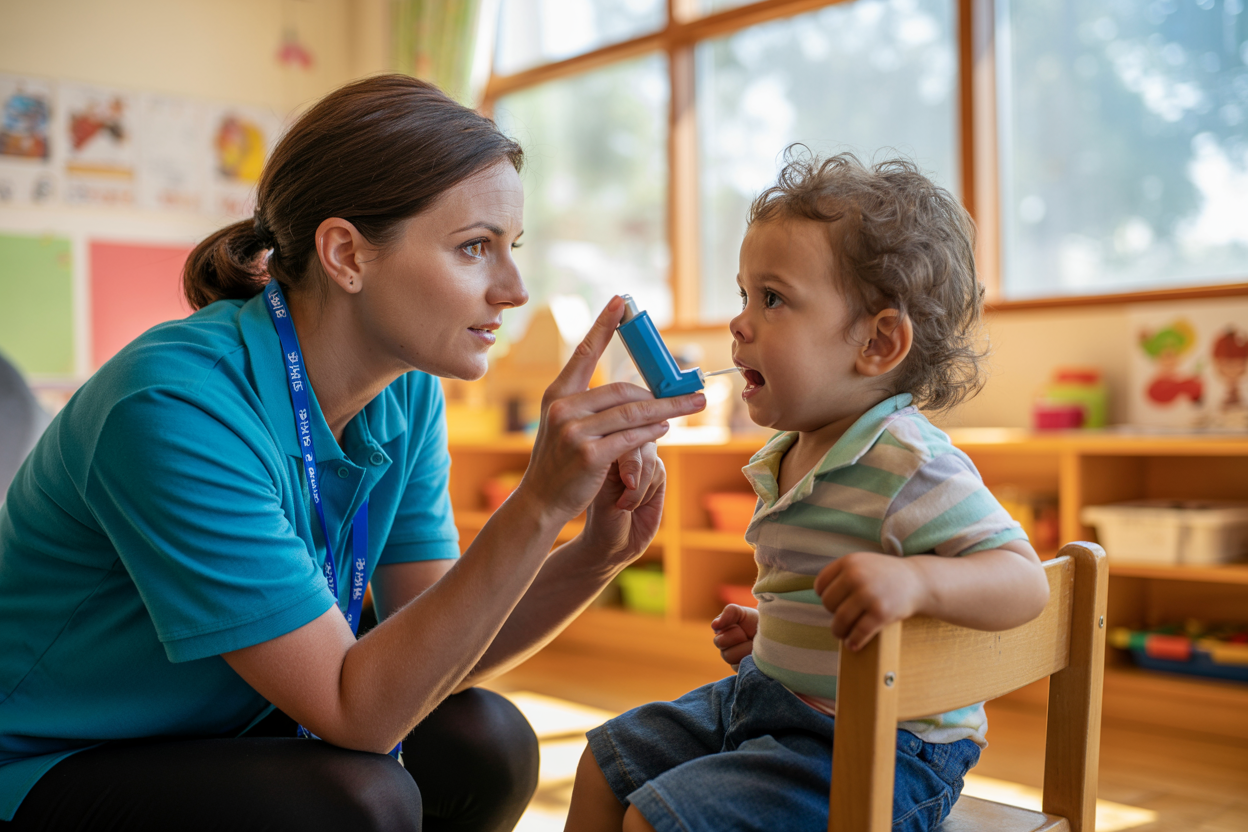
Early Warning Signs: What a Mild Attack Looks Like First
The Signs That Often Get Missed
Early asthma signs in a childcare room don't look like emergencies. They look like a tired kid. A quiet kid. A kid who just needs a minute. That's exactly why they get missed.
A persistent dry cough is often the first thing you'll notice, particularly if it intensifies after outdoor play or physical activity. Slightly faster breathing than normal is another early marker, but in a room where children have just been running, it barely registers. A mild wheeze at this stage is only audible if you're close to the child. A child self-limiting their own activity is one of the more reliable early signals. They stop running, sit down without being asked, or drift away from the group without explanation. Older children may say their chest feels funny or tight. Toddlers who can't verbalize it will often become unusually irritable or restless instead.
Think of these as the signs that happen before the obvious signs. The window where early intervention can prevent escalation entirely.
Triggers Common in Brisbane Childcare Environments
Grass pollen is the dominant outdoor trigger from August through November. Dust and cold morning air during winter-to-spring transitions also contribute. Indoors, mold in older center buildings, dust mites, and pet dander on children's clothing are consistent year-round triggers. Emotional triggers matter too. Excitement or distress, including crying, can trigger bronchospasm in sensitive children. Thunderstorm asthma is a Brisbane-specific risk. During storm season, ryegrass pollen ruptures into particles fine enough to penetrate deep into the airways. Children in outdoor play during or just before a storm are directly exposed.
When Mild Becomes Something More
A mild episode can move to severe in minutes, especially in children under 5 whose airways are proportionally narrower. The transition is not always dramatic. A child may simply go quiet, become limp, or stop responding. In a busy room, that can read as a child settling down, when in fact they are tiring. Four puffs of blue reliever via spacer is the correct first response. If there is no improvement within 4 minutes, escalate immediately. A child who goes quiet in an asthma episode is not improving. They may be tiring.
How to Recognize a Severe Asthma Attack: The Full Checklist
This is the section worth knowing about the cold, because when a child is in severe respiratory distress, you will not have the headspace to think through a list. You need to already know what you're looking at.
What You'll See: Visual Signs
Cyanosis is a late sign, meaning by the time you see it, the situation is already serious. Retractions mean the respiratory muscles are at maximum capacity. Hunched posture is instinctive. A child sitting like that is not resting. They are working.
What You'll Hear: Auditory Signs
Wheeze is the sound most educators associate with asthma. In a severe attack, it may paradoxically disappear, not because the child is improving, but because airflow has become so restricted it can no longer generate sound. A silent chest in a distressed child is a medical emergency. Call 000 immediately. Grunting on exhales, particularly in toddlers, indicates significant respiratory effort. Stridor is a harsh, high-pitched sound on inhale rather than exhale. If you hear stridor alongside wheeze, there is upper airway involvement and 000 must be called immediately.
What You'll Notice in the Child's Behavior
Behavioral signs deserve the same weight as visible physical signs. A child who can only get out single words or has stopped all activity and is entirely focused on breathing has crossed a line. Unusual limpness in a toddler is respiratory fatigue. Older children may show visible fear, and your calm response directly affects their physiological state. Anxiety increases oxygen demand. Loss of consciousness or unresponsiveness is life-threatening. Call 000 immediately and move to CPR if the child stops breathing.
The Reliever Test
Four puffs of blue reliever (salbutamol) via spacer, one puff at a time with four breaths after each puff. If there is no improvement after 4 minutes, the attack is severe. Call 000 and continue giving 4 puffs every 4 minutes until the ambulance arrives. The reliever isn't just treatment. It's also a diagnostic. A child who doesn't respond within 4 minutes is telling you exactly how serious this is.

What Happens in the Body During a Severe Attack
During a severe asthma attack, three processes happen simultaneously. Bronchoconstriction narrows the airway as smooth muscle contracts; this is what responds to reliever medication. Inflammation swells the airway lining, further reducing an already-narrowed diameter. Mucus hypersecretion then blocks passages compromised by both. Imagine breathing through a drinking straw being pinched from the outside, while the inside walls swell and fill with thick fluid. That is what a child is working against with every breath. Children have proportionally smaller airways than adults, so even modest swelling reduces airflow dramatically. A child who appears to be calming down may be exhausted, not improving. This is one of the most dangerous misreads in a childcare emergency. As oxygen saturation drops, the brain is affected first. Confusion, unusual drowsiness, a child who can't follow a simple instruction: these are signs of oxygen deprivation.
The Asthma First Aid Response: What to Do After You Recognize It
Sit the child upright. Do not lay them down. Give 4 puffs of blue reliever via spacer, one puff at a time with the child breathing in and out 4 times after each puff. Wait 4 minutes. If there is no improvement, call 000 immediately and continue giving 4 puffs every 4 minutes until the ambulance arrives. Do not stop administering reliever while waiting for paramedics. Keep the child upright and calm. Distress increases oxygen demand and worsens bronchospasm. Do not leave the child alone. Assign another educator to manage the rest of the group and contact parents. Note when the attack began, when you first gave the reliever, and how many doses have been given. If the child loses consciousness and stops breathing, move to CPR.
A severe asthma episode requiring ambulance attendance is a notifiable incident under the Education and Care Services National Law and National Regulations. The centre director must be notified immediately and in Queensland, the regulatory authority must be notified within 24 hours. Document time of onset, signs observed, medication given, and who was present. Review the child's action plan with parents afterward and debrief with staff, particularly any educator who administered medication for the first time.
Every child with a diagnosed asthma condition should have a written plan from their GP or pediatrician. Under ACECQA standards this is not optional. Plans vary in quality. Some are outdated. Some are vague. Educators should not assume a plan is current without reading it. If a newly enrolled child has no plan on file, raise it with the director before the child begins attending.
Why Brisbane Childcare Educators Are at Higher Risk of Missing It
Queensland has among the highest rates of childhood asthma in Australia. The warm, humid climate and high pollen load create a trigger environment that peaks hard from August through November. Thunderstorm asthma is a documented, recurring risk in Southeast Queensland. During storm season, ryegrass pollen ruptures into particles fine enough to reach deep into the airways, and children in outdoor play are directly exposed. During Brisbane spring, multiple children may be symptomatic on the same day under the same atmospheric conditions.
Many Brisbane centers book staff through HLTAID012 and consider their asthma obligations met. They are not. HLTAID012 does not deliver the practical training required under Regulations 136 and 137. The specific course codes required for ACECQA compliance are 22300VIC and 22556VIC. Those codes must appear on the certificate. An assessor looks for those specific codes. If they aren't there, the training doesn't count. Educators who have completed HLTAID012 but not 22300VIC or 22556VIC have not practiced the specific spacer technique, action plan interpretation, or escalation decision-making those units require.
Rushed or passive training produces confidence without capability. Hands-on repetition is the primary driver of performance under pressure. Passive observation produces short-term recall, not muscle memory. The skills that degrade fastest are the ones that matter most: spacer technique, recognizing the silent chest, and the decision to call 000 without waiting for a second opinion.

Why Hands-On Training Makes the Difference
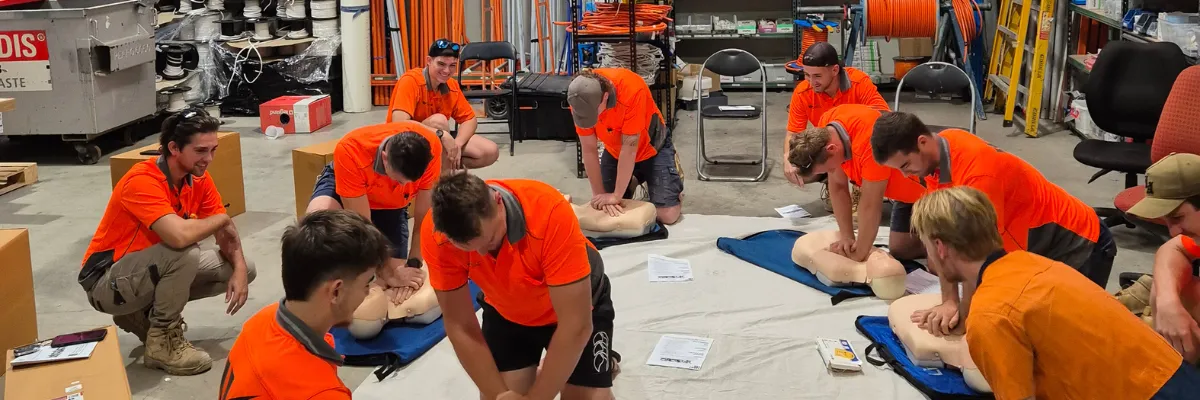
Recognition knowledge and performance knowledge are not the same thing. A person can read every warning sign in this article and still freeze in a real emergency if they have never physically practiced the response. Emergency medicine research distinguishes declarative knowledge, knowing what to do, from procedural knowledge, being able to do it under stress. Only hands-on simulation builds the latter. Cognitive load during an emergency is significantly higher than during calm learning, and only skills rehearsed to automaticity remain accessible under those conditions.
A compliant face-to-face course should include hands-on practice with actual spacer devices and EpiPen trainers, scenario-based learning requiring real-time escalation decisions, specific instruction on interpreting written asthma action plans, direct coverage of ACECQA regulatory requirements, and a certificate issued on the day bearing the correct course codes, 22300VIC and 22556VIC. Online-only courses do not satisfy Regulations 136 and 137.
Before booking, check that the provider delivers both 22300VIC and 22556VIC in a single session, uses a face-to-face format with actual trainer devices, has a trainer with direct childcare sector experience, issues the certificate on the day with the correct course codes, and has verifiable RTO registration on training.gov.au.
WHAT’S NEXT
Knowing how to recognize a severe asthma attack is not a box to tick on a compliance form. It is a skill that exists in the gap between a child who struggles and a child who doesn't make it, and the width of that gap is determined by how prepared the educator in the room actually is.
Knowledge without practice has a ceiling. You can read every warning sign in this article and still hesitate when a child goes limp in front of you if you have never physically worked through that scenario. Procedural memory, the kind that holds under stress, only forms through repetition with real devices in real situations.
This is what separates 22300VIC and 22556VIC from a general first aid refresher. These units exist because the childcare environment carries a distinct and elevated risk, and generic first aid training doesn't address the specific decisions an educator has to make when a four-year-old's reliever isn't working. The practical component isn't a formality. That is the point.
If your 22300VIC or 22556VIC certificate is coming up for renewal, or if you have never completed these specific units, Saturday sessions are available across Brisbane through [BRAND_NAME], a registered RTO. Your certificate will be issued on the day, correctly coded with the units an ACECQA assessor will look for, and delivered to your inbox before you leave.
The child in your room with the peanut allergy, the one who gets wheezy every September, the new enrollment whose action plan arrived on their first day, they don't need you to be covered on paper. They need you to be ready.