
How Often Renew First Aid Certificate in Australia?
You did a first aid course a couple of years back. Maybe work made you do it, maybe it was an "I should probably sort this out" moment. Either way, it's sitting in a drawer somewhere, and now you're wondering: is this thing still valid, or did it quietly expire while you weren't looking?
Here's the short version, and it's the bit most providers don't explain properly. Your HLTAID011 Provide First Aid certificate is good for 3 years. But the CPR component (HLTAID009) inside it needs a top-up every 12 months to stay current with Australian Resuscitation Council guidelines and Safe Work Australia recommendations. Two different clocks, one piece of paper, and it's probably the single biggest point of confusion for anyone trying to stay compliant.
This guide covers how long each part of your certification lasts, why the 12-month CPR rule exists, what happens if you let it lapse, and how to renew quickly in Brisbane or on the Gold Coast, without redoing the whole course from scratch.
How Often Do You Need to Renew a First Aid Certificate?
In Australia, your first aid certificate (HLTAID011) is valid for 3 years before it needs a full renewal. The catch is the CPR component (HLTAID009) inside that same certificate, which needs a top-up every 12 months, in line with what the Australian Resuscitation Council and Safe Work Australia both recommend.
Renewal timeline at a glance:
HLTAID011 Provide First Aid: renew every 3 years
HLTAID009 Provide CPR: refresh every 12 months
HLTAID012 Childcare First Aid: renew every 3 years (CPR component still annual)
You don't need to redo the whole course every single year, just the shorter CPR refresher, unless your full 3-year certificate has also run out.
How Long Does a First Aid Certificate Last in Australia?
HLTAID011 Provide First Aid: the 3-year rule
Let's get the headline number out of the way first. Your HLTAID011 certificate is valid for 3 years from the day you complete it. That's the figure on your Statement of Attainment, that's what your employer will check, and that's what most people mean when they ask how long their first aid cert lasts.
Three years sounds like a long time, and for most of the certificates, it is. But it's not the whole story.
Why first aid certificates expire at all
Fair question. Why can't you just learn it once and be done?
Two reasons. The first is skill fade. CPR technique, compression angle, how to manage someone who's choking, all of it fades faster than people expect. You might feel confident the week after your course. Eighteen months later, with no practice, that confidence usually isn't backed up by much.
The second is that guidelines change. The Australian Resuscitation Council reviews and updates its guidelines periodically, based on the latest research into what actually saves lives. Compression depth, ratios, defibrillator use, the advice has shifted before and it'll shift again. A certificate that never expired would mean people doing first aid based on advice that's years out of date.
Does this apply to every first aid course?
Mostly yes, with some nuance depending on which course you did.
HLTAID012 Childcare First Aid: same 3-year structure, CPR component still annual
HLTAID014 Provide Advanced First Aid: also a 3-year cycle
HLTAID015 Provide Advanced Resuscitation and Oxygen Therapy: same pattern, 3 years full cert, CPR annually
The full certificate is a 3-year thing. CPR is a 12-month thing, sitting inside it.

The 12-Month CPR Exception Everyone Misses
This is the part that trips most people up, and honestly, it's not really their fault. Nobody hands you a certificate with a flashing warning that part of it expires way sooner than the rest.
Why CPR has its own shorter timeline
CPR decays faster than almost anything else taught in a first aid course. It's physical, high-pressure, and most people never do it outside of training. You can read about wound management and broadly remember the principles two years later. CPR doesn't work like that, the rate, the depth, the rhythm of compressions and breaths is muscle memory, and muscle memory needs topping up.
That's why the Australian Resuscitation Council recommends CPR be refreshed every 12 months, even though the rest of your first aid knowledge stays current for the full 3 years.
HLTAID009 sits inside HLTAID011: what that actually means
Here's where the confusion kicks in. HLTAID011 isn't one course bolted together with no structure, it actually contains HLTAID009 Provide CPR as a component within it. So when you do your full HLTAID011, your CPR gets ticked off at the same time.
The problem is that the component has its own, shorter shelf life. Twelve months after your HLTAID011, your CPR knowledge is technically due for a top-up, even though your full certificate isn't due to expire for another two years.
It's a bit like a car with a 3-year warranty, except the tires need replacing every year regardless. The car's still under warranty. The tires still need attention.
Who enforces the 12-month rule
Nobody made this rule up to sell more courses. It comes from a few directions:
Safe Work Australia, through its model Code of Practice on First Aid in the Workplace, recommends CPR currency be maintained annually for anyone designated as a workplace first aid officer
Industry bodies, particularly fitness, where Fitness Australia requires current CPR for instructor registration
Insurers, who may ask for evidence of current CPR training during risk assessments or after an incident
So even if your employer never mentions it, someone in the compliance chain probably expects that annual top-up to have happened.
What Happens If You Don't Renew on Time?
This is the part people are actually a bit worried about when they land on a page like this. Let's deal with it directly.
Compliance and insurance risk
If you're a designated workplace first aid officer and your CPR or full certificate has lapsed, there's a real gap there. Not a dramatic one, but a gap nonetheless. Your workplace may be out of step with its WHS obligations if it's relying on you as the nominated first aider and your currency has expired.
For a business owner, that matters. If an incident happens and it comes out that the first aid officer's certification has lapsed, that's not a great position to be in.
Will you need to redo the whole course?
This depends entirely on what's lapsed.
Lapsed CPR only (under 3 years since your full HLTAID011): you just need the shorter CPR refresher, not the whole course again
Lapsed full certificate (past the 3-year mark): you'll need to redo the full HLTAID011, since the whole certificate, not just the CPR component, is now out of date
A lapsed CPR refresher is a quick fix. A lapsed full certificate means starting again. Worth knowing which boat you're in before you book anything.
Good Samaritan protection vs. certified currency
Quick note, because it's worth separating two things. Good Samaritan protections exist to protect people who step in to help in good faith during an emergency, regardless of whether their certificate is current on the day.
That's separate from workplace compliance, though. Being legally protected for stepping in is one thing. Meeting your employer's, industry body's, or insurer's requirement for current training is another. One doesn't replace the other, and this isn't something we'd give specific legal advice on beyond that general distinction.
Industries and Roles With Stricter Renewal Requirements
Not every job treats first aid renewal the same way. Some industries are fairly relaxed about it. Others watch the dates closely, for good reason.
Childcare and education settings
Childcare is probably the strictest of the lot. Under ACECQA's National Quality Framework, specifically Regulations 136 and 137, services need staff with current first aid, including CPR, anaphylaxis, and asthma management training, on site whenever children are present. Renewal dates tend to get tracked closely by center management.
Construction, trades, and high-risk worksites
High-risk industries carry their own pressure here. Construction sites, electrical work, anything with elevated injury risk, tend to have stricter internal policies than the bare legal minimum. Site inductions often check first aid currency directly, and a lapsed certificate can mean being turned away from a site on the day.
Fitness, hospitality, and customer-facing roles
Fitness instructors sit in an interesting spot, since Fitness Australia requires current CPR for ongoing registration and insurance. Hospitality and other customer-facing roles deal with a different pressure, lots of foot traffic, lots of potential for choking or allergic reactions, which makes current training less of a compliance box and more of a genuinely useful thing to have on shift.

How to Renew Your First Aid Certificate (Fast)
Here's the part that should feel like a relief after all that. Renewing isn't the ordeal people sometimes expect.
Do you need the full course or just a CPR refresher?
This is the first question to answer before booking anything.
If it's been under 3 years since your full HLTAID011 and only your CPR has lapsed, you just need the shorter CPR refresher
If it's been over 3 years, or you've never done HLTAID011, you'll need the full course
It is worth checking your original certificate date before booking, so you book the right one.
What renewal involves at Accelerate First Aid
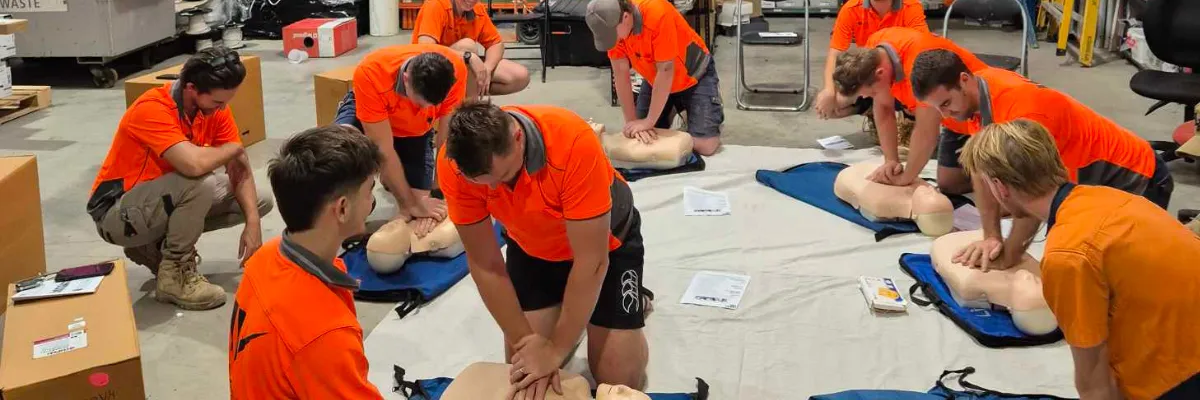
We've tried to make this as painless as we reasonably can. Renewal involves a short online theory component you do from home at your own pace, followed by a 1.5-hour practical session in person, where you run through CPR technique with one of our trainers.
Brisbane and Gold Coast renewal locations
We run renewal sessions across both Brisbane and the Gold Coast, so wherever you're based, there's a practical session within reasonable reach.
If it turns out you only need the CPR side and not the full renewal, there's a quicker, cheaper path for that too.
Conclusion
The three-year and twelve-month distinction trips up almost everyone the first time they hear it. It's just not explained clearly at the point of booking a course, so it sits there quietly until someone asks, usually around the time their certificate starts feeling a bit old.
Once you know the structure, it stops being confusing. One clock runs for three years, covering the bulk of what you learned. A shorter clock runs underneath it for twelve months, covering just the CPR component, the skill that fades fastest and matters most in the moment it's actually needed.
Letting either lapse isn't a catastrophe, but it does leave a gap, a compliance gap, an insurance gap, or simply a confidence gap the next time something happens in front of you. None of those are worth carrying around longer than necessary.
Checking your own dates is a five-minute job. Pull out the certificate, or the email confirmation, and work out which clock you're dealing with. From there, the next step is usually obvious, either a quick refresher or a full renewal.
A bit of awareness now saves a scramble later, and it means the knowledge behind that piece of paper stays sharp enough to actually use, not just current enough to satisfy a checklist.