How Long Is a Childcare First Aid Course, Really?
Chloe was standing in the staff room at 6:45am, coffee in one hand, roster on her phone in the other, trying to work out how she was going to get three educators certified without breaching ratios or closing the toddler room for the day. That scramble, the "how am I supposed to fit this in" moment, is basically the reason this article exists.
So let's just answer it straight up. If you're asking how long a childcare first aid course is, the real answer is this: HLTAID012 runs to about 4 to 6 hours of online theory plus 1.5 hours face to face for the practical. That's it. No full day locked out of the center, no mystery.
But "how long" actually breaks down into three separate questions, and center directors usually want all three answers before they'll even pick up the phone to book. How many hours is the online component? How long is the practical session on the day? And how long does the certificate actually last before someone's back doing it all again? We'll go through each one below, plus how to stagger training across a team so nobody's pulled off the floor at once and a room doesn't end up short-staffed.
How long is a childcare first aid course, in total?
A full HLTAID012 childcare first aid course takes between 5.5 and 7.5 hours, split across two parts:
Online theory: 4 to 6 hours, done in your own time before the practical
Face to face practical: 1.5 hours, on the day, with an assessor
Certificate validity: 3 years for the full qualification, with a 12 month CPR refresher recommended in between
Jump to the bit you actually need:
The two parts of a childcare first aid course
Online theory hours
Practical session time
Certificate renewal timing
Fitting training around ratios
Getting a new hire certified fast
The Two Parts of a Childcare First Aid Course
Here's the thing most directors assume before they've actually looked into it: they think HLTAID012 means pulling an educator out for a whole working day. It doesn't. The course splits into two completely separate chunks, and only one of them happens at a set time and place.
Component | Format | Duration | Where it happens |
Online theory | Self-paced, done individually | 4 to 6 hours | Anywhere, on any device, over however many sittings your educator needs |
Practical assessment | Face to face, with a trainer | 1.5 hours | On-site at your center, in a group session |
So really it's: theory first, on their own time, then a short practical block once everyone's ready. That's the whole shape of it.
Think of it a bit like a driving test. Nobody expects you to learn everything about the road rules in the same hour you're sitting the actual test. You study it beforehand, whenever suits you, and the test itself is the short bit at the end. Childcare first aid works the same way. The online theory is the study, the practical is the test, and they don't have to happen back to back or even on the same day.
That's honestly the part that changes how directors plan around it once they realize it. You're not booking "a day off the floor." You're booking a 90 minute window.
How Long Is the Online Theory Component?
The online theory sits at 4 to 6 hours total, and it's the part that scares people more than it should, mostly because "6 hours" sounds like a chunk out of someone's week when really it's spread out however they want it.
What's covered in the online modules
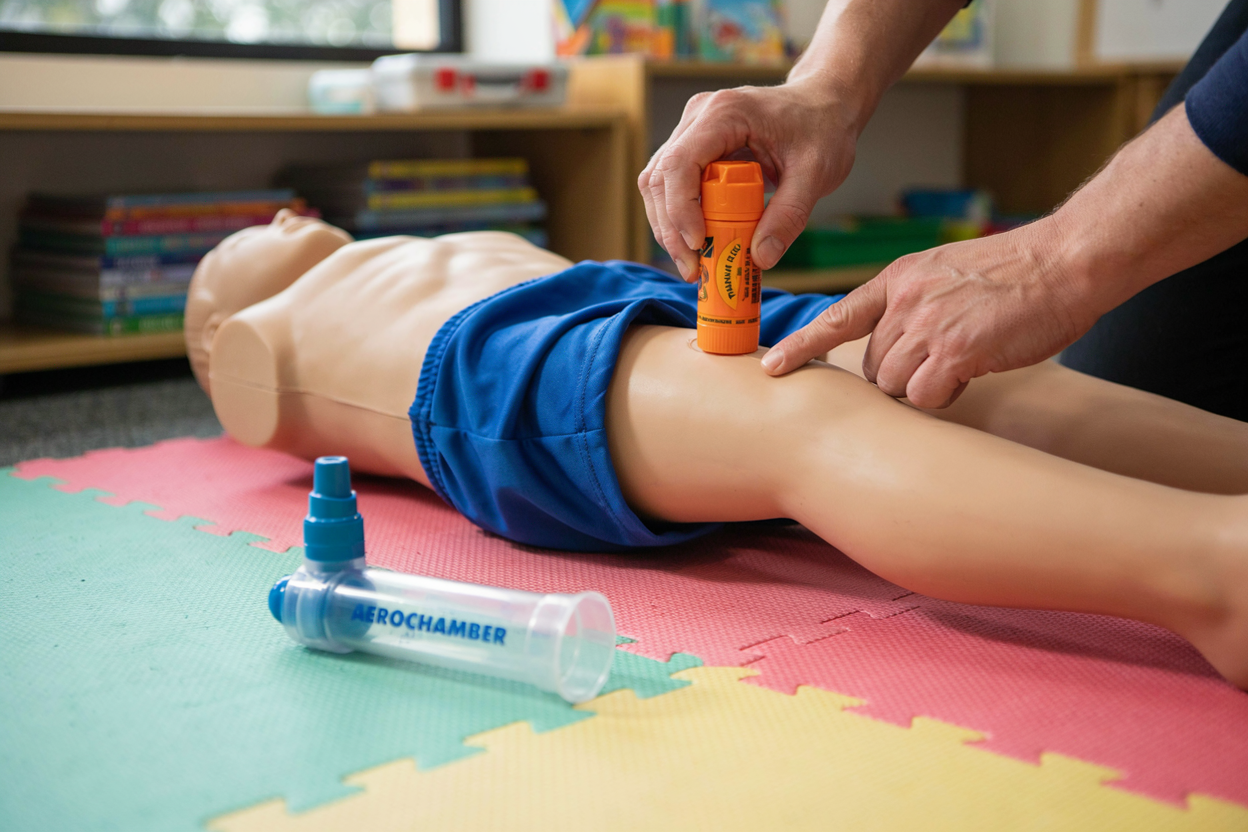
The theory covers CPR fundamentals, recognizing and responding to asthma attacks, anaphylaxis and EpiPen use, and infant and child-specific first aid scenarios, which is the bit that actually separates HLTAID012 from a generic workplace first aid course. It's not just "here's CPR." It's CPR on a manikin sized like an actual toddler, choking response for a child who can't tell you what's wrong, and the exact signs of an allergic reaction escalating in a room full of three year old's.
Can educators do it in their own time?
Yes, and this is where a lot of the "how many hours is this really going to eat into my week" anxiety can ease off a bit. It's self-paced, so an educator can knock out an hour on their lunch break, another hour once the kids have gone home, and finish the rest over a couple of evenings on the couch. Nobody's asking them to sit still for six hours straight in one go.
If you've ever felt unsure exactly which course your team needs, whether it's HLTAID012 versus HLTAID011 or whether the asthma and anaphylaxis units are separate again, that confusion is common and it's not on you. Generic Google results tend to blur all this together because most of what's written online isn't written for a childcare setting specifically. If in doubt, it's worth a quick call rather than guessing and booking the wrong thing.
How Long Is the Face-to-Face Practical Session?
The practical sits at 1.5 hours, and it's the part that actually happens at your center, with everyone in the room at once.
What happens in the 1.5-hour session
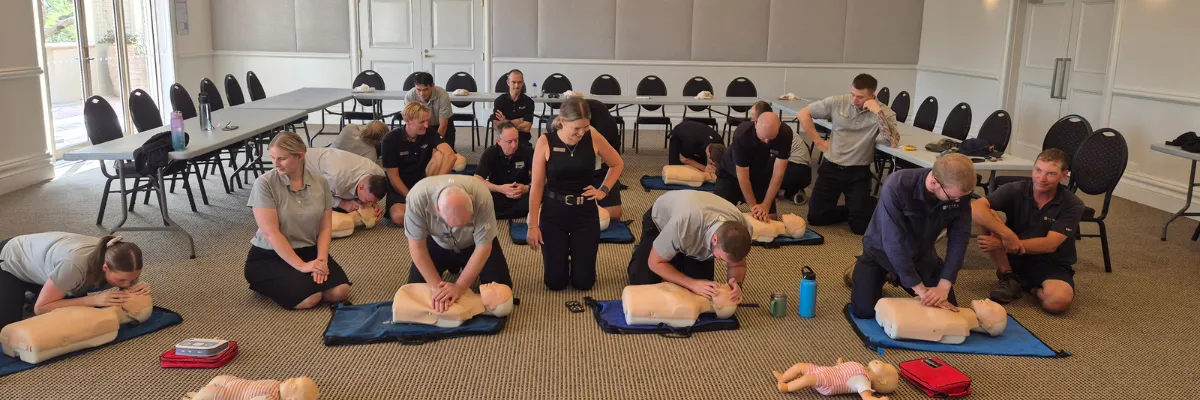
In that window, educators run through a CPR skills check on adult, child, and infant manikins, practice using an EpiPen and asthma devices hands-on, and work through scenario-based assessment, so it's not just theory being recited back, it's "here's a child having a reaction, show me what you'd actually do." That's the difference between a certificate that looks good on paper and a team that's genuinely calm when something real happens.
On-site vs. training center: does location change the time?
The 1.5 hours stays the same either way, but where it happens changes how much of your day it actually costs you. Accelerate First Aid runs practical sessions on-site, at your center, which means no educators driving off to a training facility and burning half a day on travel and coordination. The trainer comes to you, runs the 1.5 hours in a room you've already got, and your team's back on the floor straight after.
If you've ever had to organize transport, find someone to cover a room while staff drive across town for training, and then do it all again picking them back up, on-site training removes that whole layer of logistics. It's 90 minutes, in your building, and done.
How Long Until the Certificate Needs Renewing?
HLTAID012 is valid for 3 years, but the CPR component specifically has a 12 month recommended refresher in between, since CPR skills fade faster than the rest of the content sticks. So it's not a straight "set and forget for three years" situation, it's more like a big renewal every three years with a lighter top-up in the middle.
We've gone into the full detail on what drives that 3 year window and why CPR gets treated differently in our piece on how long a HLTAID012 certificate actually stays valid, so we'll keep this section short rather than repeat it here.

How to Fit Training Around Ratios (Without Closing a Room)
This is the bit that actually keeps directors up at night, more than the hours themselves. Under the NQF, you've got to keep a minimum number of currently-certified first aiders on-site at all times, which means you can't just send your whole team off to training on the same day. Do that and you're breaching ratios, or worse, closing a room and turning families away.
The fix is staggering. Say you've got a 12-person team. Instead of one all-staff day that guts your ratios, you split them into three smaller groups of four, each running their own practical session on a different day or at a different time. One group trains while the rest of the center runs as normal, then the next group goes, then the last. Nobody's ever pulled out in numbers big enough to leave you short.
Staggered scheduling in practice: 12 educators → 3 groups of 4 → 3 separate practical sessions, ratios intact the whole way through
Once your team's certified, keeping on top of who's due for renewal and slotting new hires in as they start is its own ongoing job, and that's exactly what our piece on the steps to getting a childcare first aid certificate walks through in more detail.
How Long Does It Take to Get a New Hire Certified?
New hires are the never-ending part of this job, and you know that better than anyone. The moment your team's fully certified, someone resigns and the clock starts again on somebody new. So the real question isn't just "how long is the course," it's "how fast can I get this person counting toward ratio."
Here's the elapsed time in practice: book them in, they complete the 4 to 6 hours of online theory in their own time over the first few days, then they slot into the next scheduled practical session at your center for the 1.5 hour hands-on component. Depending on when that next session falls, a new educator can go from "just started" to fully HLTAID012 certified and counting toward your ratios within a week or so, sometimes faster if there's a practical slot coming up soon.
That's the whole point of keeping training on a regular, staggered rhythm rather than treating it as a once-a-year event. New starters don't have to wait months for the next big training day. They just slot into whatever's already scheduled.
Want your new hires certified without the wait? Book online or call 0434 778 243 and we'll get them into the next available practical session.
Getting a team fully certified doesn't have to mean losing a day, closing a room, or waiting weeks for the next available slot. Once you break the course down into what it actually is, a handful of hours online and ninety minutes in person, it stops feeling like this huge looming commitment and starts feeling like something you can just schedule around, the same way you'd schedule anything else on the roster.
The certificate timeline helps with that too. Knowing it's three years for the full qualification, with a yearly CPR top-up in between, means you're not caught guessing every few months about who's due and who isn't. It's a rhythm you can actually plan against, rather than a deadline that sneaks up on you the week before an assessment.
Ratios are where most of the real stress lives though, and that's fair enough, because breaching them isn't just a paperwork problem, it's turning families away at the door. Staggering groups, training four at a time instead of the whole team at once, is the bit that quietly solves that. Nobody's pulled out in big enough numbers to leave a room short, and the center keeps running like any other day.
New hires stop being the constant headache too once training's running on a regular rhythm instead of a once-a-year event. A new educator doesn't have to wait months to be useful on the floor. They slot into whatever's already scheduled and they're counted within a week or so, which matters a lot in an industry where someone's always coming or going.
At the end of it, the hours themselves were never really the hard part. It was the not knowing, the scrambling, the wondering whether the next assessment was going to catch a gap nobody meant to leave. Once the shape of the course is clear and the training's staggered properly, that background hum of never quite feeling covered starts to settle, and running a genuinely safe center stops being something you're chasing and starts being something you just are.