How Effective Is CPR Training? Survival Rates Explained
Every four minutes, someone in Australia goes into cardiac arrest outside of a hospital. Most of them survive — or don't — based on one factor: whether the person standing closest to them knows what to do.
That person could be you. At a school carnival. At a backyard BBQ. At the pool with your kids.
Will you genuinely be able to save someone? Or will you freeze, blank on the steps, and stand there wishing you'd done more than just attend a course a few years back?
That's the real question behind "how effective is CPR training" — and it deserves a real answer. Trained bystanders save lives at rates that are hard to argue with. Not always. Not guaranteed. But the gap between doing something and doing nothing is measurable, significant, and consistent across every major study on out-of-hospital cardiac arrest.
The research is clear — and it should make you want to book a course this weekend.
If you already know you need to book — [view available CPR course dates in Brisbane here] — or keep reading to understand exactly why this training matters.
How Effective Is CPR Training?
CPR training is highly effective at improving survival outcomes for cardiac arrest. Key findings from Australian and international research:
Bystander CPR doubles or triples survival rates for out-of-hospital cardiac arrest
Every minute without CPR reduces survival odds by approximately 10%
Immediate bystander CPR can maintain vital blood flow until paramedics arrive
Trained bystanders are significantly more likely to act — untrained bystanders hesitate due to fear of doing harm
Hands-on training outperforms online-only formats for retention and real-world performance
In Australia, fewer than 1 in 10 cardiac arrest victims currently receive bystander CPR before ambulance arrival
CPR training does not guarantee survival — but it demonstrably increases the odds. The gap between doing something and doing nothing is the difference that matters.
What the Survival Rate Research Actually Shows
Out-of-Hospital Cardiac Arrest: The Numbers
Approximately 25,000 Australians suffer out-of-hospital cardiac arrest every year. Without bystander intervention, the overall survival rate sits below 10%. That's a brutal number.
With immediate bystander CPR, survival rates in favourable conditions can climb to somewhere between 20 and 40 percent. That's not a rounding error — that's two, three, sometimes four times as many people making it out alive. The Australian Resuscitation Council and ANZCOR data back this up, and it's consistent with findings published in the Resuscitation Journal across multiple international studies.
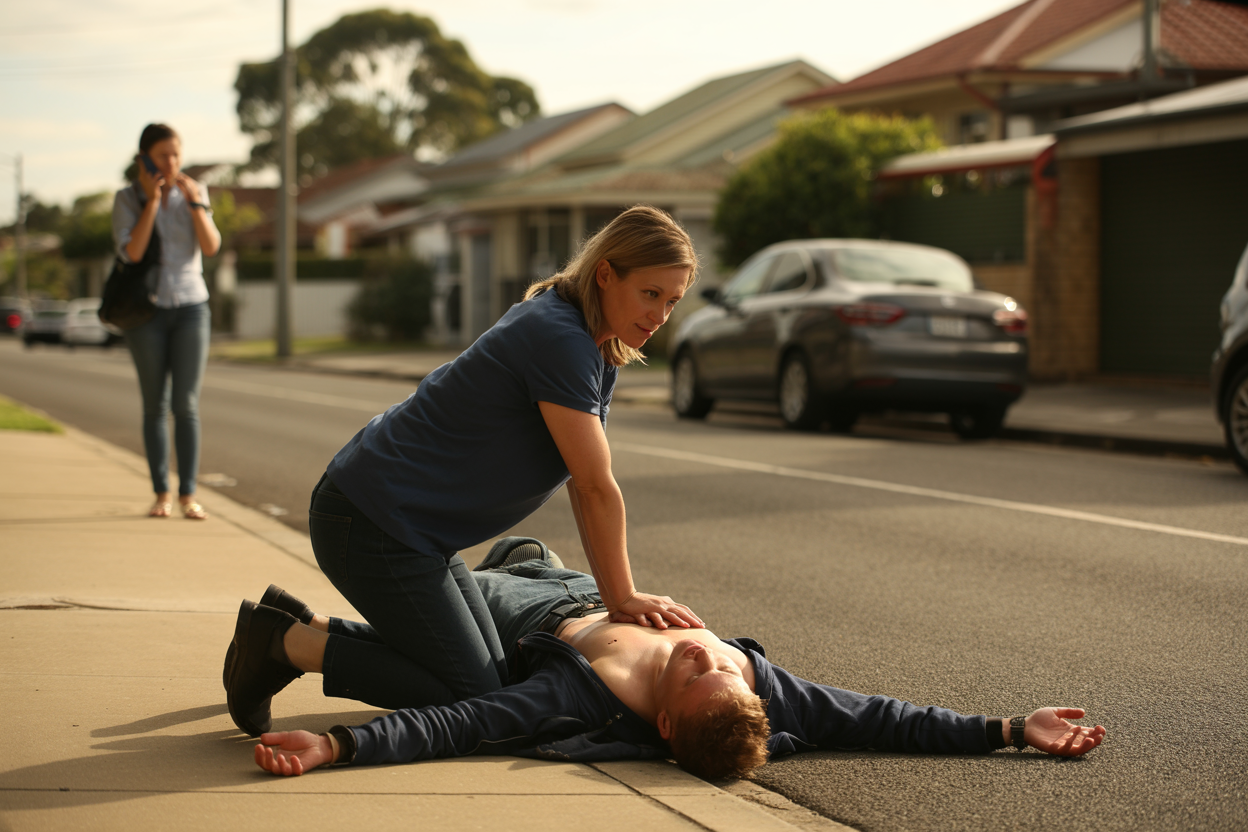
That's what bystander CPR actually does. It doesn't replace the ambulance. It doesn't fix the underlying problem. What it does is keep oxygenated blood moving to the brain and heart until the paramedics arrive with the equipment to do the rest.
The 10% Rule: Why Every Minute Counts
Here's the part that hits differently when you actually do the math.
For every minute that passes without CPR or defibrillation, survival odds drop by roughly 10%. By the time paramedics pull up, 80 to 100 percent of those survival odds may already be gone — unless someone on the scene started CPR before they arrived.
That's not said to scare you. It's said to be honest about what the data shows. The bystander — the person standing right there — is the bridge between collapse and the ambulance. Not a medical professional. Not a hero. Just someone who knew what to do and did it.
That's you, if you've done the training.
What "Effective" Looks Like in a Real Queensland Context
Queensland carries a specific risk profile that most other states don't quite have. The climate, the lifestyle, the outdoor culture — it creates more situations where cardiac and drowning emergencies are genuinely likely.
Backyard pools. Moreton Bay. School sport carnivals. Construction sites. ANZCOR notes Queensland's drowning risk spikes hard during swimming season, and the state consistently records some of the country's highest drowning statistics involving children.
In any of those environments, the most likely first responder is whoever is standing closest. That's almost always someone who is not a paramedic.
Does CPR Training Actually Prepare You — Or Just Certify You?
The Difference Between a Certificate and a Skill
A certificate proves you attended. A skill proves you can actually do something when it counts.
That distinction matters more than most people realise when they're shopping for a CPR course. Because not all training is equal — and the format of your training has a direct impact on whether you'll perform competently under pressure or freeze up when it's real.
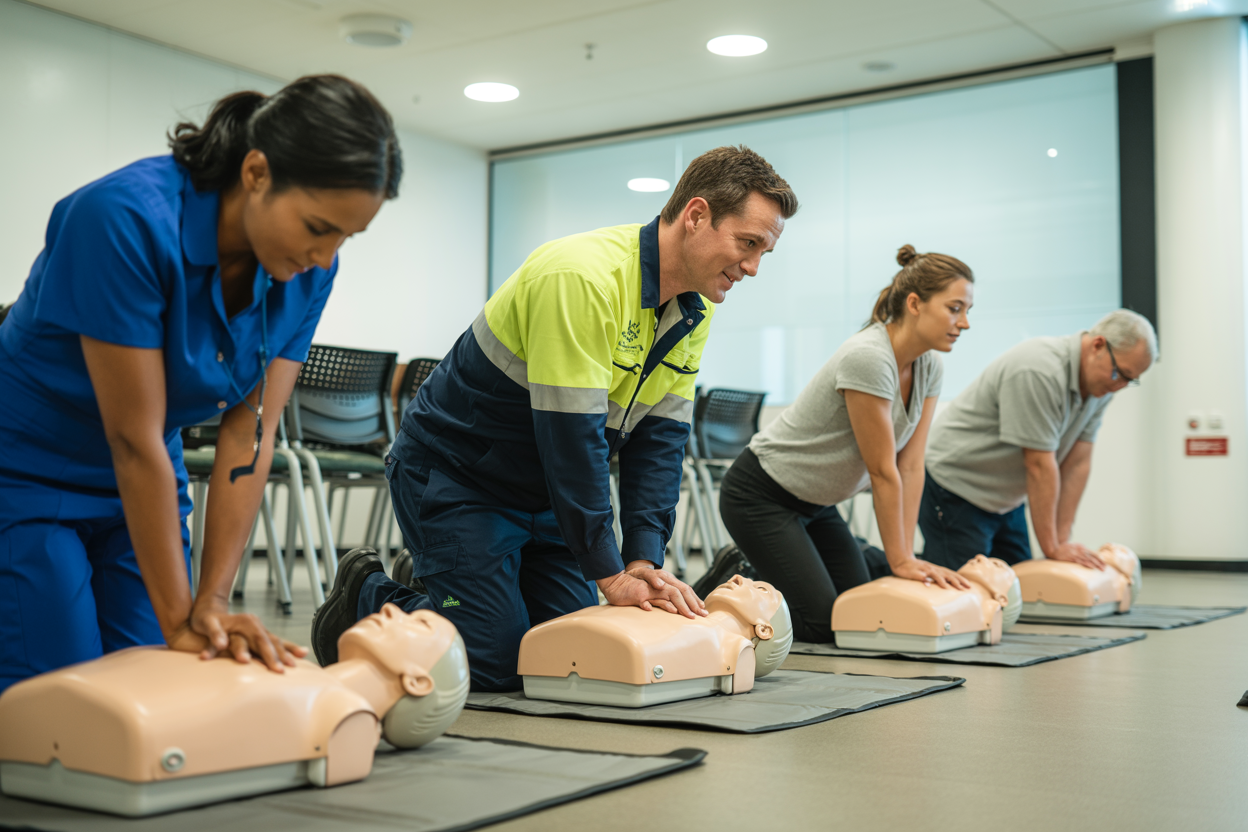
Research on CPR training effectiveness shows that retention varies dramatically depending on how the training was delivered. The markers of a course that actually builds capability are pretty consistent: manikin practice with real feedback on compression depth and rate, hands-on repetition, and scenario-based learning that puts you through the sequence under mild stress rather than just watching someone else do it.
One thing worth being clear on: online-only CPR is not nationally recognised under current Australian Resuscitation Council guidelines. An online certificate will not satisfy your employer's compliance requirements. It won't meet ACECQA standards for childcare workers. And it won't give you the muscle memory you actually need. This isn't a criticism of people who've looked at online options — it's information that most providers don't make obvious enough.
What Hands-On Training Changes in the Brain
There's a reason HLTAID009 requires a practical component, not just a theory assessment. It's not bureaucratic box-ticking. It's based on how motor learning actually works.
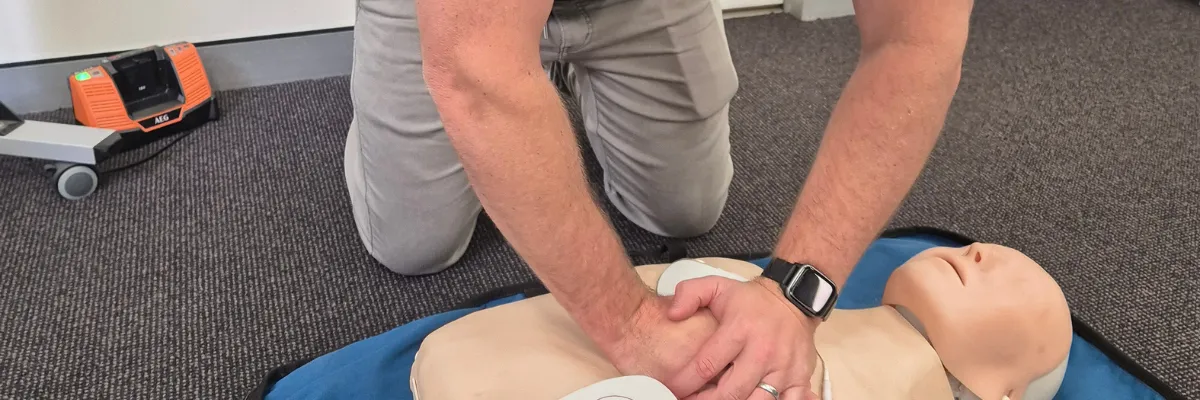
Physical practice — real repetitions on a manikin, with a trainer watching your hand placement and counting your compression rate — creates procedural memory. The kind that lives in your body, not just your head. Under real emergency conditions, when adrenaline is spiking and your brain is not operating calmly, people revert to trained muscle memory. Not what they read in a handout months ago. Not what they watched in a video. What their hands have actually done, repeatedly, with feedback.
That's the whole point of hands-on CPR training. And it's why the research consistently shows it outperforms online-only formats for both retention and real-world performance.
Trainer Quality Matters
Here's something the research on CPR training flags consistently but that most providers don't talk about openly: trainer feedback quality is one of the biggest variables in whether students actually develop usable skill.
Good training means you get corrected. You get coached on your compression depth. You get run through the sequence more than once. You leave with your technique actually refined — not just your attendance confirmed.
It's not a sales pitch. It's just what the evidence says about how people learn physical skills under pressure.
"Even the best training has an expiry date. Here's what the research says about how fast CPR skills actually fade."
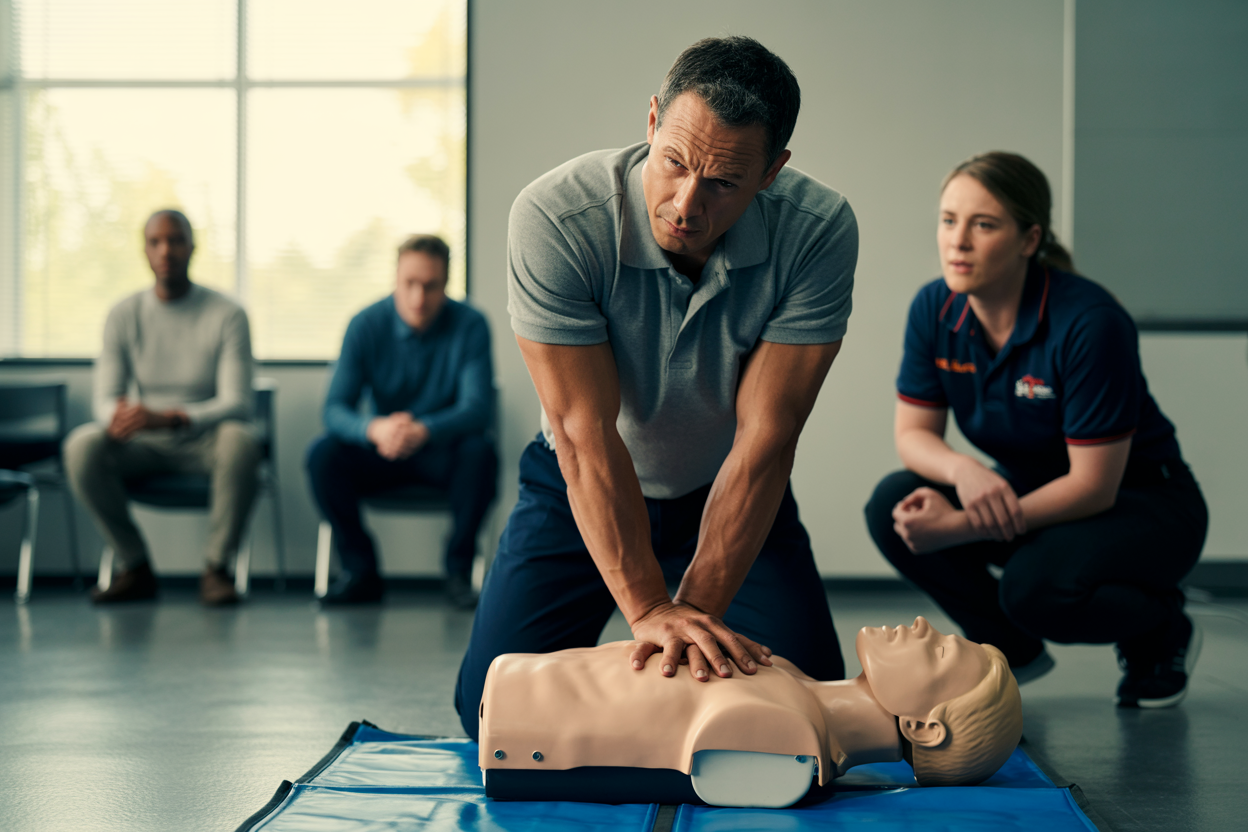
The Skill Fade Problem | And How to Beat It
What Research Says About CPR Skill Retention
Here's something that doesn't get talked about enough in CPR training circles: the skill fades. Faster than most people expect.
Research consistently shows that CPR skills degrade significantly within months of training without any practice in between. Compression rate accuracy, correct hand placement, and appropriate depth — the three things that actually determine whether your CPR is effective — are the first things to go.
Studies have found that fewer than 50% of trainees perform CPR to the required standard at the 12-month mark without a refresher. That means if your certificate is technically still current, there's a reasonable chance your technique has drifted enough to matter in a real emergency.
That's not a reason to panic. It's a reason to treat renewal seriously.
Why Annual Renewal Is Evidence-Based, Not Just Compliance
A lot of people treat the 12-month renewal as an admin task — something HR reminds you about, you book it, you tick it off, you move on. But the Australian Resuscitation Council's recommendation for annual renewal isn't arbitrary policy. It's grounded directly in that retention data.
The renewal isn't just about keeping your certificate current. Each renewal incorporates the latest ANZCOR guideline updates — compression ratios, CPR-only protocols, AED integration. The guidelines do get updated, and what you learned a few years ago may not reflect current best practice. Framing the renewal as an upgrade rather than a repeat is actually more accurate.
Think of it less like renewing your driver's licence and more like actually getting back behind the wheel after a year of not driving. The renewal is the mechanism that keeps the skill usable — not just the certificate valid.
Certificate expired or coming up for renewal? ART runs CPR renewal sessions every weekend in Brisbane.
What You Can Do Between Renewals
There are a few things you can do in the months between courses to keep the skill sharper than it would otherwise be.
Practice on a manikin at home — even occasional repetition helps lock in procedural memory
Use a CPR feedback app — several apps simulate compression feedback and can help you check your rate and rhythm
Review the ANZCOR quick reference card — a five-minute refresh every few months costs nothing and keeps the sequence front of mind
None of these replace the hands-on practical course. But they're the difference between a skill that's maintained between renewals and one that's starting from scratch every 12 months.
"Now that you know why the skill matters and how to keep it sharp — here's how to make sure you're choosing a course that delivers both."
Who Should Get CPR Training | And Who Can't Afford Not To
The Groups With the Highest Obligation
Some people sit in roles where CPR training isn't really optional — it's expected, sometimes legally, sometimes professionally, sometimes just by the nature of what they do every day.
Parents and carrers of young children — Drowning and choking are among the leading causes of preventable child death in Queensland. Backyard pools, bath time, beach trips, swimming lessons — the environments where a young child can get into serious trouble fast are exactly the environments Queensland families spend most of their time. For this group, CPR training is less of a professional requirement and more of a baseline parenting decision.
Childcare and education workers — ACECQA requires current first aid certification for workers in approved childcare services. HLTAID009 is the minimum standard, and an expired certificate is a compliance gap that affects both the individual worker and the service's registration. This isn't a grey area.
Fitness professionals and gym instructors — Cardiac events during exercise are disproportionately common compared to sedentary activity. If you're running classes, coaching clients, or managing a gym floor, you have a duty of care obligation and — depending on your insurer — potentially a policy requirement for current first aid certification.
NDIS and aged care support workers — Both the NDIS Quality and Safeguards Commission and aged care quality standards reference first aid currency as part of the worker competency framework. For support workers taking on higher-care clients, a current HLTAID009 is increasingly a baseline expectation rather than an optional extra.
Construction and trades workers — Safe Work Australia and Queensland WHS legislation reference first aid provisions on site. Depending on site size and risk classification, having a current first aid officer on site is a legal requirement — and CPR is the foundation of that.
Community sport coaches and officials — Queensland community sport peak bodies are increasingly requiring current CPR certification for volunteer accreditation. This one's moving from best practice to standard expectation faster than most volunteers realize.
The "Everyday Person" Case
All of those professional obligations are real. But cardiac arrest doesn't check your job title before it happens.
Around 70% of cardiac arrests in Australia occur in the home, according to ARC data. Not on construction sites. Not in gyms. In someone's lounge room, kitchen, or backyard. The most statistically likely person who will ever need CPR from you is not a stranger on a city street — it's someone you know. A partner, a parent, a neighbour, a friend at a BBQ.
CPR training isn't about being ready for a dramatic public emergency. It's about being ready for the situation the data says is most likely — a quiet, ordinary moment that turns serious fast, with no one else around to step in.
You don't need a professional reason to do this. The personal reason is more than enough.
What to Look for in a CPR Course That Actually Works
The Non-Negotiables
Not all CPR courses are built the same. And given that the whole point of doing this is to be genuinely capable in an emergency — not just compliant on paper — it's worth knowing what separates a course that actually prepares you from one that just processes you through.
Here's what to look for before you book:
✅ Nationally recognized — the HLTAID009 unit code should be issued by a registered RTO. You can verify any provider on training.gov.au before you hand over your money
✅ Hands-on practical component — manikin time is mandatory, not optional. If a course doesn't include it, it won't meet ARC guidelines and won't be accepted by your employer or ACECQA
✅ Same-day or next-day certificate — compliance deadlines are real. A course that takes a week to issue your statement of attainment is a problem if you have a job application or audit coming up
✅ Flexible scheduling — most working adults can't do a weekday 9-to-5 course. Weekend sessions and early morning options are the baseline expectation, not a bonus feature
✅ Brisbane-based trainer — local knowledge, real local scenarios, an accessible venue you can actually get to
Red Flags to Avoid
Just as useful as knowing what to look for is knowing what to walk away from.
❌ Online-only CPR certificates — not nationally recognised, will not satisfy your employer, will not meet ACECQA requirements, and will not give you the procedural memory that hands-on training builds
❌ No RTO number visible on the website — if a provider isn't displaying their ASQA registration number, that's worth questioning before you book
❌ Vague venue details — if you can't find out exactly where you're going, that's a gap in transparency that tends to reflect the course quality
❌ No Google reviews or no response from the provider to existing reviews — a provider who doesn't engage with their reviews is showing you something about how they treat students
❌ Certificate not issued same day — in a market where compliance deadlines are real, this is a practical problem, not just an inconvenience
Ready to Book Your CPR Course in Brisbane?
Advanced Resuscitation Training delivers nationally recognised HLTAID009 CPR training in Brisbane. Hands-on, practical, and built around real skill transfer — not just getting a certificate in your inbox. Your statement of attainment is issued the same day, so if you've got a compliance deadline coming up, you're covered.
Booking takes less than three minutes online. No account required, instant confirmation, and all your course details sent through immediately.
If you've been putting this off — because life got busy, your certificate quietly lapsed, or you just haven't gotten around to it — this is a straightforward thing to fix. All it takes is one session to go from uncertain to genuinely ready.
Advanced Resuscitation Training is an ASQA-registered RTO. HLTAID009 CPR training, Brisbane-based, with real trainers and real results.