HLTAID015 Practical Assessment: What to Expect (Brisbane)
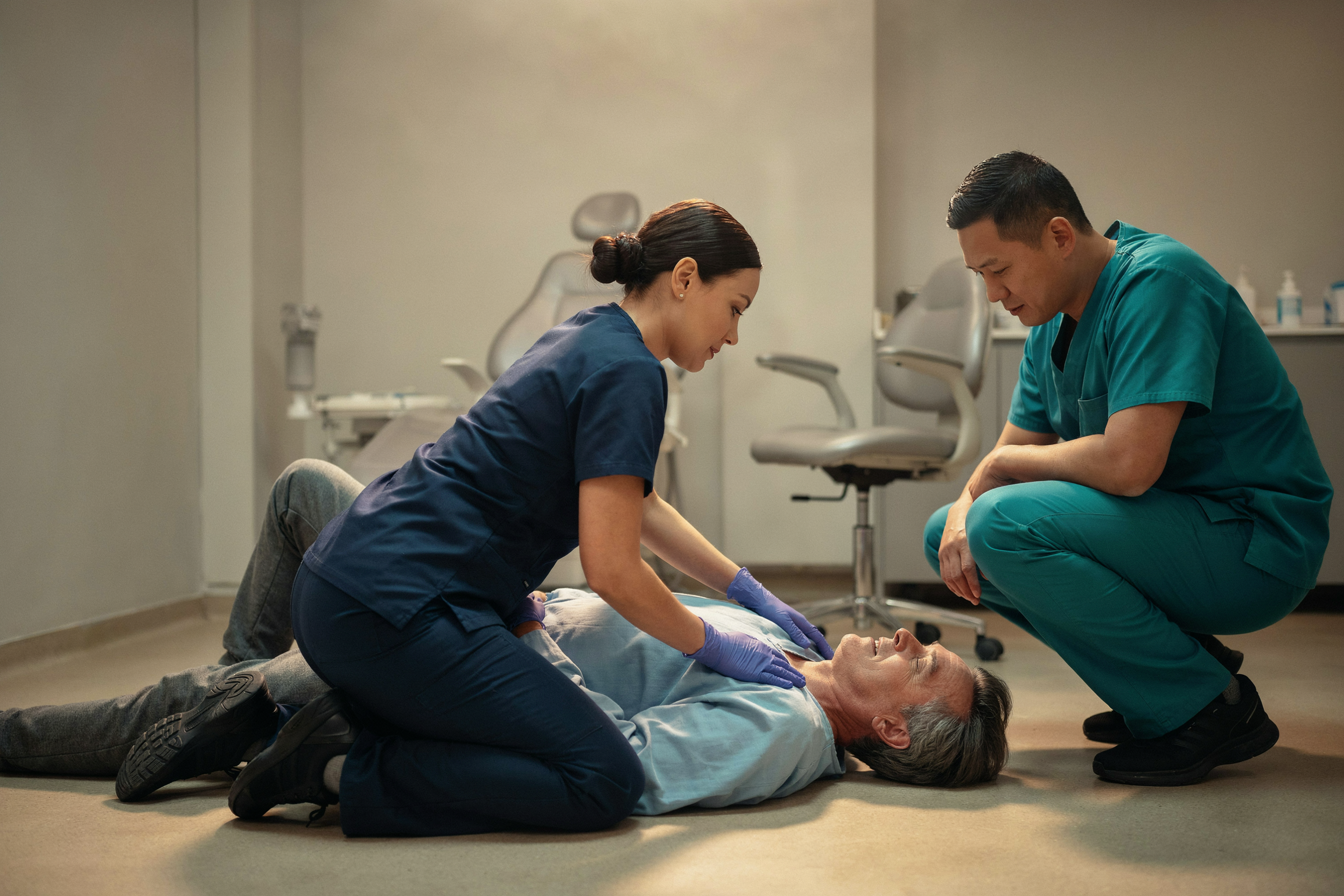
It's 5:30pm and the last sedation patient has gone home. Your dental assistant is kneeling beside an adult manikin on the surgery floor, keeping compressions going, while a colleague ventilates with a bag-valve-mask hooked up to oxygen. The trainer calls a swap. They change places with barely a pause. Then the AED prompts a shock. That's the HLTAID015 practical assessment, and for most of your clinical team it's the part of the course they worry about most.
Here's the good news. Nothing in it is a surprise. The tasks are set nationally in the unit's assessment requirements, they're not made up on the day by the trainer. And they go well past CPR: two-rescuer resuscitation with oxygen, putting in an airway adjunct, suctioning, an AED shock, oxygen for a conscious patient, bleeding control, and checking all the gear afterwards.
This guide walks through each task, what the assessor looks for, the equipment, and how to get nervous team members ready. If you're booking for a whole practice in Brisbane, it also covers running the assessment on site, after hours.
What Is Assessed in the HLTAID015 Practical Assessment?
The HLTAID015 practical assessment tests whether you can use resuscitation and oxygen equipment in realistic scenarios. Under the unit's national assessment requirements, each candidate has to show they can:
Manage an unconscious, breathing casualty, including positioning to protect the airway.
Perform at least 2 minutes of uninterrupted single-rescuer CPR on an adult manikin on the floor.
Run two-rescuer CPR with bag-valve-mask ventilation and oxygen, rotating with minimal pauses.
Insert a basic airway adjunct and use suction if the casualty vomits.
Follow AED prompts to deliver at least one shock.
Perform at least 2 minutes of CPR on an infant manikin.
Give supplemental oxygen to a conscious casualty after checking vital signs.
Control life-threatening bleeding with a tourniquet and hemostatic dressing.
Report the incident and check, clean and store the equipment.
Contents: How the Assessment Runs · Resuscitation Tasks · Oxygen and Bleeding Tasks · Reporting and Equipment · Equipment Used · Physical Requirements · Preparing Your Team · On Site in Brisbane · If Someone Isn't Yet Competent
How the HLTAID015 Practical Assessment Runs on the Day
First thing to tell your team: nobody's trying to catch them out. Once people know how the day runs, most of the nerves settle.
Practical skills versus knowledge questions
There's two sides to the HLTAID015 assessment. The practical covers the Performance Evidence, the hands-on tasks the assessor watches. The Knowledge Evidence covers legal duties, the five rights of oxygen, contraindications, AED safety and equipment faults, usually tested with written or oral questions. Our advanced resuscitation blended learning guide explains the online and practical split.
Scenarios, not a checklist read-out
The HLTAID015 assessment requirements call for realistic, in-depth scenarios and simulations. A simulated environment is fine if it reflects the real workplace and its equipment. The trainer runs a scenario, your team responds, and the assessor watches each person against the required tasks. It feels more like a drill than an exam.
Your currency is checked first
Before anyone's assessed, the unit requires evidence of currency, as set out in first aid codes of practice. So collect every team member's current HLTAID011 certificate before the session, not on the night. Our advanced resuscitation course prerequisites piece explains why.
Who assesses your team
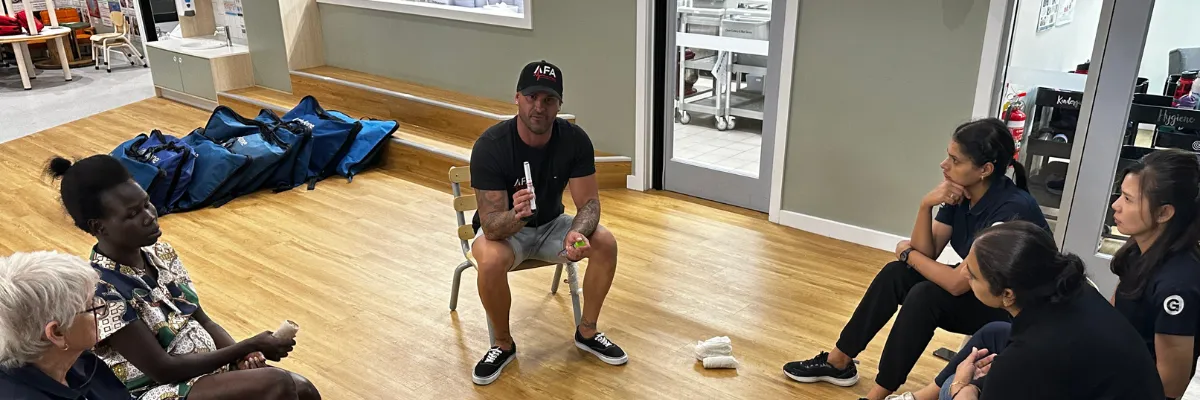
Assessors have to meet the Standards for RTOs and either hold HLTAID015 or show equivalent skills and knowledge. At Accelerate First Aid, that's Jarryd Hunter, our Lead Trainer, who comes from a paramedic background.
None of this can be done online, and our HLTAID015 face to face requirements piece explains why.
With the format clear, here's what each person will actually be doing on the floor.
The Resuscitation Tasks, Step by Step
This is the core of the advanced resuscitation practical. Each task covers what's required, what the assessor watches and the slip we see most. For technique, your trainer works from the ANZCOR Guidelines.
The unconscious, breathing casualty
What's required: positioning the casualty to reduce the risk of airway compromise.
What the assessor watches: recognizing the casualty is unresponsive but still breathing, and getting them into a position that protects the airway.
Common slip: freezing on how to move them. In a dental practice this looks like a sedated patient who goes unresponsive but keeps breathing, and your team has to get them out of the chair and into the recovery position.
Two minutes of single-rescuer adult CPR on the floor
What's required: at least 2 minutes of uninterrupted CPR (5 cycles of compressions and ventilations) on an adult manikin on the floor.
What the assessor watches: CPR that keeps going, without stopping, for the full two minutes.
Common slip: fatigue in the second minute. It feels a lot longer on your knees than it sounds.
The floor part is fixed. CPR in the dental chair isn't assessed as a substitute.
Two-rescuer CPR with bag-valve-mask and oxygen
What's required: at least 2 minutes of bag-valve-mask ventilation with oxygen and at least 2 minutes of compressions, with at least two rescuers rotating with minimal interruption to compressions.
What the assessor watches: the BVM working with oxygen connected, compressions staying steady, and a smooth swap.
Common slip: a long, messy pause at the swap. That's the moment the assessor watches closest.
For a sedation practice, this is the task that matters most. It's the closest thing to a real emergency in your surgery.
Airway adjunct and suction
What's required: select and insert an appropriate basic airway adjunct on an anatomical model. An adjunct is a simple device that helps hold the airway open. You'll also respond to regurgitation or vomiting with positioning and suction.
What the assessor watches: the right adjunct chosen and put in properly, and a quick response when fluid shows up.
Common slip: treating it like chairside suction. Your team deals with fluid in the mouth every day, which helps, but emergency suction on an unresponsive casualty is a different job.
Delivering a shock with the AED
What's required: follow the AED prompts and deliver at least one shock.
What the assessor watches: prompts followed as given. It's done on an AED training device, not a live unit.
Infant CPR
What's required: at least 2 minutes of uninterrupted single-rescuer CPR on an infant manikin on a firm surface.
Common slip: assuming it won't come up. It's required even if your practice only treats adults.
Resuscitation is only half of the unit. The oxygen and bleeding tasks catch more teams out.
Oxygen Therapy and Bleeding Control Tasks
This covers what's assessed, not how to do it. For technique, see our five rights of oxygen administration guide and the ANZCOR Guidelines.
Oxygen for a conscious casualty
Your casualty is awake for this one. Before any oxygen goes on, each person checks respirations, pulse, oxygen saturation and level of consciousness. From there, they have to:
Select and prepare the right equipment
Check the area for ventilation and any ignition sources
Give oxygen at the correct flow rate
Manage an equipment malfunction
Flag that last one. The trainer may set up a fault on purpose, and staying calm while working through it is what's being looked at.
Tourniquets and hemostatic dressings
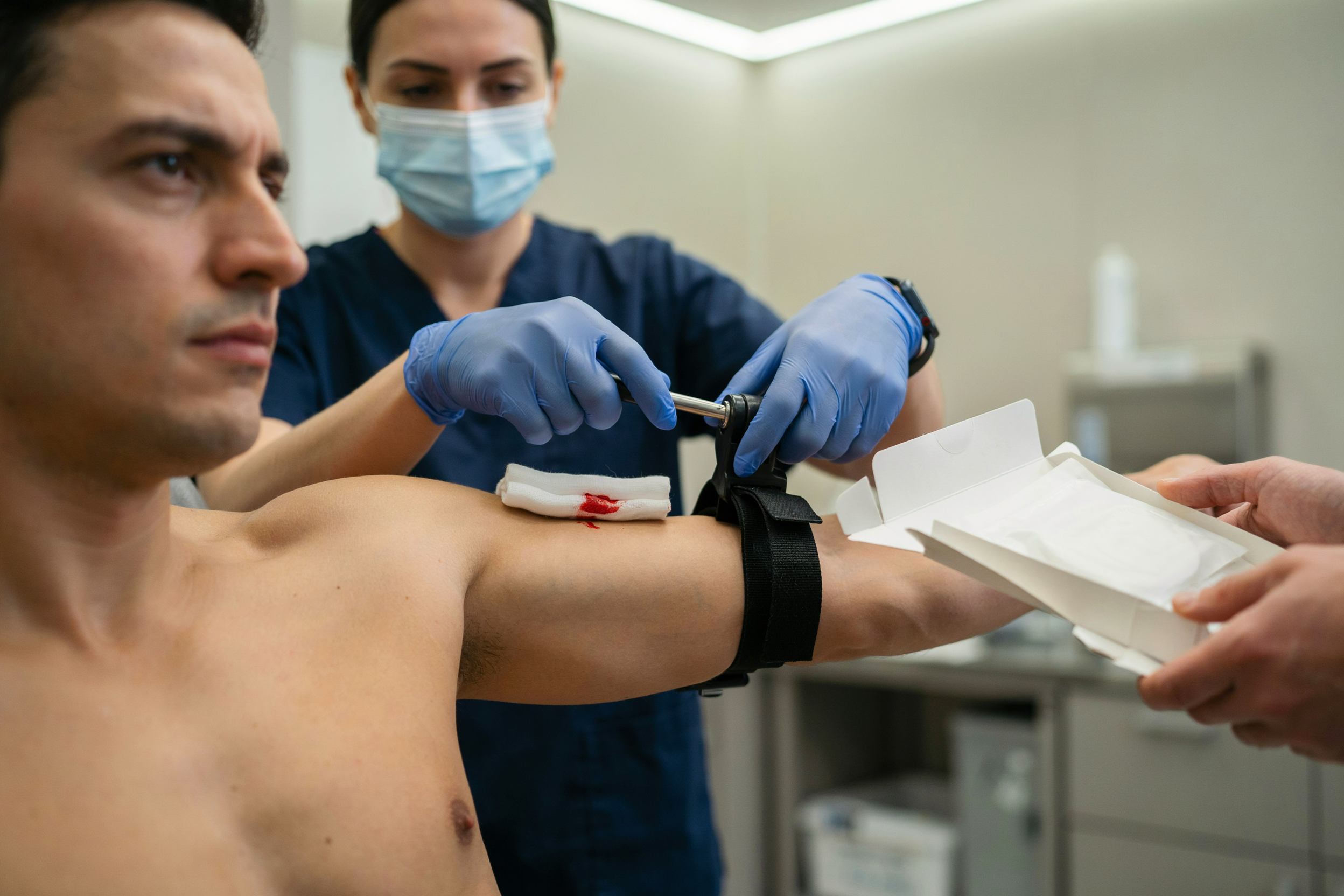
Here's the one dental teams don't see coming. Each person manages life-threatening bleeding using a tourniquet and a hemostatic dressing, which is a dressing treated to help blood clot faster, while wearing PPE.
It can feel out of place in a dental surgery, but it's part of the unit, full stop. Better your team hears it from you now.
Reporting and Equipment Maintenance: The Part Teams Forget
Most people think the HLTAID015 assessment ends when the manikin's "breathing" again. It doesn't. The last two tasks happen after the emergency, and they line up closely with what you deal with every week as a practice manager.
The incident report
Each person gives an accurate verbal and written report, including the vital signs they recorded, then takes part in a review of the incident.
It sounds like paperwork, and it is a bit. But these habits carry straight over to your practice's own incident records, which is the documentation you'll want on file if something ever goes wrong in the chair.
Checking, cleaning and storing the kit
The assessor wants to see each person handle dismantling, storage and disposal, cleaning and decontamination, and checking the gear and diagnosing faults.
And this is where the surprises turn up. Expired AED pads. A cylinder lower than anyone realized. Suction tubing gone missing. Better to find all that on assessment night than in a real emergency.
Most of those maintenance checks happen on equipment your practice already owns.
Equipment Used in the HLTAID015 Practical Assessment
Every item below comes from the Assessment Conditions in the HLTAID015 assessment requirements. If it's on this list, it'll be in the room.
Category | Items |
Resuscitation | Adult and infant manikins, BVM, anatomical model with basic airway adjunct, suction devices |
Defibrillation | AED training device |
Oxygen | Oxygen resuscitation system with cylinder and regulator, pulse oximeter, selection of masks and tubing |
Bleeding | Tourniquets, tourniquet trainer, hemostatic dressings, wound packing trainer |
Other | PPE, incident report form with space for vital signs |
Can the assessment use your practice's own equipment?
Fair question. There's not much point training on a regulator that looks nothing like yours.
The unit requires simulated environments to include the relevant equipment of that workplace. That supports using your practice's own regulator, suction unit and AED alongside the RTO's kit. AED trainers and manikins are still required, though, and your live AED isn't used for the shock task. So your team gets hands-on time with your real gear, and the assessed shock happens on a trainer.
Physical Requirements and Reasonable Adjustments
This is a quiet worry for a lot of people. Someone has dodgy knees, a bad back, or they're pregnant, and they're worried about kneeling for CPR. So let's be straight: adult CPR has to be done on the floor, and that can't be waived.
What can happen is a reasonable adjustment. Under the Standards for RTOs, a reasonable adjustment can change how something is assessed, but it can't remove a required task. ASQA's guidance on reasonable adjustment explains how that works across accredited training.
The best thing your staff can do is speak up early, so there's time to plan.
Got a team member with a physical concern? Talk to a trainer about reasonable adjustments before you book.
How to Prepare Your Clinical Team for the Practical
This part's for you. Most of what makes an advanced resuscitation assessment go smoothly happens in the week before.
Get the online pre-learning done early.
Collect current HLTAID011 certificates and USIs. Anyone without a Unique Student Identifier can get one at usi.gov.au.
Do a quick walk-through of your own kit the week before. Pull out the oxygen, suction and AED and let everyone handle them.
Pre-assign pairs for the two-rescuer task. Mix confident staff with newer ones. The newer assistant gets steadied, and the experienced one practices leading.
Dress for kneeling. And on a long sedation day, eat beforehand.
Normalize the nerves. The assessor checks safe, competent practice, not perfection. Say that out loud to your team.
Is your team assessment-ready?
☐ Current HLTAID011 held by every team member
☐ USI on file for everyone
☐ Online pre-learning complete
☐ Pairs assigned for the two-rescuer task
☐ Kit walk-through done
☐ AED pads in date
☐ Physical concerns raised with the trainer
☐ Clothing for kneeling sorted
Preparation is easier when the assessment comes to you.
Running the HLTAID015 Practical Assessment On Site in Brisbane
Sending staff to public classes one at a time means different dates, parking and lost hours. Bringing the HLTAID015 practical assessment into your practice fixes that.
Here's how onsite advanced resuscitation training in Brisbane works with us:
It's held in your practice after the last patient, so no surgeries get closed.
Scenarios are set in your actual layout. Around the chair, through a doorway, in the recovery room. The places where a real emergency would happen.
Certificates are issued as a batch afterwards, so your records stay tidy.
Our HLTAID015 course page has the full details, and our HLTAID015 accredited course Brisbane guide covers the course itself in more depth.
What Happens If Someone Is Not Yet Competent?
It happens. If someone doesn't get a task over the line, it's recorded as "not yet competent", not "fail". People get there at different speeds.
The usual next steps are simple: feedback on what didn't come together, more practice on that skill, and reassessment of that specific task, not the whole course.
So a wobbly swap doesn't mean starting from scratch. Tell your team that up front.
Ready for the Floor, Not Just the Certificate
Go back to that 5:30pm scene, the swap happening without a hitch. That's not luck. That's a team who knew what was coming.
Nothing in the HLTAID015 practical assessment is a surprise. The tasks are set nationally, the equipment is listed, and the assessor wants safe, competent practice, not perfection.
What catches people out is what nobody mentions in the staffroom: infant CPR, tourniquets, and the kit check where expired pads turn up. Tell your team now.
The hard work sits with you in the week before: certificates, USIs, pre-learning, a kit walk-through and sensible pairs.
And if someone stumbles, it's "not yet competent", not a fail. Knowing that keeps people calm.
At the end of the day, you're not just ticking a compliance box. You're building the confidence that if a patient goes down in the chair, your team will move fast, use the right equipment and do it right. Running the assessment in your own practice, around your own chair and with your own gear, is the most natural way to get them there.