Is HLTAID015 Face to Face Required? Here's the Truth
You've searched "HLTAID015 online" and found providers offering fully remote delivery. Looks convenient. Maybe even a bit too convenient. Now you're sitting there wondering will that certificate actually hold up when your employer checks it, when AHPRA audits your CPD records, or when an aged care compliance reviewer asks to see your training documentation?
It's a completely fair question. And it's one worth getting right before you book.
HLTAID015 Provide Advanced Resuscitation and Oxygen Therapy is not your standard first aid course. It sits above HLTAID011 and covers advanced airway management, oxygen therapy, and resuscitation techniques that must be physically demonstrated on a manikin under direct trainer observation. That last part is the bit a lot of providers gloss over.
The practical component is not optional. It can't be ticked off via a video call. It can't be substituted with an online quiz. Under ASQA's Standards for Registered Training Organisations, combined with the requirements of the nationally accredited HLT Health Training Package, face-to-face practical assessment is mandatory. Any provider offering a fully online HLTAID015 completion is not delivering a compliant course regardless of what their certificate looks like.
This article covers what the rules actually say, what "blended learning" legitimately means for this unit, how to verify a provider is delivering compliantly, and why all of this matters differently depending on whether you're a nurse managing AHPRA CPD, an aged care worker under Aged Care Quality Standards, or a WHS manager responsible for a team of designated first aid officers.
If your certificate needs to hold up under an AHPRA audit, an aged care compliance review, or a SafeWork QLD inspection getting this right before you book matters.
Does HLTAID015 Have to Be Face to Face?
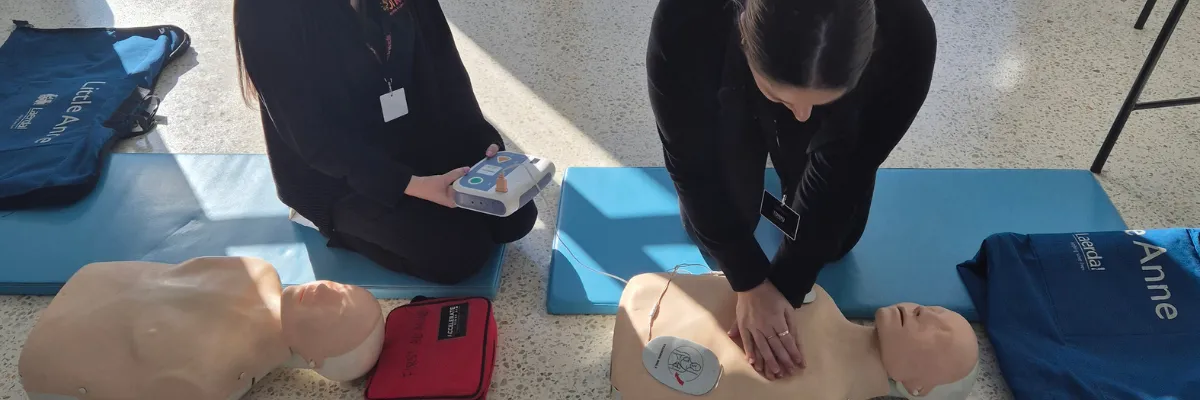
Yes HLTAID015 must include a face-to-face practical assessment component. As a nationally accredited unit under the HLT Health Training Package, HLTAID015 requires candidates to physically demonstrate advanced resuscitation and oxygen therapy skills on a manikin under direct trainer observation. This cannot be completed online.
What must be completed face to face in HLTAID015:
Resuscitation technique demonstrated on an approved manikin
Oxygen therapy equipment setup and operation
Advanced airway management skills, including bag-valve-mask use
Two-person CPR technique
Scenario-based assessment under trainer observation
Competency sign-off by a qualified assessor in person
What can be completed online (pre-learning only):
Theory components and knowledge questions
Pre-course reading and self-paced modules
That's the short answer. The longer answer, the one that explains why this matters for your specific situation and how to make sure the provider you're looking at is actually doing it right is below.
📋 The one thing to know before you read further: HLTAID015 cannot be completed fully online. A face-to-face practical assessment is mandatory under the HLT Health Training Package. Any certificate issued without a verified in-person assessment session is not compliant under ASQA's Standards for Registered Training Organizations.
What the Rules Actually Say About HLTAID015 Delivery
There's a lot of noise online about flexible delivery, self-paced learning, and remote certification. Some of it is legitimate. Some of it isn't. When it comes to HLTAID015, the rules aren't ambiguous and they don't leave much room for creative interpretation.
ASQA Standards and the Training Package Requirements
HLTAID015 sits within the HLT Health Training Package and is delivered by ASQA-registered RTOs. That matters because ASQA's Standards for Registered Training Organisations 2015 require that assessment conditions specified in the unit of competency are actually met not approximated, not adapted for convenience, met.
The unit of competency for HLTAID015, published on training.gov.au, specifies assessment in a "real or simulated workplace environment" with direct observation by a qualified assessor. A trainer physically present, watching you perform the skills, and signing off competency to the required standard. An RTO that issues an HLTAID015 certificate without conducting a verified face-to-face practical assessment is operating outside its obligations under the Standards for RTOs, and the certificate it produces is not compliant.
What "Blended Learning" Legitimately Means for This Unit
You'll see the term "blended learning" used by a lot of providers. In the context of HLTAID015 it's a legitimate and common delivery model when it's done correctly. Blended delivery means theory and knowledge components are completed online before the course day, and the practical skills assessment is completed face to face. Both are required. The online pre-learning is not the course it's the preparation for the course.
Blended delivery is compliant. Fully online delivery is not. If a provider's course structure doesn't include a mandatory face-to-face practical session, that's not a blended model that's a non-compliant one.
Understanding the rules is one thing, understanding what happens when those rules aren't followed is another.

Why This Matters The Real Consequences of a Non-Compliant Certificate
A certificate with the wrong unit code, missing RTO details, or issued without a verified practical assessment isn't just a paperwork problem. Depending on your role, it can mean a failed CPD audit, a regulatory finding against your facility, or a gap in your employer's duty of care that doesn't surface until something goes wrong.
Here's what that looks like for each group.
For Nurses and Healthcare Professionals
AHPRA registration renewal requires documented CPD hours from nationally accredited training delivered through a compliant RTO. The burden of verification sits with the registrant, not with AHPRA. AHPRA does not pre-approve providers. If you're audited and the certificate you submitted was issued without a verified face-to-face practical component, it will not satisfy the requirement. The fact that the provider looked legitimate and charged a normal course fee is not a defense.
For nurses in ICU, ED, and cardiac care settings where HLTAID015 is increasingly specified over HLTAID011 by hospital employers a non-compliant certificate creates a gap in employer records that HR will eventually flag. The safest position is a certificate from an ASQA-registered RTO with HLTAID015 on its scope, issued after a verified face-to-face practical session.
For Aged Care and NDIS Workers
The Aged Care Quality & Safety Commission audits aged care facilities against the Aged Care Quality Standards, and training records are a standard part of that review. A worker holding an HLTAID015 certificate issued without a compliant practical assessment creates an audit finding not just for the individual, but for the facility.
The NDIS Commission applies a similar lens. Under the NDIS Practice Standards, registered providers must demonstrate that workers have the skills and training to support participants safely. A certificate that can't be verified as compliant doesn't satisfy that requirement, regardless of how it looks on paper. Workers who come through a properly delivered HLTAID015 course aren't just ticking a compliance box; they're walking away with skills they'll actually use when it matters most.
For WHS Managers and Corporate Buyers
Under the WHS Act 2011 (QLD), employers as PCBUs have a duty to ensure workers have the skills and training required for their role. A designated first aid officer holding a non-compliant HLTAID015 certificate represents a gap in that duty of care. And "we didn't know the provider wasn't compliant" is not a recognized defense under WHS legislation. In a SafeWork QLD audit, a certificate with missing unit codes or issued by a provider without HLTAID015 on their scope won't hold up. One compliance review that flags non-compliant documentation can unwind months of preparation.
Quick reference what's at stake by role:
Nurses & paramedics: Non-compliant cert = AHPRA CPD audit risk
Aged care & NDIS workers: Non-compliant cert = facility audit finding
WHS managers: Non-compliant cert = duty of care gap under WHS Act 2011 (QLD)
The good news is that verifying a provider's compliance before you book takes less than five minutes.
How to Verify a Provider Is Delivering HLTAID015 Compliantly
Most people book a course the same way they'd book anything online find a provider, look at the reviews, hit enroll. For HLTAID015, that process misses the one step that actually matters. Here's how to check before you commit.
Check the RTO Registration
Every legitimate HLTAID015 provider must be registered with ASQA and have HLTAID015 listed on their scope of registration. This isn't something you have to take the provider's word for you can verify it yourself at training.gov.au.
How to check an RTO's scope on training.gov.au:
Go to training.gov.au and select "Search for an RTO"
Enter the provider's name or RTO number
Confirm HLTAID015 appears on their listed scope of registration
If HLTAID015 isn't on the scope, the provider cannot legally issue a compliant certificate for that unit. Full stop.
What a Compliant HLTAID015 Certificate Looks Like
Once you've completed the course, your certificate should include all of the following:
RTO name and RTO number
Your full candidate name
Unit code: HLTAID015
Unit title: Provide Advanced Resuscitation and Oxygen Therapy
Issue date and expiry guidance
If any of those elements are missing particularly the RTO number and unit code the certificate will not hold up under an AHPRA audit, an aged care compliance review, or a SafeWork QLD inspection. A certificate that looks professional but is missing the unit code is worth exactly nothing in a regulatory context.

HLTAID015 Face to Face vs HLTAID011 Is There a Difference in Delivery Requirements?
This is one of the more common questions that comes up before booking, particularly for workers who already hold a current HLTAID011 and are trying to work out whether they actually need to upgrade or whether their employer is asking for something their existing cert already covers.
Both units require face-to-face practical assessment. Neither can be completed fully online. But HLTAID015 goes further and the additional practical components are the reason the two certs are not interchangeable.
The additional requirements in HLTAID015 aren't padding. They reflect real skills that need to be physically demonstrated: oxygen therapy equipment setup and operation, bag-valve-mask technique, and coordinated two-person CPR none of which are assessed in HLTAID011.
If your employer, contract, or regulatory body specifies HLTAID015, an HLTAID011 certificate is not a substitute. That's true regardless of how the HLTAID011 was delivered or how recently it was completed. The two units assess different competencies, and the organizations that specify HLTAID015 do so precisely because they need those additional skills covered.
For workers who already hold a current HLTAID011, upgrading to HLTAID015 doesn't necessarily mean starting from scratch but the pathway depends on your provider and your existing currency. It's worth confirming the right entry point before you enroll.
Ready to Book a Compliant HLTAID015 Course?
The question of whether HLTAID015 has to be done face to face isn't really a grey area. The training package is clear, ASQA's standards are clear, and the assessment requirements for this unit have always pointed in the same direction: a qualified assessor, a manikin, and a practical session that cannot be replicated through a screen. What changes depending on who you are is the consequence of getting it wrong.
For healthcare professionals, a non-compliant certificate is a CPD portfolio problem that doesn't show up until AHPRA runs an audit. By then the course is done and the only path forward is to repeat it properly. That's an avoidable outcome with one step taken before booking verifying the RTO's scope on training.gov.au.
For aged care and NDIS workers, regulatory audits review training records as standard. A certificate that can't stand up to that review creates a finding against the facility, not just the individual worker. The workers who come through a properly delivered HLTAID015 course aren't just ticking a compliance box they're walking away with skills they'll actually use, which is the whole point.
For WHS managers and safety officers coordinating training across a team, the documentation matters as much as the delivery. A certificate with the correct unit code, RTO number, and issue date, issued after a verified face-to-face practical session, is a document that holds up. Anything short of that creates a gap in the compliance record that tends to surface at the worst possible time.
Weekend and flexible scheduling options exist for those who can't make a standard weekday course work. Shift workers, rostered staff, and anyone with non-standard hours shouldn't have to choose between compliance and their roster. Providers who understand the healthcare and aged care workforce build their schedules accordingly and those are the providers worth finding.
If you've read this far, you already know what to look for. HLTAID015 on the RTO's scope. A mandatory face-to-face practical session. A qualified assessor. A certificate with the right details on it. Those four things separate a compliant course from one that looks the part but won't hold up when it needs to. Getting advanced resuscitation training right matters for the certificate, and for what that certificate is actually supposed to represent.