HLTAID012 Trauma Management: Full Module Breakdown
It's 2:47pm on a Tuesday and one of your toddlers has just come off the climbing frame wrong. Wrist at a funny angle, screaming, and the educator who reaches her first has about four seconds to decide what happens next. Or maybe it's a kitchen bench edge during afternoon craft, or a burn from a cup of tea someone forgot to move off the low table. These aren't hypotheticals. They're Tuesday.
Every center director knows this feeling, that quiet background hum of never quite being sure everyone on the floor could handle a real emergency if one landed in their lap right now. It's not about doubting your team. It's about knowing that reading a manual once, months ago, isn't the same as being able to act without thinking when a child is genuinely hurt.
This is the bit of HLTAID012 that actually matters when something goes wrong, not the certificate on the wall, but what your educator does in the sixty seconds before help arrives. That's what HLTAID012 trauma management training is built for.
The module breaks down into four skill areas: bleeding control, fracture and soft-tissue injury care, shock recognition, and burns management. Here's exactly what your team can handle, and what that means for keeping your center ratio-safe and compliance-ready every day.
Why Trauma Management Is a Core Part of HLTAID012 (Not Just an Add-On)
A lot of centers picture HLTAID012 as basically CPR with a few extra bits bolted on. It's not. Trauma management is a genuine chunk of the course, and it's the part most likely to get used in any given week. CPR gets rehearsed, thankfully, far less often in real life than a scraped knee, a bumped head, or a splinter that turns into a full meltdown. If you asked most educators to list the emergencies they've actually handled in the past year, the trauma list would be a lot longer than the resuscitation one.
The four skill areas at a glance
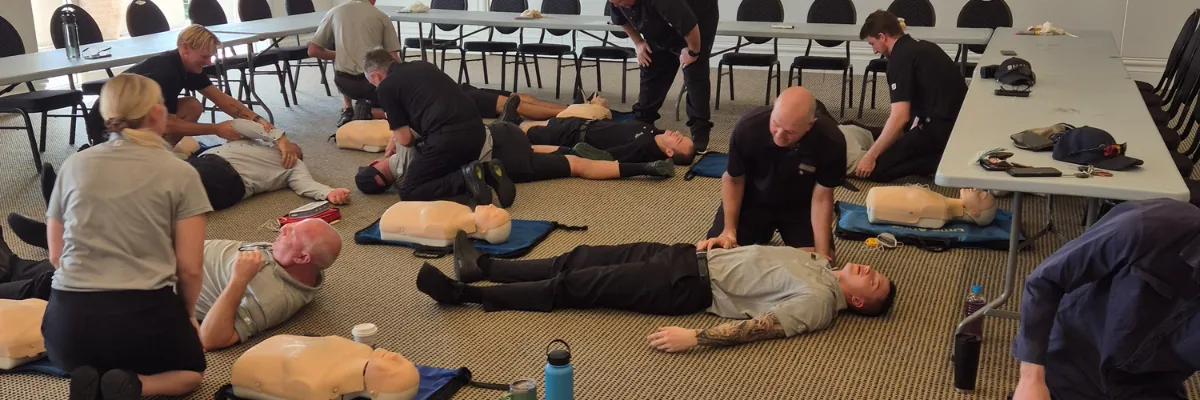
Bleeding, fractures, shock, burns, that's the run of it. Each one gets proper hands-on time, not a five-minute slide and a nod. Educators practice on each other and on mannequins, and get asked "what do you do now?" mid-scenario so it sticks. Because when a real kid is really bleeding, nobody has time to remember a slide.
Why childcare settings need this differently than a general workplace course
A standard workplace first aid course is built around adults, adult bodies, adult injuries, adult ways of communicating what hurts. Your center is nothing like that. You've got a two-year-old who can't tell you where it hurts, a bench height that's wrong for every technique a general course teaches, and injury patterns that don't show up in an office: climbing frame falls, bites, craft-scissor nicks, a toddler who's bitten through her lip on the slide.
A course built around HLTAID012's childcare context matters more than whatever's cheapest and closest. Your educators are learning how to treat a wound on a squirming, frightened three-year-old, while the other seventeen kids in the room are watching, and while someone still needs to keep supervising the sandpit.
Bleeding Control: What Educators Actually Learn
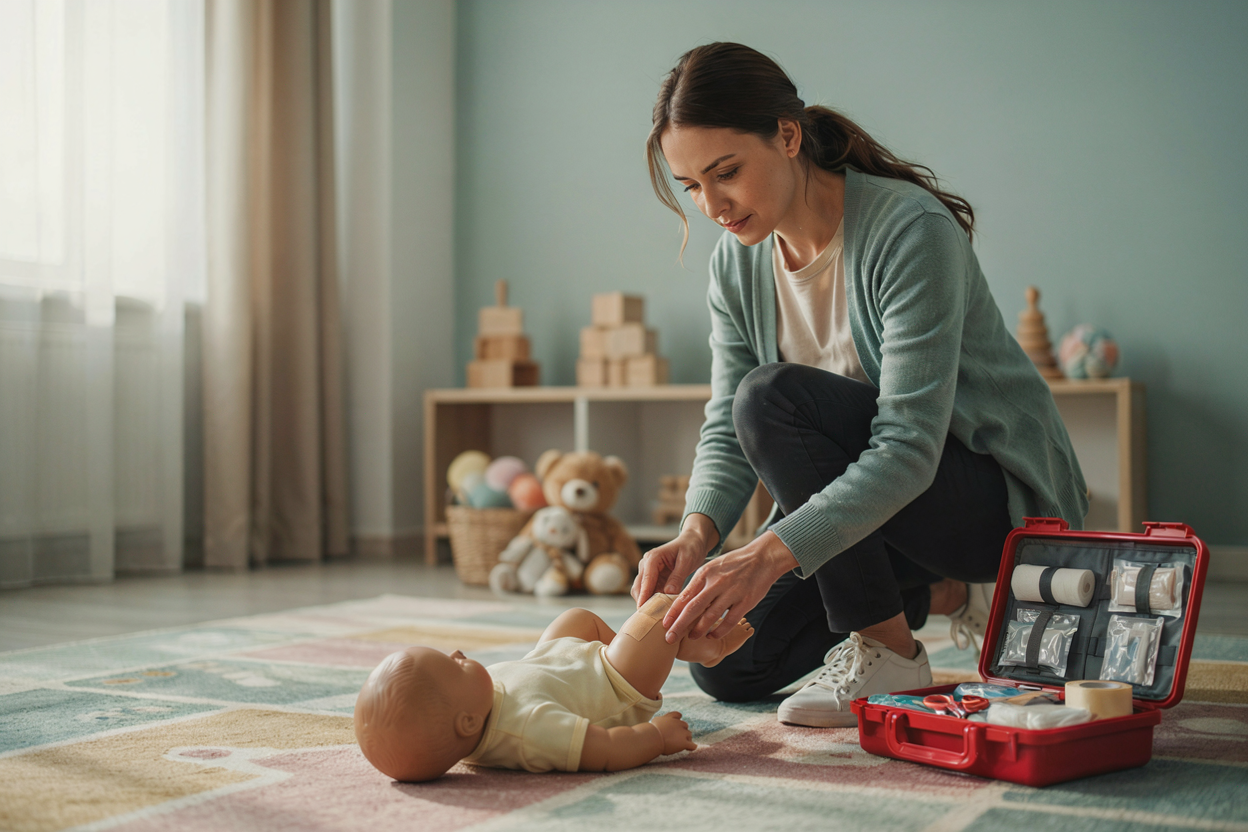
This is usually the first scenario educators picture when they think "childcare injury," and fair enough, it happens the most. A scraped knee bleeds. A bumped nose bleeds a lot more than it looks like it should. And every now and then something more serious happens, and that's the moment this training is for.
Direct pressure and wound dressing
The core skill is simple to say and harder to do calmly with a screaming toddler in front of you: apply firm, direct pressure to the wound, keep it there, and don't peek every ten seconds to check if it's stopped (it hasn't, and lifting the dressing restarts it). Educators are trained in proper wound dressing, clean, secure, and appropriate for a wriggly kid who wants to run straight back to the sandpit the second it's covered.
There's also a calming-the-child element to this that doesn't get talked about enough. A toddler who sees blood and panics fights the treatment, which makes everything harder. Part of what's drilled into educators is staying visibly calm themselves, because kids read an adult's face before they read the injury. A steady voice and a confident hand do half the work.
Managing severe bleeding until help arrives
Most bleeding in a childcare setting is minor. But educators are also trained for the rare, serious end, where bleeding won't stop with pressure alone, and the priority shifts to controlling blood loss and keeping the child calm and still while waiting for an ambulance. An educator who's drilled this before doesn't freeze. They also know to keep talking to the child the whole time, reassuring them, watching for any change in color or responsiveness, because that's often the first sign things are heading toward shock.
Age-specific considerations
A bleeding infant and a bleeding five-year-old are different situations. Infants have far less blood volume, so what looks like "not much" can matter more than in an older child. Toddlers fight the dressing. Pre-schoolers can sometimes help by holding still if you talk them through it. This training covers all three, because a one-size-fits-all technique doesn't hold up across an age-mixed center, and your center almost certainly has all three age groups under one roof.
If bleeding is severe enough, it can tip into shock, which is exactly where the next section picks up.
Want your whole team confident in these exact skills? See upcoming HLTAID012 sessions for your center.
Fracture & Soft-Tissue Injury Management
Kids fall. It's basically the job description of being a kid. Most of the time it's a graze and some tears that stop the second you produce a band aid with a dinosaur on it. But sometimes it's more, and knowing the difference is what this part of the module trains your team to do.
Recognizing a suspected fracture
Young children's bones are still developing, so a fracture doesn't always look or behave like it would in an adult. Sometimes there's no obvious deformity at all, just a kid who won't use an arm and cries when you touch near the elbow. Educators are trained to recognize the subtle signs: swelling, reluctance to move or bear weight, pain on touch, and a kid who's just "not right" about a particular limb. This subtlety is exactly why generic first aid training falls short here, a course built for adults assumes the injured person can tell you clearly what's wrong, and a two-year-old simply can't. She'll show you with her whole body instead, if you know what to look for.
Immobilization for small bodies
Once a fracture is suspected, the goal is simple: stop the injury getting worse before help arrives. Immobilization on a small, wriggling body isn't the same as on an adult. Educators learn how to support and immobilize the injury in a way that works for a toddler-sized arm or leg, without needing the child to hold still and cooperate, because they usually won't. A lot of this comes down to technique that steadies the limb using what's on hand, calmly, without adding to the child's distress.
When to call an ambulance vs. manage on-site
This is one of the most valuable judgement calls in the whole module. Not every bump needs an ambulance. But some do, and hesitating costs time. Educators are trained on the clear warning signs that mean "call now": obvious deformity, inability to move the limb at all, or an injury mechanism serious enough, a fall from height, for instance, that internal injury can't be ruled out just by looking.
What we're really building isn't a checklist to memorize and forget. It's confidence under pressure, the ability to look at an injured kid, stay calm, and know what to do next without freezing or guessing. That confidence is what separates an educator who handles the situation from one who's frozen, waiting for someone else to take charge.
Shock Recognition and Response
Shock is the one that catches people out, because it doesn't always look dramatic. No blood, no obvious injury sometimes, just a kid who's suddenly pale, cold, and not quite themselves. It's genuinely dangerous if it's missed, precisely because it can be quiet.
Early warning signs specific to children
Kids show shock a bit differently to adults, and it can move faster in a small body. Educators are trained to watch for the early signs: pale or grey skin, clammy or cold skin, a faster than normal breathing rate, restlessness or unusual drowsiness, and a kid who just seems "off" in a way that's easy to notice once you know what you're looking for. That last one matters more than people expect, an educator who knows a child well will often notice something's wrong before any textbook sign shows up clearly.
Correct positioning and monitoring
Once shock is suspected, positioning matters. Educators learn the correct way to position a child to support blood flow, and how to keep monitoring them properly while waiting for help. Shock can change quickly, so this is active watching, checking breathing, checking responsiveness, and staying with the child the whole time. It's not a task you hand off and check on later, it needs someone dedicated to it until help arrives.
How shock can follow from bleeding, burns, or allergic reactions
Shock isn't its own separate emergency that shows up out of nowhere, it's often a follow-on from something else. Severe bleeding can tip a child into shock. A serious burn can too. So can a severe allergic reaction. That's why this training doesn't teach these skills in isolation: bleeding control, burns response, and anaphylaxis management all connect to the same underlying skill of recognizing and responding to shock. Understanding that connection is part of what makes an educator genuinely prepared, rather than just having memorized four separate lists.
If your team also handles individual medical action plans for allergies, this connects directly with anaphylaxis response, worth having both trained together rather than treating them as separate boxes to tick.
Burns Management
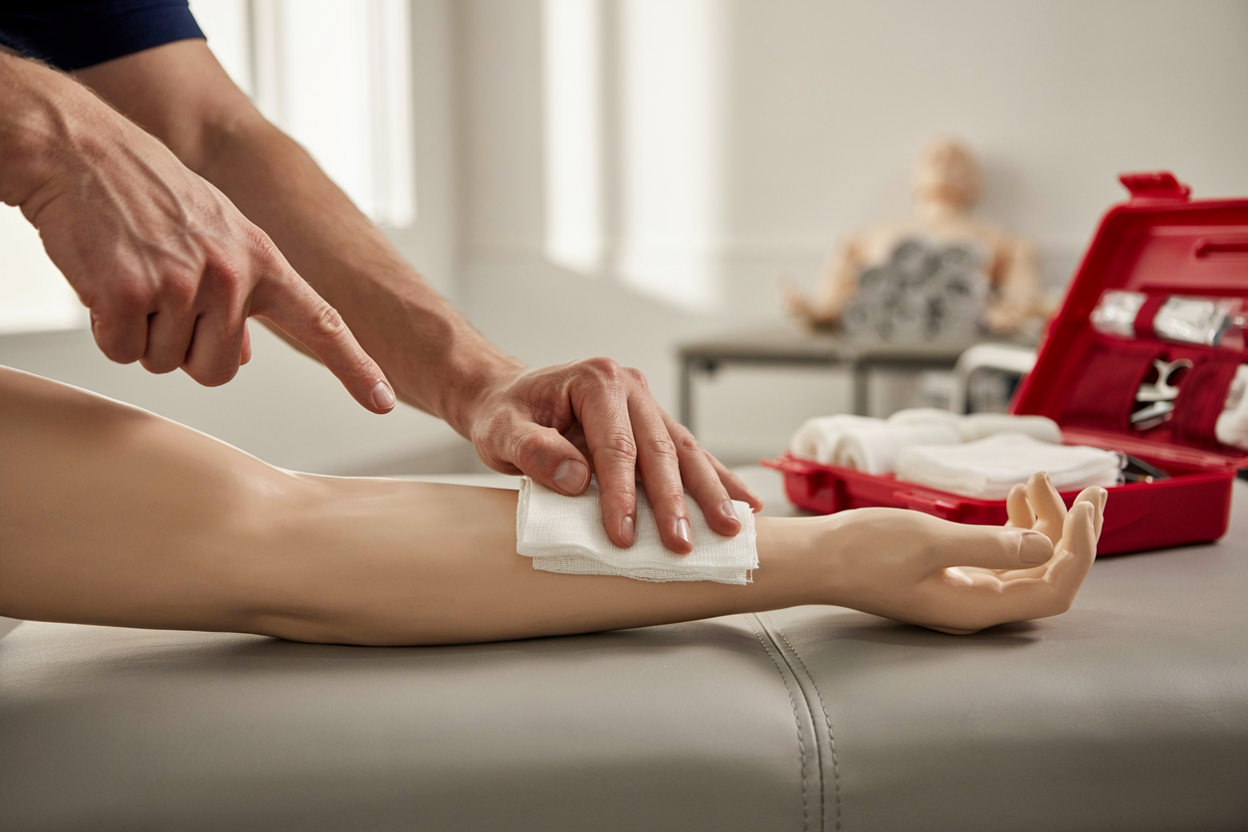
Burns are one of those injuries where everyone's got an old wives' tale about what to do, and most of them are wrong. This part of the module teaches the right response, and un-teaches the myths educators might have picked up along the way.
Immediate cooling response
The first response to a burn is cooling, and the timing matters more than people think. Educators are trained on the correct cooling duration, not just "run it under water for a bit and hope." Stop too early and the burn keeps damaging tissue underneath the skin, even after it looks okay on the surface. Cool running water is the standard response, and educators are trained to keep it going even when a distressed child is trying to pull away.
What NOT to do
Ice on a burn feels intuitive but actually makes tissue damage worse. Butter is an old one that refuses to die, it traps heat in and can increase infection risk. And popping a blister? Don't. It's the skin's own protective barrier, and popping it opens the door to infection. Part of the training is being confident enough to stop a well-meaning colleague, or panicked parent, from doing any of these.
When a burn requires urgent medical escalation
Not every burn needs an ambulance, but some absolutely do. Educators learn the clear signs that push a burn from "manage on-site" to "call now": size of the burn relative to the child's body, burns on the face, hands, or genitals, deep burns, and burns on very young infants, where the margin for error is smaller. Knowing that threshold, and acting on it without second-guessing, is exactly what this section of the module is designed to build.
WRAPPING UP
Four skills, one Tuesday afternoon at a time, that's really what this module comes down to. Bleeding control, fracture care, shock recognition, and burns management aren't separate hurdles to clear on the way to a certificate. They're the actual, practical things your educators reach for the moment something goes wrong, and they're connected in ways that matter, a bad enough bleed or burn can tip straight into shock, and knowing that link is half the battle.
What this training really buys you isn't paperwork. It's the ability to trust that whoever's on the floor when an accident happens, whether it's a scraped knee or something far more serious, knows exactly what to do without freezing or guessing. That trust is worth more to a director than any certificate on a wall, because it's the thing that actually gets tested on a random Tuesday, not during an assessment.
There's also a quieter benefit here that's easy to overlook. Educators who feel genuinely confident in trauma response aren't just safer, they're calmer day to day. Kids pick up on that calm. Parents pick up on it too, even if they couldn't tell you exactly why a particular center feels more settled than another. Confidence built through real, hands-on training has a way of showing up in a room long before anyone actually needs to use it.
None of this replaces good judgement, common sense, or simply knowing the individual kids in your care. But it gives every educator on your team a shared, reliable foundation to work from, so nobody's improvising in the moment something serious happens. That consistency, across every shift and every room, is what turns a group of individually capable educators into a genuinely prepared team.
And that's really the whole point. Not a shelf full of certificates, not a box ticked for an assessor, but a team who can walk into any given day knowing that if something goes wrong, they've got this. That peace of mind is hard to put a price on, and it's exactly what proper trauma management training is built to deliver.