
HLTAID012 Practical Assessment: What to Expect
Most people booked into a childcare first aid course aren't worried about the theory. They can sit at a laptop, click through modules, answer some multiple choice questions, no real stress there. It's the practical day that gets under people's skin. The thought of kneeling on a mat in front of an assessor, doing CPR while someone watches and takes notes, that's what keeps the nerves up in the days leading in.
Here's the thing though, once you know what actually happens on the day, most of that dread drops away pretty fast. The HLTAID012 practical assessment isn't a surprise test designed to catch you out. It's a structured, predictable process, and if you've done the online theory properly, you already know most of what's coming.
This guide walks through exactly how the assessment is structured, what your assessor is actually looking for, why the nerves everyone feels are completely normal, and how to walk in on the day properly prepared. If you're a centre director trying to work out how to book your team in without blowing your ratios for the day, we've covered that too.
How the HLTAID012 Practical Assessment Is Structured
The practical assessment isn't a standalone event that pops up out of nowhere. It's the second half of a two-part course, and the two halves are meant to work together.
Why theory has to be done and passed first
Before anyone gets near a manikin, the online theory component needs to be finished and passed. This isn't just box ticking. The theory covers the knowledge base you're expected to already have in your head on assessment day, things like the DRSABCD action plan, recognising anaphylaxis versus a straightforward asthma flare, when to call for help versus when to manage on scene. If you rock up to your practical without having properly worked through the theory, you'll feel it. The assessor isn't there to teach you the basics from scratch, they're there to watch you apply what you should already know.
For a fuller breakdown of how the whole course fits together, our HLTAID012 Training Course Overview covers the theory side in more detail.
What the face-to-face session actually looks like
The face-to-face component is run in small groups, not a packed room watching one manikin get passed around from person to person. You'll usually be working alongside a handful of other candidates, sometimes other educators from your own centre, sometimes people from different workplaces altogether. Sessions can run on-site at your centre or at a training location, depending on what's been booked.
Expect a mix of demonstration and hands-on practice before the actual assessed component starts. Nobody gets thrown straight into being watched and graded the second they walk in the door. There's a warm-up, a refresh of key skills, and then the observed part where the assessor is actually marking what you do.
How it fits into the overall course timeline
The full HLTAID012 course covers theory and practical combined. Most candidates finish the online theory in their own time, then come in for the face-to-face practical session on a set date. Once you've passed both components, your certificate is issued and you're covered until your next renewal comes around.
If you want the official unit details straight from the source, the training.gov.au HLTAID012 unit summary lays out exactly what the qualification covers.
What Assessors Are Actually Looking For
This is the part that causes the most anxiety, not knowing what's actually being marked. So let's take the mystery out of it.
CPR technique and sequence
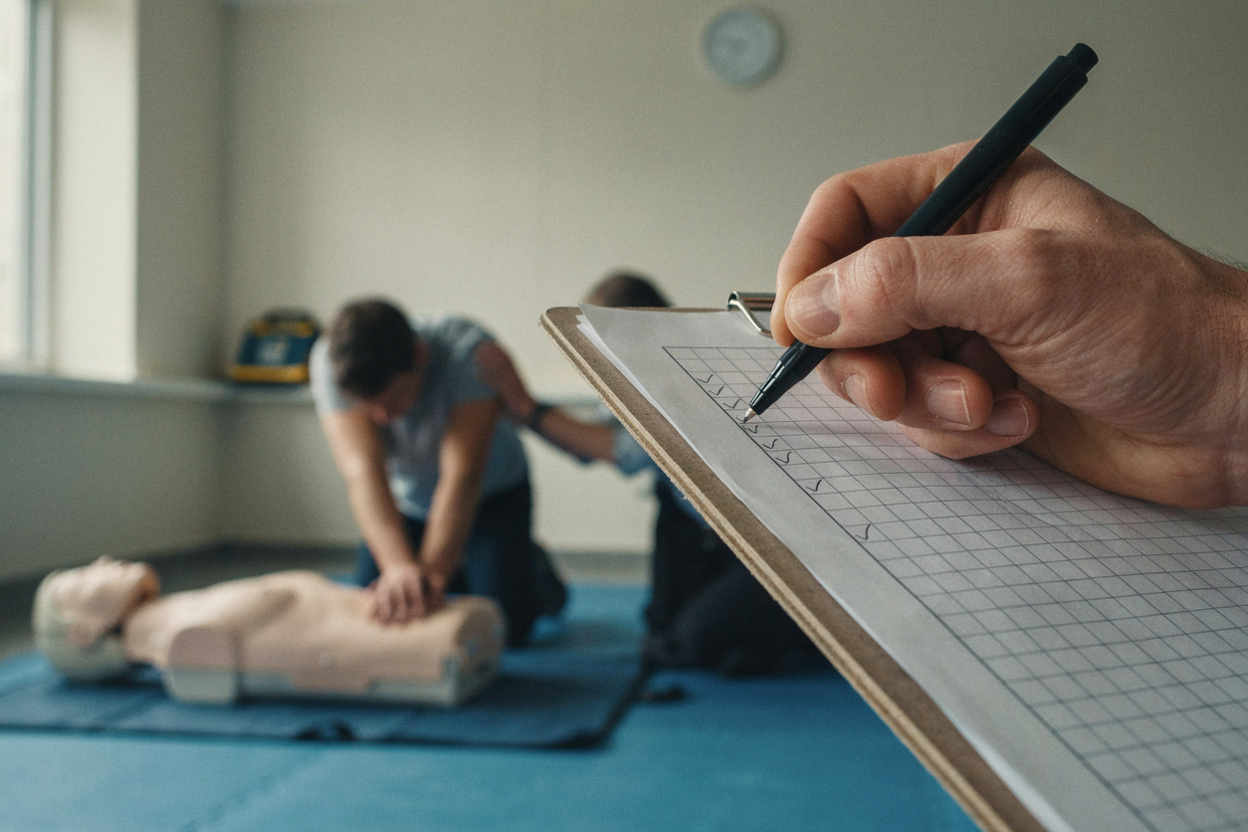
This is the backbone of the whole assessment. You'll be marked on CPR for both an adult manikin and an infant manikin, and it's done floor-based, kneeling on the ground the way you'd actually need to in a real childcare setting. The assessor is watching for correct hand placement, compression depth, compression rate, and full recoil between compressions. They're also watching the sequence around it, checking for danger, checking responsiveness, calling for help, opening the airway, checking breathing, starting compressions without wasting time second-guessing yourself.
All of this is assessed in line with ANZCOR guidelines (the Australian and New Zealand Committee on Resuscitation), which is the same authority every first aid provider in the country is required to teach to. Nobody's marking you against some in-house version of CPR, it's the national standard, full stop.
Scenario response and decision-making
You'll also work through scenario-based demonstrations, things like a choking episode, an asthma attack, an anaphylactic reaction. The assessor isn't looking for a perfect script. They're watching whether you can recognise what's happening, respond in the right order, and know when to escalate, like when to call an ambulance versus when the situation is manageable on scene. We've gone into the specifics of these scenarios in a lot more depth in our piece on the Top 10 Childcare First Aid Course Scenarios, worth a read if you want to go deeper than what's covered here.
Communication, documentation and reporting
The bit people forget about is that first aid doesn't end the second the emergency is over. Assessors are also watching how you communicate during the scenario, are you talking through what you're doing, are you directing others in the room, and afterwards, how you'd document and report the incident. This varies a bit depending on the RTO delivering the course, but the expectation across the board is that you can clearly explain what happened, what you did, and what needs to happen next.
What your assessor is checking off: CPR sequence and technique, scenario recognition and response, communication under pressure, and incident reporting. Four broad areas, nothing hidden.
Common Reasons Candidates Feel Nervous (and Why That's Normal)
Nerves before a practical assessment are about as universal as it gets. Nobody walks in feeling completely relaxed, and if they tell you they do, they're probably lying a little.
Performance anxiety, being watched and assessed live
There's something about knowing someone is standing there with a clipboard, actively marking what you do, that changes how your body feels. Hands go a bit shaky, your mind blanks on something you knew cold an hour ago. This is a normal physiological response, not a sign you're not cut out for it.
Fear of freezing or forgetting steps under pressure
This one's especially common with CPR sequences. People know the steps perfectly when they're calm at home, then blank the second they're kneeling on a mat with eyes on them. Assessors have seen this a thousand times over. A brief pause to collect your thoughts isn't a fail, it's just what being human under mild pressure looks like.
Group assessment nerves
Being assessed alongside other candidates adds another layer for some people, that feeling of being compared to the person next to you. Worth remembering that everyone in that room is focused on their own performance, not scrutinising yours. The assessor isn't running a competition, they're checking each person against the same fixed criteria.
The honest truth is that nerves usually settle within the first few minutes of the session once you realise the assessor isn't trying to trip you up. They want you to pass. Their job is to confirm you can do this safely, not to hunt for reasons to fail you.
How to Prepare for the Practical Assessment
A bit of preparation goes a long way toward taking the edge off assessment day nerves.
What to revisit beforehand
In the day or two before your session, run back through the DRSABCD action plan and the key sequences from your theory component. You don't need to memorise a script word for word, but having the order of operations fresh in your head means you're not trying to recall it for the first time while being watched.
What to bring and wear
Because the CPR component is floor-based, wear something you can comfortably kneel and move in. Closed shoes are a must, no thongs or slides. Loose, comfortable clothing beats anything restrictive. Bring any ID or paperwork your provider has asked for, and bring a water bottle.
What to bring checklist: Closed shoes, comfortable clothing you can kneel in, ID/paperwork if requested, water bottle, and your completed theory confirmation.
Physical capacity requirements
This one's worth being upfront about. The practical assessment involves kneeling on the floor and performing sustained chest compressions, and that's a genuine physical requirement, not just a formality. ACECQA and RTOs both expect candidates to demonstrate this physically, because in a real emergency that's exactly what's needed. If you have an injury, a pregnancy, or a condition that affects your ability to kneel or perform compressions, it's worth having a conversation with your provider before the day so alternative arrangements can be discussed. Better to raise it early than be caught out on the day itself.

What Happens If You Don't Pass the First Time
This bit tends to worry people more than it needs to.
The re-assessment process
If an assessor identifies a gap on the day, whether that's a technique issue with CPR or a scenario response that needs more work, the usual approach is a re-assessment on the same skill, not a full do-over of the entire course. Most of the time this happens on the spot, the assessor gives feedback, you have another go, and that's that. In cases where more practice is genuinely needed, a follow-up session gets booked in.
Why this is common, not a failure
HLTAID012 is delivered as competency-based training, which just means you're assessed against a fixed standard rather than graded on a curve against other candidates. Some people nail everything first, some need a second attempt at one particular skill. Neither outcome says anything about whether you'll be a capable first aider once you're certified. It happens regularly, and it's built into how the qualification is designed to work.
For Directors, the ratio-planning angle
If you're the one booking staff in, a resit does matter for your planning. It means that educator isn't counted toward your certified ratio until they've cleared the re-assessment, so it's worth factoring a buffer into your scheduling rather than assuming everyone clears first time. Our piece on the Steps to Get Your Childcare First Aid Certificate walks through the certification pathway in more detail if you're mapping this out for your whole team.
Booking Practical Assessments Around Your Centre's Ratios
If you're running a centre, the practical assessment isn't just about the individual educator sitting it, it's about what happens to your floor while they're off doing it. This is where most of the actual logistics headache lives.
On-site vs training-centre-based options
You've got options here. Sessions can be run on-site at your centre, which cuts out travel time and lets you keep a closer eye on staffing across the day, or at a training location if that suits your scheduling better. Neither is inherently better, it depends on what works for your team and your roster that week.
Staggered, small-group bookings
The single biggest mistake we see centres make is booking every educator into the same session on the same day. That might look efficient on paper, but it means your whole team is off the floor at once, and if you're not careful, you're breaching ratios or closing rooms to manage it. Staggering staff across small groups, a few educators one session, a few more the next, keeps your centre running while still getting everyone certified within a reasonable window.
How Accelerate First Aid structures this for centres
This is exactly the kind of thing we work through with centre directors on a regular basis. Rather than a single all-staff day that shuts your rooms down, we help plan small-group sessions that keep enough certified first aiders on-site at all times, so you're never scrambling to cover ratios while training is happening.
Book your team's HLTAID012 practical assessment in small groups, no ratio breaches, no closed rooms. Call us on 0434 778 243.
The practical assessment isn't the obstacle it feels like in the lead up to it. Once you understand the structure, the two halves working together, theory first and then the face-to-face session, most of the mystery that fuels the dread just isn't there anymore. It's a set process, run the same way session after session, not some surprise test built to catch people out.
What's actually being watched on the day is narrower than most people imagine going in. CPR technique and sequence, scenario recognition and response, communication and documentation, that's genuinely most of it. Four broad areas, assessed against a fixed national standard, not against the person kneeling next to you.
The nerves are real and they're normal, and pretending otherwise doesn't help anyone. Shaky hands, a blank moment mid-sequence, that tight feeling of being watched, every single candidate deals with some version of it. None of that means you're not cut out for this, it just means you're a person doing something in front of another person, which is uncomfortable by nature.
Preparation matters more than natural talent here. A bit of revision on the sequences, the right footwear, a realistic understanding that you'll be kneeling and working the floor for a while, all of that does more to settle nerves than any amount of worrying the week before ever will.
If a resit happens, that's not a mark against anyone. Competency-based assessment means everyone gets measured against the same bar, and some people clear one particular skill on a second go rather than the first. It's built into how the qualification works, not a sign of anything gone wrong.
For anyone juggling a whole team's worth of certifications against the daily reality of running a centre, the logistics around booking matter just as much as the assessment itself. Staggered sessions, small groups, staff who aren't all pulled off the floor on the same day, that's what keeps a centre running while everyone gets certified. Getting both the assessment and the booking right means walking into any regulatory check with genuine confidence, not a scramble the night before to explain a gap on paper.