HLTAID011 Nationally Accredited: Brisbane Providers 2026
Type "HLTAID011 nationally accredited" into Google on a Tuesday night and you'll land on a wall of providers, every single one of them claiming the exact same thing. Brisbane's first aid market is crowded, and half the sites read like the same template with different logos slapped on top. The word "accredited" gets thrown around so casually it's started to lose its meaning, which is a problem, because it isn't a marketing word at all. It's a specific national standard, set by a regulator, and not every course wearing the label meets that standard in the same way.
If you're trying to work out which HLTAID011 Provide First Aid course in Brisbane is genuinely nationally recognized, which provider actually clears that bar, and what to check before you book, this guide walks through it in plain English: what "nationally accredited" actually means, how to verify a provider's registration, what a genuine HLTAID011 course includes, and the red flags worth watching for. By the end, you'll know what to look for so your certificate holds up the day an employer, insurer, or licensing body asks to see it.
What Does "Nationally Accredited" Actually Mean?
A nationally accredited first aid course means it's been delivered by a Registered Training Organisation (RTO) registered with ASQA, Australia's national VET regulator, and that the course meets the Standards for VET Accredited Courses under the Australian Qualifications Framework. That's the actual definition. Everything else is marketing.
For HLTAID011 Provide First Aid specifically, genuine national accreditation means:
The RTO is listed on training.gov.au with HLTAID011 currently on its scope
The course includes a mandatory face-to-face practical assessment. No fully-online course can issue a valid Statement of Attainment for this unit
You walk away with a nationally recognized Statement of Attainment, the kind employers, insurers, and licensing bodies across Australia actually recognize
The certificate is valid for 3 years, though the CPR component inside it needs renewing every 12 months
"Nationally accredited" isn't something a provider gets to decide about themselves. It's a verifiable regulatory status, and in the next section we'll show you exactly how to verify it.
How to Verify an HLTAID011 Provider Is Genuinely Nationally Accredited
Check the RTO's registration on training.gov.au
This is the single most useful thing you can do before booking. Here's how:
Go to training.gov.au and search the provider's RTO number or business name
Open their organisation profile and look at their current scope of registration
Confirm HLTAID011 is actually listed on that scope, not just an old code like HLTAID003
One thing worth knowing: scope can lapse or change. A badge on a website saying "nationally accredited" tells you nothing about today. Only the current listing on training.gov.au does.
What ASQA registration actually confirms
ASQA (the Australian Skills Quality Authority) is the national regulator for vocational education and training. Registration with ASQA means an RTO has been independently audited against the Standards for VET Accredited Courses, not self-declared as compliant. You can check a provider's status directly at asqa.gov.au.
Why "certificate" claims aren't enough on their own
Plenty of providers hand out a "certificate" at the end of a course, and it looks official enough. But there's a real difference between a genuine Statement of Attainment, the nationally recognized document tied to your training.gov.au-verified competency, and a generic certificate of completion, which can mean almost anything the provider wants it to mean.
Statement of Attainment | Certificate of Completion | |
Issued against a national unit of competency | Yes | Not necessarily |
Provider must be on ASQA/training.gov.au scope | Yes | No requirement |
Recognized by employers, insurers, licensing bodies nationwide | Yes | Not guaranteed |
Backed by a mandatory practical assessment | Yes | Varies |
A certificate isn't a Statement of Attainment. Only one of them actually gets checked against the national training register.
Once you know how to confirm a provider is genuinely accredited, the next question is what that accreditation actually gets you inside the course.

What's Actually Included in a Nationally Accredited HLTAID011 Course
The four competency areas HLTAID011 covers
HLTAID011 isn't a narrow, one-trick unit. It's built to cover the situations you're actually likely to face, and it's structured around four core competency areas:
CPR and basic life support, following current ANZCOR (Australian and New Zealand Committee on Resuscitation) guidelines
Wound and injury management, including bleeding control and basic injury care
Asthma and anaphylaxis response, two of the most common emergency presentations
The broader emergency response framework, how to assess a situation, call for help, and act in the right order rather than freezing up
If you ever see a Brisbane provider citing American guidelines (AHA-style protocols) for an Australian first aid course, that's worth pausing on. Australian courses follow ANZCOR, not the American Heart Association, and a provider mixing the two up is a small but telling sign.
Why HLTAID011 includes HLTAID009 and HLTAID010
Here's the bit that trips up almost everyone at some point: HLTAID011 isn't a competitor to HLTAID009, it contains it.
HLTAID011 (Provide First Aid)
contains HLTAID009 (Provide CPR)
contains HLTAID010 (Provide Basic Emergency Life Support)
HLTAID009 and HLTAID010 are component units nested inside the full HLTAID011 qualification. So booking HLTAID011 doesn't mean skipping CPR for something broader, it means getting CPR plus everything else in one sitting. That's the source of a lot of the "which course do I need" confusion, and it's simple once the structure is laid out.
The mandatory practical assessment
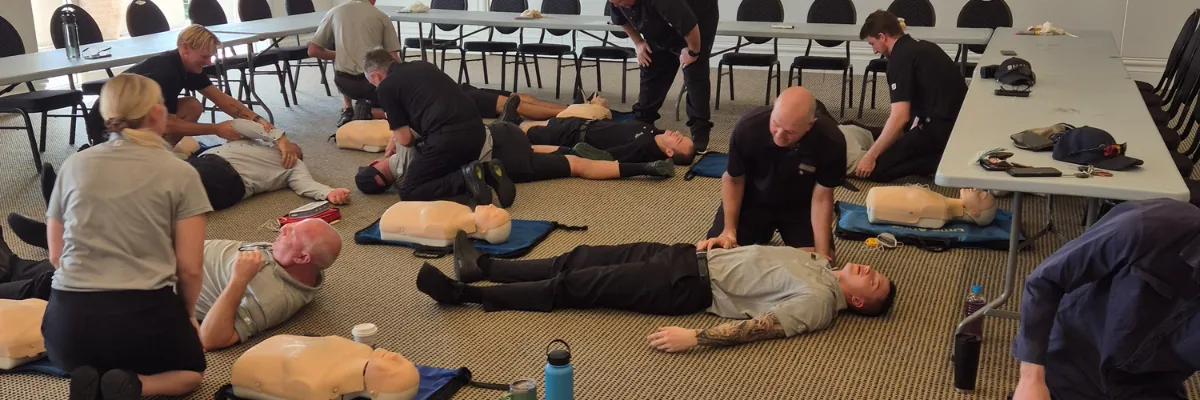
A nationally accredited HLTAID011 course has to include a hands-on, face-to-face practical assessment. There's no way around this part, and that's the point of doing the course properly rather than ticking a box online.
If the practical component makes you a bit uneasy, that's normal. A lot of people haven't performed CPR compressions in front of anyone since a school demonstration years ago, and a properly run course is built around that reality. Trainers work with people at every fitness level, and the assessment is designed to check genuine competency, not catch you out.
Knowing what's included in HLTAID011 also helps answer the question a lot of people get stuck on: whether it's even the course they need.
HLTAID011 vs Other First Aid Codes: Booking the Right One
HLTAID011 vs HLTAID009 (CPR-only)
These two get mixed up constantly, and now that you know HLTAID009 sits inside HLTAID011, the comparison is a lot easier to make sense of.
HLTAID011 (Provide First Aid) | HLTAID009 (Provide CPR) | |
Scope | CPR, wound care, asthma/anaphylaxis, emergency response | CPR only |
Who typically needs it | General workplace requirement, community/parents, most industries | Fitness, aquatics, roles where CPR alone satisfies the requirement |
Validity | 3 years (CPR component refreshed annually) | 12 months |
Includes HLTAID010 | Yes | No |
If your workplace, insurer, or licensing body asks for "first aid" broadly, without narrowing it down to CPR specifically, HLTAID011 is almost always the one that satisfies it. HLTAID009 is a narrower, shorter-validity unit for roles where CPR alone is the actual requirement.
HLTAID011 vs HLTAID012 (childcare/education setting)
If you work in childcare or education, HLTAID011 isn't necessarily the right box to tick. HLTAID012 is the unit required for education and care roles under ACECQA regulations, a distinct qualification with its own requirements, not a childcare-flavored version of HLTAID011. If you're not working in childcare or education, HLTAID011 is almost certainly the course you're after.
"I used to have HLTAID003, is HLTAID011 different?"
A lot of people land on a Brisbane provider's site holding an old certificate that says HLTAID003, unsure if what they need now is genuinely different or the same thing with a new label. Short answer: HLTAID003 has been superseded. HLTAID011 is the current equivalent, covering the same general ground with updated content aligned to current ANZCOR guidelines.
Code | Status | Notes |
HLTAID003 | Superseded | No longer issued; replaced by HLTAID011 |
HLTAID009 | Current | CPR-only, sits inside HLTAID011 |
HLTAID011 | Current | Full first aid qualification, general workplace/community |
HLTAID012 | Current | Childcare/education setting, ACECQA requirement |
Booked the right course from a verified provider? There's one more practical detail worth sorting before you commit: how long it'll actually stay valid.
How Long Does Your Nationally Accredited Certificate Last?
The 3-year HLTAID011 validity period
A genuine HLTAID011 Statement of Attainment is valid for 3 years from the date you complete the course, the standard validity period most employers, insurers, and licensing bodies work off.
Why the CPR component needs annual renewal
Here's the detail that catches people out, and it's worth understanding upfront. While your full HLTAID011 certificate lasts 3 years, the CPR component inside it has a shorter currency window. Under ANZCOR guidance, CPR skills should be renewed every 12 months, because CPR is a physical, perishable skill that fades without practice.
Your HLTAID011 certificate lasts three years, but your CPR skills need renewing every twelve months.
This isn't a bait-and-switch. It's the actual clinical guidance, and a provider who explains it clearly upfront is doing you a favor, not setting a trap.
Employer, insurer, and licensing acceptance
When an employer, insurer, or licensing body asks to see proof of your first aid training, what they're checking for is a Statement of Attainment from an RTO whose scope you can verify against training.gov.au. It's not about how polished the certificate looks, it's about whether it traces back to a genuinely accredited course.
Most of this comes down to knowing what to check for. It's just as useful to know what should give you pause.

Red Flags: Signs a Course Isn't Genuinely Nationally Accredited
Vague or missing pricing
If a provider's site advertises a headline price and you can't find an actual total anywhere, that's worth noticing. Genuine providers show the full price upfront, certificate issuance and any online module costs included, without you having to dig through a booking flow.
No mention of a practical, in-person assessment
A real HLTAID011 course has to include a face-to-face practical component. If a provider's course description reads like the whole thing can be done from your couch, that's not a genuine HLTAID011 course, no matter what the page calls it.
No visible RTO number or scope you can verify
A legitimate provider isn't shy about their RTO number, because they know you can check it. Heavy on trust badges and light on a verifiable RTO number is a gap worth taking seriously.
Five things that should make you pause:
No RTO number listed anywhere on the site
Pricing that's vague, hidden, or only revealed deep in a booking form
No clear mention of an in-person practical assessment
Certificate language that avoids the term "Statement of Attainment"
Claims of "nationally accredited" with nothing pointing you to training.gov.au to check it yourself
None of these on their own necessarily means a provider is dodgy. But if you're seeing two or three of them together, it's worth taking that flash of hesitation seriously rather than talking yourself out of it.
Ready to Book?
You've confirmed what nationally accredited means, how to verify a provider, and exactly what HLTAID011 covers. The next step is simple: book with a provider you've already checked out, or check ours.
Book your HLTAID011 course with Accelerate First Aid. RTO 31106, same-day certificate, verify our scope on training.gov.au before you even pick a date.
Still not sure which course you need? Check our course selector, or get in touch and we'll confirm it before you book.
Want a heads-up before your CPR refresher is due? Sign up for renewal reminders and we'll handle the tracking.
Working out whether a first aid course is genuinely nationally accredited shouldn't take a law degree, and honestly it doesn't. It comes down to one plain fact: the RTO has to be registered with ASQA and listed on training.gov.au with HLTAID011 actually on their current scope. Everything else, the badges, the taglines, the "fully accredited" claims plastered across a homepage, is just decoration sitting on top of that one verifiable status. Check the actual listing and you'll know whether a provider is the real deal.
Once that's sorted, the shape of a genuine HLTAID011 course is consistent. It covers CPR and basic life support, wound and injury management, and asthma and anaphylaxis response, wrapped inside a broader framework for handling an emergency calmly and in the right order. It includes HLTAID009 and HLTAID010 as component units rather than competing with them, so booking HLTAID011 means getting CPR folded into something bigger, not choosing a narrower option instead of it. And there's no way around the face-to-face practical assessment, because a course completed entirely from a couch was never going to leave you confident in a real situation.
The code confusion that trips so many people up usually clears itself up once you see the structure laid out properly. HLTAID011 is the general workplace and community course. HLTAID009 is the narrower CPR-only unit with a shorter validity window. HLTAID012 belongs to childcare and education settings under ACECQA rules, not general workplaces. And if you're holding an old HLTAID003 certificate, that code has been superseded, with HLTAID011 standing in as its current equivalent.
Validity is the other detail worth locking in rather than assuming. The full HLTAID011 certificate holds for three years, but the CPR skills inside it are only current for twelve months before ANZCOR guidance recommends a renewal. That's not a provider trying to squeeze more bookings out of you, it's simply how quickly a physical skill like CPR fades without practice, and a provider who explains that upfront is being straight with you rather than hiding it in the fine print.
The red flags are worth carrying with you the next time you're comparing options, because they show up more often than they should. Vague pricing that only reveals itself deep in a booking form. No visible RTO number anywhere on the site. No clear mention of an in-person practical component. Certificate language that quietly avoids the words "Statement of Attainment." None of these alone is necessarily damning, but seeing two or three together is a reasonable reason to keep looking rather than talk yourself past it.
None of this needs to be complicated once you know what to check for. A genuine HLTAID011 course leaves a paper trail you can verify yourself, before you've handed over a cent. Do that one simple check, book with a provider happy for you to do it, and you'll walk away with a certificate that holds up the day someone asks to see it.