HLTAID011 Face to Face Course in Brisbane: What to Expect and How to Book
The job offers email lands, and halfway down the onboarding checklist sits one line: current HLTAID011 certificate required before your first shift. An HLTAID011 face to face course in Brisbane is the quickest legitimate way to tick that box. The hands-on skills that make the certificate valid, such as CPR on a manikin and using a defibrillator, can only be assessed in person by a qualified trainer.
The tricky part is everything around it. Some courses advertised as face to face still include a lot of online study. Others promise a certificate with no practicality at all, and employers knock those back. When your start date is fixed, session times, kneeling for CPR and how fast your certificate arrives all matter.
This guide walks you through what the face-to-face part of HLTAID011 involves and which format suits you. It covers what happens on the day, how to check your certificate will be accepted, and how to book a Brisbane session that fits your week, so you can walk into your new job ready.
Let's start with the question most people ask first.
Does HLTAID011 Have to Be Done Face to Face?
Every HLTAID011 course includes a practical assessment where you show a qualified assessor you can perform first aid skills, including uninterrupted CPR on an adult manikin on the floor. How you complete it depends on the delivery format:
Fully face to face: theory and practical in one in-person session, with no online study.
Blended: online theory at home, then a shorter in-person practical.
Live virtual: online theory, then skills demonstrated to a trainer over video using a posted training kit.
If your employer asks for a face to face certificate, choose option 1 or 2 and check the provider's RTO number on training.gov.au.
If you already know what you need, you can see dates for our HLTAID011 first aid course now.
Whichever format you choose, the skills you're assessed on are the same.
What the Face to Face Part of HLTAID011 Covers
The practical is where first aid stops being something you read about and becomes something you can do. Here's what you'll practice.
The skills you'll practice and demonstrate
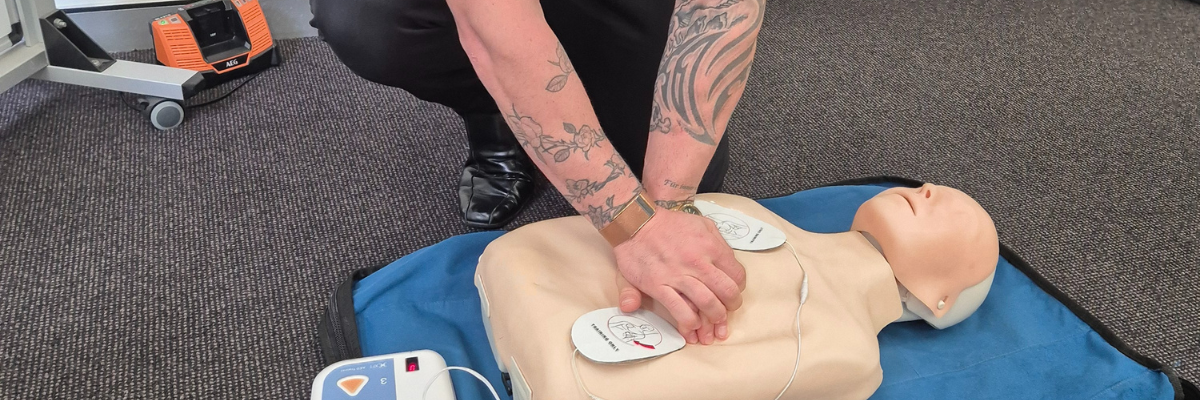
Adult and infant CPR on manikins, including uninterrupted compressions and breaths on the floor
Using an AED (automated external defibrillator)
Putting an unconscious, breathing person in the recovery position
Controlling bleeding and applying bandages
Managing choking, asthma, anaphylaxis (with a training auto-injector), fractures and sprains, and envenomation using pressure immobilization
Working through simulated scenarios and writing up an incident report
Why these skills are assessed hands-on
You could read about CPR all week, and a quiz still wouldn't show whether your compressions are deep enough, fast enough or in the right place. An assessor has to watch you do it. They check your compression depth, your rate and your hand position. They also check that you follow DRSABCD, the ANZCOR action plan, in the right order, even when a scenario gets busy and someone's calling out for help.
Most people come away glad it works this way. If you're starting in support work, the moment that counts could be a client choking on a community outing. For a lot of parents it's closer to home, like a toddler coughing and spluttering over dinner. Practicing with your own hands, with a trainer beside you, is what helps you stay calm in that moment. It's muscle memory, not a list you have to remember.
What certificate you receive
HLTAID011 includes HLTAID009 (CPR) and HLTAID010 (basic emergency life support) as component units. If you want the full explanation, read our guide on how HLTAID011 and HLTAID009 differ.
Knowing what you'll cover is one thing. Fitting it into your week is the next.

Which HLTAID011 Face to Face Format Suits Your Week in Brisbane?
Brisbane providers split the course between home and the training room in quite different ways. That's why answers to "how long does a first aid course take" vary so much. The HLTAID011 face to face format you pick decides how much of it happens in the room.
Typical formats across Brisbane providers
Format | Online study | In person | Best for |
Fully face to face | None | Theory and practical together | Getting everything done in one go |
Blended | Self-paced theory at home | A shorter practical session | Fitting it around work or childcare |
Express or refresher | Online theory | A short practical session | Renewing an existing certificate |
Doing it all in one session suits some people well, because once it's done, it's done. If you're juggling daycare drop-offs or shifts, though, blended is often the easier fit. You do the reading at home and spend less time in the room.
Doing the online theory on your phone
Most people don't sit down at a desk to do their theory. They do it on the couch once the kids are asleep, or on a lunch break.
On a blended course, you'll need to finish the theory before you come in for your practical. Leave yourself enough time for it, especially if your start date is close.
Once you've picked a format, here's what the practical session actually looks like.
What Happens on the Day of Your Practical
Feeling a bit nervous before a practical is completely normal. It's often worse if you haven't done any training since school. Knowing what's coming takes a lot of that away, so here's how the day of your HLTAID011 face to face practical runs.
Before you arrive
Finish your online theory if you're on a blended course
Have your USI (Unique Student Identifier) ready. You can create one for free at usi.gov.au
Bring photo ID
Wear comfortable clothes you can kneel in, and bring a water bottle
You'll be sharing manikins and equipment, so it's worth a quick read of our first aid course hygiene guide before you go.
How the session runs
The session follows a simple order: a welcome, a skills demo, guided practice, scenarios, your assessment, and then your certificate. The trainer shows each skill first, then you practice it with them coaching you. After that you put the skills together in realistic scenarios.
How the assessment works, and what happens if you need another go
The assessment isn't a pop quiz sprung on you at the end. Your assessor works more like a coach. You practice first and get feedback as you go, so when it's your turn to show the skill, you've already done it a few times.
If you're worried about needing another go, ask the team before you book how reassessment works. Knowing the answer up front takes a lot of pressure off on the day.
Kneeling and physical requirements
CPR has to be performed on a manikin on the floor. That's how the skill is assessed, because that's where a real casualty usually is.
If you have a knee, back or other injury, or anything that makes kneeling hard, contact the team before you book. That way they can talk you through what's involved.
Passing the practical exam gets you the certificate. Making sure it's the right one for your job matters just as much.

Will Your Employer Accept It? How to Check Your Certificate
Booking the wrong course is one of the most common worries, and it's easy to understand why. HLTAID011, HLTAID009, HLTAID012, "Senior First Aid": the names start to blur together. Checking is quick, though.
Check the unit code and the RTO number
Look at your employer's checklist and match the wording exactly. You're looking for HLTAID011 Provide First Aid. That's the code and title printed on your Statement of Attainment when you finish.
Next, check if the provider is a registered training organisation (RTO). You can search RTO 31106 on training.gov.au and see the registration for yourself.
Brisbane jobs that commonly ask for HLTAID011
Disability and NDIS support
Aged care
Fitness and personal training
Hospitality
School support roles
Trades
Face to face vs live virtual: what to check with your employer
Live virtual courses are offered by registered providers, and they're a legitimate way to complete HLTAID011. Some employers prefer or specify in-person assessment, though, and others are happy either way. If your employer asks for an HLTAID011 face to face certificate, they usually mean this. The simplest fix is to ask HR one question before you book any format: "Does the practical need to be assessed in person?"
How long your certificate stays current
The Safe Work Australia Model Code of Practice recommends a CPR refresher every 12 months and first aid every three years. Some employers set their own timeframes, so check your workplace's policy too. For more detail, see our guide on how long your CPR certificate lasts.
With the right course confirmed, booking is the easy part.
How to Book Your HLTAID011 Session in Brisbane
Booking our HLTAID011 first aid course is simple. If you've been putting it off because you're not sure where to start, these are the only three steps.
1. Pick a date. Choose the first aid course Brisbane session that suits your week. Onsite delivery is also available.
2. Complete the online theory, if your course is blended. Do it on your phone whenever suits you, and finish it before your practical.
3. Attend, get assessed and receive your certificate. Once you've finished your HLTAID011 face to face practical, your certificate is emailed to you, ready to forward to HR.
Walk Into Your First Shift Ready
That one line on the onboarding checklist can feel bigger than it really is. Once you know what the face-to-face part of HLTAID011 involves, it becomes what it is: a short, practical step between you and your new job.
Start with the format. A fully face to face course gets everything done in one session. Blended lets you do the theory at home and spend less time in the room. Live virtual options exist too, but if your employer wants in-person assessment, stick with one of the first two. If you're not sure, ask HR one quick question before you book. That saves you any guesswork later.
The practical itself is far less scary than most people expect. You'll practice every skill before you're assessed on it, with a trainer coaching you as you go. You'll kneel on the floor for CPR, so wear something comfortable. If an injury makes that hard, get in touch before you book. Feeling nervous is normal, and most people leave far more confident than when they walked in.
Before you book, check that the unit code reads HLTAID011 Provide First Aid and look up the RTO number on training.gov.au. Once you're certified, keep in mind that a CPR refresher every 12 months is recommended, so your skills stay sharp and you stay restorable.
A recognized course done once is always better than a quick one your employer knocks back. Getting the right certificate first time saves you a second booking and a delayed start.
From there, it's three steps. Choose your Brisbane date, do the theory at home if your course is blended, then pass your practical and send your certificate to HR. Start your new job on time. Book your HLTAID011 face to face session in Brisbane today.