HLTAID009 Theory Assessment: 10 Questions to Practice
If your last CPR course was before the kids came along, you probably remember bits and pieces. Thirty compressions, two breaths. Something about DRSABCD. And then it kind of trails off.
That's completely normal. CPR knowledge fades fast when you're not using it, and the HLTAID009 theory assessment checks exactly the details that slip away first. How deep you press on a baby's chest. What changes for a child. What you actually do the second someone hands you a defibrillator.
This guide gives you 10 practice questions covering the topics the theory assessment tests. Every one comes with the answer and a plain-English explanation based on current ANZCOR guidelines. Quite a few focus on babies and kids, because honestly that's the bit most parents want to get right.
Work through them on your phone during nap time, a couple at a time if that's all you've got. You'll walk into class with the theory sorted and more time for the part that counts: hands on the manikins.
What Is in the HLTAID009 Theory Assessment?
The HLTAID009 theory assessment checks that you understand the knowledge behind CPR, not just the hands-on skills. Most providers use multiple choice questions based on the unit's official assessment requirements. It covers:
Australian Resuscitation Council guidelines for unconscious and non-breathing casualties
How to recognize someone who is unresponsive and not breathing normally
Compression rate, depth, ratio and hand position for adults, children and infants
Safe use of an AED (defibrillator)
Hazards, infection control and barrier devices
Duty of care, consent and when to stop CPR
Theory vs practical at a glance
What it checks | |
Theory | What you know: the guidelines, the steps, and why you do them |
Practical | What you can do: CPR on adult and infant manikins, plus an AED trainer |
How the Theory Assessment Works at Accelerate First Aid
One thing worth knowing: formats are different from provider to provider. So if your friend did her CPR somewhere else and tells you it was "dead easy, just a few questions online", don't take that as gospel for your course. Check with us instead.
Our guide on what you need to pass HLTAID009 covers the practical side in detail.
The quickest way to find out what you remember is to test yourself.

10 HLTAID009 Practice Questions With Answers
These are original practice questions written to help you revise. They aren't taken from Accelerate First Aid's assessment or any other provider's.
Grab a cuppa, pick your answer, then tap to check it. No peeking. Better to get one wrong on your couch than in class.
Recognizing an Emergency
1. What does DRSABCD stand for?
A. Danger, Response, Send for help, Airway, Breathing, CPR, Defibrillation B. Danger, Rescue, Shout, Airway, Breathing, Compressions, Defib C. Dial, Respond, Support, Airway, Breathe, Check, Drive
Answer: A
Why: It's the order you work through in any emergency. It starts with your own safety, because you can't help anyone if you get hurt too.
2. Someone is unresponsive and takes occasional gasping breaths. What should you do?
A. Put them in the recovery position and wait B. Start CPR C. Check their breathing again in two minutes
Answer: B. Start CPR
Why: Gasping isn't normal breathing. If someone is unresponsive and not breathing normally, start CPR, even if they take the odd gasp. A lot of people get caught on this one, because a gasp looks like breathing.
Compressions and Breaths
3. What compression-to-breath ratio and rate do you use?
A. 15:2, at 80 compressions a minute B. 30:2, at 60 to 80 compressions a minute C. 30:2, at 100 to 120 compressions a minute
Answer: C
Why: It's 30:2 for every age, at about two compressions per second.
4. How likely are you to catch an infection from giving CPR?
A. Very low. Use a barrier device if one's handy, but don't delay compressions B. High, so never give CPR without a mask C. It's only safe if you're vaccinated
Answer: A
Why: The risk of transmission is very low. Compressions are essential. Rescue breaths are given by rescuers who are trained and willing to give them.
5. Where and how deep do you press on an adult's chest?
A. On the upper chest, about 2 cm deep B. With the heel of your hand on the lower half of the breastbone (the center of the chest), about one third of the chest depth (more than 5 cm), letting the chest fully recoil C. Just below the ribs, as deep as you can
Answer: B
Why: Pressing too shallow doesn't work, and pressing below the breastbone can cause injury. There's also some evidence of harm when compressions go deeper than 6 cm.
Babies and Children
6. How do you do compressions on a baby under 12 months?
A. With the heel of one hand, about 5 cm deep B. With two hands, as for an adult C. With two fingers on the lower half of the breastbone, about one third of the chest depth (about 4 cm)
Answer: C
Why: Lay rescuers use the two-finger technique for infants. For children, you use one or two hands depending on their size.
7. How do you position a baby's head to open the airway?
A. Full head tilt B. In a neutral position, supporting the chin, with no full head tilt C. Chin to chest
Answer: B
Why: Maximum head tilt shouldn't be used for infants. This is one of the details that fades the fastest if you learnt CPR years ago, mostly on adults.
8. You pull a child from the pool. They aren't breathing normally and there's water in their mouth. What do you do first?
A. Roll them onto their side and open the mouth so the water drains, then roll them onto their back and start CPR B. Press on their stomach C. Hold them upside down
Answer: A
Why: Let the fluid drain out by gravity, and don't press on a swollen stomach. Always call an ambulance after a drowning, even if the child seems to recover.
Always call an ambulance after a drowning, even if your child seems fine afterwards. Our backyard pool safety guide covers fences, supervision and CPR in more detail.
Defibrillators and Stopping CPR
9. Can you use an AED on a three-year-old?
A. No, AEDs are for adults only B. Only after 10 minutes of CPR C. Yes. Attach it as soon as it arrives, using child pads or child mode if available. If not, adult pads are fine as long as they don't touch
Answer: C
Why: Pediatric pads are preferred for children under 8, but adult pads are reasonable if that's all you have. For a small child, put one pad on the front and one on the back.
10. When can you stop CPR?
A. After 10 minutes with no response B. When the person responds or breathes normally, when you physically can't keep going, or when a health professional takes over or tells you to stop C. As soon as the ambulance has been called
Answer: B
Why: Don't pause to check for breathing. Keep going until one of these things happens.
What These Questions Cover
Knowledge area (training.gov.au) | Covered by |
ARC guidelines and recognizing a non-breathing casualty | Q1, Q2 |
Hazards, infection control and barrier devices | Q1 (Danger), Q4 |
Legal considerations: duty of care, consent | Our Good Samaritan CPR in Queensland guide |
CPR considerations: airway, AED, when to stop | Q7, Q8, Q9, Q10 |
Techniques for adults, children and infants | Q3, Q5, Q6 |
Three of those questions were about babies and children, and that's where most of the differences are.

Infant, Child and Adult CPR: What Changes
If you learnt CPR years ago for a job, chances are you mostly practiced on adult manikins. Doing CPR on a baby feels completely different. The basics stay the same, but a few of the details change, and those details are what the theory assessment checks.
Adult | Child (1 to 8) | Infant (under 1) | |
Hands | Two hands | One or two hands | Two fingers |
Depth | One third (more than 5 cm) | One third (about 5 cm) | One third (about 4 cm) |
Ratio and rate | 30:2, 100 to 120 a minute | Same | Same |
Head position | Head tilt, chin lift | Head tilt, chin lift | Neutral, support the chin |
AED pads | Adult | Child pads preferred under 8; adult if none | Child pads preferred; front and back placement |
Why Babies Are Different
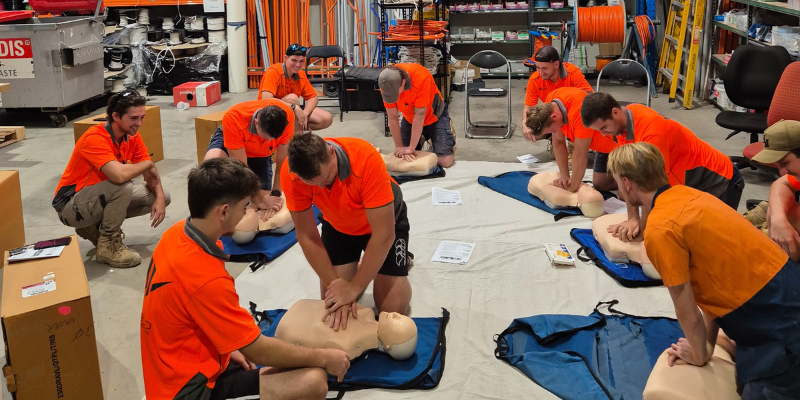
A baby's airway is smaller, their chest is softer, and their head needs to stay in a different position. That's why the infant CPR steps aren't just adult CPR made smaller. It's also why the assessment requires you to practice on infant manikins, not only adult ones. A lot of parents tell us this was the part they were most nervous about. Once they've got their two fingers on that little manikin chest and felt how deep 4 cm actually is, it starts to make sense.
What About Choking?
Choking isn't part of the HLTAID009 knowledge evidence, but it's worth a quick mention because it's a common worry for parents. ANZCOR recommends back blows and chest thrusts. Abdominal thrusts are not recommended. Choking is covered in more depth in HLTAID011 First Aid, which includes HLTAID009.
Knowing the differences is half the job. The other half is getting the theory to stick.
How to Prepare for Your HLTAID009 Theory Assessment
You don't need a whole evening with a highlighter. With a baby and a toddler in the house, that's not happening anyway. Small bits of revision work better.
Study in Short Bursts on Your Phone
Nap time is your friend here. Do a few questions while the baby's down, then put the phone away and do a few more the next day.
Use Your Pool's CPR Sign as a Revision Card
Regulated pools in Queensland must display a compliant CPR sign. You walk past yours every time you open the gate, so read a step or two as you go. It's a free revision.
Say the DRSABCD Steps Out Loud
Say them in the car, while you're hanging out washing, or while you're pushing the pram. Saying things out loud makes you actually recall them, which is a lot harder than just reading. It's the same kind of recall the CPR theory test asks of you.
Ask About Support If You Need It
If reading or written questions aren't your thing, just ask. Support such as reasonable adjustments, including answering verbally, may be available.
Bring Your Questions to Class
Trainers expect questions, and good ones too. Nobody's going to judge you for forgetting things since your last course. That's the whole point of being there.
Even with good preparation, you might miss one. Here's what happens if you do.
What Happens If You Get a HLTAID009 Theory Assessment Question Wrong?
Getting a question wrong is part of learning. It doesn't mean you're bad at CPR. Most of us are rusty, especially when life since our last course has been all nappies and school runs.
If you're curious about the full requirements for finishing the unit, the theory and the practical, have a read of our guide on what you need to pass HLTAID009.
Missed a few? Your trainer will walk you through every one hands-on. See Session Dates
Once the theory's sorted, the rest of your course is hands-on practice.
Book Your HLTAID009 CPR Course on the Gold Coast
These questions are a great start, but CPR is something your hands have to learn, not just your head. Our CPR course on the Gold Coast gives you that practice and a nationally recognized certificate.
We run Saturday sessions for when someone else can mind the kids. There are infant and child manikins in every class, so you're not just practicing on adults. With the blended format, you do the online theory beforehand, which means your class time is spent hands-on and not reading slides.
If you're after an infant CPR course on the Gold Coast, this is the one most parents start with. You can also bring your partner or the grandparents along, so everyone who minds the kids by the pool knows what to do.
Heading back to work after parental leave? HLTAID009 is nationally recognized and meets typical workplace CPR requirements, so it suits healthcare and dental roles too. It's one less thing to sort out before you go back.
When you're ready, book your HLTAID009 Gold Coast course. Want to bring your mothers' group? We run private CPR sessions at a home or community hall, so just ask about a group session. Not sure which course is right for you? Send us a message or call 0434 778 243 and we'll help you pick.