
HLTAID009 Renewal: How Often & What's Involved in 2026
Your HLTAID009 CPR certificate is good for 12 months. That's it. One year, then it's gone. Miss that window and you're off the tools at your next site induction, out of compliance with your employer, and the bit that actually matters, back to hoping you'd remember what to do if someone went down in front of you.
We see this a lot at Accelerate First Aid. Someone turns up to book their HLTAID009 renewal because their site manager flagged the cert at the gate on Monday morning, or because they just got an email reminder and realized they'd let it slide a few weeks past the date. Either way, they're not here to browse. They want to know what's actually involved in renewing, why the certificate even expires every year, and what CPR recertification covers when they walk in the door.
So that's exactly what this guide covers. We'll walk through how often HLTAID009 actually needs renewing, why the 12-month rule exists in the first place, and what happens in a renewal session from the moment you walk in to the moment your certificate lands in your inbox. By the end you'll know exactly what HLTAID009 renewal involves and why it's worth taking seriously.
How Often Does HLTAID009 Need to Be Renewed?
Your HLTAID009 CPR certificate needs renewing every 12 months. That's the renewal frequency recommended by the Australian Resuscitation Council (ARC) and it's the one that's reflected in pretty much every Australian workplace compliance requirement, including Queensland WHS legislation and the Safe Work Australia guidelines. Doesn't matter what industry you're in or what site you're working on, 12 months is the number.
Here's what actually happens at an HLTAID009 renewal session:
Attend a face-to-face training session
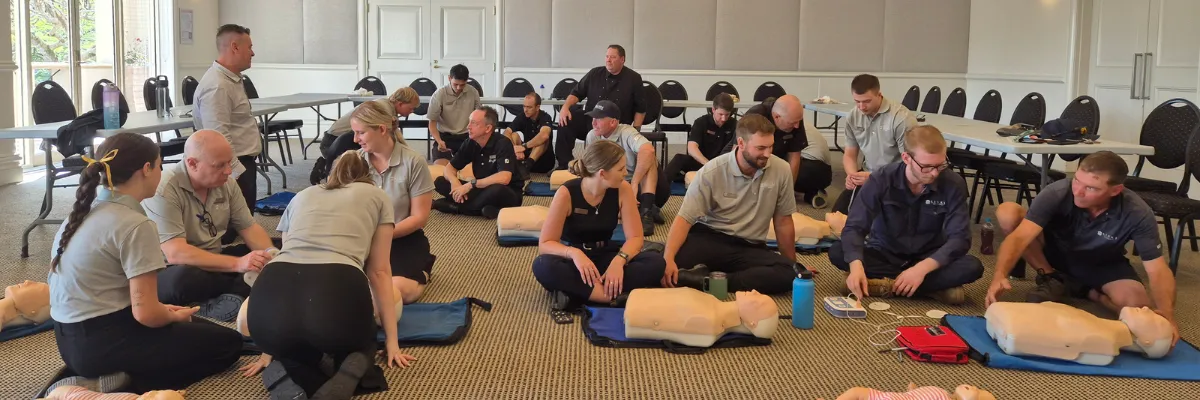
Complete hands-on CPR practice on a resuscitation mannequin (not a video, not a quiz, actual hands-on compressions)
Demonstrate correct compression technique and AED operation in front of your trainer
Receive your nationally recognized digital certificate the same day
That's the short version. If you just needed the gist, you've got it. But there's more to it than just "it expires every year." There's a reason it's every 12 months and not two or three years like some other quals, and that reason actually matters for how seriously you take the renewal itself. Keep reading and we'll get into it.
What Is HLTAID009 and Who Needs to Renew It?
Before we go any further, let's clear up something that trips a lot of people up when they're searching for this stuff online. HLTAID009 and HLTAID011 are not the same course, and mixing them up can mean you book the wrong one.
HLTAID009 vs HLTAID011: What's the Difference?
HLTAID009 is the CPR-only unit. That's it, that's all it covers, cardiopulmonary resuscitation and AED use. HLTAID011 is the full Provide First Aid course, and it actually includes the CPR component as part of it, plus a heap of other stuff like wound management, burns, fractures, and managing medical emergencies on top.
So if someone tells you they "did their first aid course" they might mean either one. Here's a quick side-by-side so you're not guessing:
Worth flagging here too, if you already hold HLTAID011, you're not off the hook on the 12-month rule. The CPR component buried inside that broader qualification still needs to be renewed every year, same as a standalone HLTAID009. People assume because their first aid cert lasts three years that they're sorted on CPR too, and that's not how it works.
Who Is Required to Hold a Current HLTAID009?
Short answer, more people than you'd think. We see HLTAID009 renewals booked constantly by:
Construction workers and site supervisors, where it's usually a condition of site access
Warehouse and logistics staff, particularly where there's machinery or higher injury risk
Childcare workers, where it's tied to licensing requirements
Security staff, often a licensing condition in its own right
Fitness professionals, gym instructors, and personal trainers
Under Queensland's WHS obligations, covered by both the Safe Work Australia first aid code and the Queensland WHS Act 2011, employers have a duty to make sure there's adequate first aid coverage on site. For a lot of workplaces, that means making sure staff hold a current HLTAID009 at minimum, and a lapsed cert isn't just a personal problem, it can become the employer's compliance headache too.
Now you know who needs HLTAID009, here's how long that certificate actually stays valid.

How Long Is an HLTAID009 Certificate Valid?
Twelve months. We've said it already but it's worth saying again on its own, because this is the number that catches people out more than anything else in this whole article.
The 12-Month Rule: Why CPR Skills Expire Faster Than You Think
A fair few people ask why CPR has to be renewed every year when other quals run for two or three. Reasonable question. The answer comes down to skill decay, and it's backed by actual research, not just a rule someone made up to sell more courses.
The Australian Resuscitation Council sets this out in ANZCOR Guideline 11.1, which is exactly where the 12-month renewal recommendation comes from, and it's not arbitrary. Studies on CPR skill retention show that compression technique, depth, and rate start dropping off noticeably within 3 to 6 months if you're not practicing or going over it again. By the time you hit the 12-month mark, a lot of people genuinely couldn't perform compressions at the right depth and rate under pressure, even if they passed their assessment confidently the year before.
Quick timeline to walk through: cert issued on day one, skills already starting to slip by month six, full expiry at month twelve, renewal window opens around the same time. The gap between "I technically still hold a current cert" and "I could actually do this if someone collapsed" is bigger than most people realize, and it opens up well before the certificate itself expires.
This is exactly why situations like a family member or workmate collapsing catch people out. Someone did a course years ago, technically "knows CPR," but when it actually counts, the body doesn't remember what the brain forgot months earlier.
What Happens If Your HLTAID009 Certificate Expires?
This is the practical bit. Let your cert lapse and here's what you're looking at:
Failed site induction, most construction and warehouse sites check certification dates at the gate, and an expired HLTAID009 means you're turned away or stood down until it's sorted
Workcover liability questions, if an incident happens on site and your cert's expired, that's a complication nobody wants to be dealing with after the fact
Potential WHS breach for your employer, under the Queensland WHS Act, your employer has obligations around maintaining adequate first aid coverage, and an expired cert on their books is their problem as much as yours
The practical advice here is simple, don't wait until the week of your site induction to book your renewal. Providers get booked out, especially around end-of-financial-year and the lead-up to Christmas shutdown when plenty of tradies are scrambling to renew before sites close for the break.
Certificate expiry understood. Next: what you'll actually need to do on renewal day.
What's Involved in an HLTAID009 Renewal Session?
This is the part most people actually want to know. Not the regulations, not the research, just, what do I have to turn up and do?
What You'll Actually Do
One thing worth knowing straight up, HLTAID009 renewal cannot be done 100% online. There's a face-to-face practical component that's non-negotiable, because the whole point of the qualification is demonstrating you can physically perform compressions at the right depth and rate under assessment. Some providers will send you online theory to work through beforehand, but nobody can sign you off on CPR competency from a quiz on your phone.
Here's the rundown of what gets covered and assessed:
Compression rate and depth, practiced and assessed on a resuscitation mannequin, not just talked through
Rescue breaths, technique and timing
AED operation, how to use a defibrillator correctly, including when to apply it
Cardiac arrest recognition, knowing the signs and knowing to act fast, not freeze
Session flow, step by step: arrival and sign-in, quick theory review, mannequin practice, AED demonstration, individual assessment, certificate issued.
All training is run against the current ARC and ANZCOR guidelines, which get reviewed and updated periodically, so a renewal session isn't just repeating what you did last year, it's making sure you're current with whatever's changed in resuscitation science since your last cert.
Do You Need to Study Beforehand?
Not really, no. Some providers send a short online theory component ahead of the session, which is worth doing if it's offered because it means less classroom time and more hands-on practice when you actually get there. But there's no exam to cram for. You turn up, you practice, you get assessed doing the actual physical task.
That's the kind of difference an experienced trainer makes. Not better paperwork, better training.
One of your crew goes down, no warning, no pulse. The ambulance is still minutes away. What you practiced in that session is the only thing standing between that moment and the worst outcome of your career.
That's not a scare tactic. That's just what this certificate is actually for.

Choosing a Quality HLTAID009 Renewal Provider
You know how often you need to renew and what actually happens in the session. Last piece of the puzzle, knowing what separates a decent provider from one that's just processing certificates.
What to Look for in a Provider
First thing, always, check the RTO is actually accredited. Every legitimate provider has an RTO number, and you can verify it yourself on training.gov.au in about thirty seconds. If a provider can't or won't show you their RTO number, that's not a good sign.
Beyond that, here's what separates a decent renewal session from a waste of time:
Green flags:
Individual mannequins for every participant
Experienced trainers with a real background in emergency response, not just someone who did a trainer course last month
Same-day certificate issued digitally so you're not waiting around for paperwork
Clear information upfront about what the session actually covers
Red flags:
No RTO number displayed anywhere on the site
No reviews, or reviews that are generic and say nothing specific about the actual training
Online-only options for something that legally requires a face-to-face component, if you see this, walk away
A provider that's cheaper isn't automatically the better choice if you freeze when it counts. This isn't really a "value for money" decision in the normal sense, it's the difference between a piece of paper and an actual skill you can rely on under pressure. Many employers cover CPR renewal as part of standard workplace compliance, so it's worth checking with your employer rather than assuming it's coming out of your own pocket. And if you've got a few people on your team who all need renewal around the same time, group bookings are worth raising with whoever handles training, since bringing people through together tends to be more efficient than everyone booking separately.
The Bottom Line on HLTAID009 Renewal
Twelve months. That's the number this whole article comes back to, and it's not going to change because it's inconvenient or because last year flew by faster than you expected. Your CPR skills start slipping well before that certificate technically expires, which is exactly why the renewal window matters more than just ticking a compliance box at your next site induction.
What you actually do in that session is the part worth caring about, more than the certificate itself. Hands-on mannequin practice, proper compression depth and rate, AED operation you've actually run through with someone watching, that's what's still in your hands and your head if someone goes down in front of you with the ambulance still minutes away. A piece of paper doesn't help anyone. What you practiced in that room does.
Don't let a quality renewal session be the thing you put off. Standing there not knowing what to do is the alternative, and it's the way too many people have found themselves after letting a cert lapse or doing a rushed, tick-and-flick course that never really taught them anything.
If you're reading this because your cert's already expired, or it's close enough that you're starting to think about it, don't let it drift. Book it before you need it, not after. Find a provider with individual mannequin time and a trainer who's actually worked in emergency response, then get it done and get back to not thinking about it for another twelve months.