HLTAID009 Duration: How Long Is a CPR Course? A Guide for Gold Coast Parents
The baby goes down at one. The toddler's at kindy till three. And your partner's away on swing until next week, so you've got a small window to yourself, if you're lucky. For heaps of Gold Coast parents, that little window is what decides whether a CPR course happens at all. Which is exactly why the HLTAID009 duration matters so much when you finally sit down at 10pm, phone in hand, to book something.
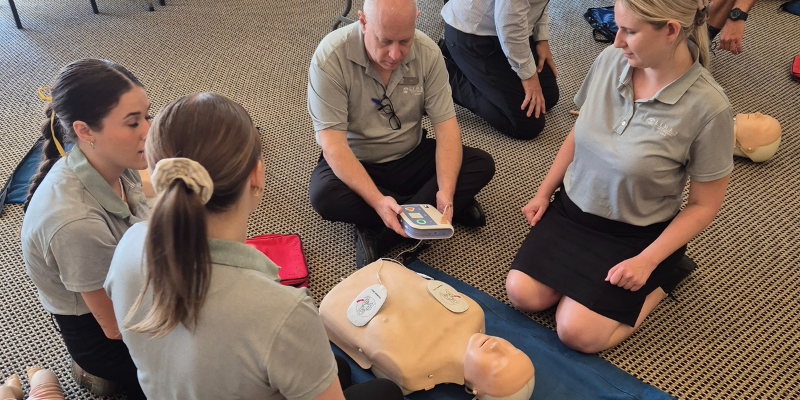
Here's the short answer. An HLTAID009 Provide Cardiopulmonary Resuscitation course is a short course, done in a single session. Plenty of providers shorten the in-class part too, by getting you to knock over the theory online first, in short bursts at home. At Accelerate First Aid, the session includes hands-on practice on adult, child and infant manikins plus your practical assessment.
This guide walks through where the time actually goes, from the online theory right up to the moment your trainer signs you off. You'll see how blended learning cuts down your time away from the kids, how a CPR course stacks up against a full first aid course, and how to find a weekend session close to home before pool season really kicks in.
How Long Does HLTAID009 Take?
HLTAID009 Provide Cardiopulmonary Resuscitation is one of the shortest nationally recognized first aid units you can do. The exact time depends on the format you book:
Face-to-face course: everything in one class, covering theory, hands-on practice and assessment.
Blended course: online theory at home first, then a shorter practical session for training and assessment.
Refresher session: a shorter session for people renewing a current CPR certificate.
Every format includes a face-to-face practical assessment. You must perform uninterrupted CPR on an adult manikin on the floor, plus CPR on an infant manikin and use of an AED trainer. A nationally recognized Statement of Attainment is issued once you are assessed as competent.
The time goes further than most people expect, especially if all you remember from your last course is "30 and 2".
Where the Time Goes in an HLTAID009 CPR Course
The HLTAID009 duration doesn't really mean much until you can see it laid out. So here's how a typical course breaks down, start to finish.
Online Theory Before Class (Blended Only)
If you book a blended course, the theory comes first, and you do it on your phone. Short bursts. A few minutes here and there, while the baby's asleep. You'll cover DRSABCD (the action plan every first aider works through), how to recognize someone in cardiac arrest, your duty of care basics and infection control.
Hands-On Practice on Adult, Child and Infant Manikins
This is where most of the class time goes. You'll do compressions and breaths on adult and infant manikins over and over, until your hands start doing it without you having to think.
Your trainer explains the difference between a child and an infant in plain language. A baby gets two fingers on the chest, and your mouth goes over their mouth and nose. A bigger child gets one or two hands, depending on their size. You'll also practice:
swapping rescuers so nobody tires out
putting someone in the recovery position
what to do if they vomit or regurgitate during CPR
Vomiting during CPR happens more than people think, and it's way less confronting once you've practiced it.
Using a Defibrillator (AED Trainer)
Plenty of parents admit they'd be too nervous to touch the defib at the shops. Then they use the AED trainer in class and realize the thing literally talks you through every step. Turn it on and follow the voice. That's most of it.
Your Practical Assessment
To be assessed as competent, you'll do uninterrupted CPR on an adult manikin on the floor, plus CPR on an infant manikin. It isn't a one-shot exam. Your trainer coaches you as you go, and if something needs work, you practice it again.
Before you wrap up, there's also a short debrief on what happens after an emergency. It covers how doing CPR can affect the rescuer, and how incidents get reviewed and reported. That's part of the unit (Element 4), and our CPR Debriefing guide goes into it more.
Receiving Your Certificate
Once you're assessed as competent, you receive a nationally recognized Statement of Attainment.
How much of that time you spend in an actual classroom comes down to the format you pick.

Face-to-Face or Blended: Which CPR Course Format Is Quicker?
Here's something most people don't realize. A blended CPR course doesn't always save you much time overall. What it saves is time away from home, and for parents that's usually the number that counts.
How Blended CPR Training Works
With a blended CPR course, you do the theory online first, whenever suits you. Then you come in for a shorter practical session where it's all hands-on: manikins, AED trainer, assessment, done. The total time can end up pretty similar to a face-to-face course. The difference is that part of it happens on your couch, not in a training room while someone else minds the kids.
Blended | Face-to-face | |
Time at home | Online theory, at your own pace | None |
Time in class | Shorter, practical only | Longer, theory and practical |
Total time | Similar overall | Similar overall |
Suits | Parents who can study in short bursts | People who learn best with a trainer explaining |
Can You Do HLTAID009 Completely Online?
No. A nationally recognized HLTAID009 always needs an in-person practical assessment. Nobody can check your compression depth through a screen. So if you come across a "100% online" HLTAID009 offer, treat it as a red flag.
Which Format Suits Parents With Young Kids?
If you can knock over the theory during nap time, go blended. You'll spend less time out of the house, and that's often the difference between booking it this week and putting it off till next summer.
Face-to-face makes more sense if you learn better when a trainer talks you through the theory in person. It also suits you if you know, realistically, the modules just won't get done with a baby at home. One outing, all done.
If you're weighing up a CPR course against a full first aid course, the time difference is a lot bigger.
CPR Course vs First Aid Course: How the Times Compare
HLTAID009 vs HLTAID011 Duration
A first aid course (HLTAID011 Provide First Aid) is a much bigger commitment. It takes a lot longer face-to-face, or you do online theory followed by a longer class than CPR.
One thing that catches people out: HLTAID011 already includes HLTAID009. So if you're doing first aid, don't book CPR separately as well. You'd just be doing the same thing twice.
Course | What it covers | Typical time | Refresh every | Best for |
HLTAID009 CPR | Adult, child and infant CPR, AED use | Shortest option | Every year | Parents wanting core life-saving skills, fast |
HLTAID011 First Aid | CPR plus choking, bleeding, burns, bites, allergic reactions | Much longer | 3 years (CPR still yearly) | Broader skills once CPR feels solid |
Which Course Should Parents Do First?
For most parents, CPR first. It's the quickest way to get the core life-saving skills under your belt. Once you're feeling confident with that, first aid builds on it with choking, bleeding, burns, bites and allergic reactions.
If you're heading back to work after parental leave, check with your employer (a dental practice, say) which unit they actually ask for before you book. HLTAID009 is a nationally recognised unit, accepted by employers across Australia. Some workplaces want the full first aid course instead.
You might also see HLTAID012, the childcare first aid course, come up in your searches. That's a different course for people working in education and care. Parents don't need it.
For the full breakdown, have a read of our Difference Between CPR and First Aid guide.
Once you've done CPR, keeping it current takes far less time.
How Long Does a CPR Refresher Take?
Refresher Time vs First-Time Course
A CPR refresher is often shorter than doing the course for the first time.
A refresher is really built for people whose CPR is still current, though. If your last course was back in 2015 and all that's left is a vague memory of "30 and 2", book the full course. You'll get a lot more out of it.
Why CPR Is Refreshed Every Year
The Australian Resuscitation Council recommends renewing CPR every year, and most Queensland workplaces follow that too. Your certificate doesn't have a legal expiry date, but CPR is a skill that fades quicker than you'd think. Compression depth and rhythm are the first things to slip, and a short yearly session is the easiest way to keep them sharp. For the full story on validity, see Is Your CPR Accreditation Valid? guide.
For parents, September is a good time to book your renewal. You'll have it done before pool season properly starts.
Get a reminder before next pool season: We'll send you a nudge when it's time to renew.
A few simple things on the day decide whether you finish on time.
What Can Make Your CPR Course Longer or Shorter
Things That Add Time
Most CPR courses finish when they're meant to. A few things can stretch the day out, though:
Online theory that isn't finished, so it has to be caught up before you start
No USI at sign-in
Arriving late, which pushes everything back for you, and sometimes the group as well
Needing a bit of extra practice before your assessment
That last one is completely normal and allowed for, so don't stress about it.
How to Finish on Time
Here's what helps you walk out on schedule:
Create your USI (Unique Student Identifier) at usi.gov.au before the day.
Finish your online modules a day early, not in the car park.
Wear comfortable clothes you can kneel in.
Eat beforehand, because doing CPR is more of a workout than it looks.
Arrive a little early.
It's worth knowing that you'll need to kneel on the floor and do uninterrupted CPR as part of the assessment. If you've got an injury, a sore back or knees, or anything that affects your mobility, just get in touch with your trainer before the day. They can talk it through with you.
For everything else you'll need before booking, see our CPR Course Requirements: What You Need Before Booking guide.
The last piece is finding a session that fits around naps, kindy and a partner who works away.
Fitting a CPR Course Around the Kids on the Gold Coast
Weekend and Daytime Sessions on the Gold Coast
For most parents, a weekend CPR course on the Gold Coast is the easy option. A Saturday morning session means your partner or the grandparents can mind the kids while you're out, and you're home again not long after.
With little ones at home, you shouldn't have to drive across the city with a car seat in the back. Look for a CPR course close to home, with easy parking.
Private Group Sessions for Mothers' Groups and Families
If you've been meaning to sort this out, chances are half your mothers' group has too. With a private session, one booking covers the whole group, and the trainer can come to a home or a local community hall.
Training the Grandparents and Babysitters Too
If the grandparents watch the kids by the pool every week, it makes a lot of sense for them to learn CPR as well. You're just giving everyone who looks after your kids the same skills, so whoever is there on the day knows exactly what to do.
Here's a nice way to think about it. Every regulated pool in Queensland has to display a compliant CPR sign, so you walk past one every time you open the gate. A CPR course is what turns that sign into something your hands actually know how to do.
Book a CPR Course That Fits Around Your Week
It's a hot afternoon in January. The kids are splashing around in the pool, someone's yelling "watch this!" for the fifth time, and you're sitting on the edge with your feet in the water and a coffee that's gone cold. And there's no knot in your stomach this time.
That calm doesn't come from a certificate on the fridge. It comes from knowing your hands would know what to do. You've practiced on the infant manikin, you've used the defib, and you've done your assessment on the floor. It's not a "what if" anymore. It's a skill you've actually got.
And the HLTAID009 duration really is the easy part. It's one short session, done once, then a quick refresher each year.
Start by choosing your format. If you can knock over the theory in short bursts during naps, go blended and spend less time away from home. If you'd rather get it all done in one outing with a trainer walking you through it, face-to-face is the way to go.
Next, pick a Saturday or weekday session close to home. Choose a time when your partner or the grandparents can mind the kids, so you can actually focus.
Then bring someone with you. Your partner, a grandparent who babysits, a friend from your mothers' group. It means one more person in your kids' world who knows exactly what to do.