HLTAID009 Assessment: What to Expect on the Day
Booked your HLTAID009 course and now your brain won't stop running the "what if" tape? You're not the only one. Almost every person we see the night before their session sends the same message, some version of "what happens if I stuff it up." It's the number one worry, hands down, and it shows up regardless of age, job, or how many first aid courses someone's already sat through in their life.
Here's the thing about that worry, it usually comes from picturing the wrong scenario entirely. People imagine something closer to a driving test, an examiner with a clipboard, a pass or fail moment, a long silent wait for results. That's not what HLTAID009 looks like in real life, not even close.
So here's the truth, and it's a good one: HLTAID009 isn't an exam. There's no trick questions waiting to catch you out, no written test, no sitting in a stuffy room for hours filling in bubbles. It's a short, practical session where you show your trainer you can do CPR on a manikin, and they tick you off as you go. That's it. No hidden traps, no gotcha moments built into the process.
This guide takes you through the whole thing, start to finish, check-in through to certificate, so by the time you walk in on the day, you already know exactly what's coming. No surprises, no guesswork, just a clear picture of what the next hour or so actually looks like.
What Happens at a HLTAID009 Assessment?
Quick answer, if you're skimming this on your lunch break:
Your HLTAID009 assessment is a short practical session, not a written exam. Here's the run-down:
Check-in: you arrive, confirm your details, settle in
Quick theory recap: your trainer checks your online pre-course work is done
Practical demonstration: CPR on a manikin, checking response, calling for help, airway, compressions, rescue breaths
AED demonstration: showing you can use an automated external defibrillator correctly
Feedback and sign-off: your trainer confirms you're competent, right there on the spot
Certificate: issued digitally, no long wait involved
No pass/fail exam pressure hanging over you. It's competency-based, which basically means your trainer is coaching you the whole way through, not sitting back waiting to fail you. Think of it less like a test and more like someone standing beside you making sure you've got the technique right before you leave. That's genuinely the whole philosophy behind how these sessions run.
The word "assessment" tends to carry a lot of baggage from school, from exams, from job interviews. Strip all that away here. What you're actually doing is showing your trainer, in real time, that you can respond if someone in front of you needs CPR. That's a completely different thing to being examined.
Before You Arrive: What to Bring and How to Prepare
What to Bring
Keep this part simple, don't overthink it. Grab these before you head out the door:
Photo ID
Your USI number
Your confirmation email or booking reference
Comfortable clothing, since you'll be kneeling and moving around on the floor, so save the tight jeans for another day
If you did any online pre-course theory, bring evidence you've finished it. That's it. That's the list. No calculators, no textbooks, no printed notes to memorise on the drive over.
A quick word on the clothing point, because people underestimate it. You'll spend a chunk of the session down on the floor working on a manikin, so anything restrictive around the knees or waist is going to bother you more than the actual assessment will. Trackpants, shorts, whatever you'd wear to the gym, that's the right call. Save the smart-casual outfit for another day.
Should I Study Beforehand?
Short answer, no, not really. If you've already worked through the online theory component, that's covered what you need. There's no last-minute cramming required here, no flashcards, no 11pm YouTube binge trying to memorise compression ratios. Just turn up, and let the practical session do the rest.
If anything, over-preparing tends to backfire a little. People who show up having watched a dozen different CPR videos the night before sometimes second-guess themselves more, not less, because every video shows a slightly different technique or a slightly different pace. Trust the training you've already done, trust your trainer to guide you through the rest, and leave it at that.
Once you've got everything sorted, here's what actually happens when you walk through the door.
Check-In and Getting Settled
Arrival and Sign-In
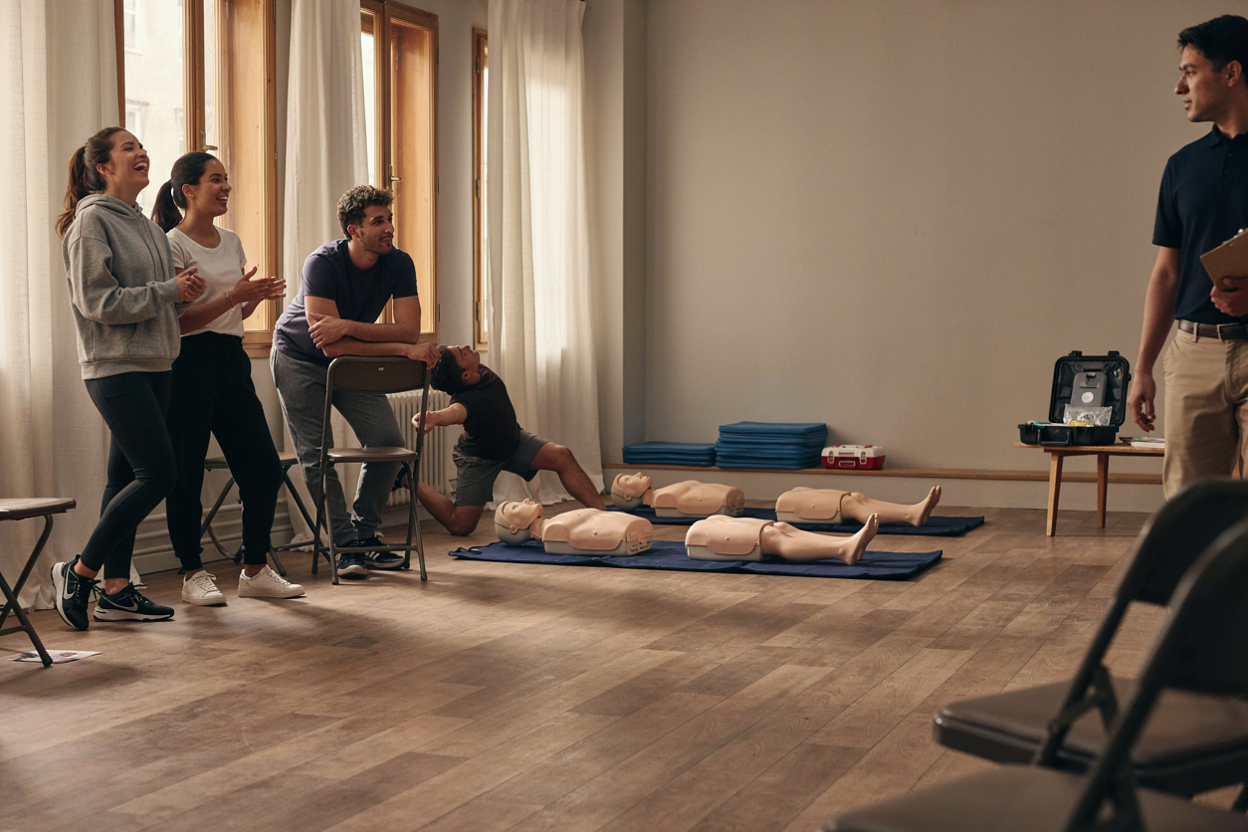
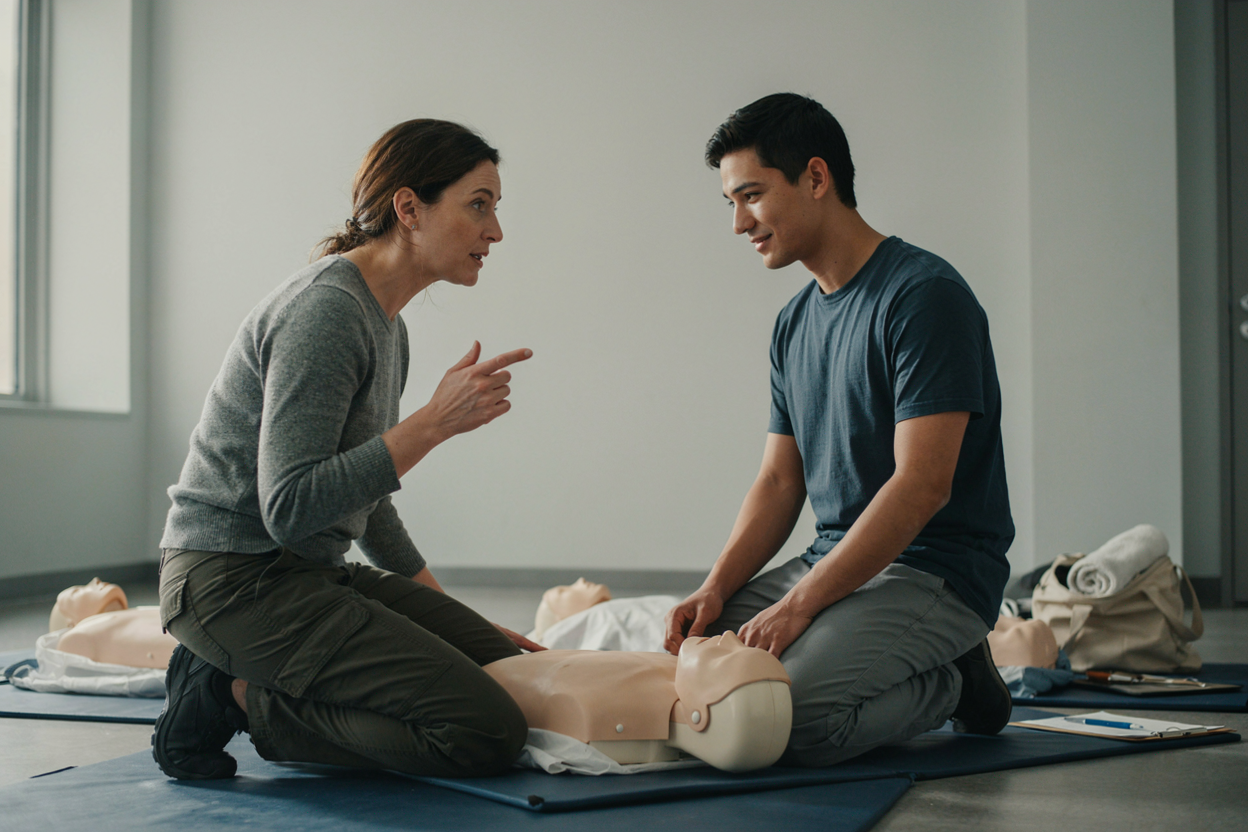
Nothing dramatic happens here. You rock up, someone at the front confirms your name against the booking list, and you're pointed toward the room. The room itself is set up more like a training space than an exam hall. No rows of desks, no silence, no invigilators pacing up and down. You'll see manikins laid out, maybe a training AED unit on a table, and people milling about chatting before things kick off.
That informal energy is deliberate. Nobody's whispering, nobody's nervously flicking through notes in the corner. It feels closer to a workshop than anything resembling school, and that tends to be the first thing that puts people at ease once they've actually walked in. Small talk usually kicks off naturally too, people comparing why they're there, a job requirement, a coaching ticket, a first-time booking as a new parent, and that shared context tends to settle everyone in faster than any formal introduction could.
Meeting Your Trainer
You'll meet your trainer early on, and this is where a lot of the nerves start to settle. The whole point of the session is to help you get it right, not catch you out. If you've read reviews mentioning trainers who are friendly and don't drag things out, that's exactly the tone we're going for. Quick chat, settle you in, and get moving.
Most trainers running these sessions have real-world backgrounds in emergency response or clinical work, which changes the whole feel of the room. They're not reading off a script, they're drawing on actual experience, and that comes through in how they explain things and how they respond when someone's technique needs a small correction.
The Practical Assessment: Step by Step
DRSABCD and Initial Response
This is the framework everything else sits on, and it's simpler than the acronym makes it look:
D: Danger. Check the area's safe before you go near anyone.
R: Response. Check if the person's responsive.
S: Send for help. Call triple zero, or get someone else to.
A: Airway. Make sure it's clear.
B: Breathing. Check for it properly.
C and D: Compressions, then defibrillation if needed.
Your trainer walks you through this in plain English, step by step. Nobody expects you to nail it silently and perfectly the first time through. In fact, most trainers will talk you through each letter out loud as you go, almost like a checklist you're working through together rather than something you're reciting from memory under pressure.
The reason DRSABCD gets so much attention isn't because it's complicated, it's because in a real emergency your brain tends to go blank. Having a simple sequence you've physically practised means your body knows what to do even when your thoughts are racing. That's the actual purpose behind drilling it during the assessment, not to trip you up, but to build muscle memory you can rely on later.
CPR on the Manikin
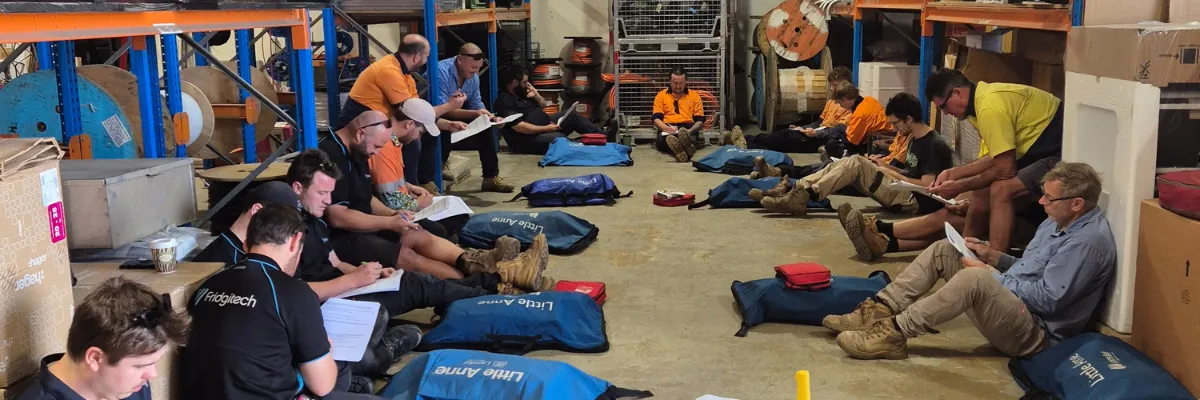
This is the bit people picture when they think "assessment," and honestly, it's the least scary part once you're in it. You'll do compressions and rescue breaths on the manikin while your trainer watches your technique, your rhythm, your positioning. They're not hunting for reasons to fail you, they're watching to help you improve as you go.
Your arms will get tired, that's completely normal and every single person who's ever done this course knows the feeling. Compressions are physical work, more than people expect walking in, and your trainer knows that too. If your rhythm drifts or your depth isn't quite right, they'll step in, adjust your positioning, and get you going again. Nobody's standing back silently taking notes and letting you struggle. If you want the full detail on exactly what's being marked, that lives over in our companion guide, HLTAID009 Assessment: What You Need to Pass.
Using the AED
No prior experience needed here, none at all. Your trainer will show you how to use an automated external defibrillator, and then you'll demonstrate it back. It's more straightforward than people expect, the machine genuinely talks you through most of it.
Modern AEDs are built for exactly this situation, someone under pressure who's never touched one before. The unit gives you clear voice prompts, tells you where to place the pads, and even tells you when to stand clear before it analyses the heart rhythm. Your trainer is there the whole time too, so between the machine's own guidance and a real person beside you, this step tends to feel far less intimidating than people assume before they've actually tried it.
If reading through those steps made you a little nervous, that's completely normal, and it tends to fade fast once you're actually moving through it with your trainer beside you.
After the Assessment: Results and Your Certificate
When You Find Out
You find out straight away. Not a week later, not an email that shows up out of nowhere three days after you've stopped thinking about it. Your trainer confirms your competency on the spot, before you even leave the room.
There's something genuinely reassuring about that immediacy. You don't walk out wondering, you don't spend the drive home replaying every compression in your head trying to guess how you went. Your trainer tells you directly, and that's it, done.
Getting Your Statement of Attainment
Here's how it lands in your hands:
Trainer confirms you're competent
Your Statement of Attainment gets processed
Certificate is issued digitally, no long wait involved
It's nationally recognised, so whatever employer, club, or licensing body is chasing you for it, this covers you. Want the full detail on what the certificate actually looks like? Head over to our HLTAID009 Statement of Attainment guide.
Because it's delivered digitally, you're not stuck waiting on a physical copy to arrive in the post before you can hand it to your employer or upload it to whatever compliance system your workplace uses. That's a small detail, but for anyone who's been chasing a deadline, it makes a real difference.
Booking Your HLTAID009 Assessment
Solo or Group Bookings
Coming on your own? Easy, book a spot and you're done. But if you're a sports club, gym, or hospitality venue needing several people done at once, that's just as easy to sort. Group bookings mean your whole team walks out certified together, no chasing individual staff members to book their own separate sessions one at a time.
This matters more than people expect for club and venue bookings specifically. Coaches, coordinators, and managers are usually the ones stuck coordinating everyone's individual schedules, and that job gets a whole lot easier when the whole group goes through the same session together. Everyone's certified on the same day, everyone's compliance is sorted in one go, and nobody's left chasing down the one staff member who kept putting it off.
Whether you're a tradie who needs a current ticket for a job site, a coach getting your whole squad compliant before the season starts, or a new parent wanting real confidence rather than just a piece of paper, the process is the same either way. Book, show up, get it done.
Next steps, in order:
Check your booking confirmation
Grab your ID and USI
Show up ready, we'll handle the rest
Most people spend more time worrying about their HLTAID009 assessment than the assessment itself actually takes. That's not us being dismissive of the nerves, it's just what tends to happen once you're actually in the room. The version in your head, the one with the silent panel of judges and the pass/fail cutoff, isn't the version that shows up on the day.
What actually shows up is a trainer standing next to you, talking you through compressions, nudging your hand position if it needs it, and letting you have another go if something didn't land right the first time. Nobody's counting you out. Everybody in that room, trainer included, wants you walking out the door with your certificate. That shared goal changes the whole feel of the session, it stops being something done to you and starts being something you're working through together.
There's a reason competency-based assessment exists in the first place. The point was never to see who could memorise a ratio under pressure, it was to get people who can genuinely respond if someone collapses in front of them, whether that's at work, at training, or at home with their own kid. The format is built around getting you there, not around weeding you out. Every part of the session, from the plain-English DRSABCD walkthrough to the trainer standing right beside you during compressions, exists to build real, usable confidence rather than to catch you out on a technicality.
So if you're sitting on a booking confirmation and you've still got that knot in your stomach, that's completely normal, and it usually clears up about five minutes into the session. Bring your ID, bring your USI, wear something you don't mind kneeling in, and let the trainer do their job. You genuinely don't need to prepare beyond that, and trying to over-prepare tends to add more stress than it removes.
Whether you're renewing because your certificate's about to lapse, ticking a box for your employer, or getting certified for the first time because you're about to be a parent, the day itself is short, straightforward, and a lot less intimidating than the lead-up to it. You'll be out the door with a digital certificate before you know it, and the version of the assessment you'd built up in your head beforehand will already feel like it belonged to someone else's experience, not yours.
And once you've done it once, every renewal after that gets easier, because now you know exactly what's coming. No more guessing, no more googling "what happens at a HLTAID009 assessment" the night before, no more running through worst-case scenarios in your head on the drive over. Just book, show up, and get it done, the same way you'll do it again next cycle, and the one after that.