HLTAID009: What You Need to Know Before You Enroll
Someone collapses in front of you. It could be a colleague at your desk, your child at the pool, or a stranger at the shopping centre. In that moment, what you know — and what you do in the next 60 seconds — determines whether they survive.
HLTAID009 — Perform CPR — is the nationally recognised unit of competency that gives you that knowledge. And it's one of the most practical things you can do for the people around you.
Before you book, it helps to understand exactly what HLTAID009 covers, who needs it, how long the certificate lasts, and what to expect on the day. This guide answers all of it — no jargon, no filler.
What Is HLTAID009?
HLTAID009 — Perform CPR is a nationally recognised unit of competency under the Australian Skills Quality Authority (ASQA) framework. It's the standard CPR certification required by most Australian employers, childcare providers, and workplace health and safety regulators.
The course covers:
How to recognise a life-threatening emergency
How to perform CPR on adults, children, and infants
How to use an automated external defibrillator (AED)
How to manage an unresponsive casualty until emergency services arrive
HLTAID009 replaces the previous unit HLTAID001 and has been the current nationally recognised standard since 2021.
Who Needs HLTAID009?
The short answer is: more people than you'd think. Whether you're ticking a compliance box for work or just want to know what to do if something goes wrong at home, HLTAID009 is the qualification that covers it.
Workplace & Compliance Requirements
In Queensland, there are several industries where holding a current HLTAID009 certificate isn't optional.
Childcare educators are the most well-known example. ACECQA mandates that all educators hold a current certificate, and an expired one can trigger a compliance issue at your next service assessment. If your cert has lapsed, you need to sort it before your next audit — not after.
NDIS support workers are in a similar position. Most providers require HLTAID009 as a condition of employment, renewed annually. For construction and trades workers, the WHS Act Qld sets out first aid requirements for worksites — and CPR certification is part of meeting those obligations. Hospitality and events staff, fitness instructors, and personal trainers often need it too, either for insurance requirements or as a condition of industry membership.
Personal & Family Reasons
Not everyone booking a CPR course is meeting a deadline. Plenty of people just want to be ready.
For parents — especially those with young kids or a pool at home — HLTAID009 is less about compliance and more about peace of mind. Queensland consistently records among the highest rates of drowning in Australia, with children under five among the most at-risk groups, according to Royal Life Saving Australia.
Jess booked her HLTAID009 after her second child was born. She wasn't meeting a deadline — she just wanted to know what to do if something happened at the pool. One course later, she did. No medical background required.
Professional Licensing Requirements
AHPRA-registered practitioners in aged care, allied health support, and community health roles are also expected to hold current CPR certification. If you're working toward a paramedic pathway or returning to a clinical setting, HLTAID009 is usually one of the first boxes on the checklist.
Across all of these groups, no prior medical knowledge or experience is required to enrol. You don't need to know anything going in. That's the whole point.
Need more than CPR? See HLTAID011 — Provide First Aid for the full first aid qualification, or HLTAID012 for the childcare-specific emergency first aid unit.
What Does HLTAID009 Cover?
A lot of people are surprised to find out HLTAID009 has two parts. There's an online theory component you complete before the course day, and then a face-to-face practical assessment where you actually get hands on a manikin and do the work. Both parts matter — and knowing what's coming makes the whole experience far less daunting.
The Online Theory Component
Before you show up on the day, you'll complete a short online theory module at your own pace — on your phone, tablet, or laptop, whenever suits you. This is where you cover the foundational knowledge: the DRSABCD action plan, the chain of survival, how to recognize a cardiac arrest versus other emergencies, and the theory behind how an AED works.
It's not a test you can fail. It's preparation. By the time you walk in on the day, you've already got the framework in your head — which means the practical session is less about learning from scratch and more about building the muscle memory to actually do it.
The Face-to-Face Practical Assessment
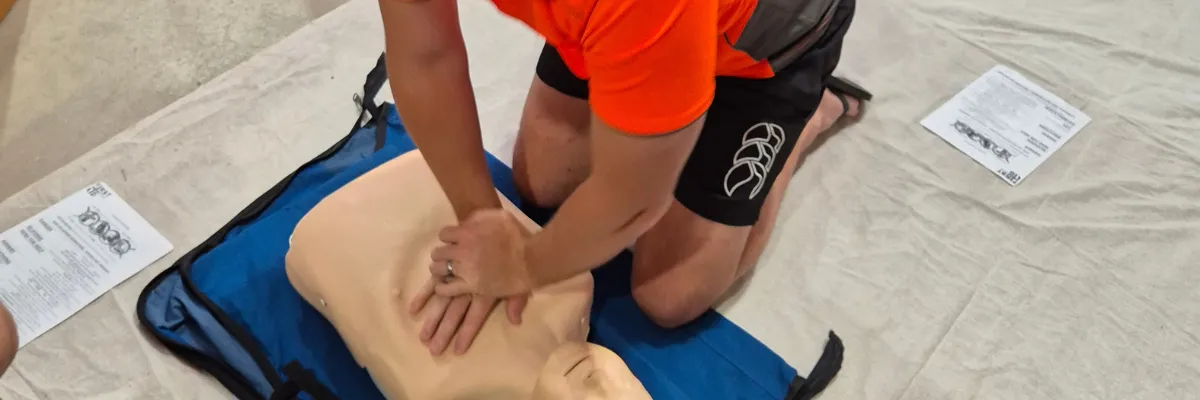
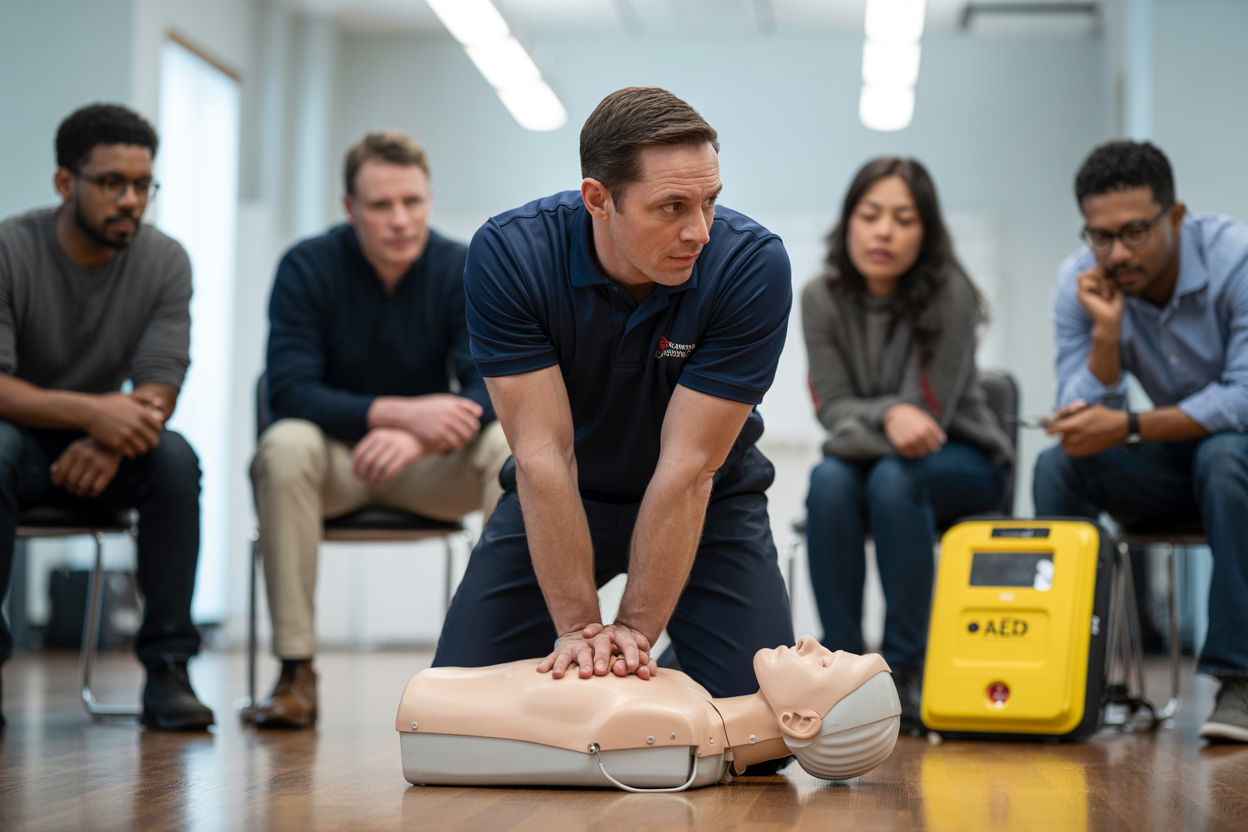
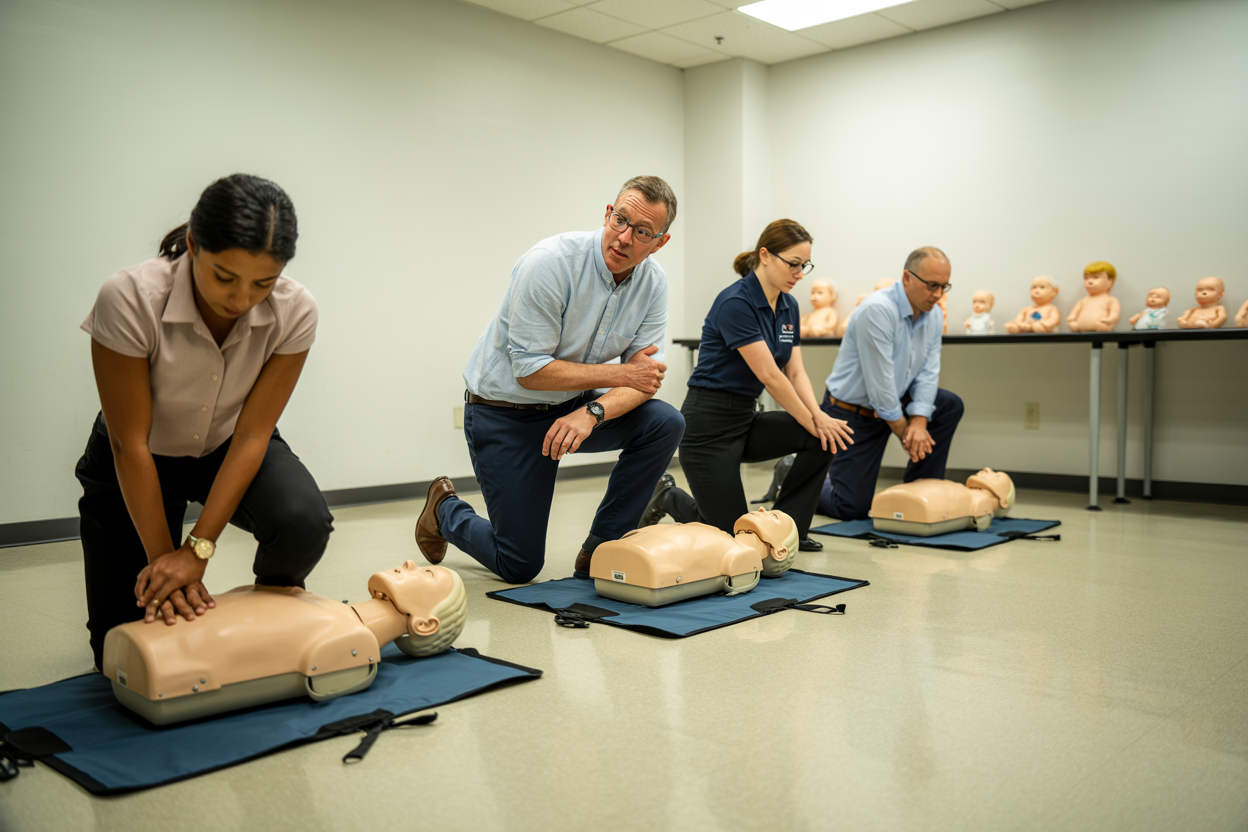
This is the part that counts, and it's also the part most people are quietly nervous about. You'll practice CPR on adult, child, and infant manikins — working to the current Australian Resuscitation Council standards, which means compressions at 100 to 120 per minute, to a depth of around five to six centimetres for adults, with a 30:2 compression-to-breath ratio. You'll also go through CPR-only protocol, which is relevant in situations where rescue breathing isn't possible or appropriate.
The AED practical is part of the session too — pad placement, establishing a safe zone, and working through the shock delivery sequence. It's one of those things that feels complicated until you actually do it, and then it clicks pretty quickly.
What You'll Be Assessed On
The assessment is competency-based — not exam-based. There's no written test, no standing up in front of the group and reciting information, no being put on the spot. The trainer watches you perform the skills and marks you as competent once you've demonstrated you can do it. That's it.
Most people are assessed and signed off on the day without any issues. If something doesn't quite land the first time, a good trainer will work through it with you. The environment is relaxed, practical, and hands-on from start to finish — not a lecture theatre.
How Long Does HLTAID009 Last?
Your HLTAID009 certificate is valid for 12 months from the date it's issued. That's not an arbitrary rule — it comes directly from the Australian Resuscitation Council (ARC), the peak body that sets resuscitation guidelines in this country, and there's solid clinical reasoning behind it.
The 12-Month Rule Explained
The ARC sets the renewal cycle at 12 months because CPR guidelines are updated regularly as new research comes in. What was considered best practice three years ago may have been refined. Compression depth standards, CPR-only protocols, and AED procedures are all subject to periodic review — and your certificate reflects the guidelines current at the time you were trained.
That's why a certificate from four years ago isn't just expired on paper. It may also reflect an older version of the guidelines. You can verify the current HLTAID009 unit requirements directly on the training.gov.au unit listing, and check current resuscitation guidelines at the Australian Resuscitation Council.
Why Annual Renewal Matters | It's Not Just a Compliance Box
Here's something most people don't realise: CPR skill retention degrades significantly within months of initial training, even for people who felt confident walking out of their course. Research cited by the ARC shows that without practice, compression technique, rate, and depth all drop off measurably — and that decline can start within a few months.
So the 12-month renewal isn't just about keeping a certificate current. It's about making sure the skill is actually there when you need it.
Angela had done CPR training years earlier but wasn't sure she'd remember the sequence under pressure. Her renewal course covered the latest ARC guideline updates and she left feeling genuinely ready — not just recertified. That's the difference between ticking a box and actually being prepared.
What Happens If Your Certificate Expires
If your certificate lapses, most employers won't accept it — full stop. For childcare educators, an expired HLTAID009 can flag as a compliance issue at an ACECQA service assessment. For NDIS workers, it can stall a registration renewal. For anyone applying for a new role that lists CPR as a requirement, an expired cert is the same as no cert.
Tom's employer flagged his expired CPR certificate two weeks before his NDIS registration renewal. He found a course, completed it, and submitted his updated credentials the same day. It was fixable — but only because he acted quickly.
Renewal is exactly the same process as your initial course. You complete the online theory component, attend the face-to-face practical, and walk out with a fresh 12-month certificate. CPR renewal sessions are available — so the scheduling piece isn't usually the problem.
What to Expect on the Day
The biggest thing that stops people booking a CPR course isn't scheduling — it's not knowing what they're walking into. So here's exactly what the day looks like, from before you arrive to the moment you leave with your certificate.
Before You Arrive
When you book your HLTAID009 course, you'll receive a confirmation email with a link to the online theory component. Complete this before the course day — it covers the foundational knowledge you'll be putting into practice. Wear comfortable clothing you can move in. No special equipment, no textbooks, no preparation required beyond the online module.
The four-step process looks like this:
Complete online theory → Arrive at venue → Hands-on practical → Receive certificate
During the Course
You'll arrive, meet your trainer, and get a quick run-through of what the session covers. From there, it's hands-on almost immediately. You're on the manikins early, working through compression technique, rate, and depth with the trainer guiding you in real time. Nobody walks in knowing everything — a good trainer reads the room and adjusts as you go.
After the Course | Your Certificate
Once you've been assessed as competent, your HLTAID009 certificate is issued the same day or within 24 hours. It's nationally recognised, valid for 12 months from the date of issue, and accepted by employers, ACECQA, NDIS providers, and industry bodies across Australia. You'll receive it digitally — ready to forward to your employer or attach to a job application.

How to Choose the Right HLTAID009 Provider
Not all CPR courses are equal — knowing what to look for saves you from wasting time on a certificate your employer won't accept.
What to Look For in an RTO
The single most important thing to check is whether the provider is a registered training organisation under ASQA. You can verify any RTO's registration at training.gov.au — if they're not listed there, the certificate they issue isn't nationally recognised, full stop.
Beyond registration, here's what a quality provider looks like:
Same-day certificate turnaround — there's no reason a competent RTO can't issue your certificate on the day
Transparent pricing — if you can't find it on the website, that's a red flag
Genuine hands-on delivery — not a tick-and-flick operation where you spend most of the day watching a video
Local providers tend to offer something the large national chains can't match: flexibility, personal attention, and faster turnaround. That advantage is real, and worth factoring in.
Questions to Ask Before You Book
Before you commit, it's worth running through a quick mental checklist:
Is the certificate nationally recognised under the HLT Health Training Package?
Is the online theory component mobile-friendly and easy to complete before the day?
What's the cancellation or reschedule policy if something comes up?
A good provider answers all of these without hesitation. If you're getting vague answers or being redirected, keep looking.
Red Flags to Avoid
An online-only CPR course might look more convenient, but it doesn't meet ARC guidelines and won't hold up when it matters. Other red flags to watch for:
No RTO number displayed on the website
No reviews, very few reviews, or a suspiciously high volume of generic five-star reviews with no detail
Certificates issued days or weeks after the course with no explanation
The HLTAID009 unit listing on training.gov.au is publicly accessible — any legitimate provider will point you there without hesitation. ARC guidelines are also publicly available if you want to verify what the current standards actually require.
When you find a provider with strong reviews, clear pricing, and a same-day certificate — that's your answer.
Your Next Steps
If you're ready to book, check available dates and lock in a session for your CPR course. If you're still deciding, download the free CPR readiness guide below and come back when the timing works. And if you need to train a team, get in touch for a group quote — we'll sort the rest.
Either way, the time you spend on HLTAID009 could matter more than any other investment you make this year.
What You Do Next Could Matter More Than You Think
CPR is one of those skills that sits quietly in the background of your life — right up until the moment it isn't quiet at all. The difference between knowing what to do and standing there hoping someone else steps in is one course. One nationally recognised certificate. One skill set that doesn't expire in usefulness even when the paperwork does.
HLTAID009 is designed for ordinary people, not medical professionals. The assessment is practical and supportive, and the certificate you walk out with is accepted by employers, childcare regulators, NDIS providers, and industry bodies right across Australia.
Bystander CPR can double or triple survival rates for out-of-hospital cardiac arrest, according to the Australian Resuscitation Council. The person who makes the difference in that moment is almost always an ordinary person who happened to know what to do.
You can be that person. Book your CPR training course, get your HLTAID009 certificate, and walk away genuinely prepared — not just certified on paper.