High-Risk Workplace Resuscitation Training Explained
If one of your designated first aid officers responded to a cardiac arrest on site today would their certification actually meet your contractual and regulatory obligations?
It's a question most WHS managers don't ask until something forces them to. And the uncomfortable reality is that a lot of high-risk Queensland workplaces are carrying HLTAID011-certified staff who genuinely believe they're compliant but whose contracts, employers, or regulatory bodies now specify HLTAID015. That's not a paperwork distinction. HLTAID015 covers oxygen therapy, advanced airway management, and a higher threshold of resuscitation competency that standard first aid training simply doesn't include. The gap between the two certifications can matter enormously when someone's life is on the line.
This article is written for WHS managers and safety officers who need a clear, practical answer to a specific question: when is high-risk workplace resuscitation training required, and what does getting your team there actually look like? You'll find out which Queensland industries and designated roles require HLTAID015, what the WHS Act 2011 and SafeWork QLD say about first aid officer competency, how to upgrade staff who already hold HLTAID011, and how to organize group training across your team in Brisbane without taking your operation offline to do it.
What Is High-Risk Workplace Resuscitation Training?
High-risk workplace resuscitation training refers specifically to HLTAID015 Provide Advanced Resuscitation and Oxygen Therapy. It's the nationally accredited certification that sits above HLTAID011 (Provide First Aid), designed for workers likely to be first on scene in a cardiac or respiratory emergency before paramedics arrive.
What HLTAID015 Covers That Standard First Aid Doesn't
HLTAID011 gives workers a solid foundation: CPR, AED use, basic airway management, and bleeding control. HLTAID015 goes further:
Oxygen therapy administering supplemental oxygen to a casualty with a respiratory or cardiac presentation
Advanced airway management including oropharyngeal airway (OPA) insertion to maintain an open airway
Bag-valve-mask (BVM) ventilation delivering controlled rescue breaths with a resuscitation bag
Structured resuscitation sequencing managing a multi-step response including team coordination and handover to paramedics
Oxygen equipment handling safe use, storage, and troubleshooting of oxygen delivery systems
These skills make a material difference when a worker goes into cardiac arrest on a remote or high-hazard worksite.
How HLTAID015 Aligns With ARC/ANZCOR 2021 Resuscitation Guidelines
HLTAID015 is taught in alignment with the Australian Resuscitation Council (ARC) and ANZCOR 2021 guidelines. Any provider delivering HLTAID015 should confirm their content reflects those updates. If they can't, that's a red flag before you put your first aid officers through their course.
You can verify HLTAID015's national accreditation status on training.gov.au.
Knowing what HLTAID015 covers is the first step. The next is confirming whether your industry requires it.
Which Industries Require HLTAID015 in Queensland?
HLTAID015 isn't a universal requirement for every Queensland workplace but for a growing list of industries, it's moved from "recommended" to "required." The distinction matters because it shifts the conversation from preference to obligation, and the WHS Act 2011 (QLD) gives that obligation real weight.
Queensland WHS Act Obligations for Designated First Aid Officers
Under the Work Health and Safety Act 2011 (QLD), a PCBU must ensure first aid training is appropriate to the hazards and risk profile of the workplace. In a low-risk office, HLTAID011 meets that obligation. In a mining services or emergency response environment, the risk profile demands more.
Contract and Tender Specifications: When HLTAID015 Is Named Explicitly
An increasing number of Queensland government contracts and resource sector supply agreements now specify HLTAID015, not HLTAID011. If your designated first aid officers hold HLTAID011 under one of those contracts, you may already be in breach of your contractual obligations even while meeting the regulatory floor.
Industries Where Standard HLTAID011 Is No Longer Sufficient
The industries where HLTAID015 is required, specified by contract, or strongly expected include:
Mining services remote sites, delayed paramedic response times
Utilities electrical, gas, and water infrastructure workers face cardiac and respiratory risk from electrical incidents and confined space work
Emergency response contractors active incident environments require advanced resuscitation capability
Oil and gas HLTAID015 is standard in most contractor requirements
Large-scale construction major project contracts, particularly government-funded infrastructure, increasingly name HLTAID015 for designated first aid officers
Government agencies and major logistics field-based roles with comparable risk profiles
Once you've confirmed your industry is in scope, the question most WHS managers face next is whether existing HLTAID011 certifications can be upgraded or whether staff need to start again.

HLTAID015 vs HLTAID011 What's the Actual Difference?
This is the question that comes up in almost every group training enquiry from WHS managers. HLTAID015 builds on HLTAID011. It's not a parallel certification but a higher level of the same competency framework, which means staff who already hold HLTAID011 are not starting from scratch.
Skills Covered: HLTAID015 vs HLTAID011 Side by Side
Who Each Certification Is Designed For
HLTAID011 suits the general workforce first aider in a standard workplace. HLTAID015 is for designated first responders in environments where casualty presentations are complex and paramedic response windows are longer.
You don't need your entire workforce trained to HLTAID015. You need your designated first aid officers trained to that standard. A tiered approach is compliant and practical, and it's how most high-risk Queensland workplaces structure their training matrix.
Upgrading From HLTAID011 to HLTAID015: The Pathway Explained
Staff holding a current HLTAID011 don't need to repeat foundational content. The pathway focuses on the additional units: oxygen therapy, advanced airway management, BVM ventilation, and structured resuscitation sequencing. Contact your RTO to confirm the correct entry point.
HLTAID015 course page | HLTAID011 course page
Understanding the skill difference is one layer of the compliance picture. The regulatory and contractual obligations that sit behind it are the other.
Legal and Regulatory Requirements for First Aid in High-Risk Queensland Workplaces
Here's what the regulatory framework says, and where compliance gaps tend to appear.
PCBU Obligations Under the Queensland WHS Act 2011
Under the Work Health and Safety Act 2011 (QLD), the PCBU's duty of care extends to first aid provision. The WHS Regulation requires that first aid training is appropriate to the hazards and risks present, not simply that a certificate exists on site. SafeWork QLD inspectors assess appropriateness, not just existence.
Safe Work Australia's First Aid Code of Practice What It Says
Safe Work Australia's Code of Practice: First Aid in the Workplace requires employers to conduct a first aid needs assessment considering the nature of the work, the hazards present, and the size of the workforce. In high-risk industries, that assessment almost invariably points toward a higher standard than HLTAID011 provides. A needs assessment concluding HLTAID011 is sufficient for a mining site will be difficult to defend in a post-incident review.
What Happens When Certification Doesn't Match the Risk Environment
If a post-incident investigation reveals the workplace's risk profile required a higher standard of training than what was held, consequences include regulatory action from SafeWork QLD, potential prosecution under the WHS Act, and civil liability. Contract compliance carries the same exposure: if your contract specifies HLTAID015 and your officers hold HLTAID011, that's a breach auditors will find.
How to Organize Group HLTAID015 Training for Your Team
Knowing your team needs HLTAID015 is one thing. Getting them through training without creating coverage gaps is another. Here's how to approach it.
Onsite vs Venue-Based Delivery: Which Suits High-Risk Workplaces?
For most high-risk Queensland workplaces, onsite delivery is the better option. Pulling designated first aid officers to an external venue creates travel time, roster disruption, and coverage gaps that compound quickly.
Onsite delivery removes those variables. The trainer comes to your site, works around your schedule, and the training actually gets done. A reputable provider will offer onsite group delivery as a standard option, not an add-on.
Staggering Cohorts to Avoid Operational Disruption
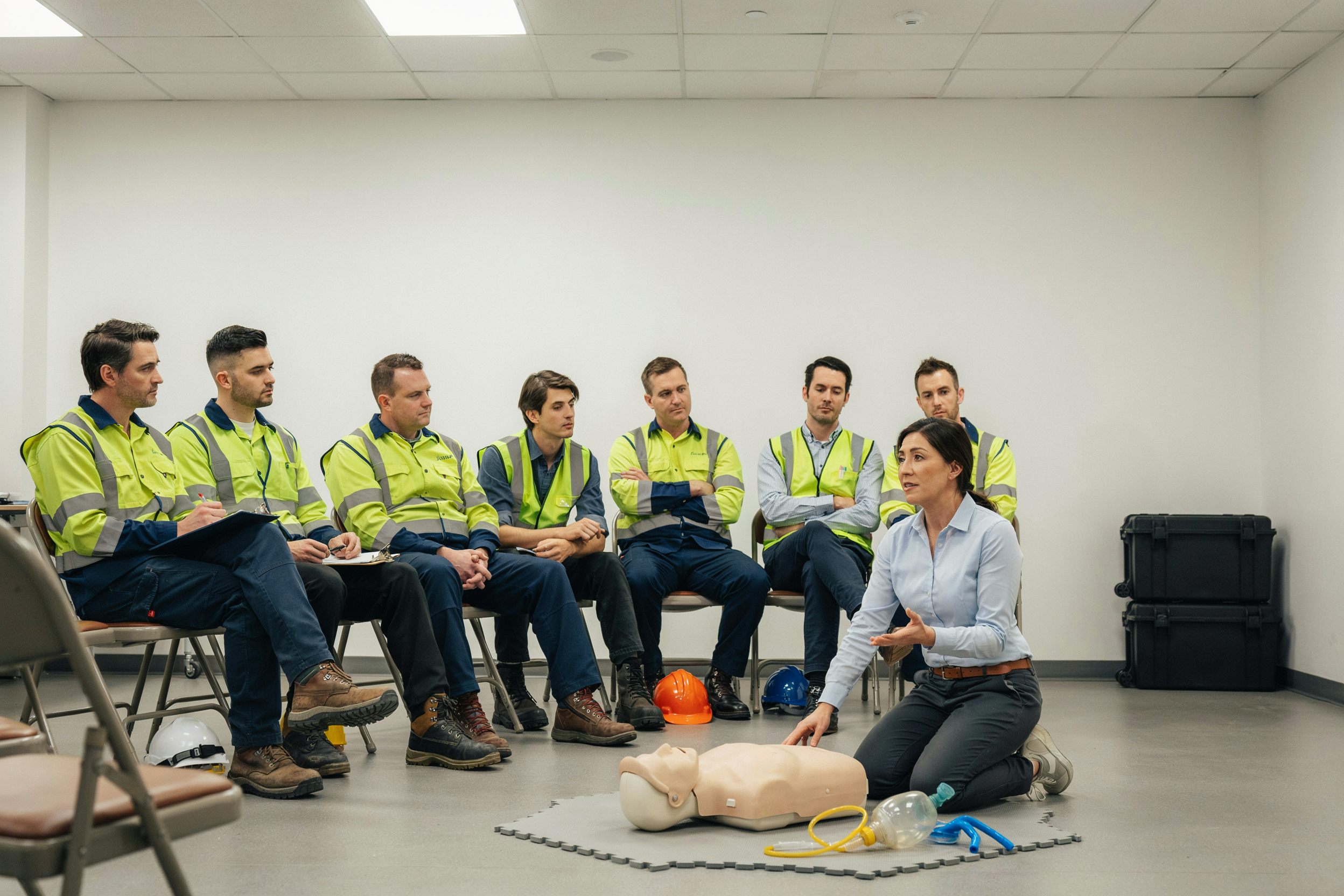
Pulling your entire first aid officer cohort simultaneously creates a compliance gap. The better approach:
Identify your total number of designated first aid officers requiring HLTAID015
Divide into cohorts so at least one certified officer remains on site at all times
Schedule across consecutive days or weeks within a single booking arrangement
Confirm overlap periods so no site is uncovered
A provider with genuine group training experience will help you map this out at the inquiry stage.
What Audit-Ready Training Documentation Looks Like
The certificate your first aid officers receive needs to hold up under audit scrutiny: correct unit code (HLTAID015), full unit title, issue and expiry dates, RTO registration details, and the participant's full legal name matching their employment records. Ask any provider to show you a sample certificate before you book.
Certificate turnaround matters too. For a group booking, you need certificates issued promptly so your compliance records are updated before the next audit window or contract review.
Once your team is trained, the final piece of the compliance calendar is knowing exactly when those certificates need to be renewed.
How Often Does HLTAID015 Need to Be Renewed?
HLTAID015 is valid for three years from the date of completion. That's the nationally recognized validity period under the ASQA accreditation framework, and it's the figure that should be sitting in your training compliance calendar for every designated first aid officer on your team.
HLTAID015 Validity Period and ARC Renewal Recommendations
The three-year validity period covers the full HLTAID015 certification but the Australian Resuscitation Council has a separate recommendation that's worth building into your training schedule. The ARC recommends that workers in high-risk roles complete an annual CPR update HLTAID009 (Perform CPR) to maintain resuscitation skill currency between full renewals.
Resuscitation is a perishable skill. Without reinforcement, technique degrades. An annual HLTAID009 refresher keeps the muscle memory current across the three-year certification window.
For WHS managers building a compliance training matrix, the structure looks like this:
Building a Renewal Schedule for Your First Aid Officer Team
The most common compliance gap isn't a failure to train. It's a failure to renew on time. Certificates expire quietly and audits reveal lapsed certifications. Build renewal dates into your WHS compliance calendar as a standing item, and look for a provider who offers renewal reminders across your team.
Renewal planning starts with finding the right provider, one whose documentation, delivery capability, and clinical currency hold up when it matters most.
Choosing the Right HLTAID015 Training Provider in Brisbane
Not every registered training organisation delivering HLTAID015 in Brisbane is delivering it to the same standard. The certificate looks the same on paper. The compliance record looks the same in an audit folder. But the quality of training, the currency of the content, and the capability of the trainer vary considerably, and in a high-risk environment, those differences are not trivial.
The starting point is accreditation. Any provider you consider should be an ASQA-registered RTO, and that registration should be verifiable on training.gov.au before you commit to a booking. National accreditation is the baseline that makes a certificate legally valid and professionally recognized. A provider who can't produce their RTO number without hesitation is telling you something about how they operate.
Guideline currency is the next filter. HLTAID015 should be taught in alignment with the ARC and ANZCOR 2021 resuscitation guidelines, and a competent provider will confirm this directly when asked. Outdated training content is a clinical problem and a compliance problem simultaneously. For a WHS manager responsible for a high-risk workforce, booking training that isn't current to the latest guidelines creates exposure that outlasts the course itself.
Trainer background matters in ways that don't show up on a course outline. A trainer who has worked in the industries they're teaching understands the actual emergency scenarios your designated first aid officers will face. They train differently because of it. A provider whose trainers rotate between school holiday first aid courses and mining site compliance training without any grounding in either is not the same thing as a provider whose team has hands-on clinical or industry experience.
Documentation quality is where a lot of providers quietly fall short. Before you book, ask to see a sample certificate. It should carry the correct unit code, the full unit title, issue and expiry dates, RTO registration details, and the participant's legal name. Anything missing from that list creates downstream problems in audits and HR records. A provider who hesitates on that request, or produces a sample that doesn't pass basic scrutiny, is worth ruling out before you've committed your team's time.
Choosing the right provider for HLTAID015 group training in Brisbane ultimately comes down to one question: can this organisation deliver what they're claiming, at the standard your workplace actually requires, with documentation that holds up when it needs to? The providers who can answer that clearly, back it with evidence, and coordinate group training without putting the compliance burden back on you are the ones worth booking.