How to Build a First Aid Response Plan for Childcare
You've got a child on the floor, not breathing. Your hands are on the manikin every year during training - but does your center have a written plan that tells every educator exactly what to do in the next 60 seconds? For most childcare centers, the honest answer is no.
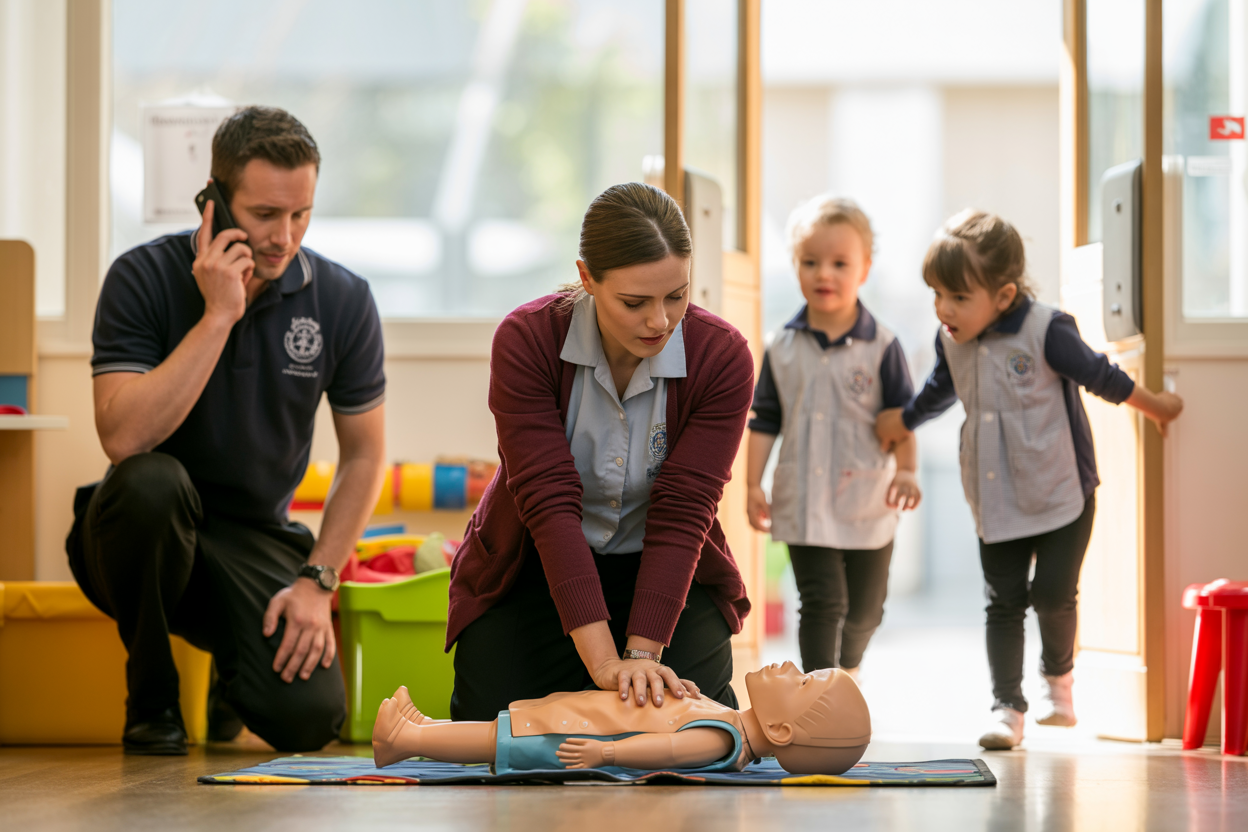
Having qualified staff on shift is one piece of the puzzle. But a first aid response plan for childcare is what actually turns individual training into a coordinated team response when seconds count. It's the difference between two educators rushing to the same child while nobody calls 000, and a center that moves like a unit - someone on the phone, someone administering care, someone looking after the other kids.
This guide is built for Queensland childcare educators and directors. It's aligned with NQS Quality Area 2, the Education and Care Services National Regulations 2011, and ACECQA requirements. By the time you're done reading, you'll have a step-by-step plan structure, clear staff role assignments, a compliance checklist, and a direct path to upskill your team through HLTAID012.
What Is a First Aid Response Plan for Childcare?
A first aid response plan for childcare is a documented, center-specific procedure that outlines exactly how staff should respond to a medical emergency involving a child or adult on the premises. It defines who does what, in what order, from the moment an emergency is identified until emergency services arrive and take over.
A complete plan covers:
Roles and responsibilities - who calls 000, who administers first aid, who manages the other children
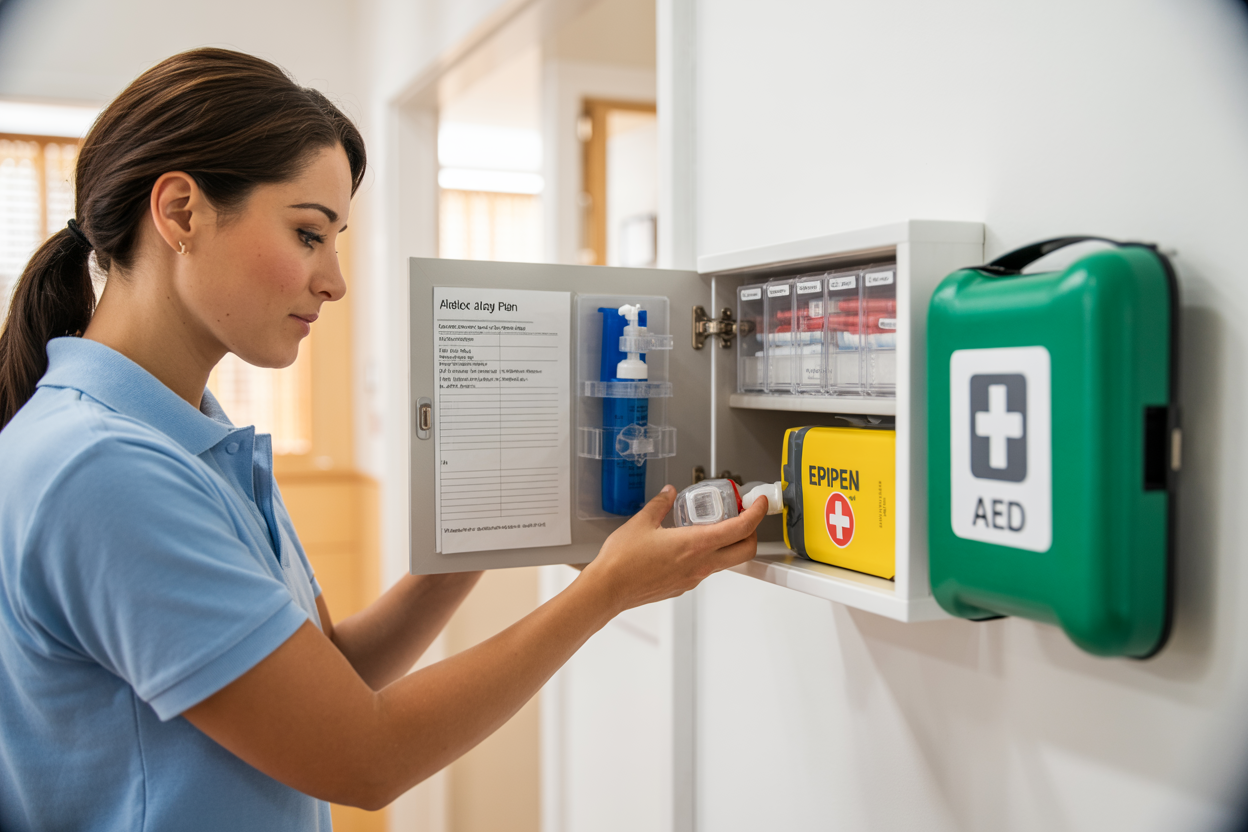
Emergency equipment locations - first aid kit, AED, EpiPen, asthma spacer
Communication procedures - notifying parents, documenting the incident, reporting to regulators
Specific pediatric emergency protocols - anaphylaxis, choking, seizure, cardiac arrest, suspected fracture
Post-incident procedures - debriefing, restocking, reporting obligations under Queensland legislation
Why Every Childcare Centre Needs a First Aid Response Plan
It's More Than a Legal Requirement
Let's be honest about what actually drives this - it's not the legislation that keeps you up at night. It's the thought of a real emergency happening on your watch and not knowing whether your team will move together or fall apart.
Under the Education and Care Services National Regulations 2011, Regulation 168, all approved childcare providers must have documented emergency and evacuation procedures. NQS Quality Area 2 goes further - Element 2.1.1 specifically references health practices and procedures, and ACECQA assessors check whether staff can actually describe what's in the plan.
Having two educators with current HLTAID012 on shift does not mean you have a plan. A certificate proves an individual has been trained. A plan proves your centre has a coordinated response. They're not the same thing.
The Gap Between Qualified and Prepared
You've got two qualified educators on the floor. A child goes into anaphylaxis. Both move toward the child at the same time. But now nobody is calling 000. Nobody is managing the other children. Nobody is locating that child's ASCIA Action Plan.
Role uncertainty is one of the primary drivers of bystander hesitation in pediatric emergencies, and the Australian Resuscitation Council has flagged this repeatedly. A written, practiced plan closes that gap - it takes the thinking out of the moment and replaces it with clear assignments.
What a Childcare First Aid Response Plan Must Include
1. Designated Roles for Every Shift
Every shift needs pre-assigned roles, and every educator needs to know which role they're filling before anything happens - not during.
Lead First Aider - initiates DRSABCD, administers first aid directly to the child
Communications Officer - calls 000, contacts parents, meets the ambulance at the entrance
Room Manager - removes other children from the area, maintains supervision ratios
Documentation Officer - records a timeline of events as they happen. In smaller centres, this doubles with the Communications Officer
If you're a family day care educator working solo, call 000 immediately, put the phone on speaker, and let the operator guide you. Your plan needs to account for this scenario.
2. Emergency Equipment - Locations and Readiness
Having the gear means nothing if your team can't find it under pressure. Your plan needs to document the exact location of your first aid kit, AED, individualized EpiPen and anaphylaxis kits (with each child's ASCIA Action Plan attached), and asthma reliever and spacer.
Every educator on shift - including relief and casual staff - needs to know where this gear is on their very first day.
3. Pediatric Emergency Protocols
Your plan needs a short, plain-language protocol for each common pediatric emergency - quick-reference prompts your team can follow under pressure.
Anaphylaxis: Identify signs → administer EpiPen → call 000 → position child → second EpiPen if no improvement → notify parents → incident report. Follow the child's ASCIA Action Plan.
Choking: Infant - back blows and chest thrusts. Child over 1 year - abdominal thrusts. Know both conscious and unconscious pathways.
Febrile seizure: Do not restrain. Protect from injury. Time the seizure. Recovery position once it stops. Call 000 if prolonged or first seizure.
Cardiac arrest: Follow DRSABCD. Commence CPR. Send someone for AED. Maintain until ambulance arrives.
Suspected fracture or head injury: Immobilize. Do not move unless danger present. Call 000. Document.
Each protocol should follow the same format: trigger signs → immediate action → who calls 000 → what to tell QAS → parent notification → documentation.
4. Communication Procedures
Internal - the lead first aider or room leader is notified immediately. Director contacted if not on the floor.
Parents and guardians - your plan names who makes the call, what they say, and when. The Communications Officer handles this - not the person doing CPR.
000 call script - center name, full street address, nature of emergency, age of child, current condition. Having this written down saves seconds under stress.
Regulatory notification - under Section 174 of the Education and Care Services National Law, serious incidents must be reported to Queensland DET. Some incident types require immediate notification.
5. Post-Incident Procedures
Incident report - completed and retained on file
Restock equipment - replace anything used immediately
Staff debrief - responding to a pediatric emergency is traumatic, even when the outcome is good. Psychological first aid for responders is not optional
Plan review - was the plan followed? What broke down? Update the document while details are fresh
ACECQA notification - if the incident meets the serious incident threshold, you've got reporting obligations
How to Write Your Centre's First Aid Response Plan - Step by Step
Step 1 - Audit Your Current Position
What qualifications does each staff member hold? Who has HLTAID012, 22300VIC, 22556VIC? Are any certificates expired or due soon? Does a written plan actually exist?
Build a tracking table - staff name, qualification, date completed, expiry date, renewal status. Update it monthly.
Step 2 - Map Your Physical Environment
Walk every room, outdoor area, and corridor with a notepad. Mark the location of all emergency equipment, exits, and assembly points. Can every educator access the first aid kit quickly from any room? What about the outdoor play area, sleep room, bathroom? Those are your blind spots.
Step 3 - Assign and Document Roles
Position-based assignment works better than name-based because staff rotate. "The most senior HLTAID012-qualified educator on the floor is Lead First Aider for that shift." Laminate it. Put it in the staff room. Induct every relief and casual educator on day one.
Step 4 - Write the Emergency Protocols
Use ANZCOR and ASCIA guidelines as your clinical source. Write in plain language. Every protocol follows the same format: trigger signs → immediate action → who calls 000 → what to tell QAS → parent notification → documentation.
Step 5 - Run a Scenario Drill
This is the step most centers skip - and the one that makes the biggest difference. Pick one emergency type, run an unannounced drill, and debrief. Did every educator know their role? Was equipment found quickly? Did anyone freeze?
Schedule drills regularly and document them. ACECQA assessors love to see that evidence.
Step 6 - Review After Every Incident or Near-Miss
Your plan is a living document. Staff change. Layouts change. New children enrol with medical conditions. Set an annual review date aligned with your HLTAID012 renewal cycle, and update after every incident while memory is fresh.
ACECQA Compliance - What Assessors Actually Look For
If you're a center director, this is the section you probably scrolled to first. Assessment and rating visits carry real weight, and first aid sits right in the middle of Quality Area 2.
Element 2.1.1 requires that each child's health needs are supported - individual medical conditions need to be reflected in your emergency procedures.
Element 2.2.1 looks at whether your center has strategies to keep children safe. A documented, practiced first aid response plan is strong evidence for this element.
Regulation 168(2)(b) requires emergency procedures to be documented and rehearsed.
Regulation 136 requires at least one HLTAID012-qualified educator present at all times children are in care. Not rostered on - present on the floor.
Assessors don't just ask you about the plan. They ask your educators. Any educator on shift might be asked, "What would you do if a child had an allergic reaction right now?" If the answer is vague, they mark what they observed. A well-practised plan means your team answers with confidence.
Legislation Reference Panel
Education and Care Services National Regulations 2011 - Regulations 136, 168
Education and Care Services National Law - Section 174
National Quality Standard - Quality Area 2, Elements 2.1.1 and 2.2.1
ANZCOR Resuscitation Guidelines (current edition)
ASCIA Anaphylaxis Action Plan
Does Your Team Have the Training to Execute the Plan?
You can have the best first aid response plan pinned to every wall in your centre. But if your team doesn't have the training to back it up, it's just paper.
HLTAID012 exists specifically because childcare emergencies are different from workplace emergencies. You're not dealing with an adult who can tell you what's wrong. You're dealing with a toddler who can't explain that their throat is closing. The manikins are smaller, the ratios are different, and the emotional stakes are different.
ACECQA requires at least one HLTAID012-qualified educator on the floor at all times. That training needs to include hands-on pediatric CPR, EpiPen trainer use, anaphylaxis management, and scenario-based practice. On top of that, your educators need annual refreshers in asthma (22300VIC) and anaphylaxis (22556VIC) management - separate ACECQA requirements that don't roll into the HLTAID012 cycle.
If you've got certificates lapsing or new educators who aren't yet qualified, now is the time to sort it out.
Your Next Steps
Start by downloading ART's free First Aid Response Plan Template and using it to document your center's procedures today. It's pre-populated with the role framework, equipment checklist, and emergency protocol prompts covered in this guide - so you're not starting from a blank page.
Once that's in place, check your team's certification status. Confirm every educator holds a current HLTAID012, and that anaphylaxis and asthma training has been renewed within the last 12 months. If any certificates have lapsed or are due to expire soon, secure a spot in an upcoming session before your next assessment visit catches you short.
And once your plan is documented and your team is trained, test it. Run an unannounced scenario drill. It's the single best way to find the gaps that no document review will ever catch. That's how you go from having a plan on paper to having a team that actually moves together when it matters.