First Aid Refresher Course Childcare: HLTAID012 Guide
Is your HLTAID012 certificate sitting in a drawer somewhere, and you're not quite sure if it's still valid... or exactly what you need to do to renew it?
It's one of the most common compliance headaches for childcare educators and directors across Queensland. A certificate quietly ticks past its expiry date. Nobody noticed. And then suddenly there's an ACECQA assessment visit on the calendar, or a new staff member who can't legally go on floor, and what was a minor admin gap becomes a very stressful problem very fast.
The consequence of a lapsed HLTAID012 isn't just paperwork - it's a service approval risk, a potential insurance issue, and a real question about who's actually covered if something happens to a child in your care. This guide covers everything you need to know about the first aid refresher course childcare workers in Queensland are required to hold - from how often you need to renew, to what the face-to-face practical involves, to whether any of it can be done online.
What Is Involved in an HLTAID012 Refresher Course?
An HLTAID012 refresher updates your skills and knowledge for the unit Provide First Aid in an Education and Care Setting - the qualification specifically approved by ACECQA for childcare workers in Queensland. Completing it means your certification meets current ACECQA requirements and you're legally counted in the ratio when children are in care.
One thing worth knowing upfront: face-to-face practical assessment is mandatory in Queensland. You cannot complete HLTAID012 entirely online, and no registered RTO can sign off your competency via video call or photo submission. The practical component has to happen in person.
Here's what the refresher covers:
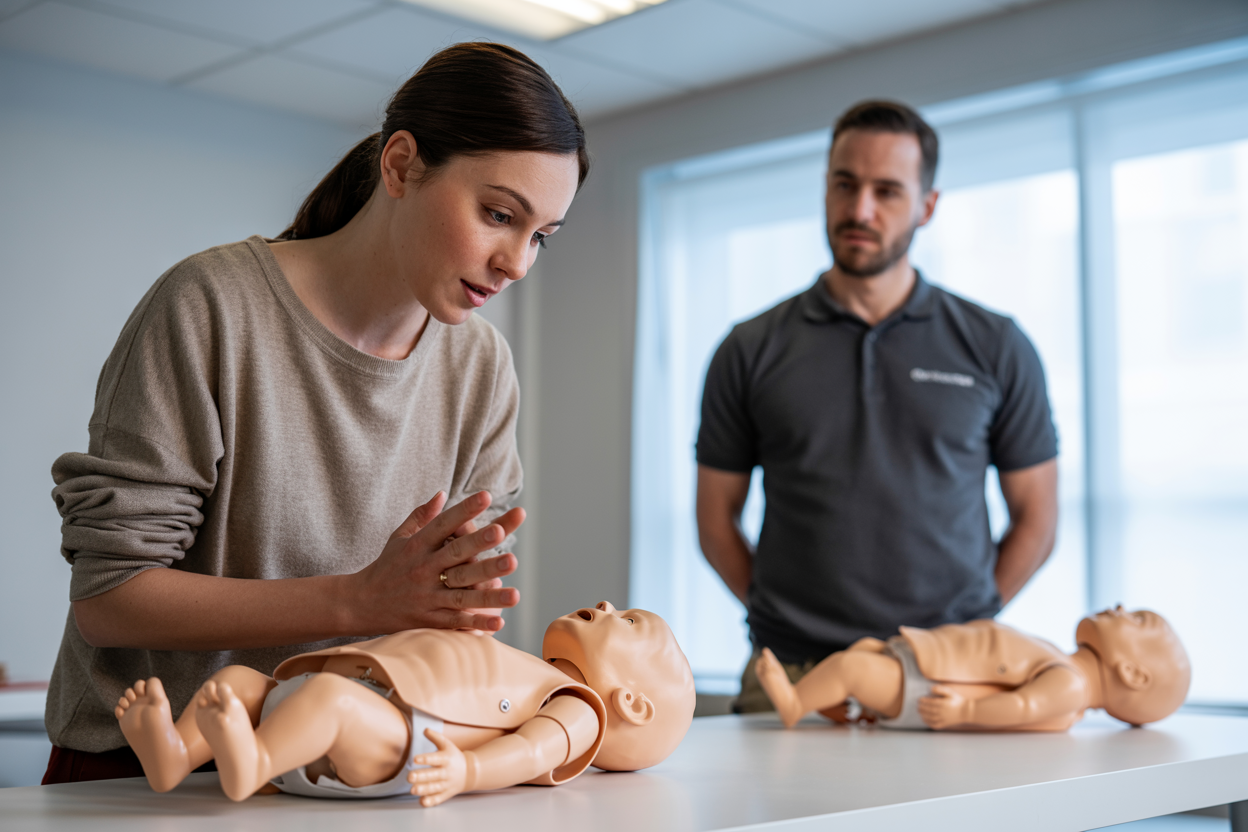
Pediatric CPR - hands-on practice with both infant and child manikins to current ANZCOR guidelines
Pediatric choking management - back blows and chest thrusts for infants and children, practiced on manikins
Anaphylaxis response - correct use of an EpiPen auto-injector trainer within a childcare emergency scenario
Asthma first aid - spacer and inhaler technique specifically for children
Emergency action plans - how to manage incidents within an education and care setting, including reading an ASCIA action plan
Online pre-learning - theory component covering anatomy, DRSABCD, and recognition of pediatric emergencies, completed before your face-to-face session
Your HLTAID012 certificate is valid for 3 years from the date of completion. Asthma (22300VIC) and anaphylaxis (22556VIC) training are separate qualifications and must be renewed every 12 months under ACECQA standards - even when your HLTAID012 is current.
Why HLTAID012 Renewal Matters for Queensland Childcare Services
Keeping your HLTAID012 current isn't just good practice. In Queensland, it's a legal requirement - and the consequences of letting it lapse go well beyond a reminder email from your director.
What ACECQA Says About First Aid Qualification Currency
Under the Education and Care Services National Regulations 2011, Regulation 136, at least one educator with an approved first aid qualification must be present at all times when children are in care. That's not a guideline. It's a regulation.
ACECQA enforces this through the National Quality Standard, specifically Quality Area 2 - Children's Health and Safety. A lapsed certificate does not satisfy Regulation 136 - even if it expired yesterday. One day over is non-compliant.
Queensland's Department of Education and Training conducts unannounced assessment and rating visits. There's no heads-up. If your compliance folder shows a lapsed HLTAID012 on the day of a visit, that's a service approval risk - not just a tick that's been missed.
The Real Cost of a Lapsed Certificate
Most educators think of a lapsed cert as an admin problem. The reality is it carries real personal and professional weight. If an incident occurs while an educator's HLTAID012 is out of date, the center's insurance position becomes complicated. The director carries accountability for maintaining compliant staffing ratios. And a new staff member without a current HLTAID012 cannot legally be counted in the educator-to-child ratio - they're effectively hands off floor until their first aid refresher course childcare qualification is current.
How Often Do Childcare Workers Need to Renew HLTAID012?
Knowing your renewal timeline is the kind of thing that seems straightforward until you're suddenly three weeks past your expiry date wondering how it happened. Here's exactly what you need to track.
The 3-Year Rule for HLTAID012
HLTAID012 is valid for 3 years from the date of issue on your certificate. Not from when you did the course. Not from the end of the calendar year. From the exact date printed on your statement of attainment.
There's no abbreviated top-up pathway. Each renewal cycle requires the full unit of competency to be reassessed - online pre-learning plus the complete face-to-face practical session. Don't wait until the 3-year mark either. Renewing before that point gives you a buffer for scheduling delays and staff rostering issues. You'll also need your USI (Unique Student Identifier) number when you re-enroll - retrievable at usi.gov.au if you've misplaced it.
Annual Requirements - Asthma and Anaphylaxis
This is where a lot of childcare workers get caught out. The 22300VIC (emergency asthma management) and 22556VIC (anaphylaxis management) units both require annual renewal under ACECQA - every 12 months, separate to your HLTAID012. If either lapses, you're non-compliant under the same Regulation 136 that governs your first aid qualification. Many Queensland childcare providers book all three together to simplify compliance tracking and get everything sorted in a single training cycle.
How to Track Expiry Dates Across Your Team
For directors managing compliance across multiple educators, a shared spreadsheet with one tab per educator, columns for each qualification, and expiry dates color-coded by urgency is still the most reliable system most centers use. Same-day digital certificates make this significantly easier - the moment your educators walk out of a session, you have what you need to update your compliance folder.
Can You Do an HLTAID012 Refresher Online?
It's one of the most searched questions around HLTAID012 renewal - and the answer is yes and no, depending on which part of the course you're asking about.
What Can Be Done Online
HLTAID012 uses a blended learning format. The theory component is completed online before you attend your face-to-face session. This covers human anatomy relevant to first aid, the DRSABCD action plan, recognition of pediatric emergencies, and the principles behind each response skill you'll practice in person. It's designed to be done at your own pace before the practical day, so you walk in ready to practice rather than spending practical time on theory.
Why the Face-to-Face Component Is Non-Negotiable
ASQA - the national regulator for vocational training - and ACECQA both require hands-on practical demonstration for competency to be signed off on HLTAID012. You cannot be assessed via video call. You cannot submit photos of yourself performing CPR. The competency assessment must happen in person, with a qualified assessor watching you perform each skill.
That requirement exists for good reason. Knowing the steps of infant CPR from a screen is a completely different thing from actually performing chest compressions on a manikin at the right depth and rate while making real-time decisions under pressure. The muscle memory and stress response don't get built online. The skills you have to demonstrate in person include CPR on both infant and child manikins, the correct choking response, use of an EpiPen auto-injector trainer, and spacer technique for a child with asthma.
What to Expect on the Day - HLTAID012 Refresher Course Breakdown
One of the things that puts people off booking a refresher is not knowing what they're walking into. Here's exactly what the day looks like.
Before the Course - Pre-Learning Requirements
Before you show up for your face-to-face session, you need to have completed the online theory module. It's not optional - it's part of the competency requirement, and arriving without it done will affect your ability to complete the assessment on the day. Bring your USI number, photo ID, and your previous HLTAID012 certificate if you have it available.
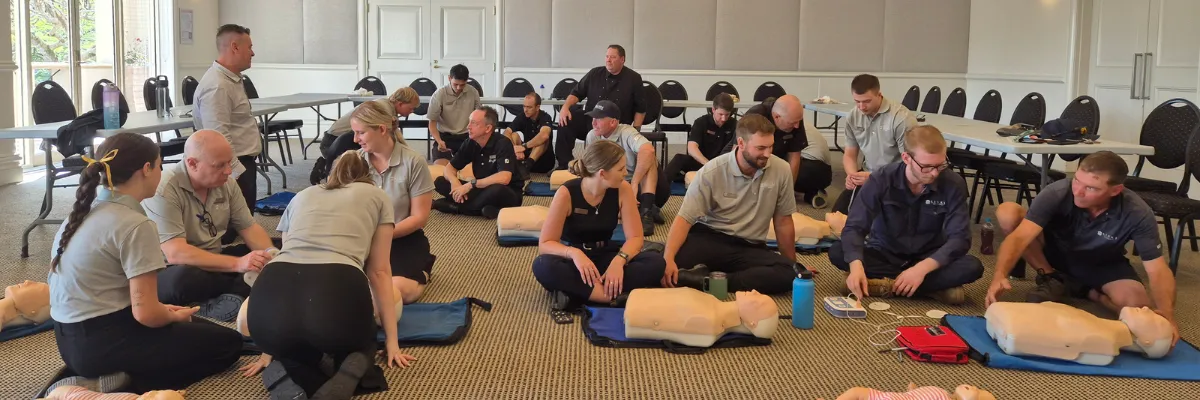
The Face-to-Face Session - What You'll Actually Do
Here's what the skills stations cover:
Infant CPR and child CPR - practiced separately on infant and child manikins to current ANZCOR guidelines. Two different manikins because the technique differs between age groups.
Pediatric choking - back blows and chest thrusts for infants and children, practiced until the response is automatic
Anaphylaxis management - using an EpiPen auto-injector trainer correctly, and reading an ASCIA action plan in a childcare scenario
Asthma first aid - spacer and inhaler technique specifically for children, not adults
Scenario-based assessments - childcare-specific situations like a child collapsing in the playground or a suspected allergic reaction at lunchtime. You're assessed in context, not just on isolated skills.
AED familiarization - understanding how to use an automated external defibrillator in a setting where children are present
A generic workplace first aid course puts you in an office or a warehouse. An HLTAID012 session puts you in a childcare setting - because that's the environment where you actually need to be able to act.
Assessment and Certification
Competency is assessed against the nationally recognized unit HLTAID012 - Provide First Aid in an Education and Care Setting. Your assessor observes each skill station and signs off once you've met the standard. Your digital certificate is issued the same day - ready for your compliance folder before you've even left the car park. The qualification is verifiable directly on training.gov.au.

HLTAID012 vs HLTAID011 - Which One Does Your Childcare Service Need?
If you've previously held an HLTAID011, or you're seeing both codes in your search results, this is worth getting clear on before you book. Enrolling in the wrong unit means your certificate won't satisfy ACECQA requirements.
HLTAID011 - Provide First Aid - is the general workplace first aid qualification, appropriate for offices, construction sites, retail and hospitality. It covers adult-focused first aid skills and the DRSABCD framework. It's a solid qualification - just not the right one for childcare.
HLTAID012 builds on everything in HLTAID011 and adds the pediatric-specific content and assessment that childcare settings require. ACECQA specifically lists HLTAID012 as an approved first aid qualification for education and care settings. HLTAID011 is not on that list. If you work in childcare - long day care, family day care, kindergarten, OSHC, or any other education and care service - you need HLTAID012. There's no grey area here.
What About HLTAID009 - CPR Only?
HLTAID009 - Provide Cardiopulmonary Resuscitation - is the CPR-only unit and does not satisfy the first aid qualification requirement under Regulation 136. What it is recommended for is as an annual CPR refresher between your 3-year HLTAID012 renewal cycles. CPR is a perishable skill, and practicing it regularly means better recall when it counts.
Group and On-Site HLTAID012 Training for Childcare Centers
If you're a center director, the individual public session model probably isn't your most practical option. Taking educators off floor one at a time while maintaining ratio is a logistical headache most directors don't have the bandwidth for.
Why Directors Choose On-Site Training
On-site training solves the ratio problem. A trainer comes to your centre, and sessions are structured around your roster - not the other way around. No travel time for your staff, no scheduling conflicts with the operating day, no gap in floor coverage. There's also something to be said for training in the place where educators would actually have to respond to an emergency - the playground, the sleep room, the lunch area. Training in that context makes the skills feel less abstract.
Managing Centre-Wide Compliance Renewals
The directors who stay on top of compliance without the last-minute panic book ahead on a stagger - scheduling group sessions periodically to catch educators whose certs are coming due before the expiry date becomes urgent.
A long day care center contacted us three weeks before a scheduled ACECQA assessment visit. Several staff members had certificates due to expire within the following month. An on-site HLTAID012 group session was delivered across two days, working around the center's roster to ensure floor ratios were maintained throughout. All educators received their digital certificates on the day of training - the center entered their assessment visit fully compliant.
Ready to Get Your HLTAID012 Sorted?
Whether you're an individual educator whose cert is coming due, or a director trying to get a full team compliant before an ACECQA visit, the path forward is the same: book early, don't wait for the expiry date to become a problem, and make sure you're enrolling in HLTAID012 - not HLTAID011.
If you're an individual educator, check upcoming public session dates and book online. Spots fill quickly around common renewal periods, so if you can see a date that works, secure it now.
If you're a director, get in touch about on-site group training. A trainer comes to your center, works around your roster, and gets your educators certified without pulling anyone off floor. One session can clear a backlog of expiring certificates and get you into your next ACECQA assessment visit with a clean compliance folder.
And if you're not sure which option fits, call the team directly. They can confirm availability, talk through your compliance requirements, and help you figure out the right approach.