First Aid Kit Requirements for Childcare Centres
A Brisbane childcare director is halfway through her ACECQA self-assessment when she opens the first aid kit. Half the supplies are expired. The cold pack is missing. There's no asthma spacer. The assessment visit is in two weeks.
It's not that she'd been careless. She'd been busy managing ratios, chasing staff certificates, handling a parent complaint, and trying to get through the day. The kit just... slipped.
First aid kit requirements for childcare centers are one of the most commonly flagged compliance gaps during ACECQA assessment visits in Queensland and the frustrating part is that the regulation itself doesn't spell out exactly what you need. Regulation 89 of the Education and Care Services National Regulations 2011 tells you to have a kit. It doesn't tell you what goes in it.
This article breaks down what Queensland childcare centers must have, what ACECQA and NQS Quality Area 2 actually expect, and how to run a simple audit so you're never caught off guard.
What Must Be in a Childcare Centre First Aid Kit? (Queensland Requirements)
A childcare center first aid kit in Queensland must contain a core set of supplies that meet the requirements of the Education and Care Services National Regulations 2011 and support the approved first aid qualifications held by educators on site.
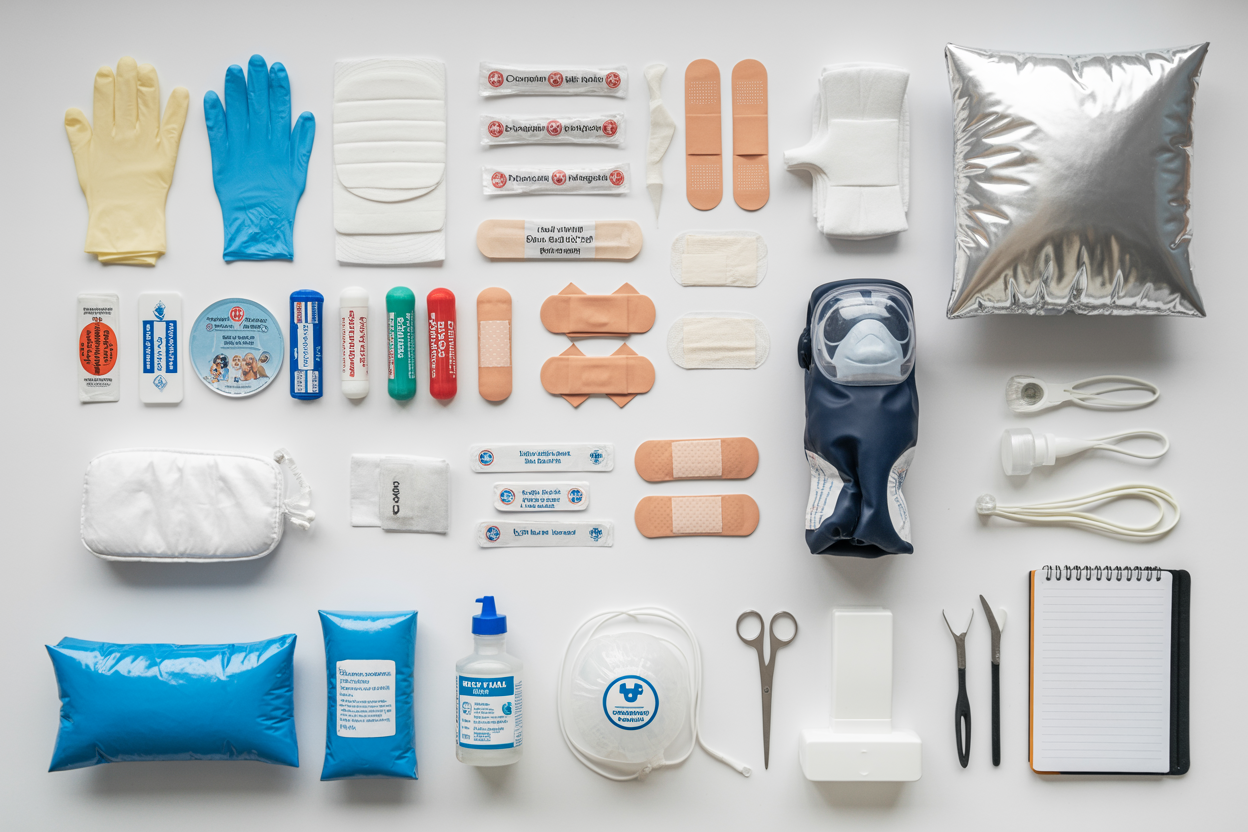
Every Queensland childcare service needs these items:
Disposable gloves (multiple pairs, various sizes)
Sterile wound dressings (various sizes)
Conforming bandages and triangular bandages
Adhesive dressings / plasters (hypoallergenic preferred)
Thermal / emergency blanket
Scissors and tweezers
Resuscitation face mask or face shield (CPR barrier device)
Cold / instant ice packs
Eye wash solution and eye pads
Wound closure strips / butterfly closures
First aid instruction guide (current edition)
Asthma spacer device (required where children with asthma are enrolled)
Adrenaline auto-injector trainer (EpiPen trainer -- for staff practice; actual device held per individual child's ASCIA action plan)
Disposable bag for waste disposal
Pen and notepad (for incident recording)
Kits must be clearly labelled, readily accessible to authorized educators, regularly audited, and restocked after any use.
What the Regulations Actually Say (And What They Don't)
The regulation that governs first aid kits in Queensland childcare settings is both clear and vague at the same time. Clear on the obligation. Vague on the details.
The Education and Care Services National Regulations 2011: Regulation 89
Regulation 89 requires approved providers to keep a first aid kit at the service. What it doesn't do is hand you a shopping list.
Regulation 89 First aid kits "The approved provider of an education and care service must ensure that a first aid kit that is appropriate to the service is kept at the service."
That word "appropriate" is doing a lot of heavy lifting. ACECQA's Guide to the National Quality Framework and NQS Quality Area 2, Element 2.1.1 step in to define what appropriate actually looks like in practice. AS/NZS 2675 the Australian standard for first aid kits also informs what a well-stocked kit should contain.
ACECQA assessors have clear expectations, and a kit that's half-empty or stocked with expired supplies won't meet the standard regardless of what the regulation technically says.
What "Readily Accessible" Actually Means in a Compliance Context
Assessors interpret "readily accessible" as:
Unlocked - the kit cannot be behind a locked door or in a secured cabinet that staff need a key to open in an emergency
At adult height - not stored on the floor or in a spot where an educator has to hunt for it
Known location - every educator on shift knows exactly where the kit is; this is often checked verbally during assessment visits
Not in a car boot - a kit stored in a vehicle that's off-site during the day does not satisfy the requirement
What the Regulations Leave Up to the Approved Provider
Because Regulation 89 doesn't prescribe a contents list, the approved provider carries the responsibility for determining what "appropriate" means for their specific service. The gap gets filled by ACECQA guidance, AS/NZS 2675, and the qualifications of the educators on site. If your service has enrolled children with known anaphylaxis or asthma, the bar rises. An HLTAID012 childcare first aid qualification gives educators the practical knowledge to determine what their kit actually needs -- and how to use every item in it.
The Complete First Aid Kit Checklist for Queensland Childcare Centers
A kit that looks full isn't the same as a kit that's compliant and ACECQA assessors know the difference.
Core Items Required at Every Service
These are the baseline items every Queensland childcare first aid kit needs, regardless of the size of your service or the ages of children enrolled:
Disposable gloves - multiple pairs, assorted sizes, latex-free preferred
Sterile wound dressings - various sizes, check expiry at every audit
Conforming bandages and triangular bandages - minimum two of each
Adhesive dressings / plasters - hypoallergenic preferred
Thermal / emergency blanket
Scissors and tweezers - blunt-ended scissors for a children's environment
CPR face mask or face shield - pediatric size, not adult-only
Cold / instant ice packs - check they haven't been previously activated
Eye wash solution and eye pads - solution has an expiry date
Wound closure strips / butterfly closures
First aid instruction guide - current edition only
Disposable waste bag
Pen and notepad - for recording incident details in real time
Additional Items for Services Enrolling Children with Known Medical Conditions
If your center has children enrolled with diagnosed asthma or anaphylaxis, your kit obligations go further.
For asthma: An asthma spacer device with the correct mask sizes for the children in your care. A spacer without the right mask size is effectively useless in an emergency. Individual asthma action plans for each enrolled child should be accessible to educators on shift, not buried in an admin folder.
For anaphylaxis: An adrenaline auto-injector trainer (EpiPen trainer) for staff practice. The actual prescribed adrenaline auto-injector belongs to the individual child -- it's prescribed, personal, and must be stored per that child's ASCIA anaphylaxis action plan. It is not a generic kit item. ASCIA action plans for every child with a known allergy diagnosis must be current, signed by the child's treating doctor, and known to all educators on shift.
Items Commonly Found in Kits That Don't Belong
Having the wrong things in your kit can create a false sense of readiness that's arguably worse than knowing you're under-stocked.
The point isn't to have the biggest kit. It's to have a kit where every item is there for a reason, in working condition, and within its use-by date.
How Many First Aid Kits Does a Childcare Centre Need?
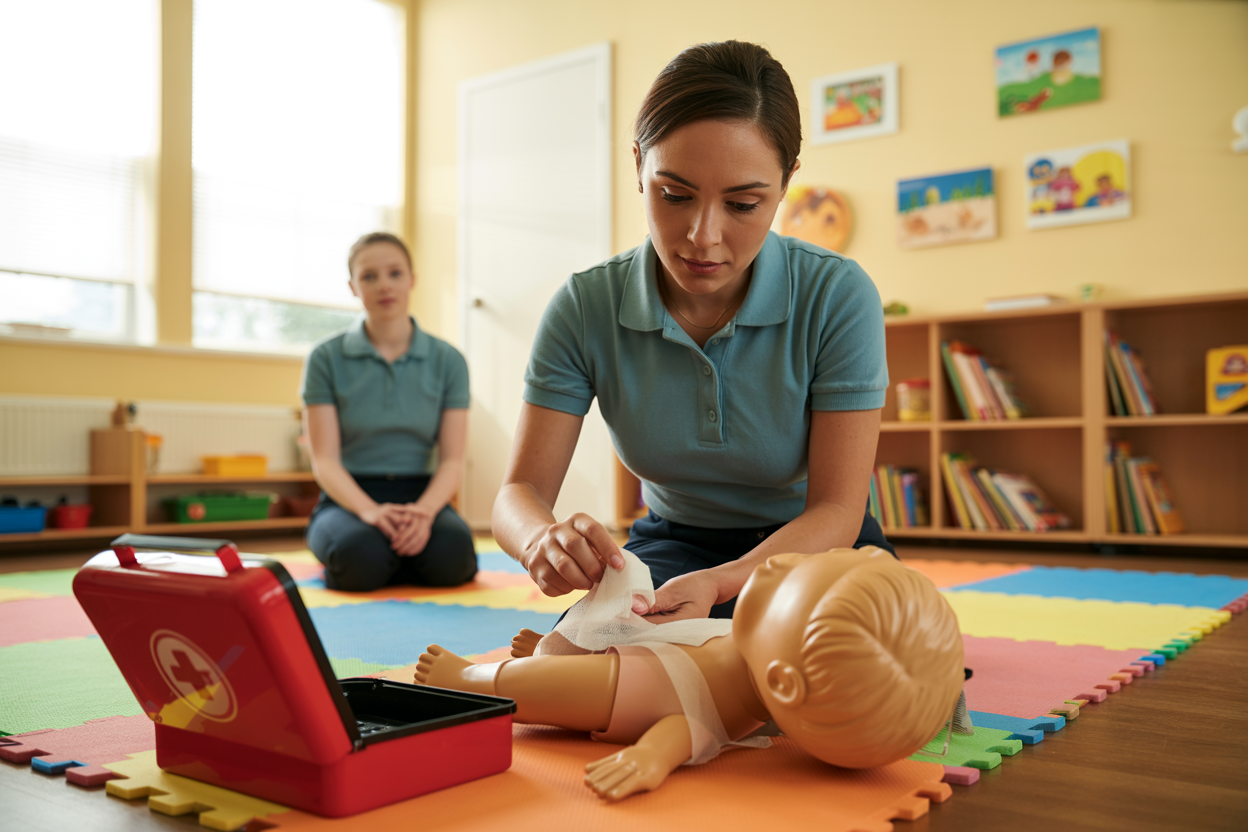
Regulation 89 doesn't give you a number. It just says the kit must be "readily accessible" wherever children are present -- and that single phrase has real implications for how many kits your service needs and where they go.
If a child has an emergency in a particular area, an educator needs to get to a first aid kit immediately. Not after walking across a building. Not after going upstairs. Immediately.
In practice, assessors expect:
One kit per floor in any multi-storey building -- a kit on the ground floor does not satisfy the requirement for children who are on level two
A kit accessible from every main care area -- if indoor rooms and outdoor play space are separated by any meaningful distance, both areas need ready access to a kit
A dedicated portable kit for excursions and outdoor activities conducted away from the main building
A practical approach for most long day care centers:
Main indoor area -- full kit, wall-mounted or shelf-mounted at adult height, clearly labelled
Outdoor play area -- either a second full kit or a well-stocked satellite kit that includes CPR barrier, gloves, dressings, and cold packs at minimum
Administration or director's office -- not a substitute for floor-level access, but useful as a backup stock location
Family day care providers operating from a single-level home generally need one well-stocked kit in an accessible, known location. But the moment children move to an outdoor area or a vehicle, a portable kit needs to go with them.
Portable Kits for Outdoor Play, Excursions, and Transport
Excursion kits are one of the most commonly missed compliance gaps in Queensland childcare -- and one of the easiest to fix. Any time children leave the main building -- a walk to a local park, a trip to the library, transport in a center vehicle -- a portable first aid kit goes with them. It needs to be checked before every excursion, not assumed to be ready from last time.
Key items for a portable excursion kit:
Disposable gloves
Sterile wound dressings and adhesive plasters
CPR face mask or shield (pediatric)
Instant cold pack
Triangular bandage
Relevant ASCIA and asthma action plans for children on the excursion
Pen and notepad
Emergency contact list for children attending
If your service uses a vehicle to transport children, a kit stays in that vehicle. Always.
How Often Should a Childcare First Aid Kit Be Checked and Restocked?
Keeping a kit compliant over months and years -- through busy terms, staff changeovers, and incidents that deplete supplies -- is where a lot of centers quietly fall behind.
No Queensland regulation specifies exactly how often you need to check your first aid kit. AS/NZS 2675 recommends an annual inspection as a minimum. For a childcare setting, that's not nearly enough.
Best practice is a two-tier approach:
Monthly visual check -- a quick scan to confirm nothing is missing, nothing is visibly damaged, and no items have been used without being replaced
Full audit every six months -- every item out of the kit, checked against a contents list, expiry dates verified, damaged items discarded, stock replenished
At a full audit, check every single item:
Expiry dates -- plasters, sterile dressings, eye wash solution, CPR face shields, and wound closure strips all carry use-by dates; these are the most commonly failed items during ACECQA assessment visits
Stock levels -- compare against your contents list and replace anything used or running low
Condition -- packaging intact, gloves haven't degraded, scissors work, CPR face mask seal is undamaged
Relevance -- update ASCIA action plans if enrolments have changed; check spacer mask sizes match current children
Instruction guide -- confirm it's a current edition; an outdated guide is a flag
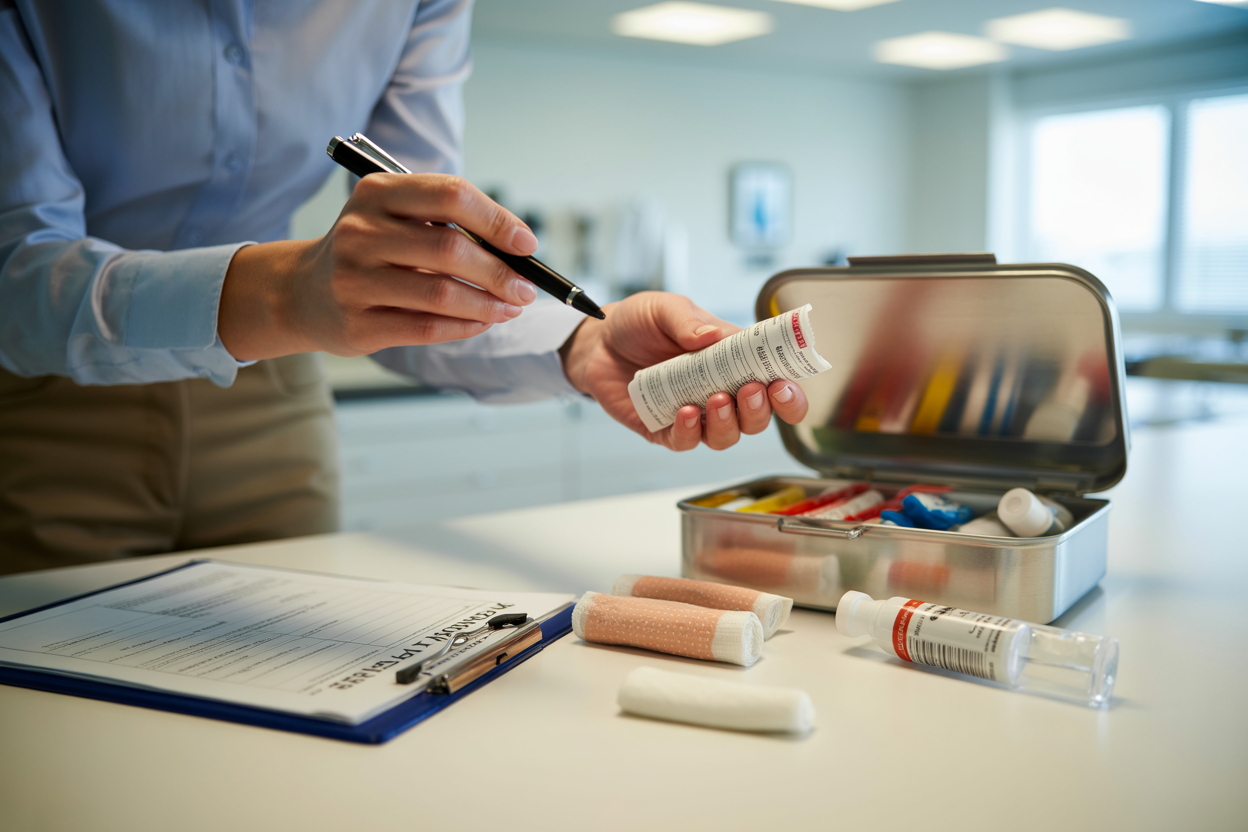
An audit log is one of the simplest documents you can maintain to demonstrate a genuine commitment to Quality Area 2. A table like this, kept in your compliance folder, is enough:
Keep it dated, keep it signed, and keep it consistent. An assessor who finds 12 months of signed audit records in your compliance folder is going to have a very different experience to one who finds nothing.
First Aid Kits and Staff Training: The Compliance Connection
A fully stocked, recently audited first aid kit only satisfies half of what ACECQA actually requires of Queensland childcare services.
A kit sitting on a shelf is a collection of supplies. It doesn't do anything on its own. The moment a child stops breathing, or goes into anaphylaxis, or chokes -- what matters is whether the educator in that room knows what to do with what's inside it. Equipment and training are two separate things, and ACECQA treats them that way.
Under the Education and Care Services National Regulations 2011 and the National Quality Standard, Queensland childcare services must have both a compliant first aid kit that is readily accessible, and at least one educator with a current approved first aid qualification present whenever children are in care. That means a current HLTAID012 childcare first aid qualification -- not HLTAID011, not an expired certificate, and not a generic workplace course not designed for a pediatric setting.
ACECQA also requires at least one educator on site with current approved emergency asthma management training (22300VIC) and current approved anaphylaxis management training (22556VIC). Both sit alongside HLTAID012, not inside it.
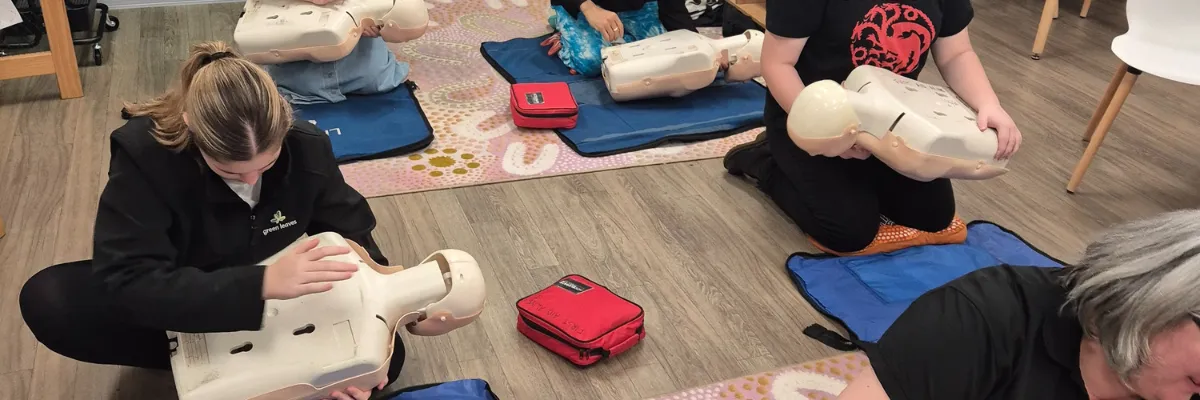
HLTAID012 - Provide First Aid in an Education and Care Setting -- is designed specifically for childcare environments. The hands-on practical component trains educators to use kit items in real scenarios: infant and child CPR with a pediatric face mask, wound dressing, cold pack application, and management of pediatric choking, febrile seizures, and anaphylaxis. One without the other leaves a gap no compliance paperwork can close.
✓ [X]+ childcare educators trained across Queensland ✓ Nationally recognized certificates issued same day ✓ ACECQA-accepted qualifications ✓ [Google review average] star average -- [review count]+ reviews
Is your team's HLTAID012 up to date?
Keeping your first aid kit compliant and your team's training current are two separate jobs -- but they belong together. A well-stocked kit with a trained educator behind it is what ACECQA is actually looking for, and it's what gives you -- and the families in your care -- genuine confidence that your service is prepared.
Staying on top of both is a real ask when you're running a busy center. Most directors are managing kit audits alongside certificate expiry tracking, ratio compliance, and NQS self-assessments. The first aid kit is one of those things that's easy to deprioritize right up until an assessor is standing in your room asking to see it.
If the training side is what needs attention, we deliver HLTAID012 childcare first aid training with weekend sessions for individual educators and on-site group training for centers who need to certify a whole team without disrupting the roster.