
First Aid Course Pass or Fail: What You Need to Know
You've booked your first aid course. But now a nagging thought: what if I freeze during the practical? What if I actually fail?
If that's where your head is at right now, you're not alone. It's one of the most common questions people ask before showing up to an HLTAID011 course — and honestly, it makes sense. You're about to be assessed on skills you've probably never practised before, in front of a trainer you've never met. Of course that feels a bit nerve-wracking.
Here's the thing though. The vast majority of people who walk into a first aid course walk out with their certificate. That's not a marketing line — it's just how the course is designed. HLTAID011 exists to build real competency, not to trip people up.
This article is going to walk you through exactly how first aid assessment works in Australia, what "pass or fail" actually means in the context of a nationally recognised qualification, and what happens if you need more time to nail a skill. Whether you're here because work needs you to have it, you're chasing ACECQA compliance, you're starting a new site on Monday, or you just want to feel prepared if something happens to someone you love — the same rules apply.
By the end of this article, you'll know exactly what to expect — and why passing is well within reach.
Can You Fail a First Aid Course in Australia?
Technically, you cannot "fail" a first aid course in Australia. Assessment outcomes under the VET framework are either Competent (C) or Not Yet Competent (NYC) and those two things are very different
Here's what NYC means in practice:
NYC is not a permanent result - it means you need additional practice or a reassessment opportunity, not that the door has closed
HLTAID011 is assessed against nationally standardised competency criteria set by ASQA - every registered RTO uses the same benchmarks
Trainers are required to give you every reasonable opportunity to demonstrate competency before recording NYC
Most RTOs, including ART, offer a reassessment pathway at no additional cost
A participant who is genuinely engaged and attempts all components in good faith will almost never leave without their certificate
How Is a First Aid Course Actually Assessed in Australia?
A lot of the anxiety people feel before an HLTAID011 course comes down to not knowing what's actually going to happen on the day. So let's break it down properly.
Two Components: Knowledge + Practical
HLTAID011 has two assessment components and you need to complete both to receive your certificate.
The first is a knowledge assessment. This is typically short-answer or multiple choice questions covering first aid principles, the DRSABCD action plan, current ARC guidelines, and how to respond in an emergency. It's not a trick exam. If you've paid attention during the session, you'll be fine.
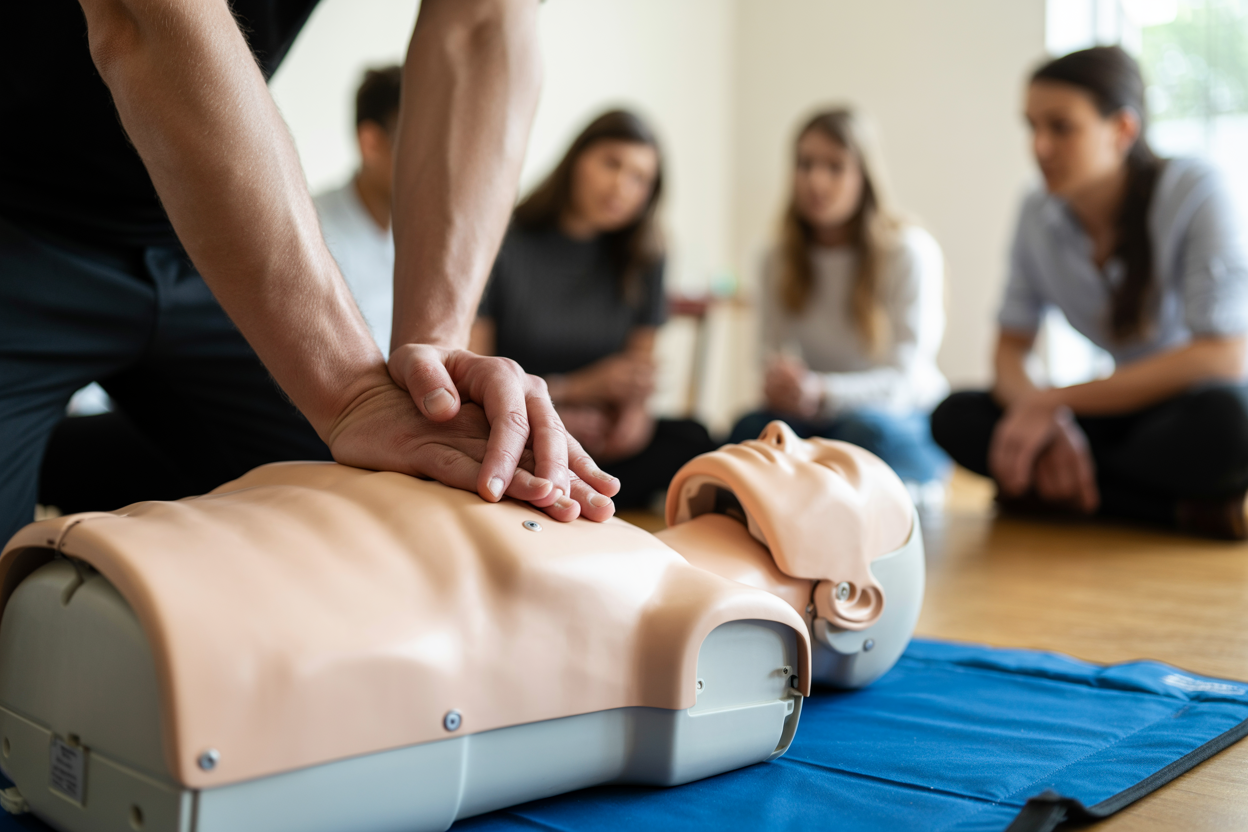
The second is the practical skills assessment. This is the hands-on component the part most people are nervous about. You'll demonstrate:
Manikin CPR using correct technique
Recovery position
Bandaging
Choking response
AED (defibrillator) operation
Neither component alone is enough. Both need to be completed to get the certificate.
What the Trainer Is Actually Looking For
Here's something that surprises a lot of first-timers. Trainers aren't assessing against their own personal opinion of how well you performed. They're assessing against nationally standardised criteria — the same benchmarks used by every registered RTO in the country.
In the practical, the key things they're looking for include correct hand placement and compression depth for CPR, proper airway management, accurate AED use, and correct bandaging technique.
But here's what they're not looking for — perfection. The standard is whether you can apply the skill safely and effectively in a real scenario. That's it.
Trainers hold paramedic and clinical backgrounds — which means when they assess your skills, they're doing it from a position of actual emergency experience, not just a textbook. All ART courses are delivered in alignment with current Australian Resuscitation Council (ARC) guidelines.
What Does "Not Yet Competent" Mean and What Happens Next?
Understanding the reassessment pathway takes a lot of the pressure off. Because once you know there's a safety net, the whole thing feels a lot less like a high-stakes exam.
NYC Is a Checkpoint, Not a Verdict
Under the Australian VET framework, assessment outcomes are binary — you're either Competent (C) or Not Yet Competent (NYC). There's no score, no grade, no percentage. NYC simply means you haven't yet demonstrated a required skill to the required standard. It doesn't mean you can't.
The most common place people hit NYC is the CPR practical. Compression depth and rate are the most frequent adjustment points — not because people aren't trying, but because most of us have never done chest compressions before and genuinely don't know how firm "firm" actually is until a trainer shows them.
The Reassessment Pathway
Reputable RTOs don't just record NYC and send you home. They offer a reassessment opportunity either on the day with some additional coaching, or at a subsequent session.
Trainers work with participants throughout the entire session to correct technique before a formal assessment attempt is even recorded. The goal is to get you there, not document that you didn't make it.
"In our experience, participants who engage with the course material and attempt all components leave with their certificate."
Have questions about how assessment works before you book? Call us or send a message — we're happy to walk you through what to expect.
The Most Common Reasons People Struggle and How to Avoid Them
Knowing what tends to trip people up is half the battle. These aren't surprising or unusual — they're the same adjustment points that come up in almost every session, and every single one of them is coachable.
CPR Compression Depth and Rate
This is the big one. Most first-timers underestimate how firm compressions actually need to be. The Australian Resuscitation Council guideline is 100–120 compressions per minute at a depth of 5–6cm for adults. That's deeper than most people expect when they first get their hands on a manikin.
The good news is that modern manikins often give real-time feedback on depth and rate — and your trainer will be coaching you through it the whole time. You're not left to figure it out alone.
Freezing Under Observation
Performance anxiety is real, and trainers know it. The training environment is deliberately low-pressure there are no time limits on the learning component, only on the formal assessment itself.
This is also where the DRSABCD framework earns its keep. Having a clear mental script — Danger, Response, Send for help, Airway, Breathing, CPR, Defibrillation means you're not improvising under pressure. You're following a sequence you've already practised. Familiarity with those steps is what stops the freeze from happening.
Uncertainty About Pediatric Scenarios
For childcare workers and parents especially, infant CPR can feel like a whole different skill set. And it is, a little — infant CPR uses two fingers rather than two hands, and compression depth is proportionally shallower. But it follows the same DRSABCD framework, and ART courses cover both adult and pediatric scenarios explicitly so you're not walking in blind.
If you work in childcare, it's also worth knowing the difference between HLTAID011 and HLTAID012 — the education and care-specific unit — before you book.
See upcoming HLTAID011 sessions and book your place
How to Prepare Before Your First Aid Course
A small amount of preparation the night before makes a bigger difference than most people expect. You don't need to study hard — you just need to show up ready.
Review the DRSABCD action plan before course day - it's the backbone of every scenario you'll work through, and having it in your head already means less cognitive load on the day
Wear comfortable clothing - you will be kneeling on the floor for CPR practicals, so activewear or flexible work clothes are the right call
Complete any pre-course online learning if ART has sent you a blended learning module -arriving with that done means more time on practical skills during the session
Bring your USI (Unique Student Identifier) - this is required for all nationally recognised training in Australia, so have it handy before you walk in the door. If you don't have one yet, grab it at usi.gov.au
Eat beforehand - a full first aid course is physically and mentally demanding, and trying to do chest compressions on an empty stomach is nobody's idea of a good time

Does It Matter Which RTO You Train With?
Short answer - yes, more than most people realise.
Every HLTAID011 course in Australia has to meet the same nationally standardised competency requirements. The certificate you walk away with is equivalent regardless of which registered RTO delivered the training. So in that sense, a certificate is a certificate.
But the experience of getting there varies a lot. Trainer background, session structure, and reassessment policy all affect whether you actually leave feeling confident — or just technically certified.
When you're comparing RTOs, here's what's worth looking at:
ASQA registration - check the national training register at training.gov.au to confirm the RTO is legitimately registered before you hand over your money
Trainer credentials - a trainer with a paramedic or clinical background brings real-world context to every scenario, not just textbook theory
Reassessment policy - a reputable RTO will offer reassessment at no extra cost if you need another attempt at a skill
Certificate turnaround - for anyone with a compliance deadline, how fast you get your certificate matters. If a provider can't tell you their turnaround time upfront, that's a flag
ART is a nationally registered RTO verify our registration at training.gov.au. Our trainers hold paramedic and clinical credentials, our reassessment policy is straightforward, and certificates are issued the same day for participants who complete competency during the session.
For HR managers and WHS officers, it's also worth noting that the Safe Work Australia first aid Code of Practice sets out employer obligations around first aid training — and training with a credentialled, ASQA-registered RTO is part of meeting those obligations properly.
Ready to Book Your First Aid Course?
The first aid course pass or fail question has a pretty straightforward answer — the system is built to get you to competent, not to catch you out. NYC exists as a checkpoint, not a verdict. And with the right trainer in the room, most people who show up and give it a genuine go leave with their certificate on the day.
Whether you're booking for a site induction, childcare compliance, AHPRA renewal, workplace WHS requirements, or just because you want to know what to do if someone you love needs help — the process is the same, and it's more manageable than most people expect before they walk in.
Nationally recognised HLTAID011 — qualified trainers, same-day certificates, weekend sessions available.