First Aid Course Manual Handling: Is It Included in HLTAID011?
The job offer's signed, your start date is coming up fast, and the onboarding checklist has two lines sitting side by side like they belong together: a current HLTAID011 first aid certificate, and manual handling training. Search "first aid course manual handling" on your phone and you'll find providers bundling them, splitting them, and describing them in completely different ways. Not what you want when the clock's already ticking.
So here's the short answer. HLTAID011 Provide First Aid doesn't include a manual handling unit. Manual handling is its own nationally recognized unit, HLTWHS005 Conduct Manual Tasks Safely.
Your first aid course will still have you moving people, though. You'll roll someone into the recovery position, get down on the floor for CPR, and support an injured limb.
This guide explains what HLTAID011 covers, what it doesn't, and how to work out which certificates your Gold Coast employer actually needs. Here's what you'll find:
What you'll physically practice on course day
How HLTAID011 and HLTWHS005 differ
Which jobs usually ask for both, including NDIS and aged care roles
How to sort both out before your start date
Does a First Aid Course Include Manual Handling?
No. A standard first aid course, HLTAID011 Provide First Aid, doesn't include a manual handling unit. Manual handling is taught in a separate nationally recognized unit, HLTWHS005 Conduct Manual Tasks Safely.
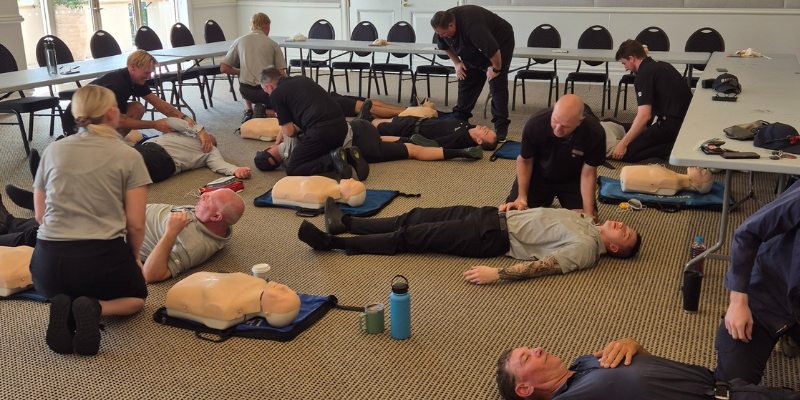
HLTAID011 does involve some safe casualty movement, though. On the day, you'll practice:
Placing an unconscious, breathing person in the recovery position
Kneeling to perform CPR on a floor manikin
Immobilizing fractures, sprains and strains
Checking the scene for hazards before you help
If a job ad or onboarding checklist asks for "first aid and manual handling", you'll usually need both units. Plenty of providers run them as separate courses, so check what your booking actually includes.
What HLTAID011 Actually Covers (and Where Manual Handling Fits)
There's no manual handling unit, but you'll still be moving people on the day, and that's exactly where most of the confusion around HLTAID011 manual handling comes from.
The four things the unit assesses
HLTAID011 Provide First Aid is built around four parts. In plain English, you need to show you can:
Respond to an emergency
Apply first aid procedures
Communicate the incident details
Review the incident afterwards
HLTAID011 also includes the CPR content from HLTAID009, so there's no separate CPR course to book. One course, both covered. Honestly, that's the bit most people are relieved to hear when they're juggling a start date and a dozen other onboarding tasks.
The moments you'll physically move someone
This is the part that can feel a bit like manual handling. A few times on course day you'll be hands-on with a person or a manikin:
Rolling an unconscious, breathing casualty into the recovery position
Adult CPR on a floor manikin, plus infant CPR on a firm surface
Immobilizing fractures, sprains and strains, plus pressure immobilization for envenomation
Doing the danger check before you touch anyone
That last one comes from the hazards and risk minimization knowledge in the unit. Look before you leap, basically. It's the first thing you do every single time, and it becomes a habit pretty quick.
What HLTAID011 doesn't teach
Here's where the line sits. HLTAID011 won't teach you:
Lifting or carrying people
Transfers, hoists or slide sheets
Lifting loads at work
None of that is in the unit, no matter how a course gets described online. If your job needs it, you'll need a different unit for it. That's what HLTWHS005 is for.

HLTAID011 vs HLTWHS005: What's the Difference?
On paper they're just two codes on a checklist, but they train you for two very different moments. HLTAID011 is about what you do when someone's hurt or sick. HLTWHS005 Conduct Manual Tasks Safely is about not getting hurt yourself while you do the physical side of your job.
Here's how they stack up side by side:
HLTAID011 Provide First Aid | HLTWHS005 Conduct Manual Tasks Safely | |
Focus | Emergency response to illness or injury | Lifting, carrying, pushing and pulling tasks done safely |
Includes CPR | Yes | No |
Includes casualty positioning | Yes (recovery position, CPR) | No |
Includes lifting techniques and aids | No | Yes |
What HLTWHS005 teaches
HLTWHS005 is a general manual tasks unit. It covers moving loads safely at work, and it's not a patient-transfer or hoist course on its own. In plain English, it trains you to:
Spot which manual tasks carry a risk of injury
Set up the task and the space before you start
Use good posture, technique and mechanical aids
Report hazards and injuries when they happen
There's a good reason employers take this stuff seriously. Sore backs and strained shoulders don't usually make the news, but they're a big part of why people end up off work. That's the gap HLTWHS005 is built to close.
Why some providers sell them as a bundle
Care and support employers often list both units, so a combined day can be handy. One booking, one trip, both lines ticked off the checklist. Makes sense.
The catch is that a bundle is still two separate units. A course might be called "first aid and manual handling", but what your employer cares about is what's printed on the certificate.
If you only see HLTAID011 on there, you've got first aid sorted and manual handling still to go.
Which Gold Coast Jobs Ask for First Aid and Manual Handling?
Knowing the difference is one thing, but what you really want to know is whether your job needs both. Every employer sets its own onboarding checklist, so treat the patterns below as a guide, not a rule.
NDIS and disability support work
Many NDIS providers list HLTAID011 as a must-have before your first shift. Some also want manual handling. Others deliver their own client-handling induction, where they train you on the exact equipment you'll use with their clients.
So when you're working out first aid and manual handling for NDIS workers, the key question is simple. Does your provider want the HLTWHS005 code on a certificate, or will they train you in-house on their own gear? It's worth a quick email to the onboarding team before you book anything extra.
Aged care and community care
Aged care follows a similar pattern, just with more client transfer work in the mix. HLTAID011 is commonly listed, and manual handling turns up on a lot of checklists too. Same advice applies: check whether they want the code or their own training.
Warehousing, logistics and trades
Logistics and construction employers often ask for manual handling because the job is lifting and moving stuff all day. First aid is usually needed for nominated first aiders on site. If that's you, start with the HLTAID011 course.
Childcare, fitness and hospitality
These roles usually ask for first aid only. Childcare is the exception on the course code, because it needs HLTAID012 rather than HLTAID011.
Not sure which course you need? Call or text us on 0434 778 243.
If you've been searching "manual handling course Gold Coast" without knowing whether you even need one, your onboarding checklist is the fastest way to find out. First aid is the one in almost every list.

What the Physical Side of a First Aid Course Is Really Like
Once you know which certificates you need, the next worry is usually the day itself, and what it'll ask of your body.
Kneeling for CPR
Let's be honest about this one. Part of the assessment is continuous chest compressions on a manikin on the floor. It's tiring, and your arms will know about it. But it's over before you know it.
A couple of things make it easier:
Wear comfortable clothes you can kneel and move in
Tell your trainer if you need a short break between scenarios
Nobody expects you to look like a paramedic on your first go. You're there to learn it, practice it, and show you can do it.
If you have a back, knee or mobility issue
Get in touch with the team before you book. Floor CPR is a requirement of the unit, so it can't be skipped, but your trainer can talk through your options with you ahead of time.
It's much better to have that chat early than to turn up on the day stressing about it.
Looking after your own body when you help someone
There's a simple idea that's worth carrying into any emergency: don't become the second casualty. Two injured people is worse than one.
In real life, that means:
Check for danger before you go near anyone
Don't try to lift someone on your own
Wait for help or paramedics unless there's immediate danger
It's not a lifting technique, just good sense. Your back has to last a whole career, especially in support work.
How to Sort Both Before Your Start Date
Now that the day itself feels a bit less scary, it's time to get moving, because your start date isn't waiting around.
Book HLTAID011 first
Start with first aid. It's the certificate most onboarding checklists name, and it includes CPR, so it knocks out two requirements in one go.
The course runs as blended delivery. You do the theory online on your phone, at your own pace, then come in for a shorter face-to-face practical. Much easier to fit around work, daycare drop-offs and everything else on your plate.
If you're after a first aid course on the Gold Coast, the booking page shows upcoming sessions. Once you've passed, your certificate gets emailed to you, ready to forward on.
Then confirm manual handling with your employer
Here's the thing about a first aid course manual handling bundle: you might not need one at all. So before you book anything extra, run through these three steps.
Check the exact unit code on your onboarding checklist.
Ask your employer whether their in-house training counts.
Book HLTWHS005 if you still need it.
Your Start Date, Sorted: What to Do Next
Untangling the whole first aid course manual handling question really starts with one small job. Grab your onboarding checklist and look for the exact unit codes. That one line tells you more than any course name or provider description ever will.
Next, book HLTAID011. It's the certificate most jobs name, and it includes CPR, so you're ticking two boxes with one booking. Do the theory on your phone, turn up for the practical, and that's the big one done.
Then have a quick chat with your employer about manual handling. Ask whether they need the HLTWHS005 code on a certificate, or whether they train you in-house on their own equipment. A quick email now could save you a course you don't actually need.
If they do want HLTWHS005, book it as soon as you know. Just remember it's a separate unit, so check both codes to show up on your paperwork if you go for a bundle.
And once your certificate lands in your inbox, forward it straight to your onboarding team. Don't let it sit there. That's the last box ticked, and you're ready to walk into your first shift feeling calm, capable and on time.