First Aid Course for Electricians: What's Required
If you're an electrician, a first aid course for electricians isn't quite the same tick-box exercise it is for most other trades. Most workers just need HLTAID011 and they're sorted. Electricians usually need that, plus something extra on top, and that's where a lot of the confusion starts.
Maybe you've done a general first aid course a while back and figured that covers you. Maybe your employer mentioned "low voltage rescue" and you weren't totally sure if that was a separate thing or the same thing with a different name. Or maybe your ticket lapsed without you noticing, and now a site induction has pulled you up on it. All of that is common, and none of it means you've done anything wrong, it just means the requirements for electrical work sit a bit differently to most other jobs.
This article sorts out exactly what's required, why electricians need more than the standard course, how each certificate stays current, and how to book everything without burning a whole day off tools. By the end you'll know precisely what to book and why.
What First Aid Course Do Electricians Need?
Electricians generally need two separate certificates, not one.
HLTAID011 (Provide First Aid) – the standard workplace qualification covering CPR, basic life support, wound and injury management, and asthma/anaphylaxis response, with the CPR component needing to be refreshed more often than the rest of the certificate.
Low Voltage Rescue (UETDRRF018) – an electrical-industry-specific unit covering rescue from live low voltage panels and equipment. Required in addition to HLTAID011 for most electrical contracting and site-based work.
Whether you need both, or just one on top of what you already hold, usually comes down to your site's WHS first aid officer requirements and the principal contractor's induction conditions. We'll walk through that decision further down.
HLTAID011: The Standard First Aid Requirement
This is the certificate almost every worker ends up needing at some point, and electricians are no exception. It's often called "the base layer" of workplace first aid, because a lot of other courses build on top of it rather than compete with it.
What HLTAID011 actually covers
CPR and basic life support
Wound and injury management
Asthma and anaphylaxis response
It's a broad, general-purpose course, designed to prepare you for the kind of medical emergency that could happen on any worksite, not just an electrical one. That's an important distinction, because it's not written with live electrical exposure in mind at all, which is part of why electricians usually need more (we'll get to that in the next section).
Staying current
Here's the catch, and it trips a lot of people up: the CPR component inside HLTAID011 needs refreshing more frequently than the full certificate does, according to ANZCOR guidelines. So you can hold a certificate that looks valid on paper while your CPR skills are technically overdue for a refresher underneath it. Worth keeping an eye on, rather than only tracking the headline renewal date.
One bit of confusion worth clearing up early: HLTAID011 isn't a rival option to HLTAID009 or HLTAID010, it actually contains both of those as component units. If someone's told you that you need HLTAID011 "instead of" one of those, that's not quite right, HLTAID011 is the bigger course that already has them built in.
If you're due for this one, book HLTAID011 with Accelerate First Aid and it's sorted in a single session.
Why Electricians Usually Need Something on Top of It
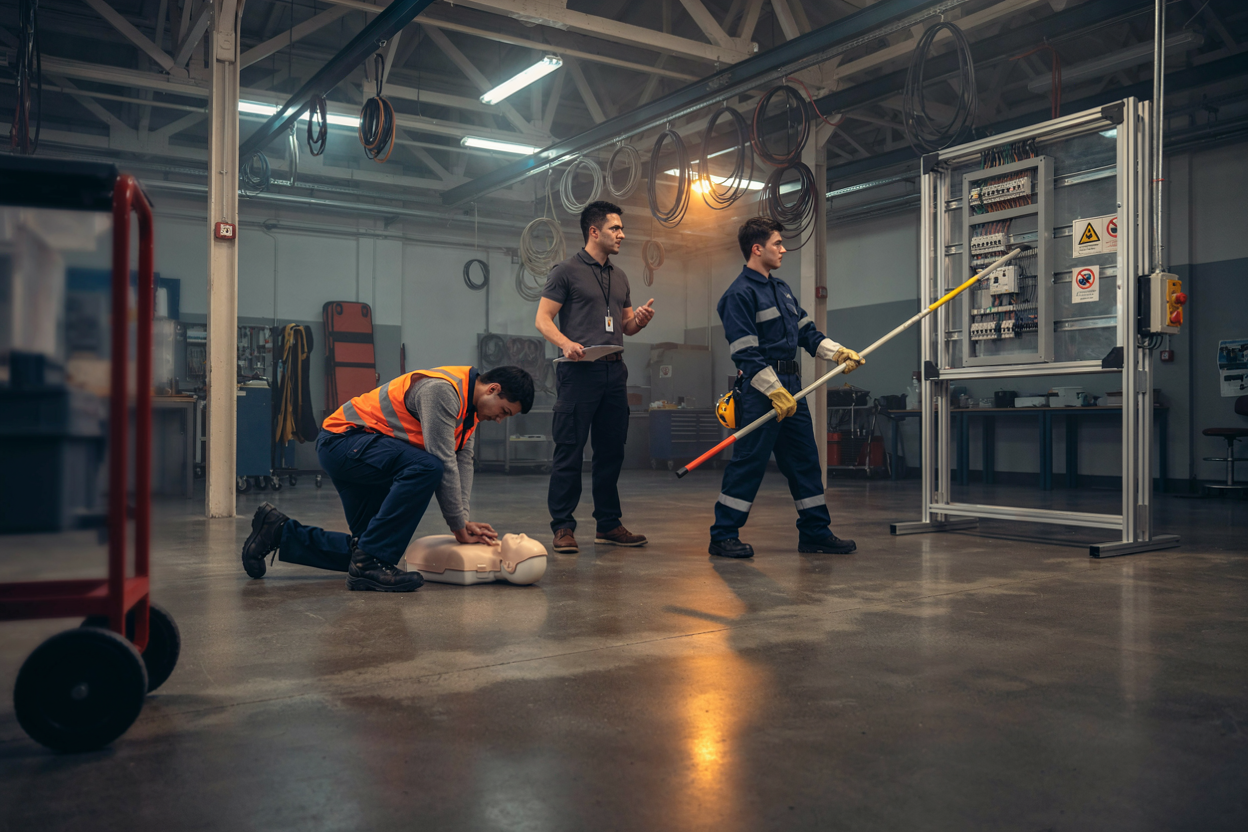
HLTAID011 is solid for general workplace emergencies, but it doesn't touch the one risk that's specific to your trade: live low voltage exposure. If someone's in contact with a live low voltage panel, the standard first aid response isn't safe to use, and that's the gap Low Voltage Rescue is built to close.
What Low Voltage Rescue actually covers
Low Voltage Rescue, unit code UETDRRF018, is the electrical-industry-specific course that trains you to safely rescue someone from contact with live low voltage equipment or panels without becoming a second casualty yourself. It's a narrow, specialised skill set, and it sits alongside HLTAID011 rather than replacing it.
Worth flagging here, because it causes a fair bit of mix-up in the market: the current, correct code is UETDRRF018. You'll still see older or incorrect codes floating around online and even on some competitor sites, like UETDRMP018 or UETDRRF004, so if you're checking your own records or a job ad against training.gov.au, UETDRRF018 is the one to match against.
HLTAID011 vs Low Voltage Rescue: what each one covers
HLTAID011 | Low Voltage Rescue (UETDRRF018) | |
Focus | General workplace first aid | Live LV panel/equipment rescue |
CPR, wounds, asthma/anaphylaxis | Yes | No |
Live electrical rescue technique | No | Yes |
Required for most electrical site work | Usually, as the base layer | Usually, on top of HLTAID011 |
For a full breakdown of Low Voltage Rescue and the electrical safety obligations around it, our electrical safety training guide covers that in more depth, this article is focused on where it fits alongside your first aid requirement, not a full LVR deep dive.
Do You Need Both, or Just One?
This is the question that trips up most electricians, and honestly, it's a fair one. The short answer is that most electricians doing live low voltage work end up needing both certificates, but there are a few site-specific factors that decide it properly.
Site-based and principal contractor induction requirements
Bigger sites, and especially anything running under a principal contractor's WHS system, will usually spell out exactly what's needed in the induction paperwork. If your induction lists both HLTAID011 and Low Voltage Rescue as conditions of entry, that answers the question for you. Smaller jobs or owner-operator situations don't always have that spelled out, which is where a lot of the uncertainty comes from.
Designated first aider obligations
If you've been named as your workplace's designated first aid officer under WHS, that's HLTAID011 territory, full stop. Low Voltage Rescue doesn't cover general workplace injuries or medical events, so it can't stand in for that role even if you've got it.
When Low Voltage Rescue alone isn't enough
This is the bit people miss most often: holding a current Low Voltage Rescue certificate doesn't mean you're covered as a workplace first aider. If you're the person your site relies on for general first aid, whether that's a formal designation or just because you're the one who's done a course, you still need HLTAID011 sitting alongside it.
A quick way to think it through:
Working around live LV panels? → Low Voltage Rescue is required
Named or expected to act as the site's first aider? → HLTAID011 is required
Both of the above apply? → You need both certificates, kept current at the same time

How to Book Both Without Wasting a Day
Once you know which certificates apply to you, the next problem is usually finding a session that fits around actual work. Nobody wants to burn a full day off tools chasing paperwork, and that's fair enough, this is meant to be sorted quickly and then forgotten about for a good while.
Combined vs separate sessions
Where it's offered, booking HLTAID011 and Low Voltage Rescue as a combined session is the most efficient option, one trip, one lot of admin, both certificates done. If a combined session isn't available for your dates, booking them as two separate sessions still works fine, it's just an extra trip. Either way, there's no requirement to do them in a particular order.
What to bring
Nothing complicated. Turn up on time, wear clothes you don't mind getting on the floor for the practical component, and bring photo ID for the paperwork. That's genuinely most of it.
Same-day certificate issuance
This is the part worth knowing upfront, because it removes a lot of the "will I actually get this in time" anxiety: your Statement of Attainment is issued the same day, digitally, so there's no waiting around for a certificate to turn up in the mail before you can hand it to your employer or site supervisor.
Renewal: Keeping Both Current Without Losing Track
Here's where the "bait and switch" feeling can creep in if nobody explains it upfront: HLTAID011, its CPR component, and Low Voltage Rescue don't all run on the same clock. Each one renews on its own separate schedule, and the schedules don't line up with each other.
That mismatch is exactly why people end up catching themselves out. You can be sitting there with a certificate that reads as current overall, while a piece of it underneath, usually the CPR component, is quietly overdue for its own refresher. It's not a scam or dodgy course design, it's just how the ANZCOR-aligned CPR currency requirement works, but it does mean a single renewal reminder isn't enough to rely on.
What happens if one lapses while the others are still current
If your CPR refresher lapses while the rest of your HLTAID011 is still technically current, you're not fully covered for a workplace first aid role until that component is brought back up to date. Same logic applies if your Low Voltage Rescue certificate lapses while your HLTAID011 is fine, you'd still be missing the electrical-specific coverage for live LV work. The certificates work as a set, and letting one slide undermines the whole point of holding the others.
The simplest fix is treating all of these as one system rather than separate things to remember individually, set your reminders around whichever one comes due first, and you'll never be caught out mid-project.
Conclusion
If you're an electrician, the honest short version is this: HLTAID011 covers you for general workplace first aid, and Low Voltage Rescue covers you for live low voltage exposure. They're not competing options and they're not interchangeable, they sit side by side, each doing a different job.
Most people working around live LV panels end up needing both, and that's not the industry making things complicated for the sake of it, it's just that a general first aid course was never designed to prepare anyone for rescuing someone from a live panel. Working out which role you actually hold on site, whether that's the designated first aider, the person doing live LV work, or both, is really what decides the answer for you.
Once you know that, the actual doing of it is the easy part. A single session can usually cover both certificates in one go, and you'll walk out with everything issued and ready to hand to whoever needs to see it, no waiting around for paperwork to catch up with you.
The bit that catches people out later isn't the initial booking, it's the renewal side of things underneath it. Each certificate, and even the CPR component sitting inside one of them, keeps its own separate schedule. Treat those as one system to keep an eye on rather than several separate things to remember, and you'll never end up holding a certificate that looks current on the surface while a piece of it has quietly lapsed.
None of this needs to be a recurring source of stress or something you sort out in a panic before a site induction. Get the right certificates lined up properly once, and it turns into a quick, predictable task every so often rather than a scramble.
That's really all this comes down to, knowing exactly what applies to you, getting both done in one trip where you can, and keeping the renewal side of things somewhere you'll actually see it. Sort that once and it stops being something you have to think about until it's genuinely due again.