First Aid Certificate Requirements in QLD: What Your Job Needs
The offer email lands on a Tuesday night. Your start date is two weeks away, and halfway down the onboarding checklist is one line that stops you: "current first aid certificate required." No unit code, no course name, and no hint which of the dozens of courses online is the right one.
That's the catch with first aid certificate requirements in Queensland. Some employers name the exact unit code they want. Plenty don't. Book the wrong course and you could lose a week you don't have.
This guide sorts it out by job. You'll see which certificate NDIS, aged care, childcare, fitness, hospitality and trades roles usually ask for, how long each one stays valid, and why a fully online certificate won't get you through onboarding. We'll also walk through how blended courses work, what happens at the practical assessment and how your certificate arrives, so you can book with confidence wherever you are in South East Queensland.
What First Aid Certificate Do You Need for Work in QLD?
Most Queensland jobs that require first aid ask for HLTAID011 Provide First Aid, the standard workplace certificate. It already includes CPR (HLTAID009), so you don't need to book both. The right certificate depends on your role:
NDIS, disability support and aged care: HLTAID011
Fitness, hospitality, retail and most trades: HLTAID011
Childcare and early childhood education: HLTAID012, plus approved anaphylaxis and asthma training
Designated first aid officers on high-risk sites: often HLTAID014
Roles that ask for CPR only: HLTAID009
Your certificate must be issued by a registered training organisation (RTO) and include a face-to-face practical assessment. Plan to renew CPR every 12 months and first aid every three years, or sooner if your employer asks.
Job | Usual requirement | Who sets it |
NDIS and disability support | HLTAID011 | Your provider's onboarding policy |
Aged care | HLTAID011 | Employer credentialing |
Childcare and early childhood | HLTAID012 + anaphylaxis + asthma | Education and Care Services National Regulations / ACECQA |
Fitness and personal training | HLTAID011 (includes CPR) | AUSactive registration |
Hospitality and retail | HLTAID011 | Employer or venue policy |
Construction and trades | HLTAID011; HLTAID014 for designated first aid officers | Principal contractor / site induction |
Clinical and emergency roles | HLTAID015 | Employer or health service |
If your checklist does name a code, go with that one. Your employer's paperwork beats any table, this one included.
The table gives you the short answer. Here's what each job actually asks for, and why.
First Aid Certificate Requirements by Job in Queensland
Your first aid requirement usually comes from one of three places: the law, an industry registration body or your employer's own policy. Sometimes it's all three. Whichever one is strictest is the one that applies to you.
NDIS and Disability Support Workers
If you're starting in disability support, this is probably the bit you came for. Most registered NDIS providers require a current HLTAID011 before your first shift. It sits on the onboarding checklist right next to your NDIS Worker Screening Check.
This is where people get mixed up. The NDIS Practice Standards require providers to manage emergencies and make sure their workers are competent, but they don't name a single unit code. So the HLTAID011 rule comes from your provider, not from the NDIS. The NDIS Quality and Safeguards Commission has the standards if you want to read them yourself.
Why full first aid and not just CPR? Think about what the work actually looks like. You might be on a community outing, driving a client to an appointment or doing in-home support with nobody else around. If a client falls, has a seizure, starts choking at lunch or has a diabetic emergency, you're the one who acts until help arrives. CPR alone doesn't cover most of that.
If you'll be supporting clients with complex needs, your provider may also ask for asthma and anaphylaxis training (22556VIC / 22300VIC). It's worth asking at onboarding so you can book both together.
Aged Care Workers
HLTAID011 is the usual requirement for aged care roles. Some residential facilities also list annual CPR (HLTAID009) as mandatory training, so you might do a CPR refresher every year even though your first aid certificate lasts longer. Clinical staff in higher-acuity settings may need HLTAID015 Provide Advanced Resuscitation and Oxygen Therapy instead.
Childcare and Early Childhood Educators
Childcare has its own rules. Regulation 136 of the Education and Care Services National Regulations requires approved first aid, anaphylaxis management and emergency asthma management training on site at all times.
HLTAID012 Provide First Aid in an Education and Care Setting is the education and care first aid unit, but it doesn't satisfy the anaphylaxis and asthma requirements by itself. You'll need those too. Before you book, check the course is on ACECQA's approved first aid qualifications list. In practice, many services ask every educator to hold all three, even though the regulation only sets an on-site minimum.
Personal Trainers and Fitness Instructors
AUSactive registration requires current CPR and first aid. HLTAID011 covers both, so one course meets both requirements. Most gyms ask for proof when they hire you and again when your registration comes up for renewal.
Hospitality, Retail and Construction
In hospitality and retail, first aid is usually an employer or venue requirement. It's often asked of duty managers and designated first aiders.
On construction sites, HLTAID011 is the usual site minimum. Designated first aid officers on high-risk sites are often asked for HLTAID014 Provide Advanced First Aid. If you're wondering how many first aiders a site needs, our guide to first aid certificate work requirements covers it.
Once you know which code your job needs, the next hurdle is the course names, because providers don't all call it the same thing.

HLTAID011, HLTAID009 and the Old Names, Explained
Course names are where most people get stuck. One provider says "Senior First Aid", another says "Provide First Aid", and a job ad just says "HLTAID011 required". They often mean the same thing.
HLTAID011 Provide First Aid: the standard workplace unit, and the one most jobs ask for. It contains HLTAID009 Provide CPR and HLTAID010 Provide Basic Emergency Life Support, so it isn't a competing course. It's the bigger course with those two already inside it.
HLTAID009 Provide CPR: CPR only. It doesn't replace HLTAID011 when a job asks for first aid.
The old names: "Senior First Aid", "Level 2 First Aid" and HLTAID003 all point to what is now HLTAID011 Provide First Aid.
So does HLTAID011 include CPR? Yes. When you compare HLTAID011 vs HLTAID009, the choice comes down to what your job asks for, not which course is better.
My rule of thumb is simple. If the job ad says "first aid", book HLTAID011 Provide First Aid. If it says "CPR only", book HLTAID009 Provide CPR. If you're not sure, don't guess. It's quick to check and saves you booking twice.
Booking the right course is step one. Keeping it current is what keeps you rostered.
How Long Is a First Aid Certificate Valid in Queensland?
So how long is a first aid certificate valid? The answer is a bit odd. The units on training.gov.au don't carry an expiry date, so your statement of attainment doesn't technically run out. How long it stays "current" depends on industry guidance and your employer's policy.
For CPR, the guidance is every 12 months. That comes from the Australian Resuscitation Council and ANZCOR, because CPR skills fade faster than most people expect. Compression depth and rhythm are the first things to slip when you haven't practiced in a while.
For first aid, the usual guidance is every three years. That comes from Safe Work Australia's First Aid in the Workplace Code of Practice, and it's the timeframe most Queensland employers work to.
If your employer's policy is stricter, theirs wins. Some aged care facilities want CPR every year without exception, and some services set their own renewal dates for everyone on staff. Check your onboarding paperwork so you're not caught out.
One tip that'll save you a headache: diarize your CPR refresher 11 months after your course date. That gives you breathing room to find a session before you fall out of currency, rather than scrambling at the last minute.
Before you book, there's one trap worth knowing about.

Is an Online-Only First Aid Certificate Valid?
Short answer: no, not for HLTAID011 Provide First Aid. The HLTAID011 assessment requirements on training.gov.au include hands-on demonstration, so a trainer has to watch you actually do the skills, like CPR on a manikin. A screen can't check that.
That's why an online only first aid certificate tends to come unstuck at onboarding. It might look official and land in your inbox almost instantly, but the HR team checking it knows what a real HLTAID011 looks like. Some people only find out it's useless when they're days away from their start date, and that's the worst time to be booking again.
The practical isn't a hoop to jump through. It's the reason your certificate gets accepted. Your employer is trusting that you've physically shown you can do this.
4 signs a certificate won't be accepted
No RTO number on the provider's website or certificate
No practical session anywhere in the course
No unit code printed on the certificate
A certificate sold without any assessment
If you're unsure about a provider, search its RTO number on training.gov.au. If the number doesn't come up, keep looking.
You can still do most of it from home, though. Blended delivery puts the theory online and the practical in person, and the practical is shorter because you've already done the reading. You walk out with exactly the same nationally recognized certificate.
So what does the blended path look like, from booking to certificate in your inbox?
How to Get Your First Aid Certificate Before Your Start Date
When you're working to a start date, you want the steps laid out and no surprises.
1. Confirm the code. Check your offer letter or onboarding checklist for the unit code. If it's unclear, ask HR, or call or text us on 0434 778 243 and we'll help you work it out.
2. Book with an RTO. Choose a session that leaves a few days' buffer before your start date. Things come up, and you don't want your first pay riding on one session going perfectly.
3. Do online learning. It's mobile-friendly, so you can work through it on your phone after the kids are in bed.
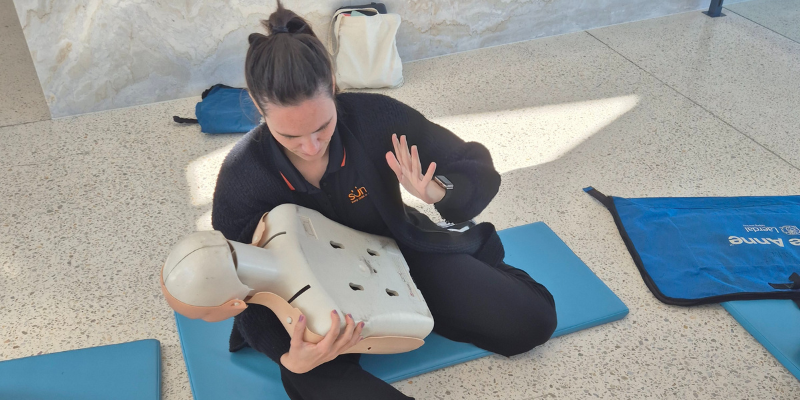
4. Attend the practical. This is the hands-on part, where you show the trainer what you've learned.
5. Receive your certificate. It's emailed to you, with the unit code and RTO number printed on it. Forward the PDF to your employer and that box is ticked.
What Happens at the Practical Assessment
If you're nervous about the practical, you're not the only one. Most people walk in feeling the same and walk out surprised at how well it went. Here's what to expect at a first aid course.
Uninterrupted CPR on an adult manikin on the floor, as the HLTAID009 Provide CPR assessment requirements set out
Other demonstrations: the recovery position, bleeding control, using an AED and working through scenarios
A trainer who coaches you through the skills before the assessment
If kneeling is hard for you or you have a physical limitation, contact the team before the day so it can be talked through.
What to Bring and Wear
Photo ID
Your USI
Comfortable clothes you can kneel in
If you're on the Gold Coast, here's how to get it done.
Getting Your First Aid Certificate on the Gold Coast
Our HLTAID011 Provide First Aid course runs practical sessions on the Gold Coast, so you're not stuck on a long drive. Less time in the car means less time paying for an extra day of daycare or calling in a favor from family.
Weekdays are hard to fit in when you're juggling a new job, kids and everything else on your list. That's why there are weekend sessions and short practical sessions to choose from.
It's a blended first aid course on the Gold Coast, so you do the theory at home before you arrive. The practical is shorter for it, and you walk out with the same nationally recognized certificate.
Most people find that far easier to fit around family than a long day in a classroom. You turn up already knowing the theory, so the session is about practicing, not sitting through slides.
The certificate is nationally recognized and issued under RTO 31106, so you can check it on training.gov.au before you hand it to HR.
Dates are right there on the booking page, with no enquiry form to fill out first. Pick the session that fits your week and leaves a few days before your start date.