
First Aid Certificate Renewal: How Often Do You Need It?
A Brisbane site supervisor turned up to a new contract site recently — hi-vis on, steel caps laced, ready to go. Got to the gate, handed over his paperwork, and was turned away on the spot.
His HLTAID011 had expired three months earlier. He hadn't noticed. His employer hadn't noticed either. The project started without him.
It's one of the most common — and most easily avoided — compliance failures in Queensland workplaces. First aid certificates expire quietly. There's no automated reminder from a regulator, no warning letter in the mail, and no grace period if a WorkSafe inspector asks to see your records on the wrong day.
The thing is, most people aren't being careless. They got their certificate, filed it away, and genuinely assumed someone would tell them when it was time to renew. That's not how it works.
This guide explains exactly how long your first aid certificate is valid in Australia, why CPR renewal runs on a different schedule, which industries and regulators have stricter requirements, and how to get your renewal sorted before a gap turns into a real problem.
How Long Is a First Aid Certificate Valid in Australia?
In Australia, a first aid certificate (HLTAID011 — Provide First Aid) is valid for 3 years from the date of issue. However, the CPR component (HLTAID009 — Provide Cardiopulmonary Resuscitation) embedded within the course should be renewed every 12 months, in line with Australian Resuscitation Council (ARC) guidelines. Most employers, regulators, and industry bodies — including ACECQA, Safe Work Australia, and Queensland Health — require both to be current.
Why First Aid Certificates Have an Expiry Date
It's a fair question. Why can't you just do the course once and be done with it?
The short answer is that the science moves. The Australian Resuscitation Council reviews and updates its resuscitation guidelines on a regular cycle — compression ratios, airway management techniques, defibrillation protocols — these aren't static. What was considered best practice when you did your course three years ago may have been refined since then. The expiry period exists to make sure the people holding these certificates are working from current, evidence-based knowledge — not an outdated version of it.
There's also the skill decay problem. Knowing how to perform CPR and actually being able to perform it well under pressure are two different things. Research consistently shows that the quality of CPR performance drops off significantly within 12 months without a refresher. Compression depth, rate, recoil — all of it degrades when the skill isn't practised. That's not a judgement on anyone. It's just how motor memory works.
So the expiry dates aren't bureaucratic box-ticking. They exist because a certificate that reflects three-year-old guidelines and three-year-old skill levels isn't the same thing as genuine preparedness. And in an actual emergency, that difference matters.

HLTAID011 First Aid Certificate: The 3-Year Rule Explained
Your HLTAID011 certificate is valid for 3 years from the date you completed the course. That date is printed on your certificate — and your expiry is calculated from there, not from when you received it in the mail or when your employer filed it.
One thing worth knowing: renewal means a full course re-sit. It's not a short top-up exam, it's not an online refresher, and it's not a theory-only session. You're completing the full HLTAID011 course again — including the practical assessment components. That's how the qualification works under the national Health Training Package (HLT), and it's what regulators and employers are looking for when they ask for current certification.
Still holding an HLTAID003? That unit code has been superseded. HLTAID003 is no longer a current qualification regardless of what date is printed on the certificate — if you're still carrying one, you'll need to complete HLTAID011. It's not a renewal of the old code. It's a new qualification under the updated Health Training Package.
This catches a lot of people off guard — particularly workers who completed training several years ago and assumed their certificate was still valid because it hadn't "expired" by the date on the card. If the unit code on your certificate starts with HLTAID003, it's time to book.
Understanding the 3-year rule is step one — but the CPR component operates on a different schedule entirely, and that's where most people get caught out.
CPR Renewal: Why It's Every 12 Months (Not 3 Years)
Here's the part that trips people up more than anything else.
HLTAID009 — the CPR unit — sits within your HLTAID011 first aid certificate. They come as a package when you do the full course. But they don't expire at the same time. Your HLTAID011 is valid for 3 years. Your CPR component should be renewed every 12 months, in line with ARC guidelines.
That means you can be sitting on a perfectly valid 3-year HLTAID011 certificate — and still have a lapsed CPR component. And here's the thing: a lot of Queensland employers and regulators check both separately.
The reasoning behind annual CPR renewal comes back to the same two factors — guideline currency and skill decay. CPR is the most time-critical intervention in a cardiac arrest. The window for effective action is narrow, the technique requires physical precision, and the guidelines that underpin it are updated more frequently than most people realise. Annual renewal keeps both the knowledge and the muscle memory sharp.
In practical terms, the bodies that specifically require annual CPR renewal include ACECQA for childcare settings, many Queensland Health employer credentialing frameworks, NDIS providers, and construction site induction packages across Southeast Queensland.
Industry-Specific Renewal Requirements in Queensland
The 3-year and annual renewal framework applies across the board — but depending on your industry, there may be additional layers on top of that. Here's how it breaks down across the main sectors in Queensland.
Childcare & Early Childhood Education (ACECQA)
ACECQA's National Quality Framework requires childcare services to maintain specific first aid ratios at all times — not just at the point of audit. That means certificates need to be current on any given day the service is operating, not just recently completed.
HLTAID012 (Provide First Aid in an Education and Care Setting) is the preferred unit for childcare workers because it's designed specifically for that environment. But HLTAID011 is widely accepted across Queensland services. The two aren't interchangeable in every context — if you're unsure which one your service requires, it's worth getting a straight answer before your next ACECQA review rather than after it.
Annual CPR renewal is effectively mandatory in childcare. A lapsed CPR component in a childcare setting isn't just a paperwork problem — it's a ratio breach, and ACECQA has the power to take compliance action against a service where ratios aren't being maintained.
Workplaces & Businesses (Safe Work Australia / WorkSafe Queensland)
The Safe Work Australia Code of Practice for First Aid in the Workplace requires designated first aiders to hold current qualifications. Current means current — not recently expired, not almost due for renewal.
WorkSafe Queensland has the authority to issue improvement notices and fines where certificate records are found to be lapsed during an inspection. Beyond the regulatory consequence, there's a civil liability dimension that a lot of employers don't think about until it's too late. If an incident occurs in your workplace and the staff member who responded held an expired certificate, that's a conversation you don't want to be having with a lawyer after the fact.
Healthcare & Aged Care (AHPRA / Queensland Health)
AHPRA's CPD framework doesn't mandate a specific first aid unit by name — but many employer credentialing frameworks within Queensland Health and private hospital networks do. Annual CPR renewal is a standard expectation across most clinical settings, and it's increasingly common for aged care facilities to require current HLTAID011 or HLTAID015 for clinical and direct care staff.
For healthcare workers, the priority isn't just compliance — it's ARC guideline currency. The resuscitation protocols you're expected to apply at work need to reflect current evidence, and annual renewal is how that's maintained.
Construction & Trades (Safe Work Australia / Site Requirements)
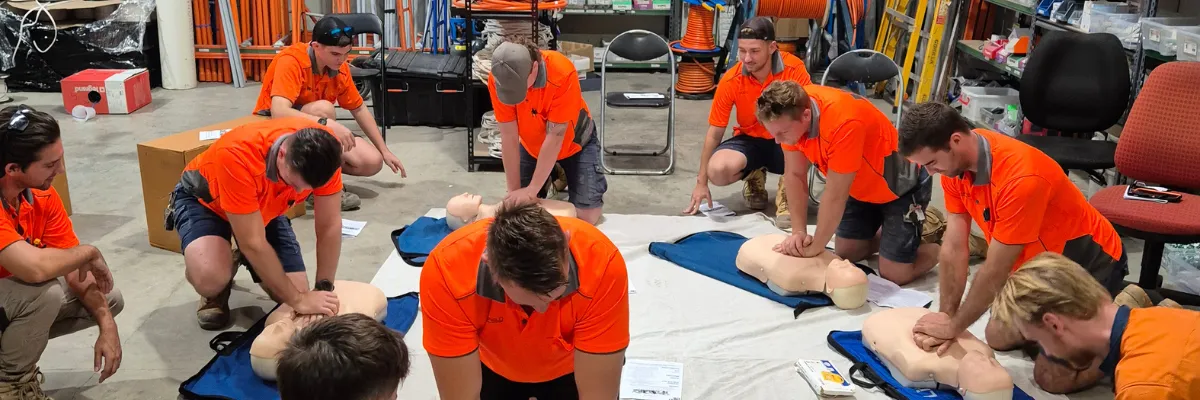
On construction sites across Southeast Queensland, site-specific induction packages commonly require current HLTAID011 — not just CPR. The certificate gets checked at the gate, and a lapsed certificate means no site access. It's that direct.
With the Olympic infrastructure pipeline driving construction demand in Brisbane through to 2032, and the northern Gold Coast corridor continuing to grow at pace, the volume of workers needing current first aid certification isn't shrinking anytime soon.
For tradies, the consequence of a lapsed certificate is immediate and financial — no access means no income for that day, that week, or however long it takes to get the renewal sorted.
Knowing your industry's requirements is one thing. Understanding what actually happens when a certificate lapses is another — and the consequences are more immediate than most people expect.
What Happens If Your First Aid Certificate Expires?
The most important thing to understand here is simple: there is no grace period.
The day after your certificate expires, it's no longer valid for compliance purposes. Not a week of leeway, not a month while you get around to booking the renewal. The moment it passes the expiry date, it's lapsed — and any audit, inspection, or incident that surfaces on that day treats it exactly the same as if you'd never been trained at all.
For businesses and workplaces, a WorkSafe Queensland inspection that finds lapsed certificates can result in improvement notices and fines. If an incident occurs and a responding staff member held an expired certificate at the time, the employer's liability exposure increases significantly — and that's before any civil claim is considered.
For childcare operators, the stakes are higher again. ACECQA has the authority to take immediate compliance action against a service where first aid ratios aren't being maintained. A single lapsed certificate in a small team can be enough to trigger that process.
For construction workers and tradies, it's the most immediate consequence of all — denied site access, lost income, and a project that starts without you.
The fix is straightforward. The risk of not fixing it isn't.
How to Renew Your First Aid Certificate
Renewing your first aid certificate is more straightforward than most people expect — but it helps to know what you're actually booking before you pick up the phone.
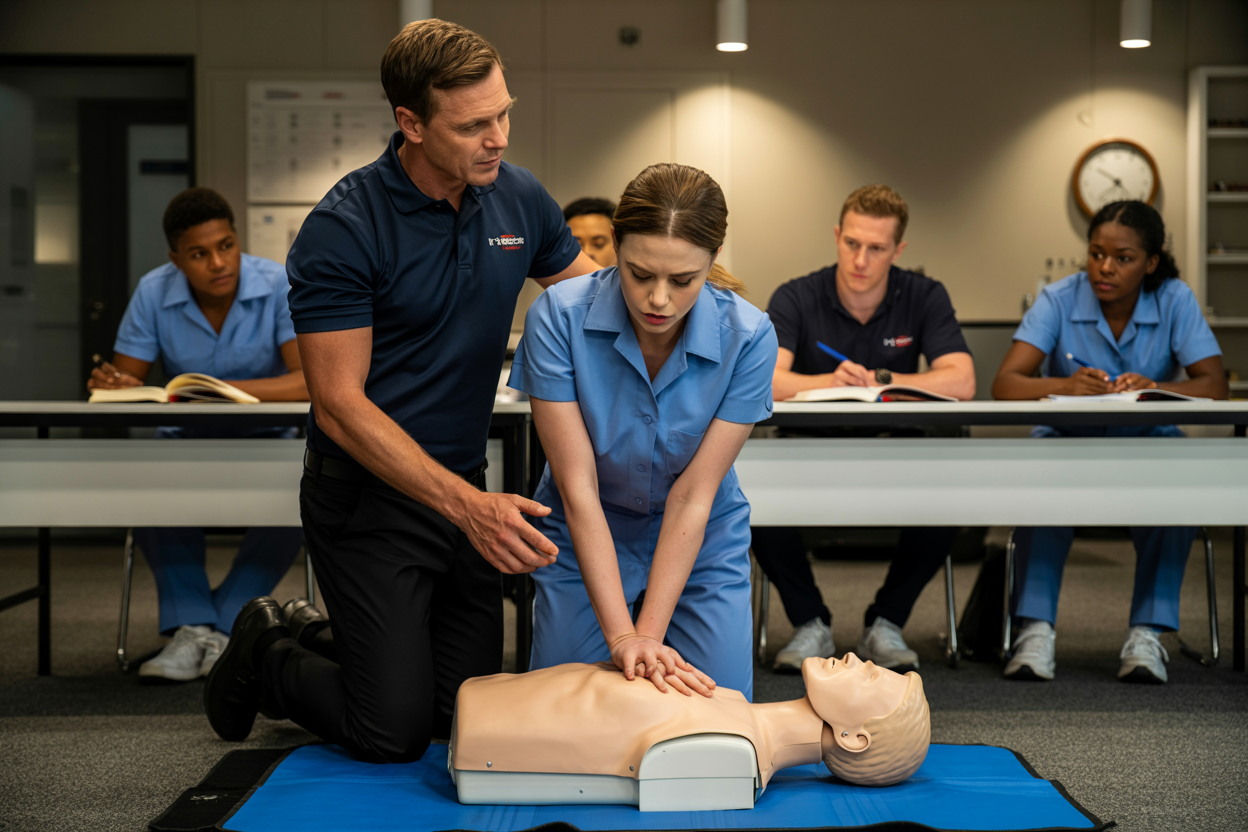
A full HLTAID011 renewal is a complete course re-sit. It's not an exam, it's not an online top-up, and it can't be done entirely from your couch. The practical assessment component is mandatory — that's what makes the qualification nationally recognised under the Health Training Package. Some providers offer a pre-course eLearning component that lets you work through the theory beforehand, which reduces face-to-face time on the day. But hands-on assessment is non-negotiable.
For a CPR-only renewal (HLTAID009), the time commitment is significantly shorter. If your HLTAID011 is still within its 3-year validity but your CPR component is due, a standalone HLTAID009 session is all you need to stay compliant for another 12 months.
Advanced Resuscitation Training runs HLTAID011 and HLTAID009 renewal sessions with public and on-site group delivery options available, with certificates issued promptly on completion.
Here's how the renewal process works:
Check your certificate expiry date — your HLTAID011 issue date plus 3 years; your HLTAID009 issue date plus 12 months
Choose your course type — full HLTAID011 first aid renewal or HLTAID009 CPR-only session
Book online — sessions available including weekends
Complete the practical assessment on the day
Receive your certificate promptly on completion
Your Next Steps
Start by checking your certificate expiry date. Pull out your HLTAID011 and look at the issue date — add 3 years and that's your expiry. Then check your CPR component separately. Your HLTAID009 renewal is due 12 months from the date it was completed, not when your full first aid certificate expires. If you're not sure where your certificates are, that's a good sign it's time to sort this out.
Once you know where you stand, confirm what your industry actually requires. The compliance table above covers the main sectors — childcare, workplaces, healthcare, construction, and schools. If your situation doesn't fit neatly into one of those categories, call ART directly and get a plain-English answer rather than guessing.
Then choose your course format. If you're renewing individually, a public session is the simplest option. If you're managing renewals for a team, on-site group delivery is worth looking at — it's less disruptive to your operations and gets everyone sorted in a single session.
From there, it's just a matter of booking. Certificates are issued promptly on completion, and the whole process is a lot less complicated than most people expect. The hard part is usually just deciding to get it done — so if your expiry date is coming up, or already passed, now's the time.