
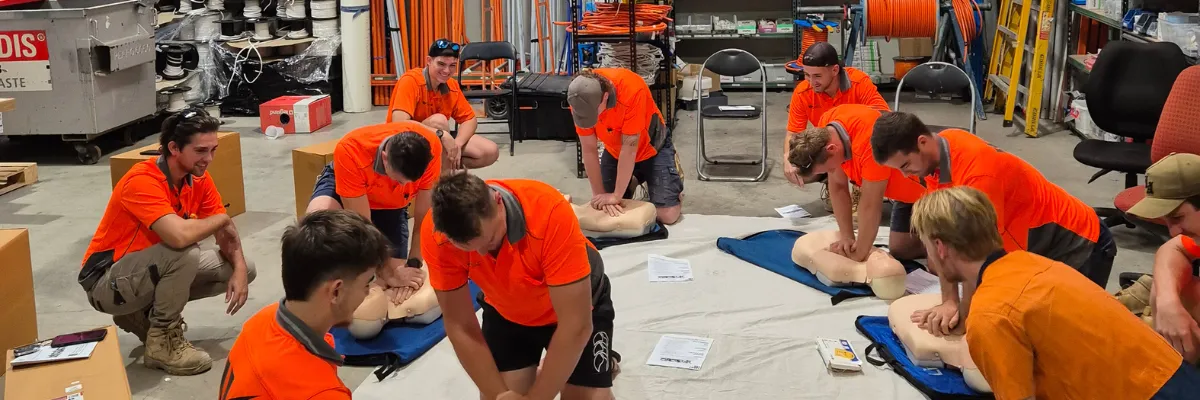
What Is the Electrical Workplace Safety Unit Competency?
If a SafeWork Queensland inspector walked onto your site tomorrow and asked to see your team's WH&S training records, could you produce them?
Most operations managers know that question makes them uncomfortable. It's not because they don't care about safety. It's because in a fast-moving business, safety paperwork always competes with three other urgent things, and it usually loses until something forces it back to the top.
UEECD0007, formally known as Apply Work Health and Safety Regulations, Codes and Practices in the Workplace, is the nationally recognized electrical workplace safety unit competency that closes that gap. It's grounded in the Work Health and Safety Act 2011 (Qld), and for any electrical worker heading into Low Voltage Rescue (UETDRRF004) certification, it's a listed co-requisite you can't skip.
This article covers what UEECD0007 involves, who needs it, what the training looks like on the day, and how to get your team certified without losing a full day of productivity.
Who Needs the Electrical Workplace Safety Unit Competency (UEECD0007)?
The electrical workplace safety unit competency (UEECD0007) is required for:
Electrical apprentices and licensed electricians completing or upgrading their Queensland electrical licensing pathway
Construction and site workers requiring a formal WH&S obligations unit beyond the White Card
Workers enrolling in Low Voltage Rescue (UETDRRF004) - UEECD0007 is a listed co-requisite for LVR certification in Queensland
Operations managers and WH&S officers in trades, construction, or industrial SMEs documenting staff compliance under the Work Health and Safety Act 2011 (Qld)
New supervisors and site managers stepping into a safety oversight role for the first time
Any Queensland business required to demonstrate due diligence in WH&S training for tendering, insurance, or regulatory purposes

What Is UEECD0007? The Electrical Workplace Safety Unit Explained
Most people searching for this unit arrive at it one of two ways. Either their employer told them they need it, or they've just enrolled in Low Voltage Rescue and an RTO flagged it as a co-requisite they don't have. Either way, the question is the same: what does it actually cover?
The full unit name is Apply Work Health and Safety Regulations, Codes and Practices in the Workplace. It sits inside the UEE Electrotechnology Training Package, the nationally recognised framework governing electrical trade training across Australia. The unit code, the learning outcomes, and the Statement of Attainment you receive are consistent regardless of which registered RTO delivers it. You can verify the unit on training.gov.au.
What UEECD0007 is not, and this trips people up, is a first aid or CPR course. It has nothing to do with emergency response. It's specifically about regulatory knowledge: understanding your legal obligations under WH&S legislation, applying workplace policies and codes of practice on the job, and participating in your workplace's WH&S consultative processes.
What the Unit Code Means
The "UEE" prefix identifies this unit as part of the Electrotechnology Training Package. "CD" refers to the competency domain, which is work health and safety within electrical and related industries. The "0007" is the unit identifier. When you see UEECD0007 on a certificate or tender document, it's a precise, unambiguous reference that WorkSafe QLD auditors and head contractors recognize immediately.
What Workers Learn in UEECD0007
The unit is built around three core performance outcomes. First, workers learn which laws and regulations apply to their specific workplace and role, not WH&S in the abstract but what actually applies to them on a Queensland site. Second, they learn how to put those obligations into practice day-to-day: hazard identification, risk reporting, and following safe work procedures. Third, they understand their right and responsibility to raise safety concerns, contribute to toolbox talks, and engage with their employer's safety systems.
These aren't theoretical exercises. The unit produces workers who know what the rules are, why they exist, and how to follow them on the tools, which is exactly what the Safe Work Australia model WH&S legislation framework was built to achieve.
Knowing why the unit is legally required in Queensland is what gives it real weight.
Why UEECD0007 Is Required for Queensland Electrical Workers
There's a version of this conversation that goes: "we've never had an incident, so we're probably fine." For a lot of Queensland SMEs, that's genuinely how WH&S training gets deprioritized. The problem is that "no incident yet" isn't the same as "compliant," and WorkSafe Queensland doesn't make that distinction when they show up.
The legal foundation is the Work Health and Safety Act 2011 (Qld). Under this legislation, every PCBU, a person conducting a business or undertaking, has a positive duty to ensure workers are trained in their WH&S obligations. That duty requires documented, verifiable training against a recognized standard, not a safety handbook handed out on day one.
For electrical work environments, the obligation goes further. The Electrical Safety Act 2002 (Qld) and the Electrical Safety Regulation 2013 (Qld) impose additional requirements specific to electrical work hazards. UEECD0007 is embedded in Queensland electrical licensing and trade qualification pathways because of this layered legislative context. It's not optional. It's part of the framework.
Your Legal Obligations Under the WH&S Act 2011 (Qld)
As a PCBU, your core duty is to eliminate or minimize risks to workers so far as is reasonably practicable, which includes making sure workers have the training they need to work safely. Completing nationally recognized WH&S training like UEECD0007 is documented proof you took that duty seriously. Not completing it leaves a gap in your due diligence record that's very hard to explain after the fact.
For businesses tendering for construction or government contracts, head contractors and procurement teams increasingly require specific unit codes on specific certificates. UEECD0007 satisfies that requirement in a way that informal inductions simply don't.
What Happens If Your Workers Aren't Trained
The consequences of a WorkSafe QLD audit finding untrained workers on your site aren't abstract. Inspectors can issue improvement notices, on-the-spot fines, prohibition notices that shut down work, and in serious cases refer matters for prosecution.
Now that the legal picture is clear, here's what the actual training experience looks like for your team.

What to Expect From UEECD0007 Training
The biggest concern most operations managers raise before booking isn't the content. It's the logistics. Do workers have to travel? What happens on the day?
UEECD0007 is delivered face-to-face, either at a training venue or on-site at your workplace. There's no fully online pathway. The assessment includes practical workplace observation or scenario-based demonstration, so a qualified assessor needs to be present. Workers complete a written knowledge assessment combined with practical scenarios that mirror real worksite situations. They're assessed on whether they understand their obligations and can apply them, not whether they can recite legislation word for word.
For most learners there are no prerequisites. If your workers are heading into Low Voltage Rescue (UETDRRF004) specifically, confirm co-requisite sequencing with your RTO before booking. For standalone UEECD0007 enrolment, virtually any worker can attend regardless of prior training history.
Face-to-Face vs On-Site Delivery - Which Is Right for Your Business?
For businesses with multiple workers to train, on-site delivery is almost always the better option. Your team doesn't travel, your operation doesn't pause, and the training happens in the environment where your workers actually do their jobs. The assessor comes to you, runs the session at your site, and workers walk away with certificates the same day or next day. Classroom delivery works well for individuals or small numbers who need the unit quickly.
What Do Workers Need to Bring?
Photo ID (driver's license is fine)
Comfortable work clothing appropriate for practical scenarios
Any existing training records if they're part of a broader qualification pathway
A pen, as assessments are paper-based at most venues
A competent RTO will provide everything else on the day.
For electrical workers specifically, there's one more piece of the puzzle worth understanding before you book.
UEECD0007 and Low Voltage Rescue - Understanding the Co-Requisite
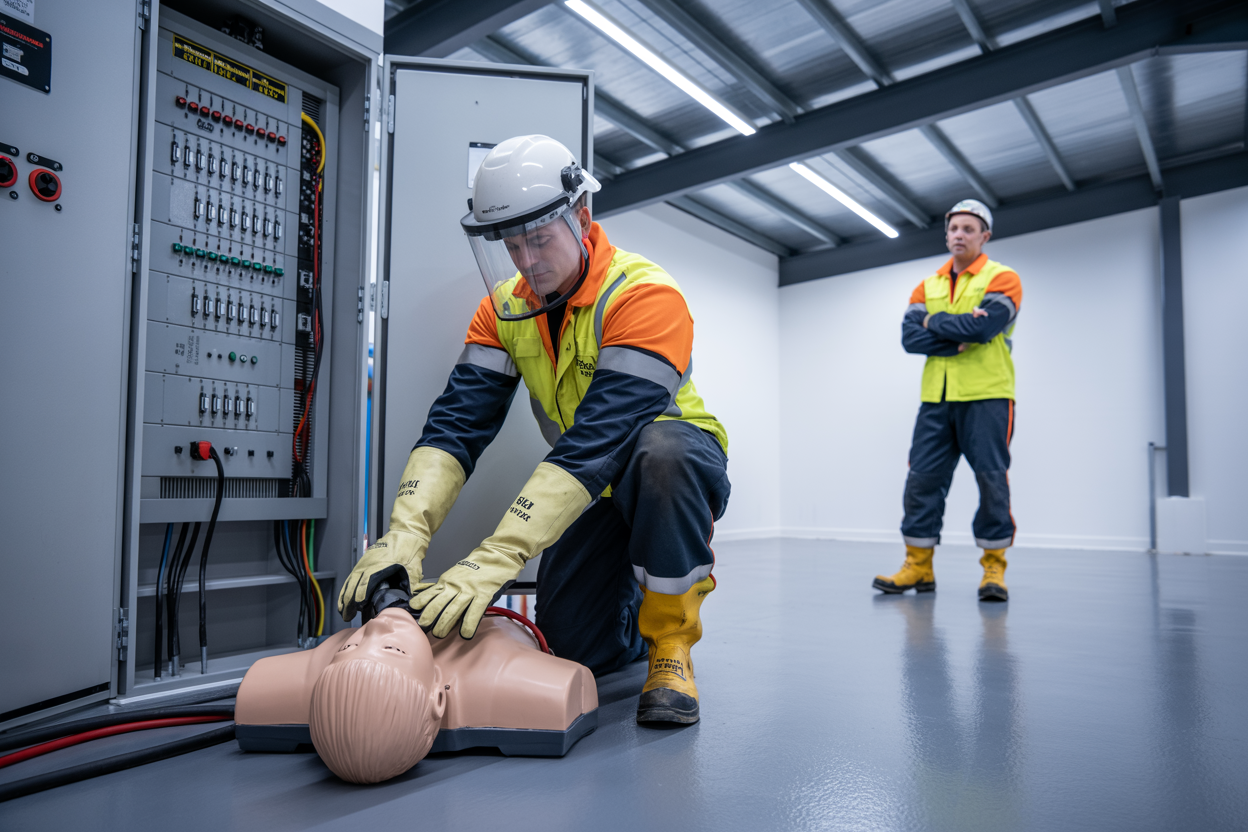
If you manage electrical workers, UETDRRF004, Low Voltage Rescue, is likely already on your radar. It's a mandatory unit for licensed electricians working on or near live electrical equipment in Queensland. What catches businesses off guard is that UEECD0007 is listed as a co-requisite for UETDRRF004, meaning your workers need both and the sequencing matters.
A co-requisite isn't a prerequisite. It doesn't have to be completed first, but it does have to be completed. Workers who arrive at LVR training without UEECD0007 on their record will find their Statement of Attainment for UETDRRF004 can't be issued until that gap is closed. For a business counting on those certificates for a contract or tender, discovering that gap on the day of training is an expensive problem.
What Is a Co-Requisite Unit and Why Does It Matter?
In the Australian VET framework, a co-requisite unit must be held concurrently with, or completed alongside, the unit it's paired with. Think of it as a companion requirement rather than a stepping stone. The reasoning is straightforward: a worker performing LVR on a live electrical site needs to understand the broader WH&S legislative framework they're operating within, not just the rescue technique itself.
For electrical apprentices, UEECD0007 is typically embedded in their trade qualification pathway so they'll have it without realizing it. For licensed electricians who trained some years ago or interstate, it's worth checking records before booking LVR renewal.
Can I Complete UEECD0007 and UETDRRF004 on the Same Day?
Yes. A registered RTO can structure a combined session delivering both units in a single day. Your workers walk away with Statements of Attainment for both units from one booking, one invoice, and one day off the tools. If your electrical team is due for LVR renewal, ask your RTO upfront whether UEECD0007 is already on each worker's record. If it's not, book the combined session.
With the co-requisite relationship clear, here's the practical step-by-step on getting your team certified without the hassle.
How to Get Your Team UEECD0007 Certified
Getting this done doesn't have to be complicated. The businesses that make it harder than it needs to be are usually the ones who leave it until there's a deadline: a tender submission, an audit notice, a new contract starting Monday. Book ahead, know what you need, and the process is straightforward.
The steps are simple: enquire with your worker count and preferred timeframe, confirm classroom or on-site delivery, lock in a date, complete the training, and receive Statements of Attainment same day or next day ready to file or submit. Group bookings give you consolidated invoicing, scheduling flexibility, and on-site delivery as a genuine option.
What to Look for in a WH&S Training Provider
Not every provider offering WH&S training is a registered RTO, and a certificate from an unregistered provider isn't worth the paper it's printed on when a WorkSafe QLD inspector asks to see it. Before booking, check three things:
ASQA registration - verify any RTO at training.gov.au or asqa.gov.au in under two minutes
Unit code on the certificate - the Statement of Attainment must explicitly name UEECD0007; a generic "workplace safety" certificate won't satisfy tender or regulatory requirements
Scope-registered delivery - the RTO must be registered to deliver UEECD0007 specifically
After the Training: Maintaining Your WH&S Training Register
Getting your team certified is step one. Keeping a training register is what turns that certificate into ongoing protection. A WH&S training register records each worker's name, the unit completed, the RTO that delivered it, the date of completion, and the renewal date where applicable. WorkSafe QLD inspectors ask for them. Head contractors ask for them at tender evaluation. Insurers ask for them when a claim is made. Having one that's current means you can produce evidence of due diligence in minutes.
The Bottom Line on UEECD0007
UEECD0007 isn't a box-ticking exercise. It gives electrical workers, site supervisors, and operations managers a genuine working knowledge of their WH&S obligations, the kind that changes how people behave on a worksite rather than just what they can say they've sat through. For Queensland businesses in construction, electrical trades, or any industrial environment, having this unit documented for your team is one of the most straightforward compliance steps available.
The legal obligations behind this unit are real and not going away. The Work Health and Safety Act 2011 (Qld), the Electrical Safety Act 2002 (Qld), and the broader Safe Work Australia framework all point in the same direction: employers have a positive duty to ensure their workers are trained, and that duty has to be backed by documented evidence. A nationally recognized Statement of Attainment for UEECD0007 is exactly that evidence. It's the difference between a due diligence record that holds up under scrutiny and one that collapses the moment an inspector starts asking questions.
For electrical workers, the co-requisite link with UETDRRF004 makes this unit doubly important. If your team is due for Low Voltage Rescue renewal, or if you've got workers who've never held LVR certification, UEECD0007 needs to be on their record before that Statement of Attainment can be issued. Sorting both units in a single combined session is the smart play. It saves time, saves money, and means your workers leave with everything they need from one booking.
On-site delivery has changed how a lot of Queensland businesses approach WH&S training. When the assessor comes to your worksite, your crew doesn't travel, your schedule doesn't blow out, and the training happens in the actual environment where your workers do their jobs. For groups, it's almost always the more practical and cost-effective option. Same-day certificate turnaround means the paperwork is done before the week is out.
Getting your team UEECD0007 certified is one of those things that feels like a task until it's done, and then it's just part of how your business operates. The WorkSafe QLD audit risk drops. The tender documentation gap closes. The low-level anxiety about training records goes away. And if something goes wrong on site, you've got documented proof that you took your duty of care seriously. In Queensland's current enforcement environment, that's exactly the kind of protection every operations manager and business owner in the trades and construction sector needs in place.