Early Childhood First Aid Course: What Educators Need
Chloe checked the roster for Tuesday morning and felt that little drop in her stomach. Sarah's first aid certificate had lapsed. Not HLTAID012 specifically, some generic workplace card from a previous job, and it took her a good twenty minutes on the phone with her RTO to work out that "first aid certified" and "ACECQA compliant" are two very different things when you're running a childcare center.
That gap catches out more Centre Directors than you'd think. An early childhood first aid course isn't the same thing as the first aid course your mate did for his warehouse job, and the difference matters the moment an assessor walks through the door. The qualification that actually satisfies your obligations under the National Regulations is HLTAID012, Provide First Aid in an Education and Care Setting, and it's built specifically around the emergencies that happen with infants and toddlers.
It sounds like a small distinction on paper. In practice it's the difference between walking into an assessment feeling settled and walking in wondering whether the folder of certificates actually holds up. A lot of Directors only find out the hard way, usually when someone's onboarding paperwork gets pulled apart line by line and a certificate that looked fine at a glance turns out not to count.
Here's what we're covering below: what an early childhood first aid course actually includes, why generic certificates don't cut it under Regulations 136 and 137, what HLTAID012 covers and what it doesn't, and how to book your team in without breaching ratios or closing a room for the day.
What Is an Early Childhood First Aid Course?
An early childhood first aid course teaches educators how to respond to medical emergencies specific to infants and young children, things like choking, anaphylaxis, asthma attacks, seizures, and infant CPR. In Australia, the ACECQA-recognized qualification is HLTAID012, Provide First Aid in an Education and Care Setting, and it's what staff in long day-care and early learning services actually need to hold.
It's not a course that was adapted from something else and repackaged for childcare. It's built from the ground up around scenarios that actually happen in a room full of under-fives, which is a meaningfully different environment to a warehouse floor or an office building.
Quick breakdown of what that looks like in practice:
Core unit: HLTAID012
Often required alongside it: 22300VIC (Anaphylaxis) and 22556VIC (Asthma), depending on the children in your care
Format: practical, hands-on training combined with an online theory component educators complete in their own time
Renewal cadence: the CPR component gets refreshed annually through HLTAID009, with full requalification due at the end of the certificate's validity period
That's the short version. There's a fair bit more nuance in how this plays out against ratios, renewals, and the units that trip Directors up most, which we'll get into below.

Why Generic First Aid Isn't Enough for Early Childhood Settings
A lot of Directors assume a first aid certificate is a first aid certificate. It's an easy assumption to make, and it's wrong in a way that can genuinely bite you during an assessment.
How Pediatric Emergencies Differ From Adult First Aid
Kids aren't small adults, and their emergencies don't play out the same way. Choking in a toddler needs a different response than choking in a grown man, the technique changes depending on age and size, and getting it wrong can make things worse rather than better. Infant CPR uses different compression ratios and hand placement entirely, a skill most general workplace courses only touch on briefly, if at all.
Anaphylaxis moves faster in a small body too. There's less room for error before things get serious, which is exactly why the training needs to be specific rather than general. A generic workplace first aid course covers the basics of recognizing an allergic reaction, but it's not built around the reality of managing multiple children with different allergen triggers in the same room, each with their own individual action plan. An early childhood first aid course is.
Seizures are another example. The response to a seizure in a toddler, and the follow-up care afterward, looks different to how you'd manage the same situation with an adult colleague. None of this is stuff you pick up by osmosis on the job. It has to be taught properly, with scenarios that actually reflect the age group you're working with.
Why HLTAID011 Doesn't Satisfy ACECQA
This is the one that catches people out constantly. HLTAID011, the standard Senior First Aid certificate, actually contains HLTAID009 (CPR) and HLTAID010 (basic first aid) as component units. So on paper it looks like it covers the basics, and in a general workplace it does the job it's meant to do. But it's a general workplace qualification, not one built for an education and care setting, and it doesn't satisfy Regulations 136 and 137 on its own.
The bit Directors miss: having a staff member with HLTAID011 doesn't count toward your minimum first-aider requirement under the Regulations. If that's the only certificate on file, you've got a compliance gap even though there's a valid-looking card sitting in the folder.
This trips up new hires more than anyone else. Someone comes in from a retail or hospitality background with a perfectly valid HLTAID011 certificate, and there's a natural assumption that it transfers across to a childcare setting. It doesn't, and finding that out during an assessment rather than during onboarding is the worst possible time to learn it.
If you want the full breakdown of how the course structure works unit by unit, we've covered that in more depth in our piece on childcare first aid course structure.
What HLTAID012 Actually Covers
HLTAID012 is the core unit, and it's a solid foundation, but it doesn't cover everything a center with kids on medical action plans is going to need.
Core Units and Skills Taught
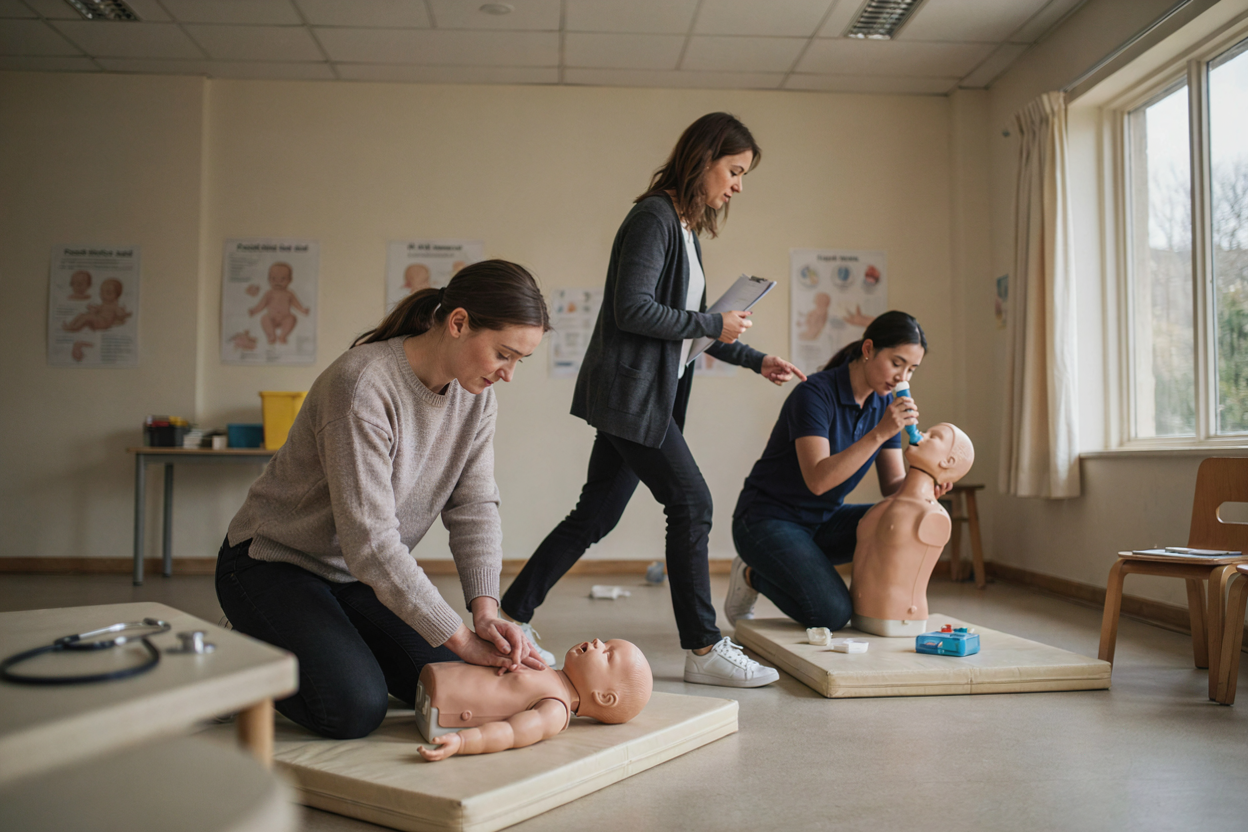
The course walks through CPR adapted for infants and children, choking response for different ages, wound care, seizure management, and basic EpiPen use. It's built around the National Quality Framework specifically, so the scenarios and assessment criteria are designed around what actually happens in a long day-care room rather than a general workplace.
Educators come out the other side able to recognize the early signs of a medical emergency, not just respond once things have already escalated. That's a subtle but important shift in focus. A lot of the value in this kind of training sits in the early recognition piece, spotting that something's off before it becomes a full-blown crisis, rather than just knowing what to do once it's already happened.
What It Doesn't Cover
Here's where a lot of center's get caught short. HLTAID012 gives staff a general grounding in EpiPen use and recognizing an allergic reaction, but it's not a substitute for dedicated anaphylaxis and asthma training when you've got children with individual medical action plans. That's a separate requirement, and it comes down to two standalone units.
Course / Unit | Who Needs It | What It Covers | ACECQA Status |
HLTAID012 | All education and care setting staff | CPR, choking, wounds, seizures, basic EpiPen use | Core requirement |
HLTAID011 | General workplaces, not childcare-specific | Standard first aid, CPR (HLTAID009 and HLTAID010 embedded) | Does not satisfy Reg 136/137 alone |
22300VIC | Staff caring for children with allergy action plans | Anaphylaxis recognition, EpiPen administration | Required alongside HLTAID012 where relevant |
22556VIC | Staff caring for children with asthma action plans | Asthma recognition, spacer and reliever administration | Required alongside HLTAID012 where relevant |
If every child in your care has an individual anaphylaxis or asthma action plan, and most centers these days do, it's worth treating 22300VIC and 22556VIC as part of the same booking rather than an afterthought bolted on later. Bundling them together also means your team gets drilled on the specific medications and devices actually sitting in your center's medical kit, rather than a generic version of the same skill.
We go deeper on exactly which combination suits different centers in our dedicated anaphylaxis and asthma unit piece.
ACECQA Compliance: What Directors Are Actually Required to Have
This is the section that keeps Directors up at night, and for good reason.
Minimum First-Aider Ratios On-Site at All Times
Under the National Regulations, centers need to maintain a minimum number of currently-certified first aiders on-site whenever children are being cared for. Not just rostered on, actually present, in the building, available to respond. That sounds simple until you're trying to run a center with staff on breaks, in different rooms, on outdoor duty, or out the back doing admin work that still needs to get done somehow.
Reg 136/137, plain English: the National Regulations require an approved provider to have at least one staff member holding an approved first aid qualification, with anaphylaxis and asthma management training where relevant, is in attendance at all times children are being educated and cared for. Miss that, and you've got a compliance breach on your hands, not just a paperwork gap.
The tricky part is that this isn't a once-a-day check. It's a requirement that has to hold true across the whole day, including lunch breaks, staff meetings, and the awkward stretch of late afternoon when numbers are thinning out and everyone's tired.
What Happens If Coverage Lapses
If an assessor turns up and finds your only certified first aider on leave, or a certificate that expired last month sitting uncorrected in the file, that's not a small thing. It affects your quality rating and it puts the center's reputation on the line, which matters more than any of us like to admit in a growing suburb with a few new centers opening up the road every year and parents comparing notes.
It's also worth remembering that individualized medical action plans change the equation. A center with multiple children on different allergen and medication plans needs staff drilled on the actual, specific scenarios in that center, not a one-size-fits-all module ticked off once and forgotten. Generic training might satisfy the letter of a requirement, but it doesn't build the kind of confidence a team needs when a real emergency happens in real time, in a room full of kids who are looking to the adults around them to stay calm.
Keeping on top of this isn't a once-a-year job. It's something you want a system for, which we cover properly in our piece on tracking certificate expiry before it becomes a problem.
Staying Ahead of Renewals (So You're Never Caught Out)
The certificate you get today isn't good forever, and the cadence trips people up more than it should.
HLTAID012 Validity vs. the Annual CPR Refresher
HLTAID012 has a set validity period, but the CPR component inside it needs to be redone every year through HLTAID009. So there are really two clocks running at once: the full requalification clock, and the annual top-up clock. Miss the annual refresher and technically the CPR component of your certificate is out of date, even though the full card hasn't expired yet. It's a subtle distinction, and it's exactly the kind of thing that slips through when a center is busy and everyone's attention is elsewhere.
A rough way to picture the cycle:
Every 12 months: CPR refresher through HLTAID009 to keep the CPR component current
At full validity expiry: complete HLTAID012 requalification from scratch
Ongoing: anaphylaxis and asthma units renewed on their own separate schedules where relevant to the children in care
Proactive Tracking Beats Reactive Scrambling
The centers that never get caught out aren't the ones with better memories, they're the ones with a system. A simple reminder that flags who's due for renewal a few weeks out beats finding out the night before an assessment that someone's certificate lapsed last week and nobody noticed.
Never miss a renewal again: we track certificate expiry for the centers we work with, so instead of chasing dates yourself, you get a heads-up before it becomes a problem. Grab our Early Childhood First Aid Renewal Tracker and take the guesswork out of it entirely.
Once training's booked and your team's certified, the goal is to never think about it again until we remind you it's time. That's the whole point of working with one provider you trust rather than starting from scratch with someone new every time a certificate's about to lapse. Book your team in, get the renewal reminders sorted, and get back to the part of the job you actually signed up for.
Every center's got its own mix of ages, allergies, and staff turnover, so there's no single training day that fixes it forever. But once you know the difference between a generic certificate and one actually built for an education and care setting, the rest gets a lot simpler. That distinction alone, HLTAID012 versus a standard workplace card, is the one piece of information that saves most Directors the most stress once it actually clicks.
The ratio trap doesn't have to feel like a trap either. Staggered, small-group sessions mean the floor keeps running while people rotate through training, and fast-tracking new hires means the constant churn of onboarding stops feeling like you're always a step behind. None of this needs to be complicated once it's set up properly, it just needs someone to actually plan around your roster instead of asking you to plan around theirs.
The same goes for renewals. Most compliance gaps aren't because someone didn't care, they're because a date slipped past unnoticed in the middle of a busy term. A bit of proactive tracking closes that gap for good, and it means walking into an assessment with actual confidence instead of a night spent checking every certificate in the folder.
At the end of the day, this all comes down to the same thing Chloe wants and every Director like her wants: staff who are genuinely ready for what might happen in that room, not just a folder of certificates that technically tick a box. Get the right course for the people actually on your floor, keep the anaphylaxis and asthma units current for the kids who need them, and the compliance side of the job stops being the thing that keeps you up at night.