
What Is the Duty of Care for First Aid? Top 5 Rules
It was a routine afternoon at a logistics depot when a forklift operator collapsed. Two staff members were on site. Neither knew what to do. The designated first aider had left eight months earlier — and nobody had organised a replacement.
That scenario plays out in Queensland workplaces more often than most employers realise — and when it does, what is the duty of care for first aid stops being a compliance phrase. It becomes a legal question with serious consequences.
This article breaks down the five core duty of care rules in plain English, grounded in Queensland WHS legislation and Safe Work Australia guidance.
What Is the Duty of Care for First Aid?
The duty of care for first aid is the legal obligation placed on employers, educators, and carers to take reasonable steps to protect people from foreseeable harm — including providing trained first aiders, appropriate equipment, and access to emergency assistance. This obligation is established under the Work Health and Safety Act 2011 (Cth), mirrored in Queensland's Work Health and Safety Act 2011 (Qld), and detailed in the Safe Work Australia First Aid in the Workplace Code of Practice. It applies to all PCBUs, school administrators, childcare operators, and anyone in a position of responsibility for others' safety.
Who the duty of care applies to:
Employers and business owners (PCBUs) under Queensland WHS legislation
Childcare operators under the ACECQA National Quality Framework
School administrators under Queensland DET requirements
Healthcare and aged care facility managers under AHPRA and employer mandates
Community and sporting club officials with responsibility for participant safety
Why Duty of Care for First Aid Matters More Than Most Employers Realise
Most Queensland employers know they need a first aider on site. What fewer understand is that this isn't a box you tick once and forget. It's a continuous legal duty — and the consequences go well beyond a slap on the wrist.
The Work Health and Safety Act 2011 (Qld) requires "reasonably practicable" action — documented, proportionate steps that reflect the size, nature, and risk profile of your workplace. A two-person bookkeeping practice and a large construction site have very different obligations, but both have them.
A WorkSafe Queensland inspector will ask: given what you knew and the risks your workers faced — did you take the steps a reasonable person would have taken? If your designated first aider left eight months ago and you didn't organise a replacement, that's not a grey area. That's a documented gap.
The Consequences of a Breach
Liability Alert: A Category 1 offence under the Work Health and Safety Act 2011 (Qld) carries fines of up to $3.6 million for a body corporate and up to $300,000 plus potential imprisonment for an individual. First aid obligation failures can contribute to a Category 1 finding where a worker is exposed to a risk of death or serious injury.
Beyond the fines, a breach opens the door to:
WorkSafe Queensland improvement and infringement notices
Civil liability exposure through common law negligence claims
Contract loss — particularly in construction and government procurement where WHS compliance is a condition of tender
Insurance implications — insurers scrutinise training records closely after a workplace incident
Rule 1. You Must Provide Trained First Aiders Appropriate to Your Workplace
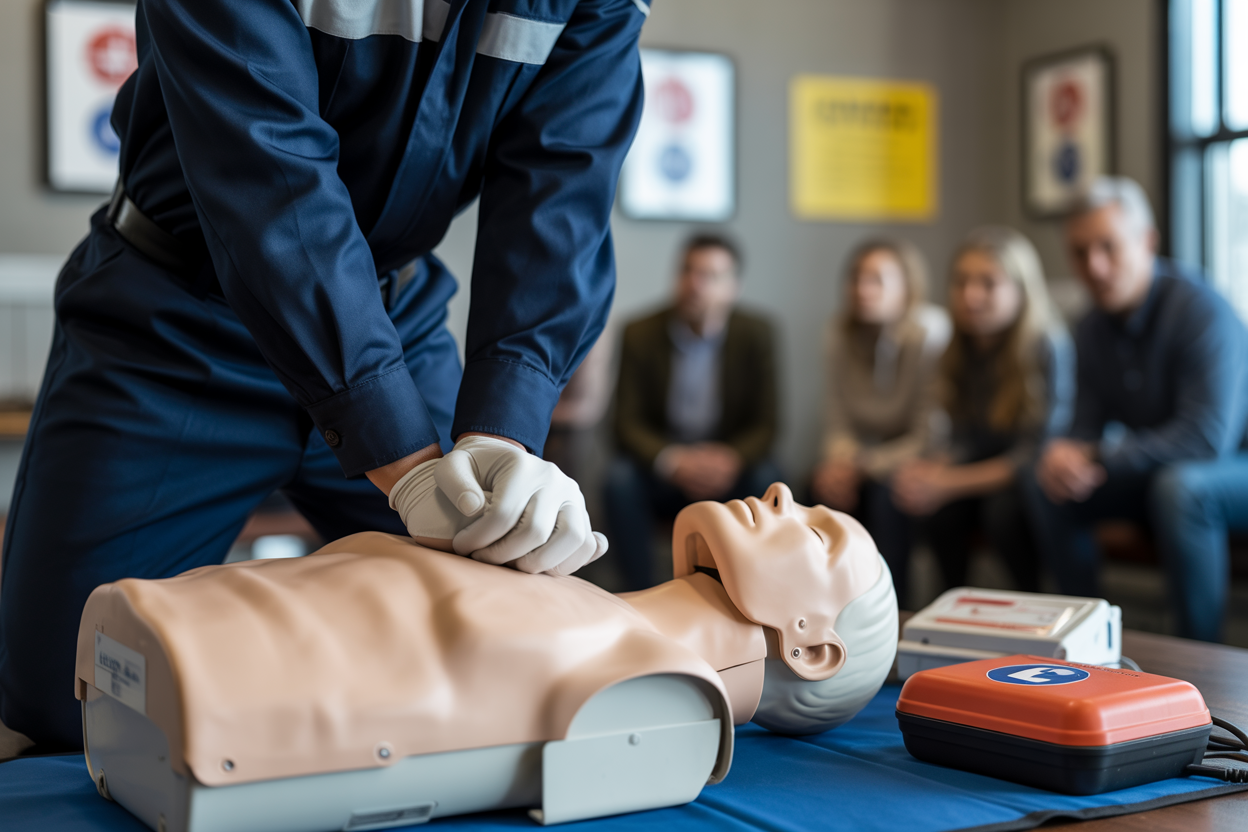
Having a first aider on site isn't optional under Queensland WHS law. The question most employers get stuck on is how many — and what qualification they need to hold.
How Many First Aiders Does a Queensland Workplace Need?
The Safe Work Australia First Aid in the Workplace Code of Practice sets out guidance ratios based on workplace size and risk level. These are not fixed legislative requirements — your actual obligation is determined by a formal needs assessment. The Code gives you a solid starting framework.
Which Qualification Satisfies the Requirement?
For most Queensland workplaces, HLTAID011 — Provide First Aid is the standard. It covers CPR, AED use, choking, bleeding, shock, fractures, burns, and emergency response — and it's what WorkSafe Queensland auditors expect to see in your training register.
HLTAID009 — Provide CPR alone is not sufficient. Staff holding HLTAID009 can perform CPR, but they're not a qualified first aider under the Code of Practice. For healthcare environments, some employers require HLTAID015 — Provide Advanced Resuscitation and Oxygen Therapy. ACECQA's National Quality Framework specifies requirements separately for childcare operators.
What Happens When Your First Aider Leaves or Their Certificate Lapses?
Your duty of care doesn't pause because your first aider resigned or their certificate ticked over. The obligation is continuous. The moment your designated first aider is no longer current, you have a gap that needs resolving immediately — not noted for later.
Build renewal reminders into your HR calendar. Keep a training register that flags expiry dates well in advance. Have a plan for who steps up when your designated first aider is unavailable.
Having the right number of first aiders is only part of it — your equipment needs to be up to standard too. That's where Rule 2 comes in.
Rule 2. You Must Maintain Adequate First Aid Equipment and Facilities
You can have the most qualified first aider on your payroll — but if they open the kit in an emergency and find expired bandages and an empty antiseptic bottle, your duty of care has still failed. Equipment isn't a supporting obligation. It's a core one.
What Equipment Is Required?
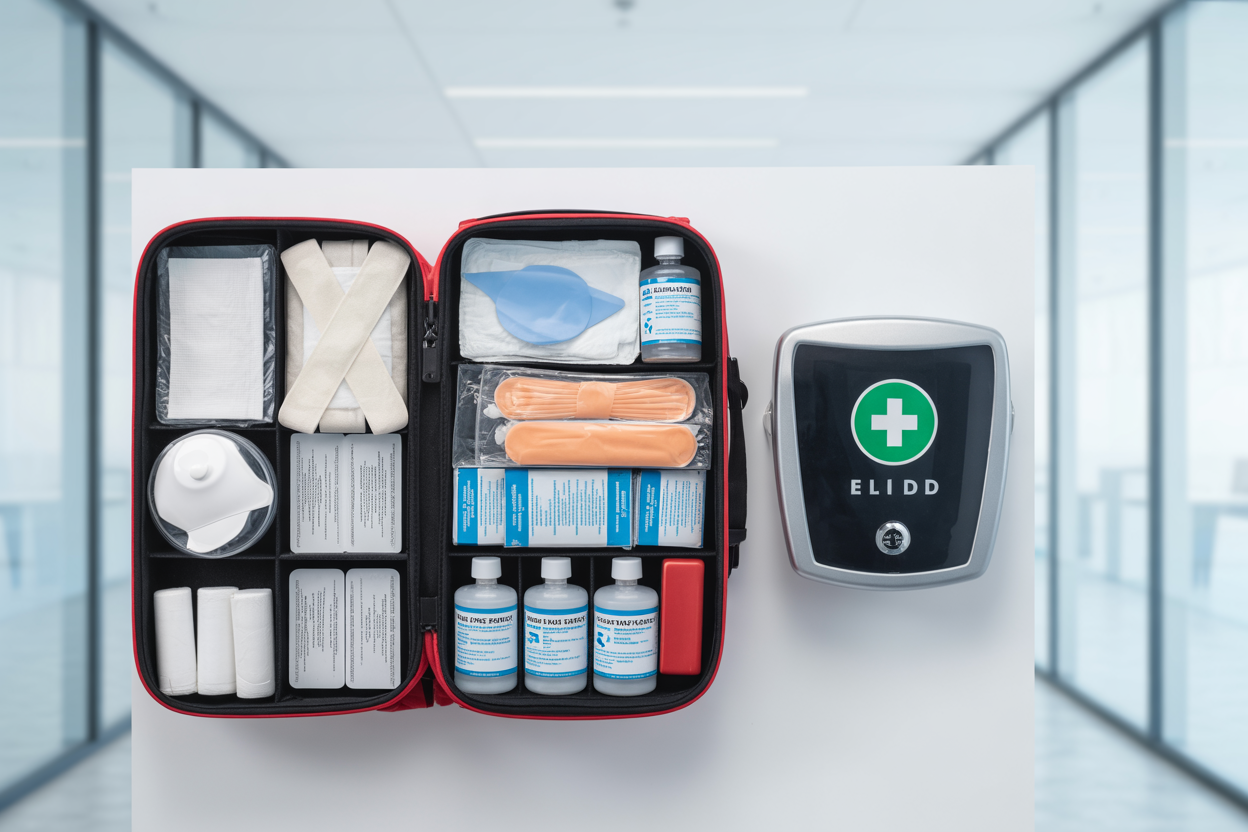
The Safe Work Australia Code of Practice requires first aid equipment appropriate to the hazards in your workplace. Every Queensland workplace needs a kit with contents that reflect its operations. The Code references Australian Standard AS 2675 as a guide. WorkSafe Queensland auditors expect to see kits that are stocked, current, and accessible — not locked in a back office or half-depleted from the last incident.
For higher-risk environments with extended emergency services response times, the obligation goes further. An Automated External Defibrillator (AED) becomes a serious consideration — particularly for aged care facilities, large construction sites, and schools.
Inspection and Restocking
Every inspection must be recorded. If WorkSafe Queensland asks to see your maintenance records and the last entry is over a year old, that's a problem regardless of whether the kit is fully stocked on the day. The person responsible should be named and assigned. "Someone checks it occasionally" is not a compliance position.
A first aid room is generally required in high-risk workplaces with larger workforces — the specific threshold depends on your hazard profile and needs assessment outcomes.
Equipment means nothing when it's inaccessible. Rule 3 addresses the obligation that catches the most employers off guard.
Rule 3. You Must Ensure First Aid Is Accessible During All Hours of Operation
A trained first aider must be accessible whenever workers are present — not just during business hours, not just on weekdays. Whenever workers are on site.
If you run a night shift, your duty of care runs through the night. If your warehouse operates on weekends, your first aid obligation runs on weekends. If a worker is on site late and something goes wrong, the fact that your designated first aider finished hours earlier doesn't protect you.
Multi-Site Workplaces and Contractors
If your business operates across multiple sites, the obligation applies at each location independently. You can't rely on a single first aider at head office to cover a separate worksite across town. Where emergency services response times are extended, the Code of Practice expects increased first aider numbers, enhanced kit contents, and a documented emergency response plan.
If you engage contractors or labour hire workers, the host PCBU retains a duty of care for those workers. Their employer's obligations don't travel with them onto your site. Under Queensland's Work Health and Safety Act 2011, first aid coverage must extend to every worker present — regardless of who signs their paycheck.
Accessibility is about presence. Rule 4 is about competence.
Rule 4. You Must Keep First Aid Training Current and Documented
Having first aiders on site covers presence. Keeping their training current — and being able to prove it — is a separate obligation that many Queensland employers treat as an afterthought. It isn't.
HLTAID011 — Provide First Aid is valid for three years. But the CPR component — HLTAID009 — should be renewed annually in line with Australian Resuscitation Council (ARC) guidelines.
The certificate looks current. The three-year expiry date is still out. But the CPR component hasn't been refreshed in over two years. That's a compliance gap invisible on the face of the certificate — and exactly what a WorkSafe Queensland auditor is trained to find.
Training Records
A WorkSafe Queensland auditor will ask to see each certified first aider's name, unit code, date of issue, expiry date, and the RTO that issued the certificate — cross-referenced against your current workforce. Certificate copies alone aren't sufficient. The register needs to be live, accurate, and owned by a specific person.
The most common reason certificates lapse isn't negligence. It's that nobody built a reminder system, and three years went by faster than anyone expected. Build expiry dates into your HR calendar at the point of certification. Assign ownership. Work with an RTO that actively supports renewal tracking.
Rules 1 through 4 are operational. Rule 5 is the foundation they all rest on — and the one most workplaces skip entirely.
Rule 5. You Must Conduct a First Aid Needs Assessment for Your Workplace
Most Queensland employers work backwards. They decide how many first aiders they think they need, book a course, and consider the job done. That skips the step that's supposed to inform every other decision — the first aid needs assessment.
What It Is and Who Is Responsible
A first aid needs assessment is a formal, documented analysis that determines what provision your workplace actually requires. It drives decisions on first aider numbers, kit contents, equipment placement, and training currency.
The PCBU is responsible — and that responsibility isn't delegable in the legal sense, even if the practical work is handed to a WHS officer or HR manager. If the assessment doesn't happen, or sits in a drawer unacted on, the PCBU wears the consequences. "We assessed it informally" doesn't hold up when a WorkSafe Queensland inspector has a training gap in front of them.
Review it at minimum annually — and after any workplace incident, significant change in workforce size, change in work type, or addition of a new site.
A Simple Needs Assessment: 5 Steps
1. Identify workplace hazards and risk level High-risk environments carry a higher first aider obligation than low-risk office or retail settings.
2. Determine workforce size and shift patterns Count every worker present during every operational hour — including casuals, contractors, and labour hire.
3. Assess proximity to emergency services Where response times are extended, your first aid provision needs to compensate.
4. Confirm first aider numbers and certificate currency Cross-reference your workforce against your training register across all shifts and sites.
5. Document findings and schedule the next review A needs assessment that exists only in someone's head provides zero protection when WorkSafe Queensland comes asking.
Is Your Workplace Meeting Its First Aid Duty of Care?
Five rules. One continuous legal obligation. And a WorkSafe Queensland audit process specifically designed to find the gaps between what employers think they're doing and what the law actually requires.
Trained first aiders need to be present, qualified, and current. Equipment needs to be stocked and accessible. Coverage needs to run across every operational hour. Training records need to hold up under scrutiny. And underneath all of it, a documented needs assessment needs to drive every one of those decisions.
Most employers who end up in front of WorkSafe Queensland didn't set out to cut corners. Certificates lapsed quietly. A first aider left and nobody organised a replacement. A night shift ran for months without a currently certified person on the floor. These aren't dramatic failures — they're the kind of slow drift that happens when compliance sits on nobody's calendar.