
Do I Need a First Aid Certificate for Work? Find Out Now
Last year a guy rang us about twenty minutes before his shift was meant to start. His boss had just told him, kind of casually, "oh by the way you'll need your first aid cert before Monday." That was it. No explanation, no list of options, nothing. He didn't even know there was more than one type of certificate. He just knew he needed something and he needed it fast.
If that sounds familiar, you're in good company. Maybe it was your manager who mentioned it in passing. Maybe a job ad you applied for listed it as a requirement and you only half-noticed at the time. Or maybe you got that little reminder email saying your old certificate has quietly expired, and now you're sitting there thinking: do I actually need this for work, or am I overthinking the whole thing?
Thousands of people across Australia ask themselves this exact question every single year, and the honest answer isn't a flat yes or no: it depends on your industry, your role, and what your employer's Work Health and Safety obligations actually require of them. But for most workplaces, the short version is: yes, in some form, somebody needs to be covered.
In this guide we're going to walk through exactly which jobs legally require a first aid certificate, which course code you actually need (spoiler: it's usually HLTAID011, Provide First Aid), how quickly you can get certified, and what happens if your workplace doesn't have anyone trained at all.
No jargon. No guessing games. Just a straight answer, so you can stop wondering and go book the thing.
Why Most Australian Workplaces Require First Aid Training
The legal basis: the Work Health and Safety Act
Here's the bit most people never get told straight: employers have what's called a duty of care. That basically means they're legally on the hook for providing a safe working environment, and part of that is making sure there's access to someone trained in first aid if something goes wrong.
This isn't a vague suggestion floating around HR departments. Safe Work Australia actually lays it out in their Code of Practice: First Aid in the Workplace, which is the document most businesses (and most WHS officers) lean on when they're working out what they need to have in place.
And the requirements aren't one-size-fits-all. They scale up or down depending on:
How big the workplace is
How risky the work actually is
How far the workplace is from emergency services
A small office in the CBD with an ambulance five minutes away has a very different obligation to, say, a remote work site two hours from the nearest hospital.
It's not just "nice to have", it's a compliance requirement
Now here's where a lot of the confusion creeps in. WHS law doesn't say every single employee in a business needs to be certified. What it actually mandates is a minimum ratio of trained first aiders compared to staff numbers and the level of risk involved.
So if you've ever wondered why one person in your office has a little first aid badge on their desk and nobody else does, that's not random. That's your business meeting (or trying to meet) its legal minimum.
If you want the full breakdown of what HLTAID011 actually covers and how the course runs, we've got a dedicated page on the HLTAID011 course that walks through it properly.
So the law says someone needs to be trained, but does that mean you specifically? That's the real question, and it's what we're answering next.
Which Jobs and Industries Actually Require It
Roles that almost always require certification
Some jobs basically come with a first aid certificate attached, whether you knew that going in or not. If you fall into one of these categories, there's a very good chance someone's going to ask you for proof sooner or later:
Designated workplace First Aid Officers (the actual job title, not just "the person who knows where the band-aids are")
Childcare educators, though worth flagging early, this one's a different code entirely. Childcare staff need HLTAID012, not HLTAID011, because of ACECQA requirements. More on that mix-up shortly.
Fitness and gym instructors, because Fitness Australia makes it a registration requirement, not just a recommendation
Construction and site supervisors
Security personnel
Sole workers, or anyone working remotely or in isolation, since there's literally nobody else around to help if something happens
Industries with elevated requirements
Beyond specific roles, certain industries just carry more risk by nature, or more people walking through the door, and the requirements reflect that:
Hospitality and retail, high foot traffic, and often it's the insurer pushing for it rather than the business owner
Aged care and disability support
Trades and field-based roles, where you're often a fair distance from help if something goes wrong
"But what if my employer hasn't said anything about it?"
This one trips a lot of people up, and it's worth addressing head-on because the anxiety around it is real. If your employer hasn't mentioned first aid certification at all, that does not automatically mean you're in the clear. It might just mean your employer isn't currently meeting their obligations, which, fair or not, isn't really your problem to solve, but it's good to know where you stand.
If you're ever in doubt, the simplest move is to check with your WHS officer, or have a look at your award or enterprise agreement. Somewhere in there is usually the answer.
Before you go and book anything though, it's worth knowing exactly which course code actually applies to you, because this is where most of the confusion happens.
HLTAID011 vs Other First Aid Codes: Which One Do You Need?
HLTAID011 – Provide First Aid (the general workplace standard)
For most people reading this, HLTAID011 is going to be your answer. It's the general workplace standard, and it covers a fair bit of ground:
CPR
Wound care
Basic life support
Asthma and anaphylaxis response
It's valid for 3 years, and the format combines a short online pre-learning component with a face-to-face practical session.
Comparison Table
If you remember nothing else from this whole article, remember this line: if you're not working in childcare or education, HLTAID011 is almost certainly your course.
What about the old HLTAID003 code?
A lot of people come to us still holding a HLTAID003 certificate, and they panic a little when they hear it's been superseded. Take a breath, holding HLTAID003 doesn't mean you're suddenly non-compliant overnight. What it does mean is you should check your renewal timing, because when it comes time to refresh, you'll be doing it under the new code, HLTAID011, not the old one.
If you want a deeper comparison between HLTAID011 and HLTAID009 specifically, that's covered in more detail on our HLTAID011 vs HLTAID009 page.
None of this is a crisis, by the way. Here's how fast you can actually get it sorted.
What Happens If You Don't Have One (and Your Job Requires It)
Risk to you personally
Not having a valid certificate when your job calls for one isn't just an awkward conversation waiting to happen. It can genuinely affect your employment eligibility, hold up onboarding, or in some cases hit your insurance or registration status, Fitness Australia registration being a good example of where this bites people who didn't see it coming.
Risk to your employer
It's not only on you, either. Your employer carries real exposure here too:
Non-compliance penalties under the WHS Act
Reputational damage and insurance exposure if something actually happens on-site and there's nobody trained around to respond
Nobody wants to find out the hard way that there was no qualified person on shift the day it mattered.
It's usually a fast fix, not a big problem
Here's the good news though, and it's worth sitting with for a second: this is rarely the crisis it feels like at the moment. In a lot of cases, you can get certified the same day. One booking, one day, sorted.
So let's get into exactly how that works.

How to Get Certified Quickly Without Disrupting Your Work Week
Online theory + in-person practical: how the blended model actually works
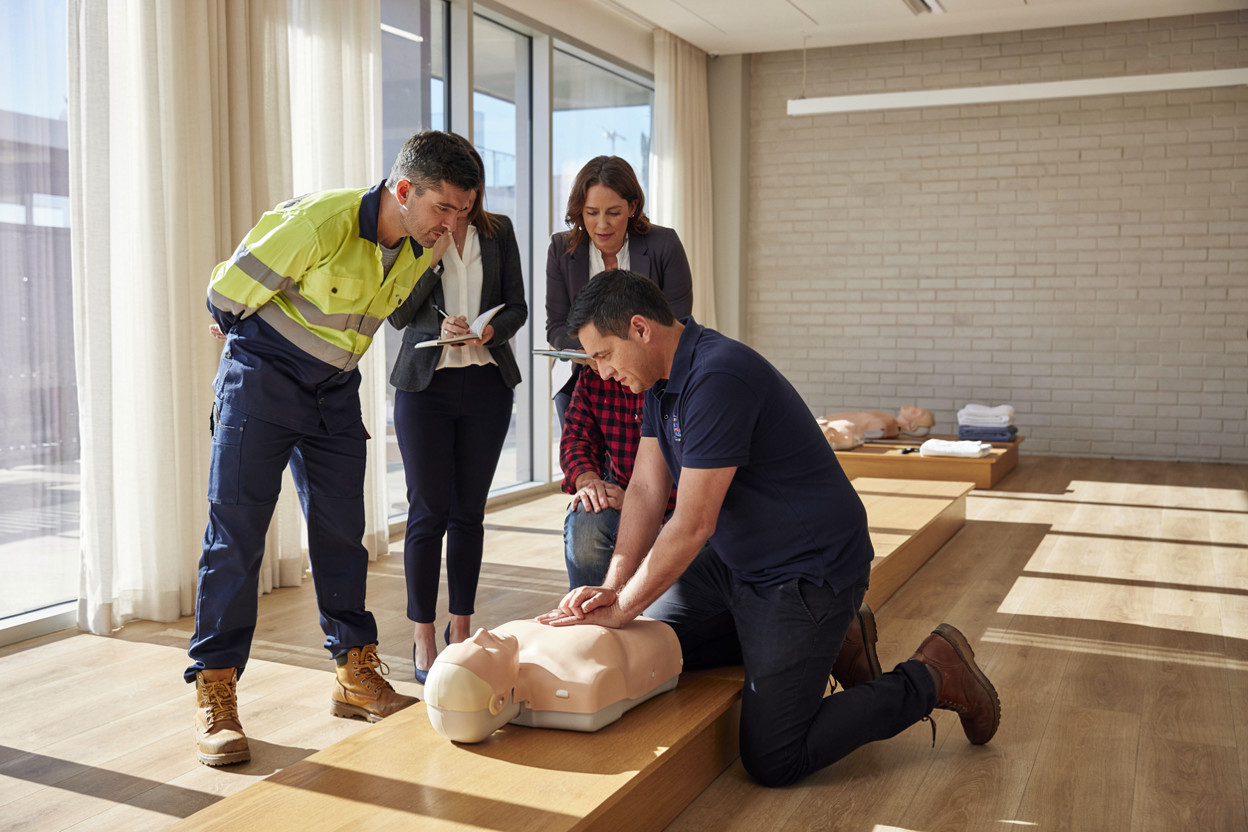
This trips people up more than it should, so let's clear it up properly. The course runs as a blended model: a short online theory component you work through before you arrive, followed by an in-person practical session where you actually demonstrate the skills.
The bit people get wrong is assuming the online module is the course. It isn't. It's the lead-in. The real assessment, the hands-on stuff, happens in person, with a trainer in the room.
What to expect on the day
This is where "manikin anxiety" comes in, and honestly, it deserves to be said out loud because almost everyone feels it and almost nobody admits it beforehand. You're not the only one nervous about doing chest compressions in front of strangers, worrying about your technique, worrying about hurting the manikin, or, irrationally but understandably, worrying about hurting an actual person somewhere down the line.
The classroom environment is built to be supportive rather than intimidating, and trainers work with people across all fitness levels and ability ranges. Nobody's there to judge your form on day one.
Same-day certificate issuance
Once you've demonstrated competency on the day, your Statement of Attainment is issued digitally, same day. No waiting a week wondering if it's going to land in your inbox before your employer asks for it.
Conclusion
At the end of the day, this whole question boils down to something pretty simple: if you work with people, around equipment, or anywhere risk exists at all, somebody nearby needs to know what to do in those first few minutes before help arrives. That's not red tape for the sake of it. That's the actual point of the law in the first place.
The good news is none of this has to feel overwhelming. Once you know your role, your industry, and what your workplace actually requires, the picture gets a lot clearer fast. Most people who go looking for this answer find out it's a smaller task than they expected, and a much smaller cost in time than the worry that sent them searching in the first place.
There's also something worth sitting with that goes beyond compliance. Knowing what to do when someone collapses, chokes, or has a reaction in front of you isn't really about a piece of paper. It's about not freezing in the moment that actually matters. Most people never think about that moment until it's already happening, and that's exactly why getting ahead of it counts for something.
The certificate itself takes a day. The peace of mind it buys tends to last a lot longer than the three years it's valid for. There's a quiet kind of confidence that comes from knowing you wouldn't just stand there if something went wrong, and that confidence doesn't show up on a form, but it shows up in how you carry yourself afterward.
If there's one thing worth taking from all of this, it's that waiting rarely makes the decision easier. The questions don't go away on their own, and the gap between wondering and knowing is usually smaller than people assume. Most of the hesitation lives in not knowing where to start, not in the actual difficulty of starting.
So whatever brought you here today, a passing comment from a manager, a job ad, an old certificate quietly expiring in a drawer somewhere, treat it as the nudge it is. Sort it, tick it off, and get back to the part of your week that doesn't involve wondering whether you're covered. Future you, and quite possibly someone standing next to you on a bad day, will be glad you did.