
Do I Need a First Aid Certificate for Work? Find Out Now
"Do I need a first aid certificate for work?" It sounds like a simple question. But for Queensland employers, the answer involves the WHS Act, Safe Work Australia's Code of Practice, industry-specific regulations, and ratios that shift depending on your workforce size.
Whether you're an HR manager trying to get ahead of a WorkSafe Queensland audit, a site supervisor whose crew starts a new contract Monday, or a childcare director decoding ACECQA's ratio requirements — the answer matters. A lot.
In Queensland, first aid certificate requirements at work aren't optional guidelines. They're legal obligations under the Work Health and Safety Act 2011 (Qld), enforced by Safe Work Australia's First Aid in the Workplace Code of Practice, and layered with industry-specific mandates that vary by sector, site size, and workforce composition.
This guide breaks down who needs a first aid certificate for work in Queensland, which certificate applies to which industry, how many trained first aiders your workplace legally needs, and what happens if you're not compliant.
Who Needs a First Aid Certificate at Work in Queensland?
Under the Work Health and Safety Act 2011 (Qld) and Safe Work Australia's First Aid in the Workplace Code of Practice, Queensland employers are legally required to ensure an adequate number of workers hold a current first aid certificate. The specific certificate required for most workplaces is HLTAID011 — Provide First Aid.
The following workers are most commonly required to hold a current first aid certificate for work in Queensland:
Designated workplace first aiders in any Queensland business under the WHS Act
Construction and trades workers — required by most site induction packages and principal contractors
Childcare and early childhood educators — mandated under the ACECQA National Quality Framework
Queensland state school staff — required under Department of Education (DET) ratios
NDIS registered support workers — required under NDIS Practice Standards
Healthcare and aged care workers — required by employer credentialing and AHPRA obligations
Hospitality and retail staff — required above minimum staffing thresholds in many venues
What Does Queensland Law Actually Say About First Aid at Work?
Most business owners and HR managers know they're supposed to have first aid covered. What they're less clear on is exactly what the law requires — and what happens when it isn't met.
The Work Health and Safety Act 2011 (Qld)
Under the Work Health and Safety Act 2011 (Qld), employers — referred to as PCBUs (Persons Conducting a Business or Undertaking) — carry a primary duty of care to provide first aid equipment and ensure access to trained first aiders at work.
The Act doesn't prescribe a rigid checklist. What it requires is what is "reasonably practicable" given the nature, size, and risk profile of your workplace. Safe Work Australia's First Aid in the Workplace Code of Practice translates that legal duty into practical benchmarks your business can measure against.
Non-compliance exposes businesses to WorkSafe Queensland improvement notices, prohibition notices, and financial penalties. And if an incident occurs while your first aid coverage is lapsed, the legal exposure compounds significantly.
The Safe Work Australia Code of Practice: What It Requires
Safe Work Australia's Code of Practice sets the minimum standards Queensland employers are expected to meet:
Low-risk workplaces (offices, retail, professional services): 1 trained first aider per 50 workers
High-risk workplaces (construction, manufacturing, warehouses, trades): 1 trained first aider per 25 workers
These ratios are minimums — not a ceiling. Businesses with multiple sites, shift work, or remote locations often need more
The Code also requires first aid kits appropriate to the workplace's risk level and size
You can read the full Safe Work Australia First Aid in the Workplace Code of Practice directly — it's the document WorkSafe Queensland inspectors reference when they walk through your door.
What "Reasonably Practicable" Means for Your Business
"Reasonably practicable" isn't a get-out clause — it's a sliding scale based on your specific situation. The factors that determine what's required include the number of workers on site, shift patterns, remoteness from emergency services, and the nature of the hazards workers face.
The further your workplace is from emergency services, and the higher the injury risk, the stronger the case for exceeding the minimum ratio. Meeting the minimum is legally defensible — but best practice sits above it.

Which Industries Must Have First Aid Certificates in Queensland?
Different industries carry different obligations — and the regulatory bodies enforcing them are not all the same.
Construction and Trades
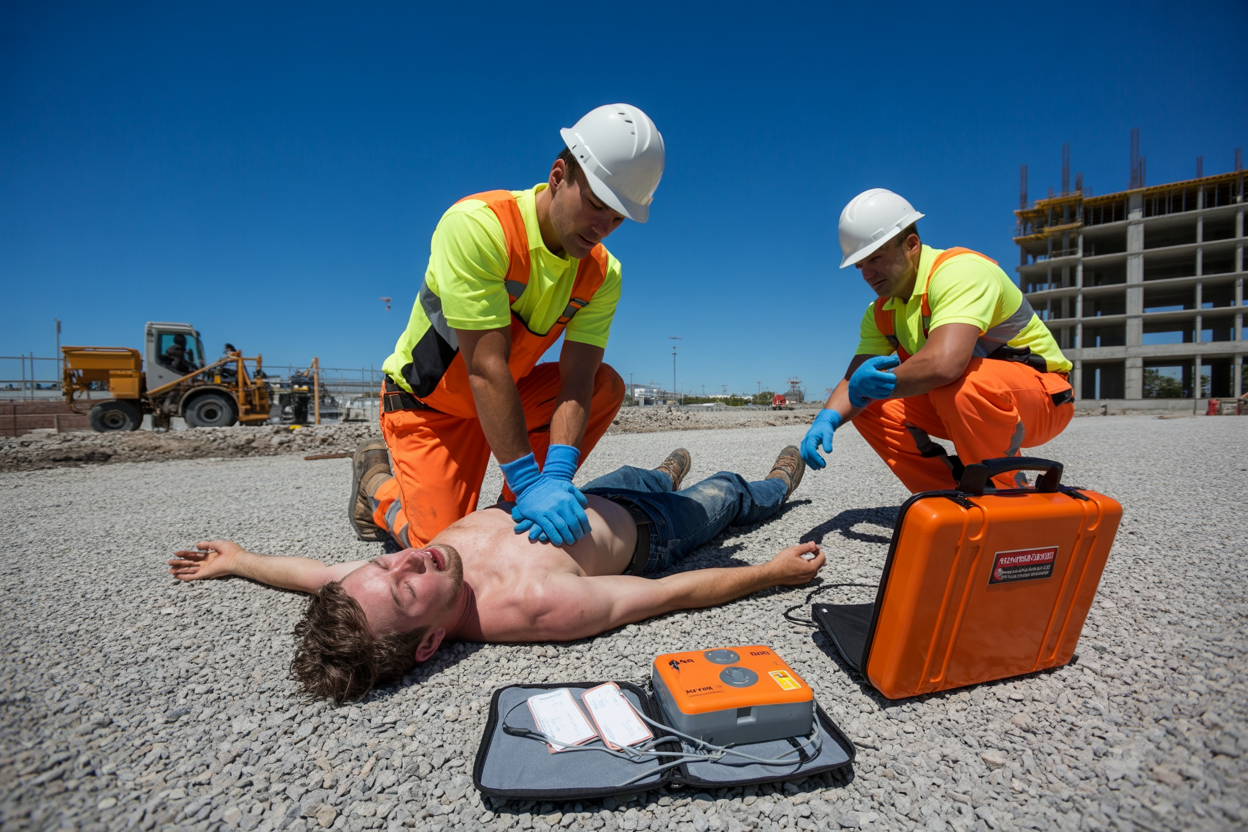
On most Queensland construction sites, a current first aid certificate isn't a recommendation — it's a condition of site access. Most principal contractors and site induction packages require HLTAID011 before a worker sets foot on site.
Queensland's construction boom is intensifying that scrutiny. The Olympic infrastructure pipeline running through to 2032 means first aid compliance is under active review. Sites are being checked. Workers without a current certificate are being turned away.
For electrical workers, the Electrical Safety Office Queensland adds a further layer — including low voltage rescue competencies that run alongside HLTAID011.
"Got told Friday I needed a current first aid cert to start on site Monday. Found ART, booked the Saturday course online in two minutes. Cert came through fast. Made the start."
Childcare and Early Childhood Education
Childcare is one of the most tightly regulated environments in Queensland for first aid — and for good reason.
ACECQA's National Quality Framework mandates specific first aid ratios on the floor at all times. At least one staff member with a current certificate must be physically present whenever children are in care. If that person steps out and no other qualified staff member is there, the service is non-compliant.
The required units are HLTAID011 or HLTAID012, depending on the setting. HLTAID012 covers pediatric-specific scenarios in greater depth. Many services hold both. If you're unsure which ACECQA expects, get that answer before your next audit — not during it. Anaphylaxis and asthma management certificates are also required under Queensland regulations, alongside HLTAID011 or HLTAID012.
Healthcare and Aged Care
For AHPRA-registered practitioners, current CPR certification — HLTAID009 — is a non-negotiable annual requirement. Many facilities also require full HLTAID011 for non-clinical support roles. In aged care, regulatory scrutiny has intensified following the Royal Commission recommendations, and NDIS Practice Standards require all registered support workers to hold a current first aid certificate.
Schools and Educational Institutions
Queensland Department of Education requires designated staff to hold current first aid certification. For prep settings, ACECQA ratios apply on top of DET requirements. TAFE campuses and universities carry the same WHS obligations across every site and shift.
Retail, Hospitality, and Tourism
Once a venue reaches a certain staffing threshold, first aid requirements kick in under the Safe Work Australia Code of Practice. High staff turnover in hospitality creates persistent certificate churn — workers come and go, certificates lapse, and the venue becomes non-compliant without anyone making a deliberate decision to let it slide.
NDIS Providers and Disability Support Services
The NDIS Commission's Practice Standards are clear: registered support workers must hold a current first aid certificate. It's one of the fastest-growing compliance segments in Queensland — and one of the most commonly overlooked until an audit brings it into focus.
Which First Aid Certificate Do You Actually Need for Work?
The unit codes don't explain themselves. Holding the wrong certificate — or an outdated one — carries the same consequence as holding none at all.
HLTAID011 - The Standard Workplace Certificate
HLTAID011 is the nationally recognised standard first aid certificate under the Health Training Package (HLT) — what most Queensland workplaces mean when they say "current first aid certificate."
If your staff hold HLTAID003, that's the legacy code and it is no longer current. A worker presenting it at a site induction or ACECQA audit is presenting an expired qualification, regardless of when it was issued.
HLTAID012 - For Education and Care Settings
HLTAID012 covers everything in HLTAID011 and adds paediatric-specific scenarios — infant CPR, EpiPen administration, and asthma response in young children. ACECQA strongly recommends — and in many contexts effectively requires — that childcare floor staff hold HLTAID012. Get that answer before an audit rather than during one.
HLTAID009 - Annual CPR Refresh
HLTAID009 is the CPR-only unit — not a substitute for HLTAID011. The CPR component of your first aid certificate should be refreshed annually per ARC guidelines, not every three years when the full certificate expires. This is the most common compliance gap across Queensland workplaces.
HLTAID015 - Advanced Resuscitation
HLTAID015 is required in clinical environments — ICU, emergency departments, coronary care units, and paramedic practice. It is not required for standard workplace first aid and won't satisfy a site induction requirement in place of HLTAID011.
How Many First Aiders Does Your Queensland Workplace Need?
Knowing which certificate applies is only half the equation. The half that catches most businesses out during a WorkSafe Queensland inspection is understanding how many trained first aiders need to be on the floor at any given time.
The Ratio Framework
These are minimums — enough trained first aiders must be present across all operating hours, every shift, every site.
What Happens When First Aiders Are On Leave?
The Safe Work Australia Code requires first aid coverage at all times during operating hours — it doesn't pause for annual leave, sick leave, or public holidays. If your workplace has exactly the minimum and one person takes a week off, you're non-compliant for that week. The fix is straightforward: train a buffer above the minimum ratio.
Multi-Site and Shift-Work Businesses
The ratio applies per site, per shift — not to your total headcount. The most common gap: businesses count total certificates across all locations and assume they're covered. If one site has trained first aiders and another has none on a given shift, that second site is non-compliant regardless of what's happening elsewhere.
What Happens If Your Workplace Doesn't Have a Current First Aid Certificate?
The consequences of getting this wrong aren't just administrative — they're financial, legal, and in some industries, existential.
WorkSafe Queensland Enforcement
WorkSafe Queensland inspectors can issue improvement notices, prohibition notices, and financial penalties — and first aid compliance is a standard item on every workplace safety inspection checklist.
If a worker is injured, no trained first aider is present, and the injury worsens — the absence of a current certificate isn't a paperwork problem. It's evidence of a failure to meet your primary duty of care under the Work Health and Safety Act 2011 (Qld).
Civil Liability Risk
A lapsed certificate at the time of an incident ends up in a legal brief. Was a trained first aider present? Was their certificate current? These are exactly the questions your WHS documentation either answers or fails to answer. A current HLTAID011 certificate for every designated first aider is the foundation of a defensible position.
NDIS and Childcare - Consequences Are More Severe
ACECQA can suspend or revoke a childcare service's approval if first aid ratios aren't maintained. The NDIS Commission can suspend or cancel a provider's registration for failing to meet Practice Standards. These aren't inconveniences — they affect revenue, reputation, and the welfare of people in care.
How to Get Your Workplace First Aid Certified
Getting compliant comes down to two decisions: which training format suits your team, and which RTO you trust.
Public Courses vs On-Site Group Training
Public courses work well for individuals who need certification quickly. On-site group training eliminates travel time, keeps your team together, and can be shaped around your actual work environment. ART delivers on-site training across Queensland.
What to Look for in a Queensland RTO
ASQA registration — verify on training.gov.au. Advanced Resuscitation Training RTO Number: [INSERT]
Trainer credentials — clinical or industry-relevant backgrounds, not generic facilitators
Certificate turnaround — a slow certificate costs site access or leaves a childcare service short on its ratio
Post-training support — renewal reminders and compliance records management
What This All Means for Your Queensland Business
First aid compliance in Queensland isn't complicated once you understand the framework. The Work Health and Safety Act 2011 (Qld) sets the duty. Safe Work Australia's Code of Practice sets the benchmarks. Your industry adds its own layer. And the certificate that satisfies most of those obligations — for most Queensland workplaces — is HLTAID011.
What trips businesses up isn't ignorance of the law. It's the gap between knowing the obligation exists and having a system in place to meet it consistently. Certificates lapse. Staff turn over. First aiders go on leave. A business that was compliant in January can find itself exposed by June without anyone making a conscious decision to let things slide.
The Queensland businesses that stay consistently compliant do one thing differently. They train above the minimum ratio, work with an RTO that sends renewal reminders, and treat first aid certification as an ongoing commitment rather than a once-every-three-years exercise. It's not a heavy lift once the system is in place — but it does require the right provider.